

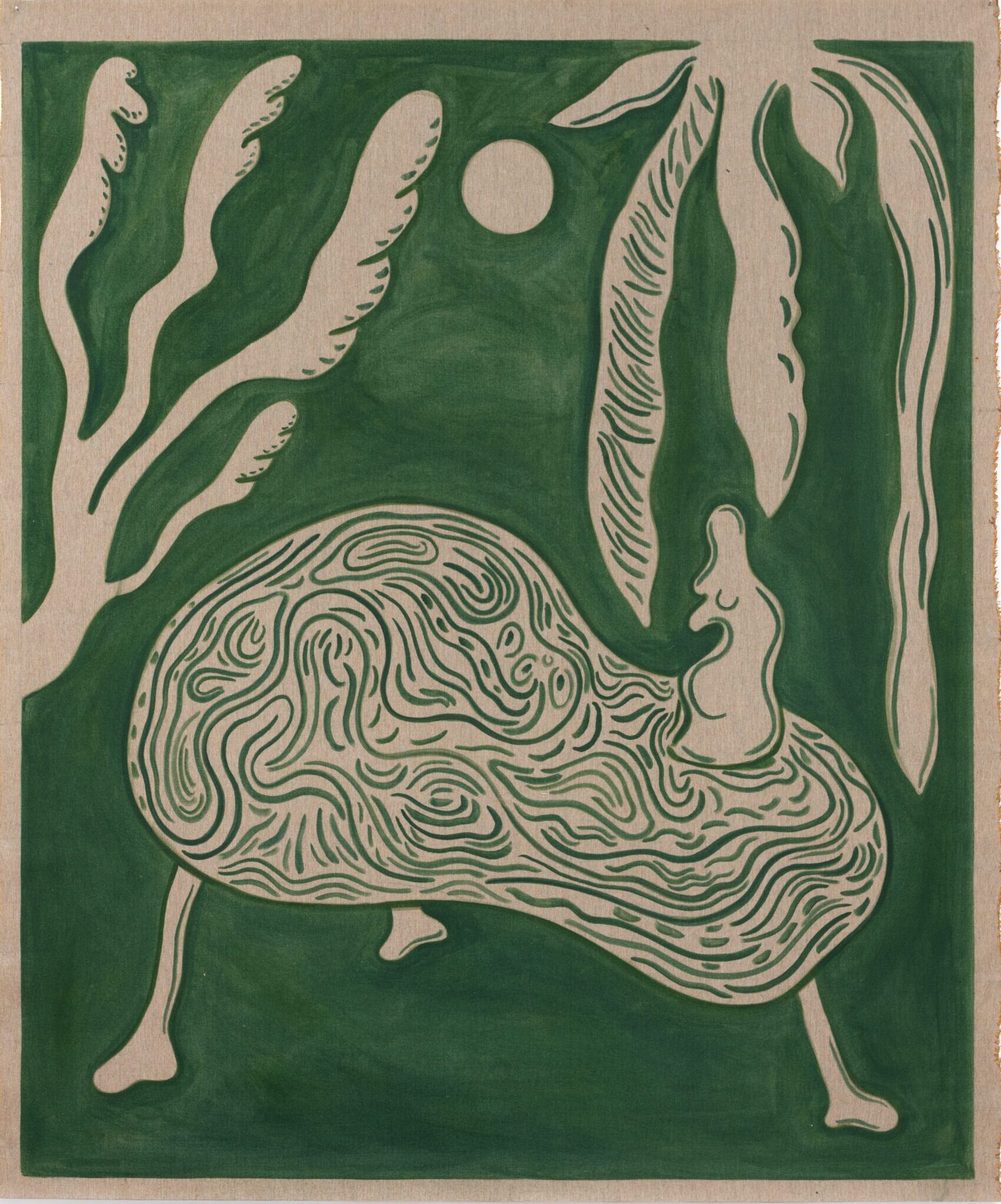
Tiago Mestre
Tiago Mestre (Portugal, 1978) is a Portuguese visual artist who has lived and worked in Brazil for 14 years. His work addresses disciplinary and territorial displacement, reflecting his background in architecture and his experience as an immigrant. Using various materials and techniques, Tiago creates sculptures, paintings, and installations that explore emblematic and anthropological questions. In the interview, he details his multifaceted practice and explains how his works interact with space, allowing for a dialogue with architectural dimensions and spectators’ perceptions. Check it out:
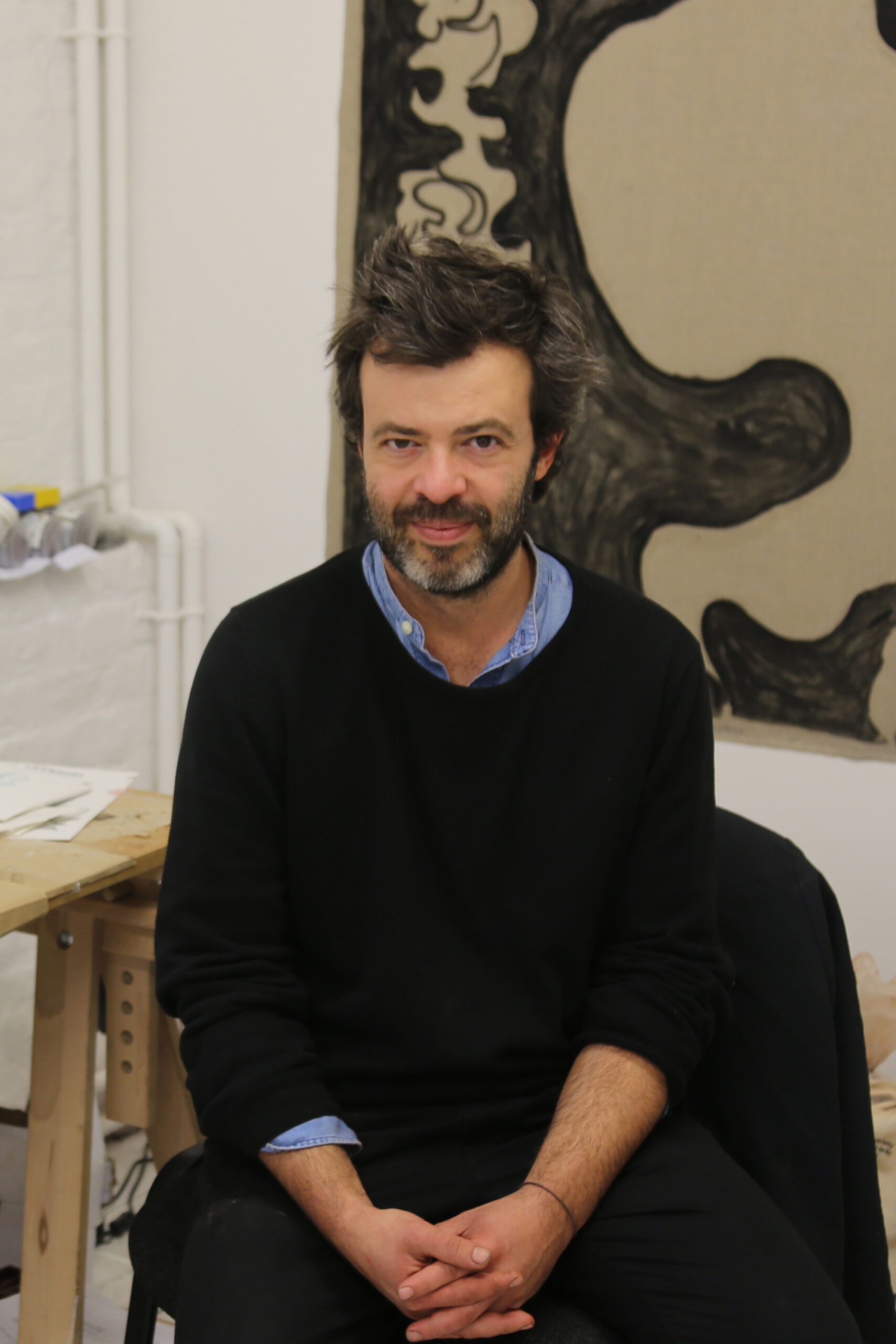
Tiago, thank you very much for being here today. I’d like to start by asking you to introduce yourself, with any information you think is relevant, to an audience that may not know you yet.
My name is Tiago Mestre, I’m a Portuguese visual artist who has lived in Brazil for 14 years. My career began in Brazil and is very much linked to the time I’ve been living here, even though I’ve exhibited abroad. Because I’m an immigrant, I think this disciplinary and territorial change shapes my work a little.
I started my artistic career while I was still working in architecture and gradually made the transition to the visual arts, even though I love both disciplines. It’s no coincidence that art has always been a field of interest for me, [since] architecture itself is somewhat contiguous with contemporary art. In our time, perhaps even more so for cultural reasons, there is a great rapprochement between the two. However, despite being similar, they are very different areas, especially in their modes of action, procedures, and reflections.
De alguma maneira, a arquitetura sobrevive um pouco no meu trabalho. Não tanto como uma capacidade de produzir e positivar espaço, como em muitos outros artistas cujo trabalho tem essa questão, trabalhos em que você bate o olho e vê que ele está produzindo espaço de um jeito que traz um know-how da arquitetura. Eu acabei por não enveredar tanto por esse caminho, mas há uma reflexão entre um lado sistemático e que se contrapõe a um lado mais livre. E também há uma vontade e uma certa capacidade de comentar, criticar e trazer algumas questões que percorreram a arquitetura, do ponto de vista dos fazedores de arquitetura, do mito moderno, da questão do Brasil moderno versus “arcaico”.
(Translation: Somehow, architecture survives a little in my work. Not so much in its ability to produce and positivise space, as with many other artists whose work contains this issue, works in which you look and see that they are producing space in a way that brings architectural know-how. In the end, I didn’t go down this path so much, but there is a reflection of a systematic side that opposes a freer side. And there is also a desire, and a certain ability to comment on, criticise, and raise some issues that, from the point of view of architecture makers, have run through architecture – the modern myth, the question of modern versus “archaic” Brazil).
My work is very multifaceted. There’s sculpture, painting, and videos – which appear infrequently, but are frequent for me in an installation context. And this installation context is also an organisation in space, a sensitive and critical tension in relation to the space in which it is presented. In this way, architecture is still present, but in a kind of expansion of the field of freedom within the discipline itself.
In the Fortune exhibition, in 2022, there was an element that seemed to float in space and, on the wall, larger black elements and some smaller ones in gold. Based on this example, I wanted to know how the decision around scale develops.
The work doesn’t relate so much to the actual scale of things, but rather to three scales of the work that appear in it. One is the scale of the hand, another is the scale of the body, and another is the scale of the place where the work will be presented. These three scales keep negotiating with each other: that of the hand, which is what I do; that of the body, because the main activator is the spectator, the one who sees (and the first spectator is me, so it starts with the relationship between the work and my body) – there is always an interaction between the body and the work, even when they are smaller things – and then the space where it is exhibited. These predominantly installation-based exhibitions have always been based on a reading of the space, which comes from architectural know-how: knowing how to look at the space, understanding the system of potentialities and what is the gap through which I want to pass. I’m not going to produce something to be functional, or provide a public service. I’m going to produce something with a kind of narrativity that needs to enter the space, because it’s normally a material thing.
In the case of this installation, Fortune, the gallery is a huge corridor, and I was going to use the wall at the end of this space. From this idea, I understood that my piece had to touch the edges, as if it were something contained by the side walls. It’s not a piece that’s floating on a wider wall; it’s a piece that rests a little on all the boundaries: bottom, side, and top. Then it dismantles itself and detaches itself from this place, which is bigger than our body, and becomes a kind of miniaturisation, which is the floating golden piece. This floating piece is a mock-up of that work placed on the wall. It’s an eminently sculptural work, but one that thematises a line of reasoning closely linked to architecture: the mock-up of a project and its materialisation. There is a symbiotic system of exchanges, not only of scale, but also of the status of each of the things in the exhibition. This theme of status has interested me for a long time, whether as a form, a device for presenting the form, a spectator, or a viewed object. All of this is a kind of theme that I try to de-hierarchise a little within the works, which is very clear in this piece you mentioned. It’s a sculptural landscape, absolutely stylised, dark, like a play of shadows, in front of which there’s this element cast in gold material. It’s a kind of circular, mental movement about everything: what is the end, what is the beginning, what is a form of extractivism within the system I’m looking at, and what it means to bring this material to produce a piece that is a kind of golden, valuable, human artefact.
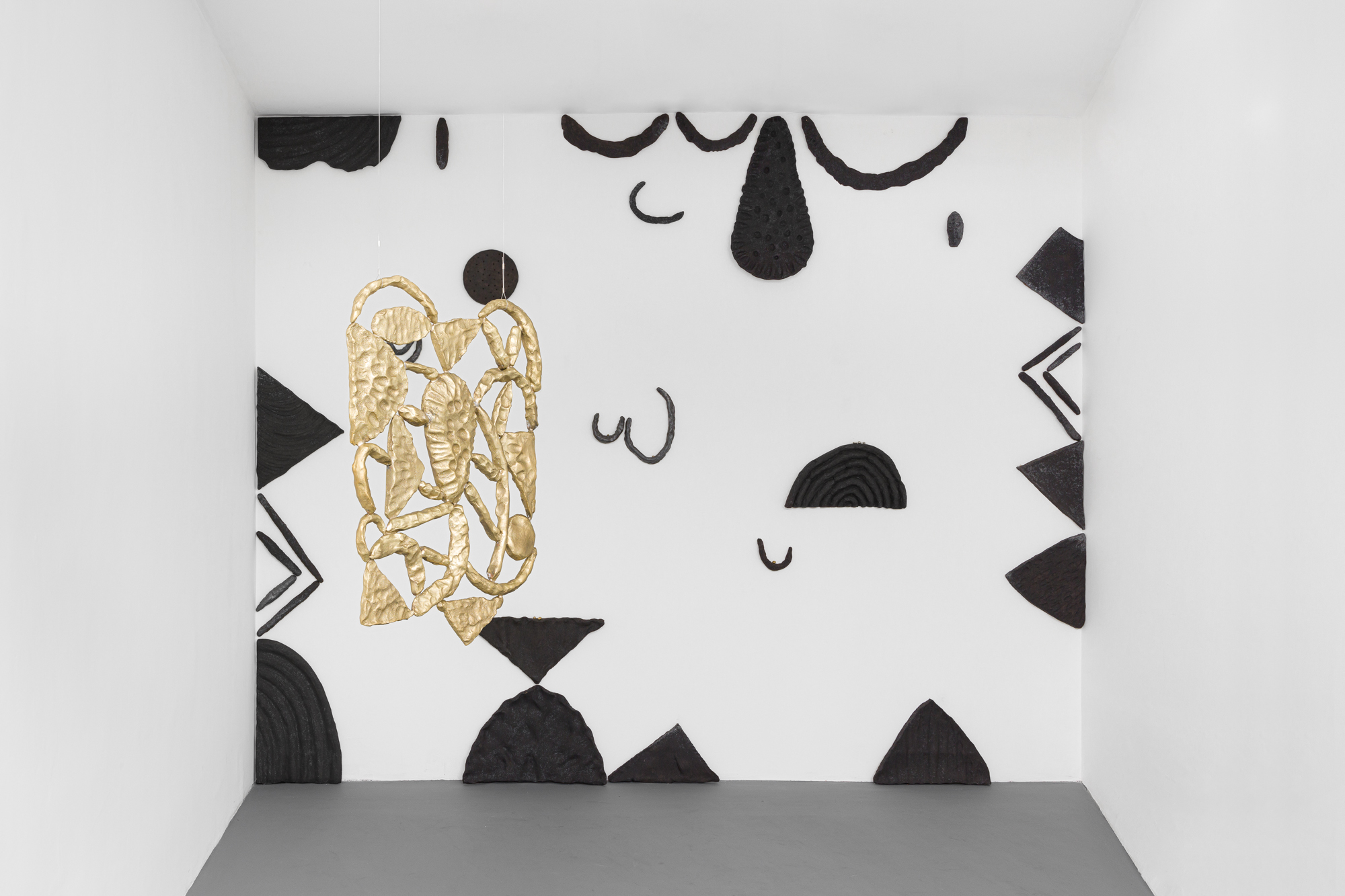
As artefacts, these separate elements really do look like pieces from other cultures, like pieces of a relief, or a column. They are very reminiscent of pieces you might find in a historical museum, which perhaps the archaeologist or historian can put into context. But it’s not easy for laypeople to reconstruct these scenes.
It’s a kind of reverse archaeology. It starts from the construction and tries to find meaning afterwards, within the work. There’s also a kind of stylised sieve in the elements. Nothing really seems to be moulded from reality. Nothing seems absolutely realistic. Everything goes through a stylising sieve, a mental process that accompanies manual production. This is an old story that we’ve carried with us since we arrived here.
It’s almost inevitable to try to understand, in this confrontation with any object, its usefulness and its aesthetics.
It’s a system of questions that we ask the objects. This space of enquiry about what is being looked at, seen, and experienced, remains for a while.
Are these sculptures repeated throughout your career in different contexts or, with each exhibition, each piece, does this process start from scratch?
It’s both together. People can often understand that it’s my work, but I like to think that each exhibition asserts itself with its own spatiality, with its own kind of question. And I like to think that this can be taken to the point of erasing this idea of the author’s mark, of style. I don’t know if this is completely achieved, but I like to think that each exhibition can install not only a different spatiality, but also a different status of the work and a different type of visuality. That’s what I’m looking for.
O meu trabalho acaba gerando, por consequência, uma repetição, uma insistência em algumas questões que talvez se traduzam na imagem do artista. Mas eu acredito que sejam coisas distintas, realmente. Cada exposição é a instauração de um mundo, uma forma de se apresentar e de implicar um jeito diferente. Tem a ver com a problemática colocada em cada exposição, e essa problemática acaba tendo uma singularidade diferenciada.
(Translation: As a result, my work ends up generating a repetition, an insistence on certain issues that perhaps translate into the image of the artist. But I think they’re different things, really. Each exhibition is the establishment of a world, a way of presenting, and implying, a different way. It has to do with the problem posed in each exhibition, and this problem ends up having a different singularity).
Normally, what is the starting point of this problem?
There are several. Some of them come from me outside, and I can’t locate them in an exteriority. But many come from a primary field that is “investigative.” I say that in inverted commas, because the investigative is something that has become very overdetermined in many of the artistic proposals of the last two decades, I would say. Some of my work starts from this level of investigative research, with reading that sometimes includes a deeper historical study, but at a certain point, which I prefer to be early on, this research stops. At that moment it’s me dealing with the ambiguity of research, rather than its assertiveness. I don’t worry so much about the assertiveness of research, or moral judgements about the world. It’s more a question that keeps vibrating in a place that isn’t quite conclusive. And that’s already a watershed between one kind of sensibility and another. For example, an exhibition I did at the British Institute three years ago was called “Tiger Tiger” [presented at the English Culture Festival, in São Paulo, from 25 May to 16 June 2019] and it was about the work of an English ceramic pedagogue, Bernard Leach (1887-1979). It was a dive into his work, questioning two or three points of strength that I thought were particularly modern, and which I was interested in focussing on.
There was also the exhibition I did with Paço das Artes, called “Fundação” [presented at the Museum of Image and Sound (MIS), in São Paulo, by Paço das Artes, from 13 September to 16 October 2016], where there were 2.40m columns that created a discussion between two eminent figures of Brazilian modernism about how to rehabilitate an archaeological structure of a column from a bandeirante [settlers in Brazil who assisted colonial expansionist expeditions] station. Sometimes the starting point is investigative and has a context in the outside world, but usually this doesn’t exactly determine the ending. It’s a kind of licence, or door that opens, for me to work.
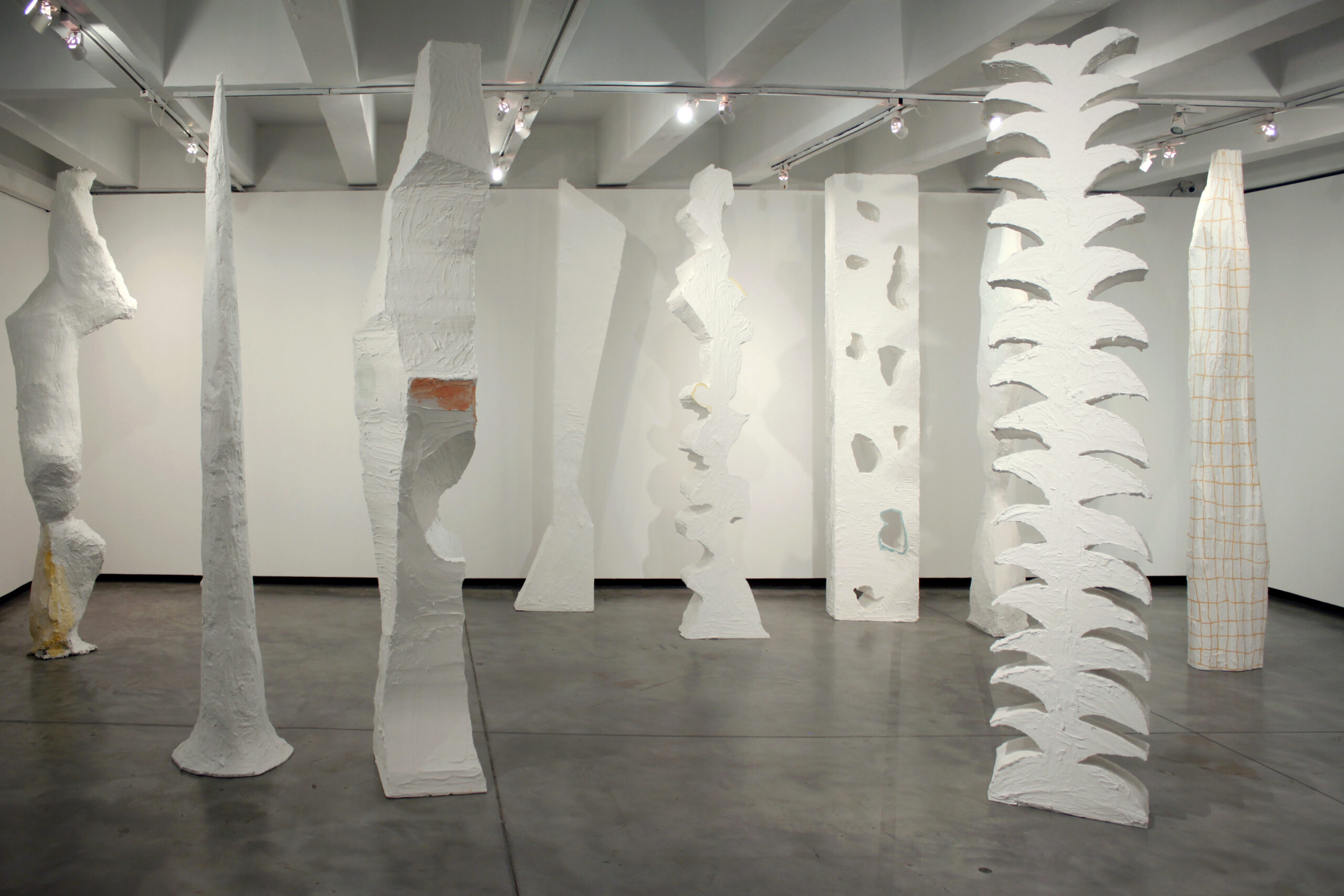
Paço das Artes, São Paulo, Brazil
Thinking about investigative work that becomes didactic, in which work and research become one and the same, how much of this research appears explicitly in your practice?
I like this field of research to stop. I finish this work at an early stage of the project so that I don’t master everything. In the “Tiger Tiger” exhibition, there was something very elementary that you could understand immediately. There was something that came from the decoration of 19th-century ceramics, and which went from ornamental to sculptural in the exhibition space. There was an insertion of round pieces, made on a lathe, within these sculptures, so there were fields of making and perceiving objects that clearly came from a kind of symbolic triad that I had identified in Leach’s ideology.
In the “Foundation” project, for example, it was a room full of columns that seemed to have absolute autonomous, constructive and compositional, freedom. However, they maintained the height of the original column from the bandeirista station of Santo Antônio casa grande e capela, in São Roque (SP), from the 1640s, which was the subject of a methodological discussion about how it should be rebuilt and what kind of shape would give continuity to what was missing from that column. So I used that same 2.40 metre measurement, and the public has at least a hint that they’re looking at things that are the same size as the one that was there years before. I’m criticising a kind of archaeological fiction, but modern at the same time, of the Brazilian past and future of the 40s. There are clues you can turn to that refer exactly to the fundamental issues we’re dealing with in the project. But this doesn’t dictate the end or lead to a conclusion. There is an exploratory field that involves a lot of intuition and making.
Because it’s really difficult not to fall into didacticism.
And for me, that’s a question. Perhaps it’s the survival of a more rational inclination, and something more expressive and intuitive. I’m also passionate about these themes. Talking to people who are no longer here, but who remain in some way. I think this is a bit of a generational trait. The 1980s and 1990s were an open door for a lot of imagery and sound. So maybe it’s a way of rethinking a certain level of contextuality, to see if it’s productive.
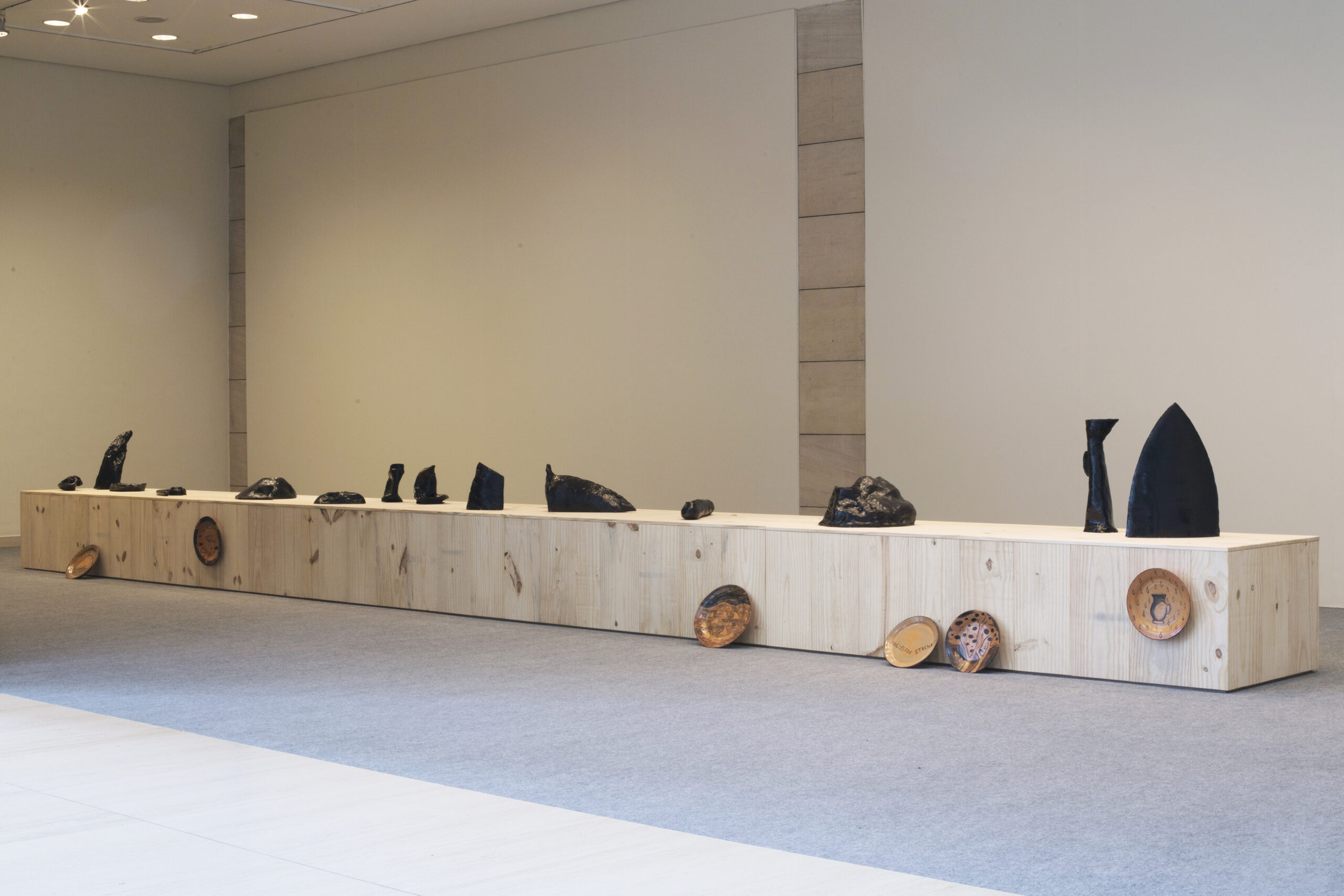
Centro Cultural Britânico Brasileiro, São Paulo, Brasil
The 1980s generation in Brazil was one of the first to open up to the world. We were born with very little access to international books and films. In the late 1990s and early 2000s, there was an explosion.
It felt like anything was possible. And that feeling was accompanied by a certain amount of anguish, because it felt like we were not adopting any kind of assertiveness. This was a liberation, but also an imprisonment.
Part of your practice is painting. What is your relationship between these media, which for many people are so different?
Painting is a field that has always interested me, ever since I was a teenager. Because of my initial training in, and the professional practice of, architecture, which I carried out for many years, drawing has accompanied me every day of my life. I’ve always drawn and I think my painting comes a little from the place of drawing, which has then gained colour over time. It’s a painting that doesn’t emerge as an autonomous project, as many of my colleagues who are strictly painters seem to have, but as a field of enquiry that always refers back to the sculptural experience.
Gosto de dizer que o meu trabalho pictórico guarda sempre uma memória de uma experiência escultórica. É uma espécie de sombra dessas experiências instalativas e escultóricas.
(Translation: I like to say that my pictorial work always harbours a memory of a sculptural experience. It’s a kind of shadow of those installation and sculptural experiences).
I always thought I would be a painter, until I started exhibiting. The very first time, the object was much more obvious. It was a discovery. This thing of making things out of materials, and the spatiality of installations, began to gain my full attention. Painting came back into my practice after that, but already in reference to this place of greater strength, which was sculpture and installation. I’ve invented various statuses for my painting, such as being a background for sculpture, being a space for thinking about something that’s going to be built (a project), or keeping a procedural memory similar to that of a sculpture. The first time I exhibited paintings was for a project I did in Coimbra in 2018, with some black sculptures [Exhibition “More News from Nowhere”, presented at the Colégio das Artes in Coimbra, from 15 June to 27 July 2018]. That exhibition shaped my interest in painting a little. The works were black paint on unbleached linen and served as a background for small sculptures, which I placed in front of them. Because they were dark and monochrome, they were also shadows, so these works come from this somewhat disinvested place. They’re not performing to their maximum capacity, whatever that means, but they refer to a negotiation with something that is of the order of the sculptural.
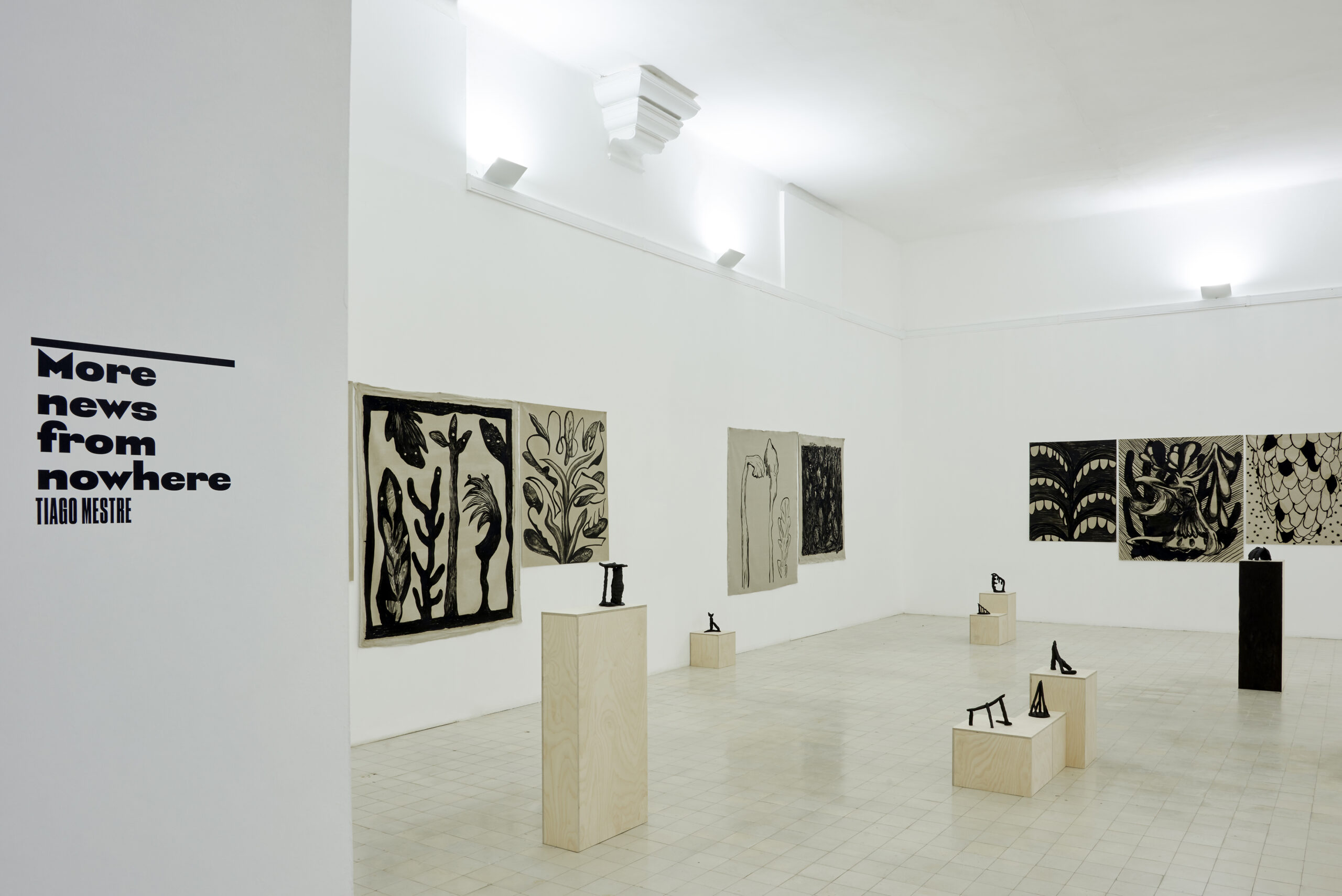
Colégio das Artes de Coimbra, Portugal
This connection between painting and sculpture that you described is reminiscent of painting applied directly to architecture, for example in frescoes…
In Portuguese culture, this valorisation of space through pictorial insertions appears a lot, whether in popular ceramics, handicrafts, or architecture. I dealt with this a lot because I lived my childhood and youth in Portugal. I think that still very much informs the things I do. This place of order too. Speaking of perhaps slightly more erudite cases of extending, accompanying, and correcting, architecture, there are these Renaissance and Baroque spaces, or even the sumptuous integration of pictorial spaces within a more palatial or sacred architecture. But this kind of insertion also happens in the more popular strata of society, only in a more austere, sparser way. I find this synthesis of knowledge marvellous. What’s more, there’s a wealth of ideology around this synthesis between the different arts, which has happened at various times in history, such as the Renaissance and Modernism. I think all these examples are marvellous. I approach them not within a productive capacity, but as critical spaces for artistic reflection.
Could you share any difficulties or challenges you’ve faced in your production, research or any aspect of your artistic practice that you’d like to discuss?
For me, I think there are two levels of challenge. One is the challenge of mediating the work, which is a struggle for any artist: to find the paths and bring this encounter to fruition, which also has to do with institutionalisation. The other relates to productive capacity, and depends on the work. Some require more effort than others. For me, being able to produce my work is still something I strive for. I think that every artist has their own difficulties in terms of their artistic reflection, and these are complex to describe in any absolute sense. But the most “material” difficulties have to do with production and mediation. I don’t know how it would be in other places either, I don’t know if this is a type of concern that is closely linked to Brazil. We have a very particular type of institution, a very commercial type of environment, and perhaps this dictates the paths of an artist in Brazil.
Your works and installations come from such diverse spaces and really demand the viewer’s presence and engagement. How is the dynamic of this encounter when it comes to different cultures and different ages?
For me, it’s always very enlightening and very rich to be able to learn from someone else’s vision of my own work. Sometimes it feels like I’m putting a mark on the work, but that’s only how I see it at the moment I’m thinking about it. Then, when the work goes out into the world, it takes on a kind of adherence, a porosity, which, fortunately, is different from what I initially formulated. Otherwise, everything would be a bit predetermined and perhaps impoverished. It’s very interesting to understand places where the public brings renewed readings of the work, or even appropriates it in a way that completely escapes from what I was thinking.
After the pandemic, I made a large sculpture in acrylic resin. It was a huge lamp with a very strange shape, which looked kind of natural, but at the same time it looked like a huge fruit, a kind of character. As I had nowhere to store it, I left it in the middle of the square in front of the studio. I thought the municipality would take it away the next day, or someone would vandalise it, or break it. The piece wasn’t attached to anything and could easily be taken anywhere. Over time, it moved from place to place, and I was very fascinated by that. Whoever took it to another place thought it looked better there, or that it couldn’t be there. That’s appropriation. This interaction is the kind of thing that doesn’t have much to do with my work, but for me it was a huge surprise, very satisfying: not only seeing the work in a another square, a completely different external space, but also realising that people had moved it without destroying it. I think these surprises are also marvellous. This work was exhibited in a space called Olhão upside down on the ceiling, occupying the entire exhibition room [The installation “Cosmos” was part of the group exhibition Unidos da Barra Funda, which inaugurated the Olhão space, located in Barra Funda, São Paulo, in 2018]. The work is no longer mine alone, and the authorship is shared. And there’s also a bit of clarification about living in a community in the city.
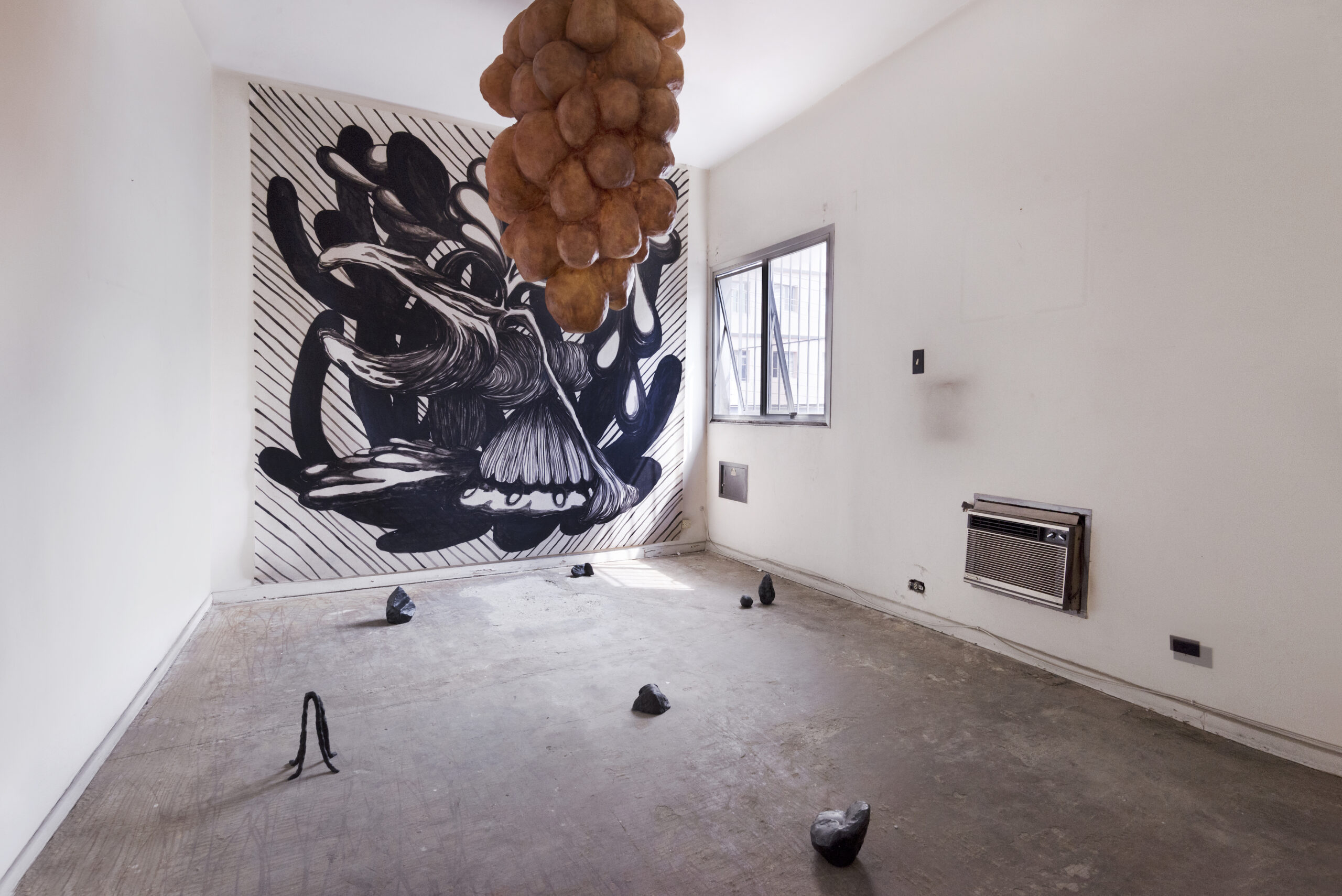
Olhão, São Paulo
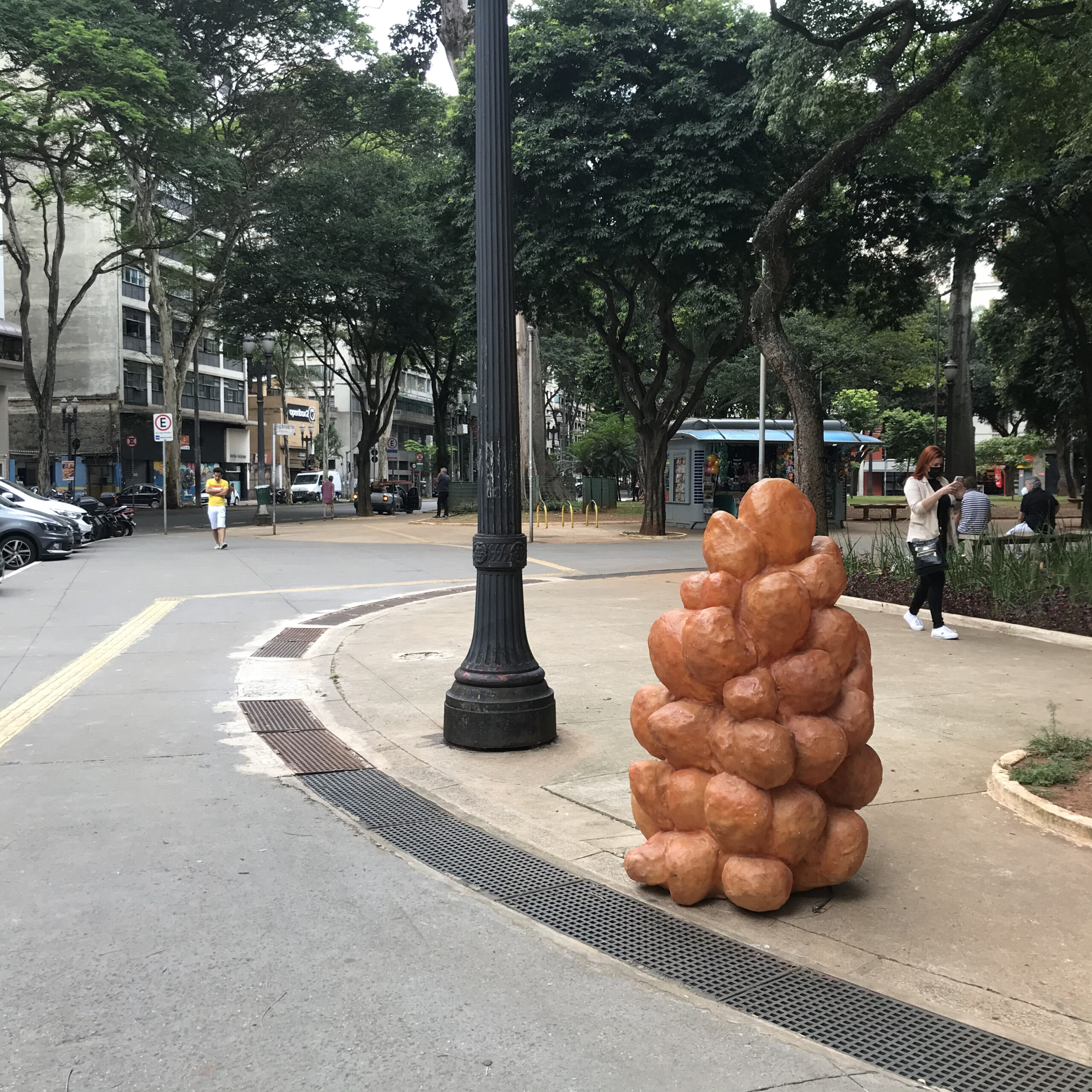
São Paulo
There is a lot of reclassification of artistic and historical objects when this appropriation takes place. For example, church altars, which are works of art, were at one time relics, originally designed to be in chapels by candlelight, and now they are under cold lights in a museum.
A work that often has the status of being sacred ends up being completely stripped of that, and the public gaze takes on a museological character. And this is also a change in status. There’s a church in Rome called San Luigi dei Francesi that has a side chapel with three works by Caravaggio (1571-1610). I visited it many years ago and, in those days, you put a coin in to switch on the spotlights. This light didn’t exist when that side niche with the three paintings was conceived. It wasn’t that light, but it’s the light of the public, whether they’re tourists, art lovers, fans of the white cube, or whatever. It’s a kind of negotiation between different points of view.
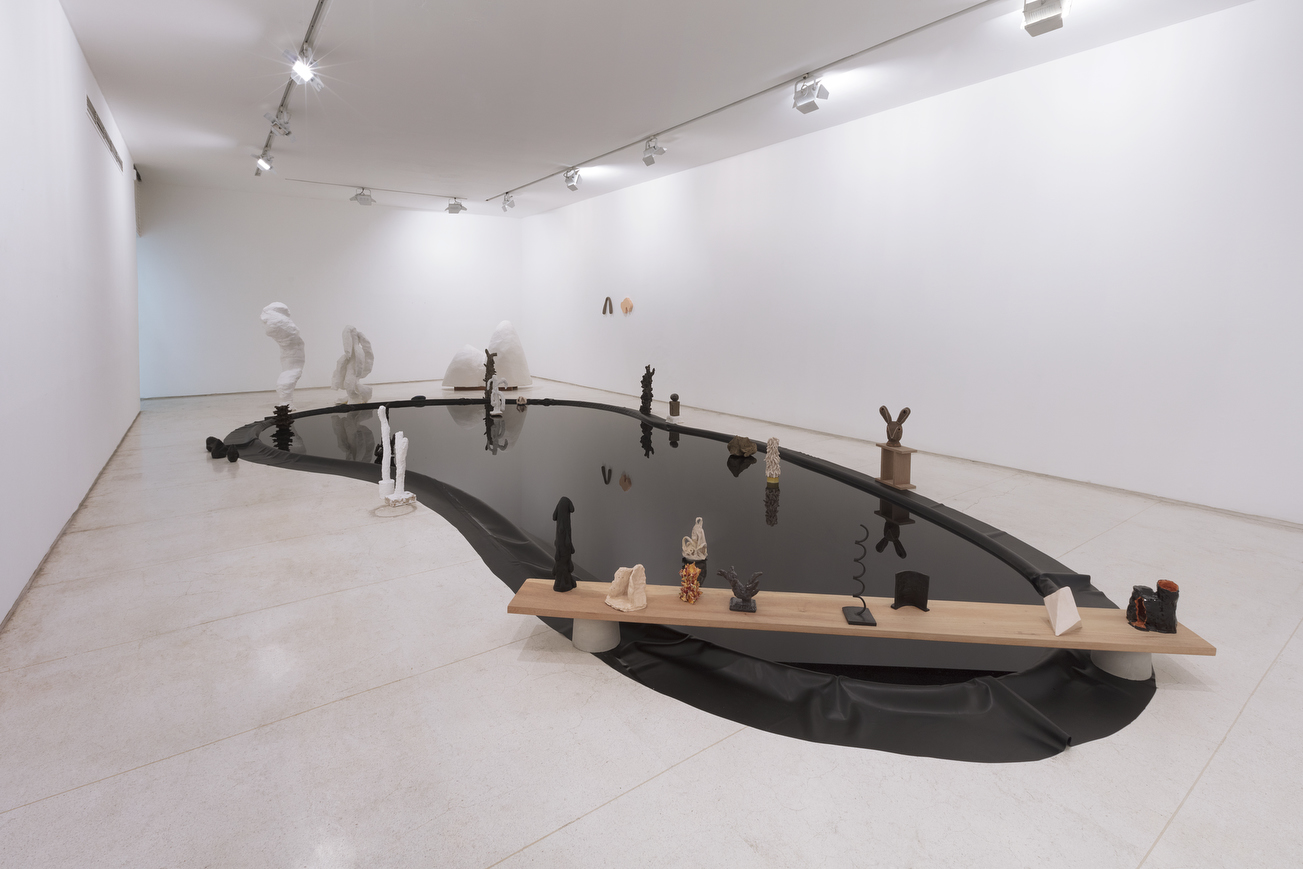
Galeria Millan, São Paulo, Brasil
In some of your installations, such as Fortuna, from 2022, or even Night, from 2017, there is a relationship between the objects in the space that is extremely fragile to reconstruct after any change, even though they are conceived as an exhibition.
Yes, it’s a kind of small world instauration. Some are more complex, others less so, and the more complex ones are sometimes difficult to redo. This lake work, Night, for example, is about a landscape placed inside a gallery. It holds the memory of an external landscape that is placed inside the gallery. This landscape organises a route around the lake, offering visibility to the sculptures. So it’s a kind of landscape protocol, or architectural promenade, which places this sense of seeing along a structure, a “path” that is different from in a white cube, where the space usually allows for different random routes. This exhibition was dealing with this, with this relationship with the natural as well. And what is this myth? What kind of affiliation is this that we always call upon, even though we paradoxically distance ourselves from this more “natural” place? It always appears as a narrative, however, whether one of progress or reactionary placement.
Interview conducted on 9 April 2024 remotely via Zoom.
Casa da Cultura do Parque, São Paulo
Ceramic, bronze | Variable dimensions
2022
Galeria Millan, São Paulo, Brazil
Plastic, water, wood, ceramic, bronze, plaster | Variable dimensions
2017
Colégio das Artes, Coimbra, Portugal
Oil on raw linen, ceramic, wood | Variable dimensions
2018
Centro Cultural Britânico Brasileiro, São Paulo, Brazil
Ceramic, wood, water | Variable dimensions
2019
Paço das Artes, São Paulo, Brazil
Plaster, wood, iron, gouache | Variable dimensions
2016
Olhão, São Paulo
Oil on raw linen, bronze, fiberglass | Variable dimensions
2018
São Paulo
Fiberglass | Variable dimensions
2022
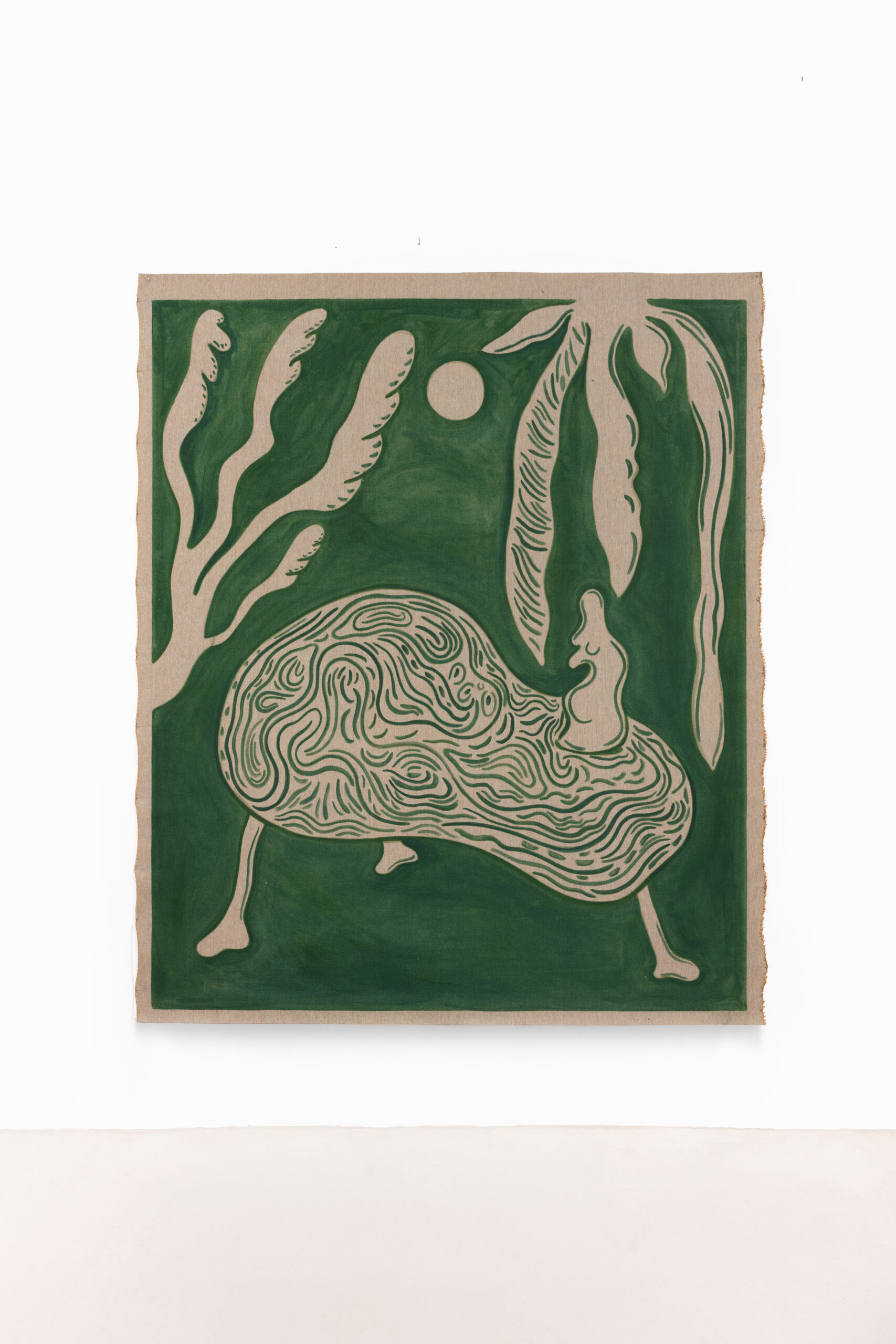
Oil on raw linen | 170 × 140 cm
2025