

Rosangela Renno
Rosângela Rennó (Belo Horizonte, 1962) sees analog photography as a form of resistance, a means of keeping alive the physical and sensory connection with the image. Her work questions the role of photography in the construction and erasure of memory, especially in the Brazilian context, where history is marked by gaps and institutional forgetfulness. In the interview, Rosângela shares how her practice explores the iconography of the photographic camera itself, reflecting on how the act of photographing and the devices that enable it have become recurring images and, paradoxically, perhaps obsolete in the age of smartphones . Check it out:

Rosângela, I wanted to start by asking you to introduce yourself, with any information you think is relevant, keeping in mind an audience that may not yet be familiar with your artistic practice.
My name is Rosângela Rennó, I’m from Belo Horizonte, Minas Gerais, and I have a degree in architecture from UFMG (Federal University of Minas Gerais) and in Fine Arts from the Guignard School, back when it wasn’t yet recognized by the MEC (Ministry of Education). Currently, it’s the School of Fine Arts at the State University of Minas Gerais. I also have a doctorate in Arts from ECA (School of Communications and Arts of the University of São Paulo). I used to joke that it was completely irresponsible of ECA to give me a doctorate because, deep down, I still feel very green. In general, my work uses research strategies, but I don’t consider myself a researcher in the true sense because I lack many tools. I invent a way of researching that suits my needs as an artist, my anxieties, and my desires. I’ve been interested in photography for many years, something that started with the very discussion about what it means to use photography not only as a language but as an idea; In other words, what does it mean in terms of connecting with reality? Is it capable of translating it? Is it a mirror, a window to reality? This whole discussion has been going on for me since the 1980s. And, from the very end of that decade, I started working with image appropriation and, from then on, I practically abandoned the act of photographing. From then on, I consider that my discussion became much broader, because I began to understand that, even in Brazil, and especially in Brazil, photography can be linked much more to amnesia than to memory, due to a series of factors: our lack of a historical narrative and how the history of Brazil has almost always relied more on gaps than on a continuum. Ultimately, for me, photography has always been a pretext for discussing broader issues.
When I arrived in Rio de Janeiro in 1990, I realized I could work in a different way, using photography as a tool for understanding the reality of the country. Before, my work was much more connected to the ontology of the photographic image itself, to the uses of language, tools, and the very genesis of the image. Initially, I was much more connected to the very notion of photographic construction. That’s why I say that the work involves pretexts and strategies.
How does the series Immemorial (1994), for example, in which you use orthochromatic film along with photographs, connect to this idea of pretexts and strategies?
Orthochromatic film is just the correct name for something we used to call Kodalith , which was the film used in printing houses to make photoliths. It was called Kodalith because Kodak was the main manufacturer. I’m from the “analog era,” when you learned to photograph and work in a photographic lab, developing films and making enlargements on paper. And I always worked in a black and white lab. This discipline was very important for me to understand what a “camera obscura” is and the optical and chemical principles it involves. The optical principle makes the connection between reality and a kind of double of it, which is chemically impregnated on an emulsion-based surface using silver salts. I’ve always liked this magical dimension that photography has. In my opinion, today, the production of images is no longer photography, because this dimension of the physical connection between the black box (or the camera obscura…) and reality is gone. Today you have a simulation of this through “zeros” and “ones.” The digital image is a construct that emulates what happened inside the black box.
If, before, with the black box, it was already very difficult to master anything in this construction, as Vilém Flusser pointed out, now we are all completely dominated by smartphone technology , by this thicknessless device that has radically transformed the dynamics of image production, including the concept of image storage. In the past, images were stored; today, images are circulated. Archiving is a thing of the past. If you think you’re archiving images in the cloud, poor you, because if one day someone decides you no longer have the right to access that file, or if the power goes out, or if that cloud explodes, it’s over. I’m saying all this because, in truth, I still appreciate the notion of the image as a document.
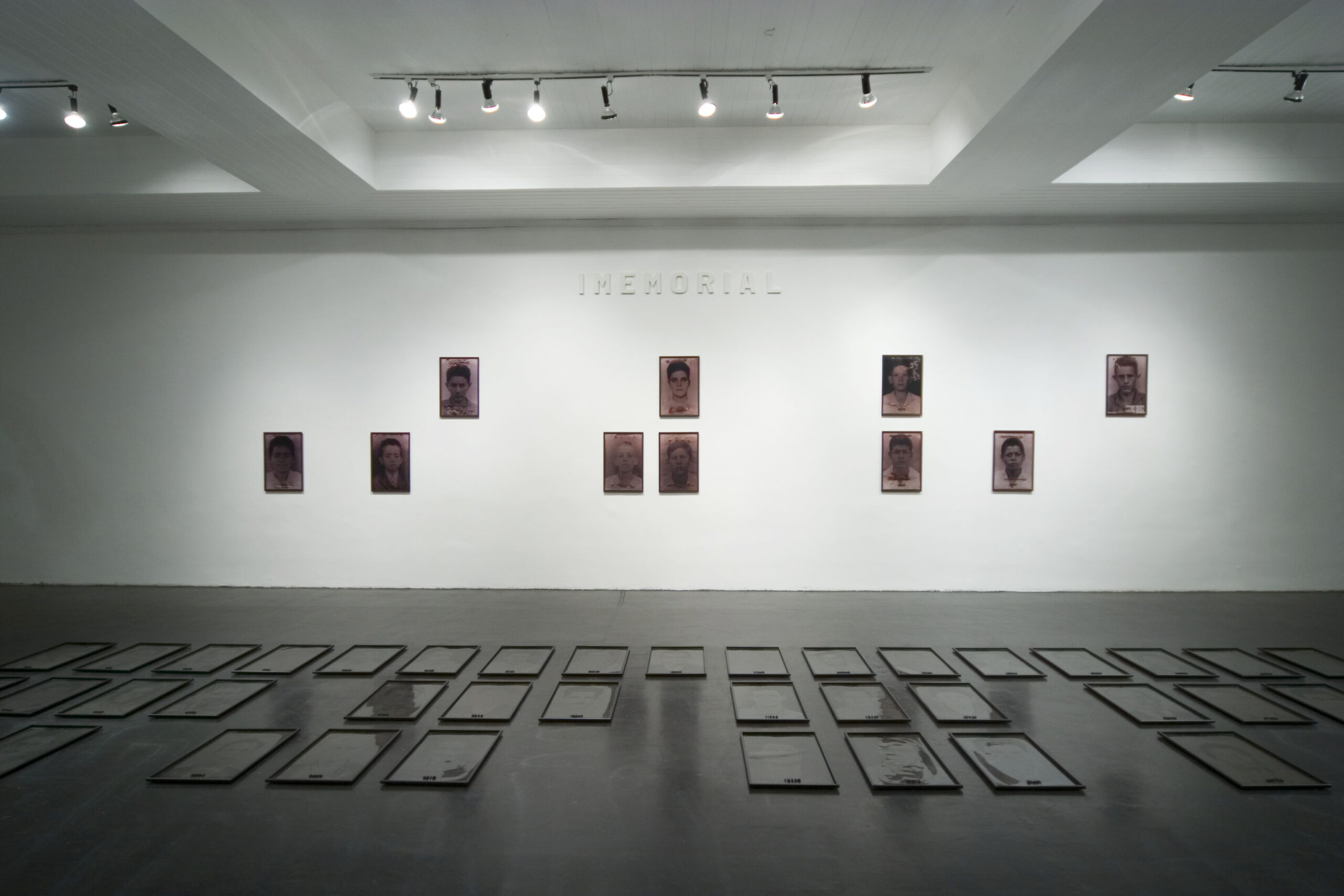
I think I myself didn’t understand why it was so seductive to me, at the time I made Imemorial , for example, to create a work from graphic film. What I discovered with that work was that if a positive slide is enlarged and placed in the projector, it’s possible to make an enlarged negative of that image on photographic paper, on graphic film. Then, by painting it black on the back, it’s possible to generate a positive image, which is composed of shades of silver and black. This result is only possible with this material. So, Imemorial is connected to the physical condition of a material; if it weren’t for that, it wouldn’t be possible to do the work in any other way.
You might ask me if I thought about this back then. No, at the time I thought about making fabulous spectral portraits of the people who died during the construction of Brasília. Today I understand that Imemorial is a work that has to do with the past, with the construction of the capital, what that specific situation represented for us and, curiously, it’s not possible to reproduce this work digitally: it’s an analog work, from analog times, that speaks about an idealized future based on analog principles. When I went to Brasília to participate in an exhibition produced by Alfons Hug, I was very moved by an oral history project organized by the Public Archive of the Federal District and decided to do a somewhat crazy project, which was to open the boxes containing the files of the employees of Novacap (Urban Development Company of the New Capital of Brazil) and look for the files of those who were proven to have died during the construction of the city. This was my first contact with the routine of an archivist or researcher: opening boxes and trying to find the portraits contained in the personnel files, because that was the only material available to do this type of research. At that time, I managed to gather about 55 portraits; I ended up choosing 40, and included photos of children, from 9 years of age, who had been registered as employees in different roles. The children’s portraits are on the wall because there was no record of them having died during the construction period of the capital. The 40 portraits that are on the floor, in trays, have acquired a somewhat “liquid” aspect, due to the shine of the film, and a spectral one, due to the effect of the silver on the black.In the 19th century, there was a photographic procedure called an ambrotype, which involved printing on glass and painting on the back. What I did in Imemorial was a series of “giant ambrotypes” on orthochromatic film. At that time, I didn’t even know it was practically the same process used in the 19th century. I only knew it would work because photographic negatives sometimes have a sheen that makes it possible to see the positive image, depending on the angle of the light.
This work was created in 1994. Was it recently presented again?
Some of my works are shown many times, I imagine, for various reasons. He [ Immemorial ] It has this spectral character, which I find very attractive and enigmatic, since there is no text besides the title on the wall. And, from time to time, curators ask to show this work. I think Brazil lives in loops , history goes back and forth. It was shown in an exhibition about Brasília, at FGV (Fundação Getulio Vargas), curated by Paulo Herkenhoff [“Brasília: the art of democracy”, from April 13 to July 14, 2024]. It gave me a major headache, because the director of FGV – who, in some way, also controls what is shown in the Foundation’s Gallery in Rio de Janeiro – demanded that a small plaque be placed explaining that the work was “a tribute” to the workers who died during the construction of Brasília. The explanatory text added to the work goes against the work’s purpose. You should look at it and be able to intuit whatever you want. If it were meant to be a “memorial,” a work of homage, I wouldn’t call it “immemorial.” The curator agreed to have a plaque stating it was a tribute to those who died during the construction of Brasília because the director of FGV (Fundação Getúlio Vargas) suspected it could generate a misunderstanding: someone might think I had done a work about those killed by the dictatorship. That was the justification for forcing us to include an explanatory text. Someone thought this text was necessary to avoid an undue association with another historical moment, which also lacks recognition and image. There are many shortcomings: of information, of historical narrative, and so many other shortcomings that we live with in Brazil. In truth, all I wanted was for the misunderstandings to arise from an “immemorial.”
Thinking about this historical movement of the Imemorial series , from 1994 to the present day, there is a shift not only political and conceptual, but also material, because I imagine that, at that time, some people who saw the work perhaps knew the material and, now, a younger audience may not be able to recognize these techniques, these materials, because they no longer have contact with analog. And I think that this reflection on the recognition of the material, of the history, of the physicality of photography is quite latent in Persistent Image , also from 2019.
Actually, this work started as a joke. One thing I had noticed is that every photographer has at least one object shaped like a miniature camera. I had several of these because I found them charming. I also noticed how the camera has become a recurring image on t-shirts, mugs, and other objects. At least for me, it seemed like a kind of warning: “Look, this image cannot be forgotten, this image will connect you with the origin of any technical image, at the moment when the new technical images are finally and completely disconnected from the analog, traditional paradigm.”
It’s not merely a technological issue. I mean, there’s a lot of talk today, for example, about the trivialization and proliferation of images, and everyone communicates through images now. The movement to popularize images, invented by industry, by Kodak for example, was already an issue even before the digital age emerged. Digital technology only exponentially amplified something that was already dictated by industry. My concern is that no one reflects on these issues anymore.
If no one explains to a young artist or photographer, who begins working already immersed in digital devices, what the analog world was like, they won’t understand everything involved in this universe of image production.
Hoje em dia, os celulares fazem o que é necessário para produzir uma imagem e fazê-la circular. Mas houve um tempo em que as imagens não eram feitas para circular de uma maneira quase instantânea. Elas não eram ferramentas de comunicação, mas, sim, ferramentas de documentação. Durante muitos anos, nem mesmo os historiadores tradicionais tinham muito respeito pela imagem fotográfica. Hoje, muitas pessoas se dedicam a analisar fotografias como ferramenta de pesquisa e ensino da história.
(Translation: Nowadays, cell phones do what is necessary to produce an image and circulate it. But there was a time when images weren’t made to circulate almost instantaneously. They weren’t tools of communication, but rather tools of documentation. For many years, even traditional historians didn’t have much respect for photographic images. Today, many people dedicate themselves to analyzing photographs as a tool for research and teaching history.) So, the work “Persistent Image” is about that. It highlights how there is a desire for the persistence (or insistence, also…) of an image, that of the analog device, associated with the documentary, starting from innocent objects: plate, glass, cutlery, t-shirt, pencil sharpener, pen drive , etc…
Do you think this return to analog is a broader interest in always referring back to origins, or is it simply a curiosity of this new generation?
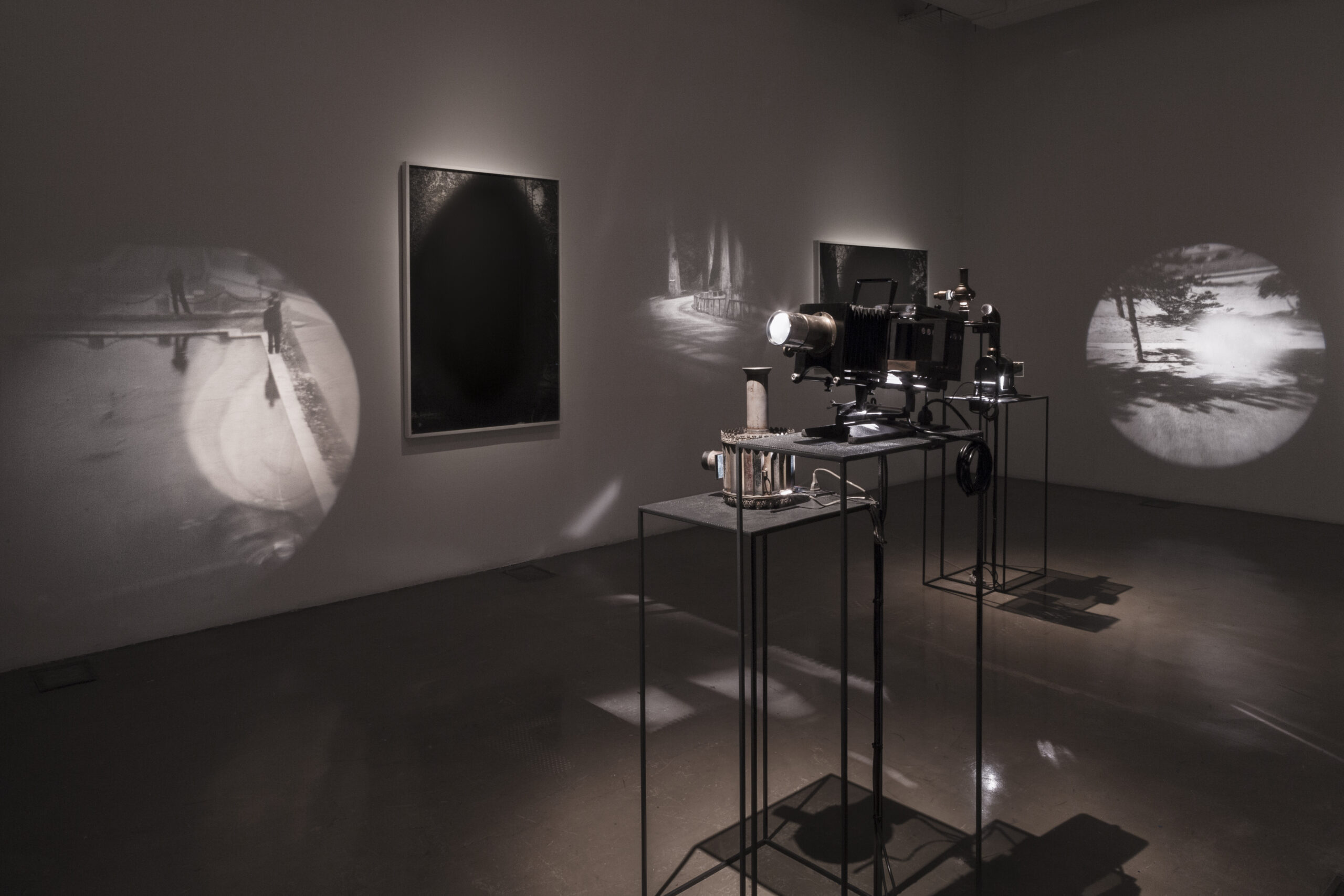
Maybe it’s a little bit of everything. I wouldn’t dare give a definitive answer, but I notice several things. First, fashion – it’s obvious, right? If someone posts, advertises Lomo on Instagram, people will buy – until they get tired of the process, because you have to make the film, then you have to develop the film, choose the photos, etc… Then, the industry will take care of making it easier for those who want to work in a vintage way : photographing with negatives or slides , transferring them to a cell phone and converting that production into something digital, so it can circulate. All of that already exists. But, in reality, everyone is thinking about the final stage, which is the circulation of images. I, in fact, am always thinking about the beginning, about this side. I’m not interested in a result, simply. Obviously, the result interests me, but what interests me is facing the traditional medium and having an experience, because I’ve done this several times. I’m photographing, for example, with a cheap 6×9 camera I bought in Porto, Portugal, which provides minimal documentation of what I need, with minimal resolution, but produces a large negative. My interest isn’t in the output or what I’ll do with it, as it can have various formats. I’m much more interested in the act of documenting and compiling that documentation. Perhaps this is the newest operation for me, as I’ve often chosen not to document and only use what has already been documented. Another example is the work Magic Lantern (2012) , in which I proposed to create “black holes” within the image – a photographic laboratory work, destroying the information contained in an image that I’ve just placed in the enlarger. After exposure in the photographic enlarger, before developing the paper, I project the light of a flashlight onto the paper and destroy the intended image before it is processed. Someone might turn to me and say that it’s possible to create an incorrect photo, destroyed by a black spot, using Photoshop . However, in Photoshop you’re simulating destruction; you’re not experiencing the image’s destruction in the lab, through the image production mechanism itself. That is, the same luminous principle that produces an image is used to destroy it. The light is the same. It’s almost like what ancient wisdom says: any substance ingested in an inappropriate dose can become a poison. Light produces an image in the correct quantity, and light destroys the same image in an inappropriate quantity.
This might distance me from photography as merely a way out, something I’m going to show the viewer, and bring me closer to disciplines, to artistic endeavors. Perhaps, finally, analog photography will enter the realm of artistic endeavors. After much struggle, after 150 years, it will have the right to calmly enter the category of visual arts. It’s as if the entire 19th-century discussion about whether photography was science or art was pointless. Everyone has produced images throughout their lives, as documents. But, who knows, maybe now they’ll give photography a break, at least analog photography.
In my opinion, I think they’ll never rest, because even today many contemporary artists, curators, and museums are still having this discussion about whether a work is photography or conceptual art, installation, and, in fact, it’s all of those things at the same time.
I don’t understand how this discussion hasn’t been resolved yet. We already have digital imaging, thinking about NFT (which, for me, is the sex of angels), and there’s still this need to compartmentalize, classify, put things in boxes, when, in fact, for me, these discussions aren’t even very serious.For example, from a conservation standpoint, within a museum, if the work is characterized as multimedia, it’s possible to connect with the expertise of various sectors that previously operated separately. Any project that depends on moving images, or even still images, involves a series of issues that now need to be addressed. For example, slides . It’s still possible to reproduce slides , and I hope that companies continue to provide ways to replace parts that become damaged over time. Jeff Wall has his own lab in his studio to produce his lightboxes , those gigantic transparencies that I think nobody else makes anymore. Because, if he can’t find anyone who works in that format, his studio can provide ways for museums to always update the works after showing them. Because it’s obvious that the image from a Jeff Wall lightbox will suffer from prolonged exposure.
It’s also interesting to observe processes that end up becoming extremely difficult to reproduce and maintain. For example, Dan Flavin used lights that he bought from stores that no longer exist. Nowadays, if a collector breaks a lightbulb from one of his installations, they have to contact the artist’s institute, which remakes the piece manually. The lightbulb has now become a sculpture. And I love to imagine Dan Flavin angry, because that’s not what he wanted.
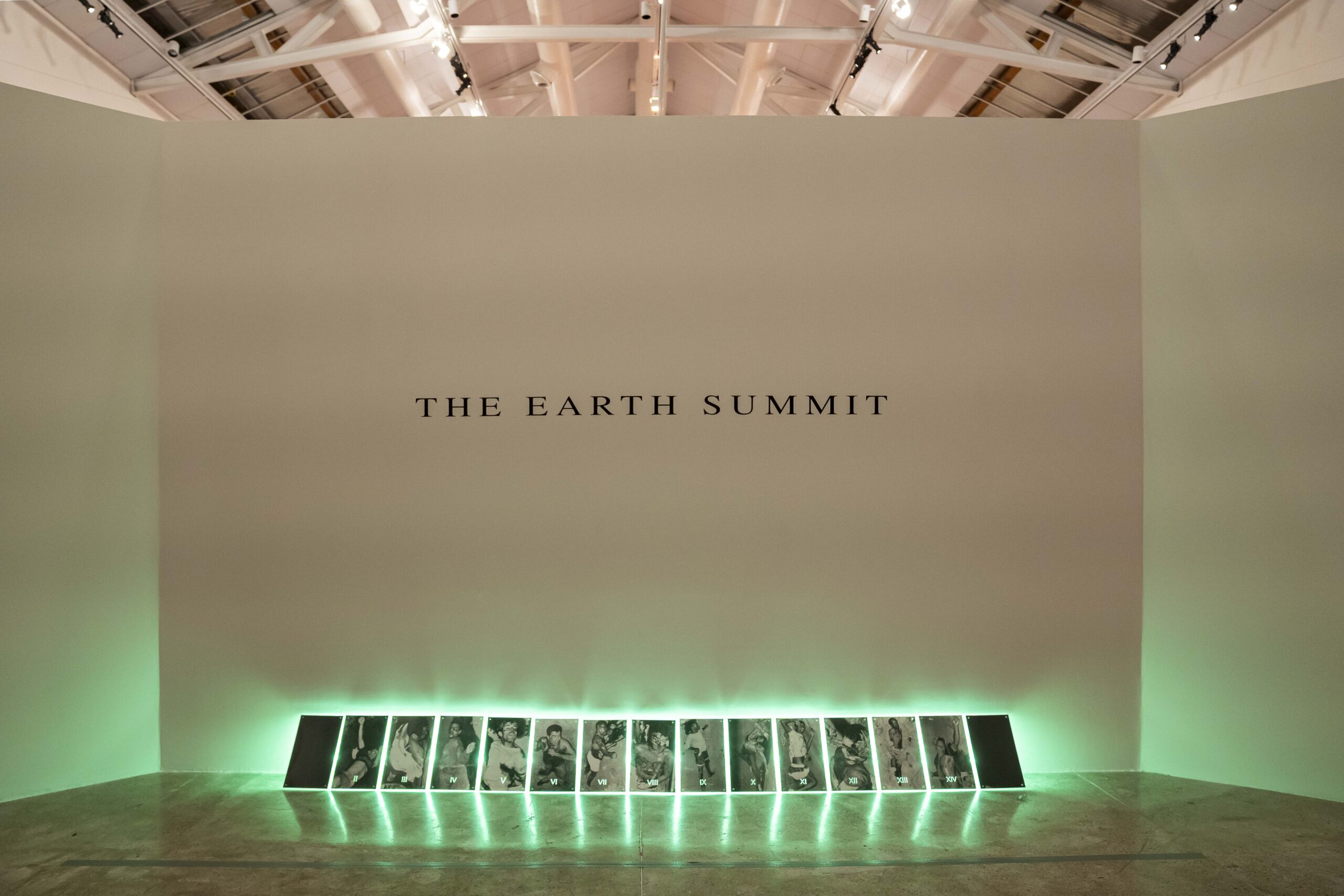
But then, I’ll refute his answer. It seems obvious to me that he wanted his work to be seen as a sculpture. The moment he takes fluorescent tubes he bought at the light bulb store into the institutionalized space of art, that object has already been transformed. Marcel Duchamp inaugurated this. So, ultimately, he has to accept the problem of technology and provide solutions so that his work continues to live on in the museum. Perhaps Dan Flavin himself, if he were alive, would say to replace the old light bulbs with LEDs, to stop this business of blowing glass and making fluorescent lamps, which isn’t even high-tech anymore, it’s the opposite, it’s low-tech .I have a work, “The Attack on Power” (1992) , which has tilted photos and two 1.20 m tall green fluorescent tube lights. And the light was even prettier, because it was brighter than the LED light today. Back then, green wasn’t a pigment green, it was a chemical fluorescence green, it was more luminous, brighter. Now, the green LED lamp is a very bright green, but I said: “It’s what we have.”
Still on the subject of the conservation process of your work, which is quite material, could you talk a little about Wedding Landscape (1996)?
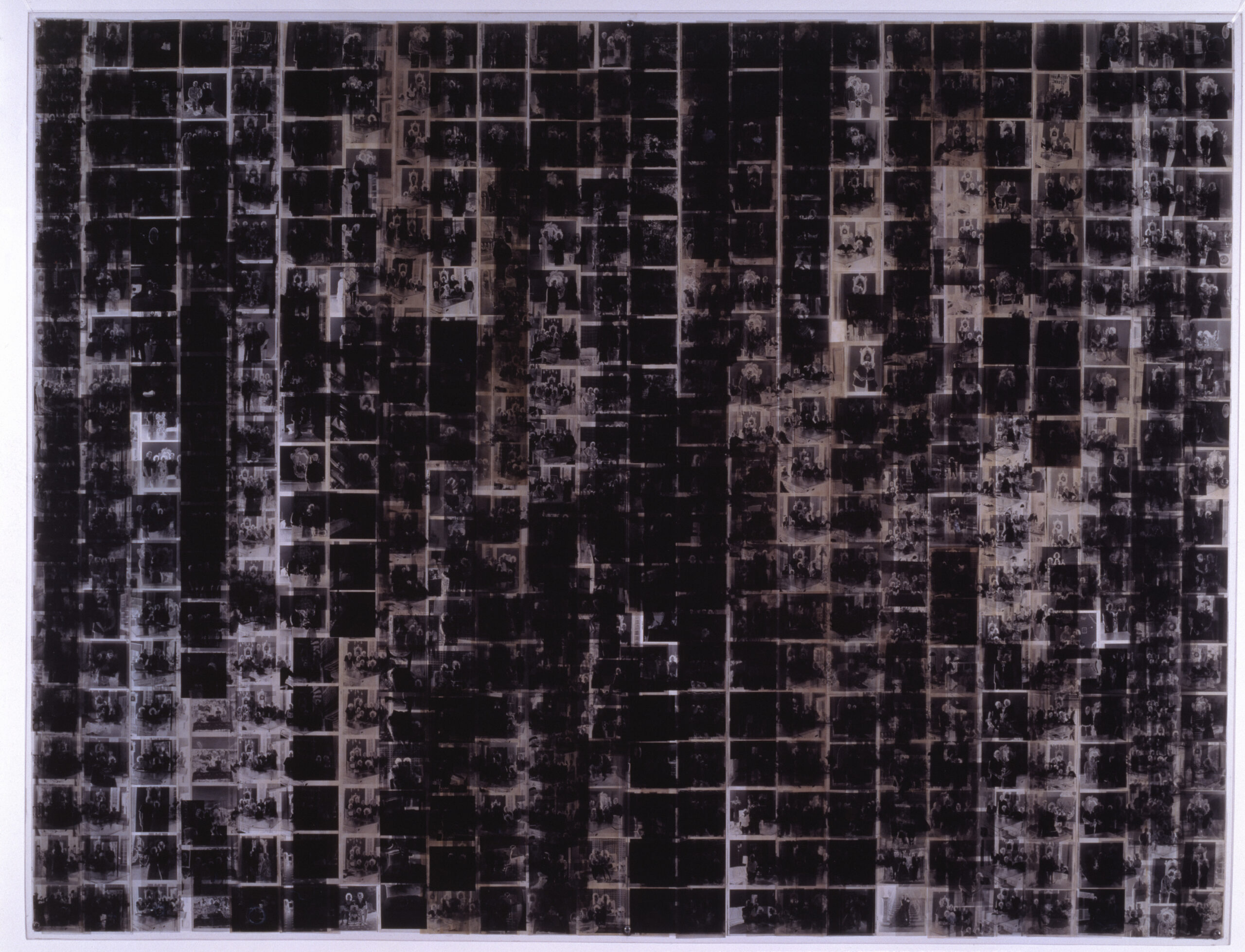
I have several works that are made with materials, properly speaking. I’ve always really enjoyed experimenting with the materiality of the photographic medium. I face several problems because of this; I have to deal with the issue of conservation all the time. Regarding Wedding Landscape , from the beginning people have been intrigued and wondering why I call it a landscape. In it, I resorted to a principle, which I used again later, of making an almost opaque image, from the overlapping of transparencies. From a distance, it’s a black blur, but as you get closer, you see that that blur is made up of countless units. You have to look for things within the image to understand it. In Wedding Landscape , the discussion was about focus: when you look at the landscape, where do you put the focus? The landscape is what the eye reaches, but your eye can drift from one thing to another, and you have to establish where you put the focus. Several visual artists have done and do this. For example, this was a discussion from Impressionism, the ability to simply focus on light. And it’s a discussion that almost no one takes to the realm of photography, but some artists do. Andreas Gursky deals with the urban landscape, mainly, in a masterful way. When faced with one of his photos, everything depends on where you direct your gaze and what you want to see. We forget that photography has all of this behind it, and it’s not necessarily a mere communicative function.I used the same principle, of the image as a large black blur, as in Wedding Landscape , which is even a play on the idea of opacity in photographic images, in the work Matter of Poetry (2008), only in a different way. In that case, I stacked slides to obtain a composite image, but then I transferred them to digital media and printed all the images into one, as if I had collapsed five to seven slides , generating a single image that results in an almost black photograph. And it is this image that goes on the wall.
Wedding Landscape also has a connection between the private and commercial sectors, since the source of the images was a photography studio, right?
It’s possible to trace several arcs in this work. First, the question of focus, which goes from near to far. And there’s the arc between the public and the private, between what you can see, from black to white, but always in an inverted, or negative, way. We can raise several questions behind the photographic image.
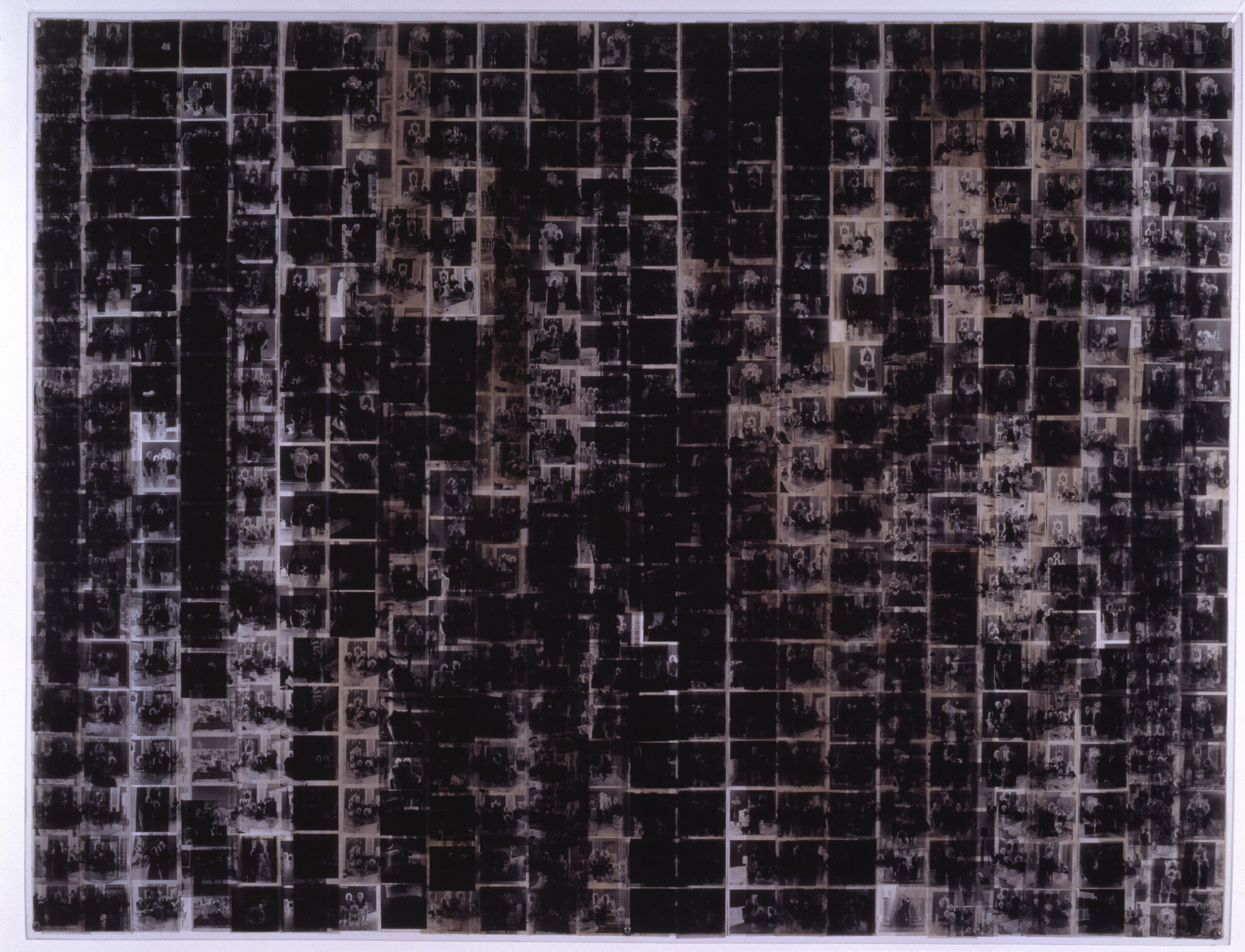
There is a denial of playfulness in photography, in general, because there is an expectation of the real, of the tangible.
Yes, and actually, I’ve always found that very limiting. I’m from that generation – which also includes Rochelle Costi and Paula Trope – that worked with a lot of freedom in photography. We were experimentalists and we liked the language, this game of constructing reality and then moving away from it, imagining other realities or simply an unfaithful and distorted representation of it. That’s why I’m so fascinated by magic lanterns, by slide projectors , by what has been abandoned in the history of photography.
Magic lanterns predate the invention of photography and catered to a taste for the phantasmagorical and the supernatural, but they adapted very well to the 19th-century invention, which had its own magic. When photography was born, there was a debate about the best way to view a photographic image—whether a printed image or an image projected onto a wall—and it was decided, over time, that it was easier to have printed images. The industry embraced this and stopped producing magic lanterns and projectors when it discovered that printing on paper was more profitable, more interesting, and less complex. I learned this very recently, by the way, because I’ve always loved projections, and in 2027 I’ll be doing a project for the Victoria and Albert Museum (V&A) in London, which has a gigantic collection of slides for magic lanterns. It’s a branch of photographic equipment from the turn of the 19th to the 20th century that has been discontinued. In fact, museums like the V&A, which have collections from the 19th century, have a mountain of images on glass that are never seen, that serve no purpose, because to use them, you would have to reassemble a magic lantern – or at least create a projection device within the exhibition space. That’s one of my projects for the V&A: to resurrect a beautiful triple lantern they have that hasn’t been used for over 100 years.
And it’s good to talk about these old things too. I think we have to talk about analog; it can’t disappear from our radar. I like talking about this subject because I think we’re losing touch with some very important issues. We have to hold on to this, for our visual sanity.
Interview conducted on 27th November 2024 remotely via Zoom.
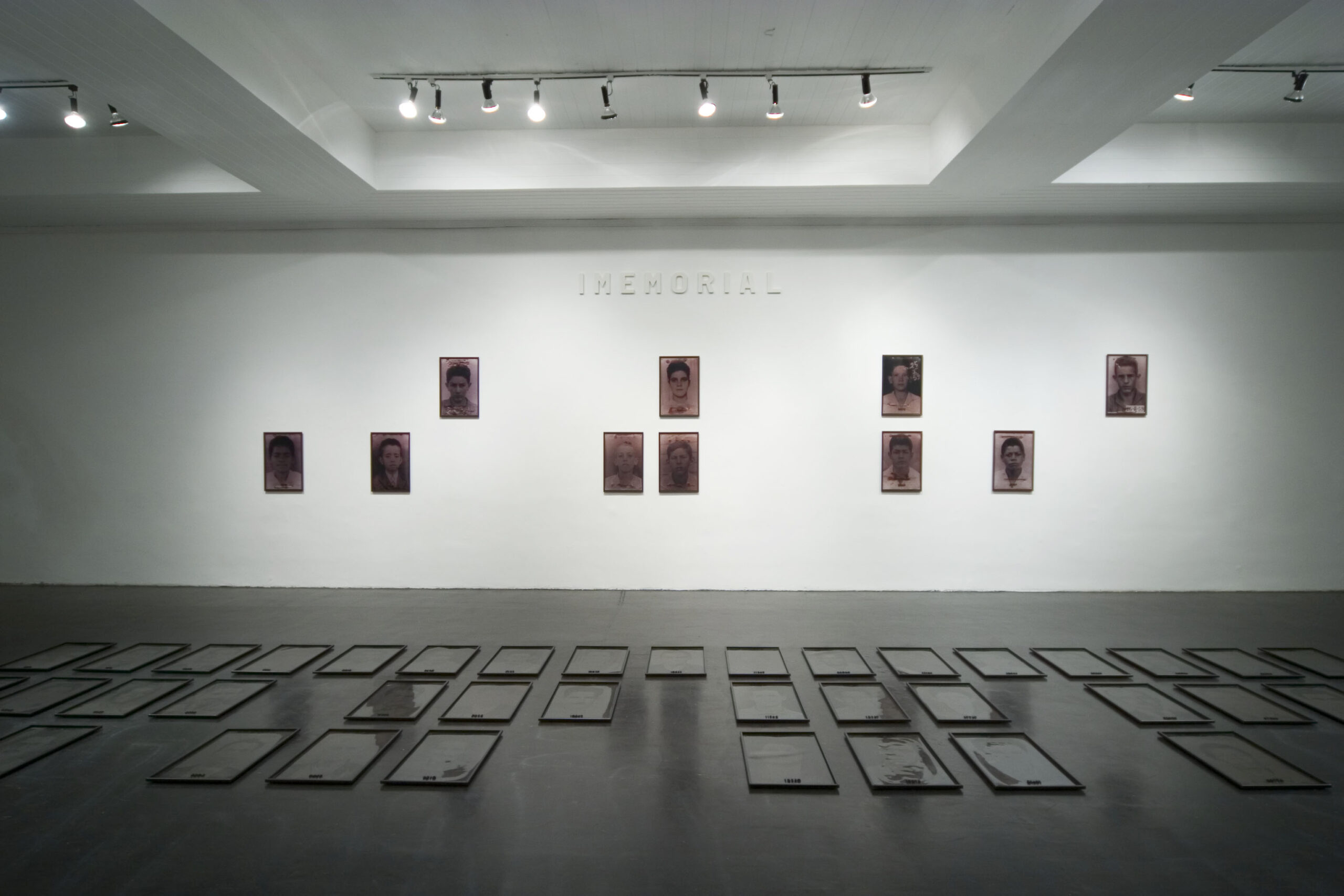
40 portraits on orthochromatic film, hand-painted, and 10 color photographs on resin-coated paper mounted with adhesive and screws. Title “Memorial” displayed on the wall in metal letters.
| 60 × 40 × 2 cm each plate
| Photo: Flávio Lamenha
1994
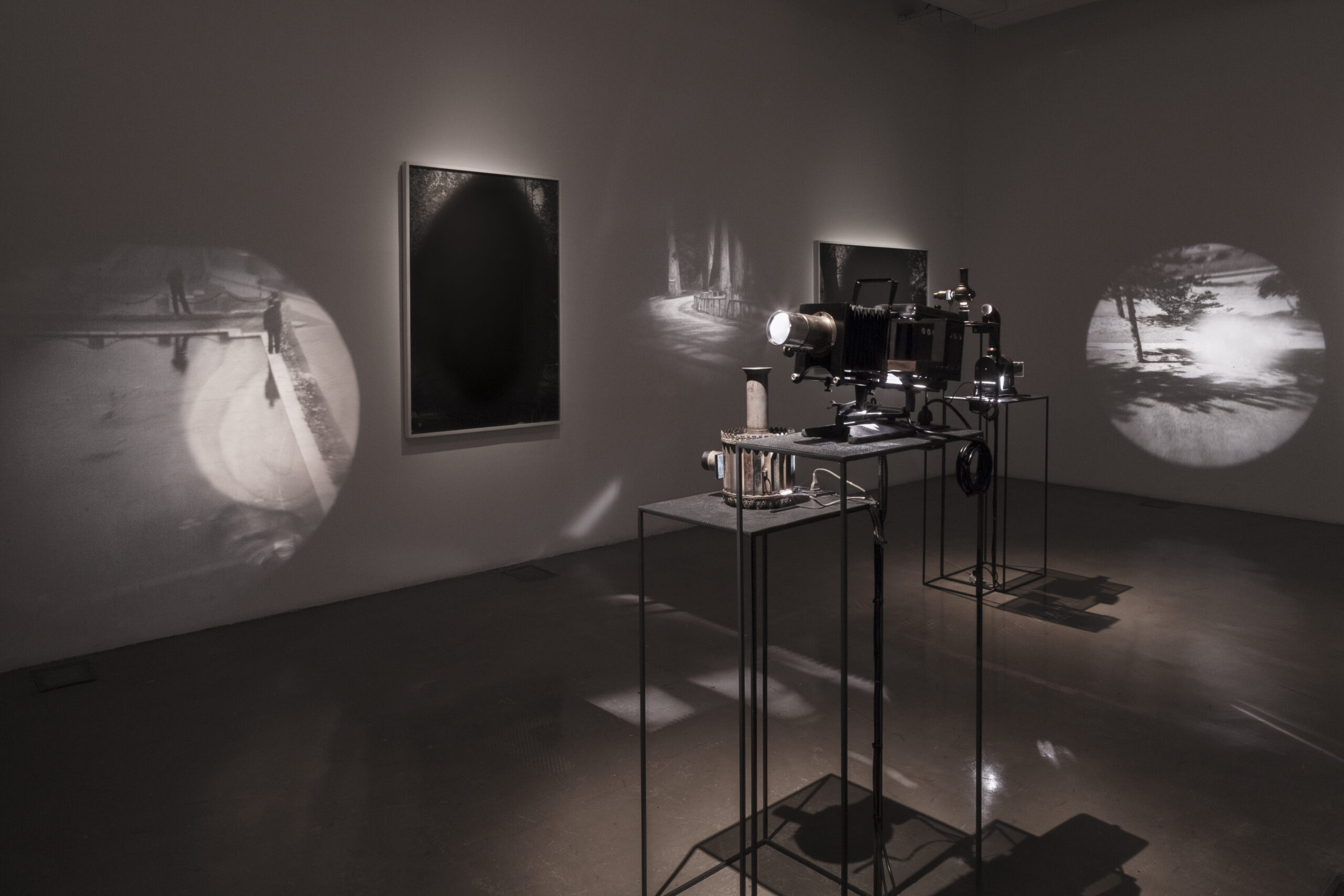
Twelve photographs on silver gelatin paper (Ilford Multigrade IV), selenium toned, 155 × 105 cm each; eight magic lanterns of various makes and dates, manufactured between the 19th and 20th centuries; iron tables; projectors; slides on Kodalith film.
| Variable dimensions
| Photo: Gabriela Carrera
2012–2016
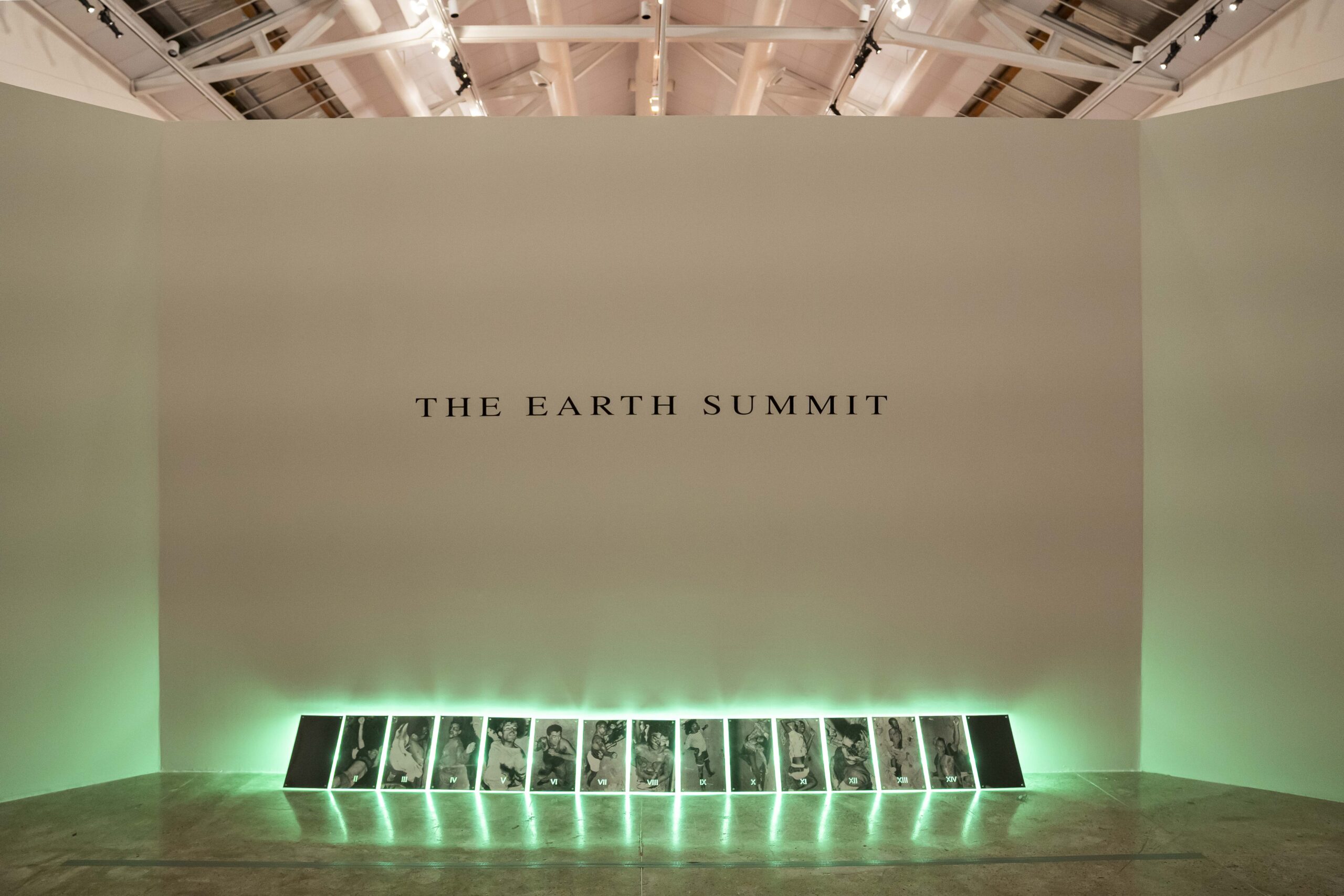
15 black-and-white photographs on resin-coated paper (appropriated from newspapers), acrylic, screws, and two fluorescent lamps; text in adhesive applied directly to the wall (The Earth Summit).
| 320 × 25 × 25 cm
| Photo: Marília Camelo
1992
Black-and-white negatives, acrylic sheets, and screws
| 114 × 149 × 1.5 cm
1996