

Felippe Moraes
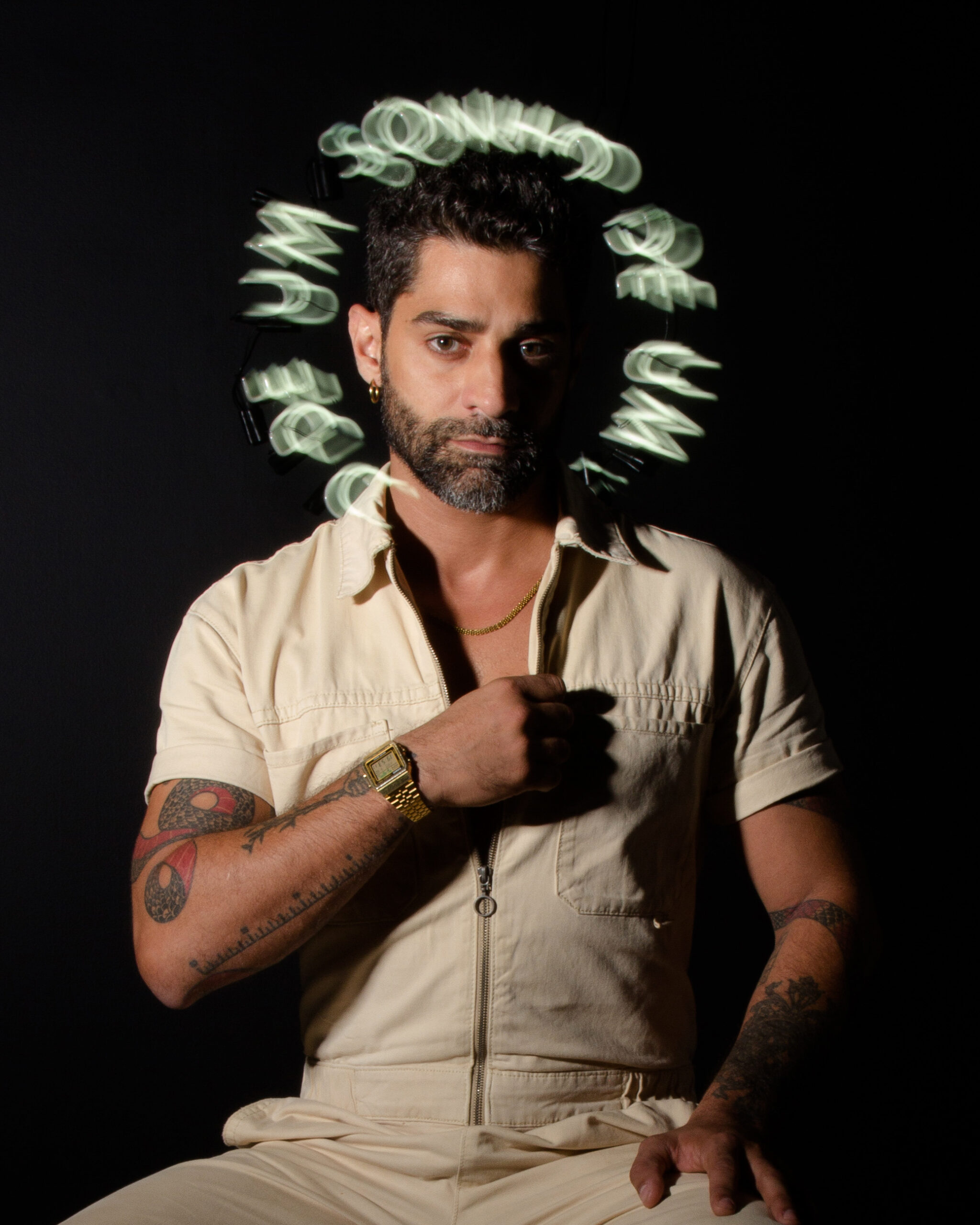
In his work with sculpture, curating, and set design, Felippe Moraes (Rio de Janeiro, 1988) investigates the sublime through a process of “conceptual distillation,” transforming scientific data about time, space, and scale into poetic experiences. Defining himself as an “artist-thinker,” Moraes uses contemporary art as a method of investigating the world, creating bridges between artistic thought and everyday experience, seeking to reveal what we share as humanity in times of division. Check out our interview with the artist:
Felippe, I wanted to start by asking you to introduce yourself, with any information you think is relevant, keeping in mind an audience that is not yet familiar with your artistic practice.
I’m Felippe Moraes, an artist from Rio de Janeiro’s suburbs, specifically Méier, and I think a large part of how I think and act in the world comes from there. I work as a visual artist, curator, and set designer, and I’m very interested in working with different facets of the visual arts in various ways that are always surprising me about what it means to be an artist, what it means to make visual art, what it means to deal with contemporary culture. Where I come from is very relevant and, above all, to how I understand myself as an artist. I understand myself primarily as an artist-thinker. I don’t define myself by techniques, by ways of doing things, but by art as a way of thinking, as a mental faculty, and by contemporary art – I say contemporary art as an achievement of the 20th century, mainly – as a new way of thinking about the world, which, like philosophy, theology, mathematics, and science, has its own methods and finds its own answers to its own questions. Therefore, I see myself as an investigator of thought through art.
Can you tell us a little about the work Escala Humana, from 2016?
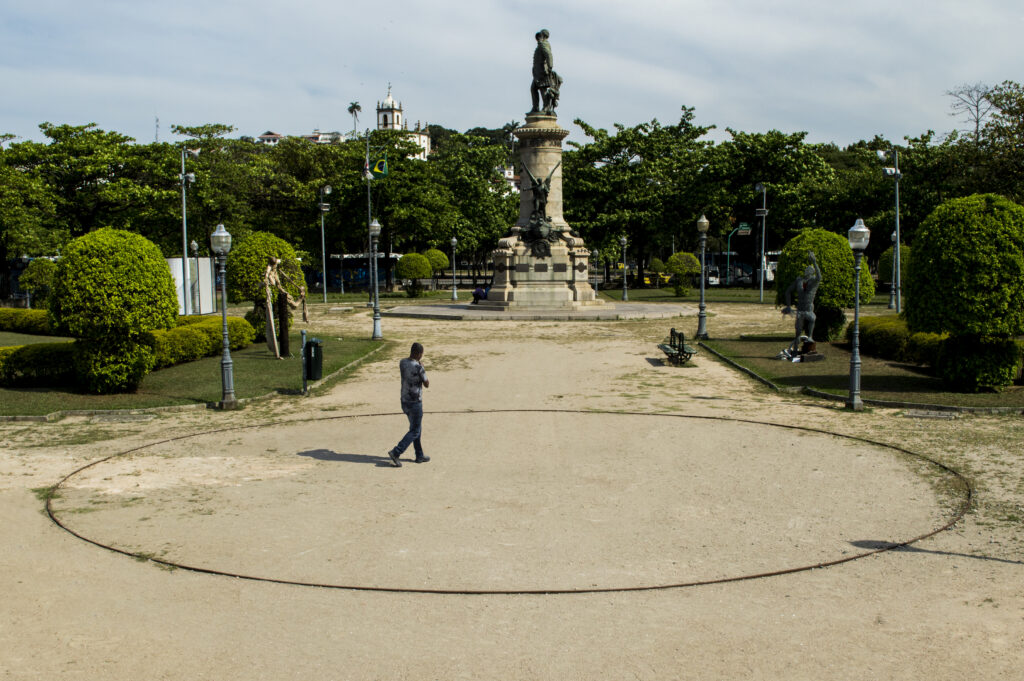
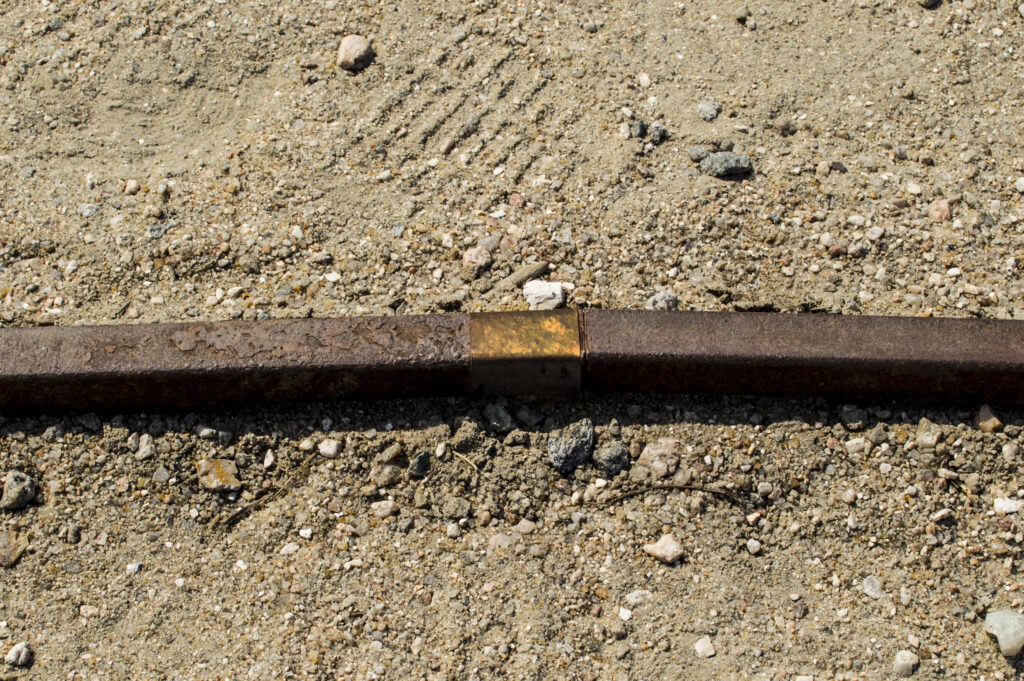
Escala Humana [Human Scale] is one of those interesting works where I establish a relationship with a phenomenon as it occurs in existence, and I focus on how science observes and measures it. This work is a circle 12-meters in diameter made of two-centimeter thick Corten steel and placed directly on a sandy floor. However, within this circumference, there is a 3.3-centimeter section of polished, gilded brass at the very edge of the work, almost hidden. This sculpture was conceived for an exhibition called Esculturas monumentais [Monumental Sculptures, an exhibition held at Praça Paris, Rio de Janeiro, from August 14 to October 2, 2016]. When you arrived at the space, you couldn’t find the work because you were looking for a sculpture, looking up or looking ahead, and when you saw it, the sculpture was actually on the ground; you were stepping on it, you could even trip over the circle. You walk around this circle, which is very large, and suddenly you would find this little square, which is the actual proportion of the period of human existence on planet Earth. The entire circle represents the time of existence of planet Earth, and this 3.3-centimeter square is specifically equivalent to human existence. It’s a work that speaks about the smallness of our existence in the face of the complexity, the size, the space and the time of the universe, of planet Earth, of the cosmos as a whole, but about how we are, at the same time, such large figures, capable of doing incredibly intriguing, complex, violent and beautiful things in this small space of time, lost on this little planet in the corner of the Milky Way. Although this work starts from very scientific notions, it is actually interested in showing, from this experience of grandeur, an understanding of our existence that is even, perhaps, spiritual. The work is called Escala Humana precisely because it speaks of the human scale as a measure, as time, but also as possibility, as a force for transforming the world around us, a force of thought. How were these great primates with opposable thumbs able, at some point, to make chipped stones, and now we are accelerating subatomic particles, colliding them just below the speed of light? How is all this contained in this small piece of brass that represents a fraction of the whole of the existence of planet Earth? This work is a good example of how I think. I collect interesting data from the world, information that moves me, and I try to transform that emotion in some way, so that other people can have the same experience of enchantment and rapture that I have. It’s about sharing the sublime.
And you mentioned this interaction of the observer in order to find the artwork. Is that a relevant part of the artwork, for you?
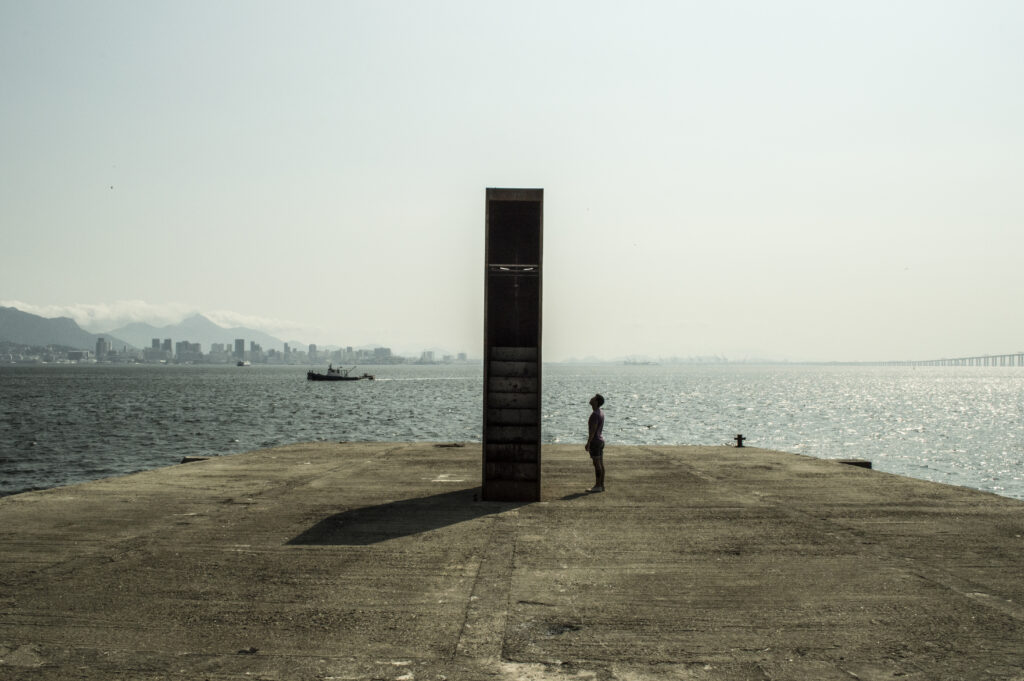
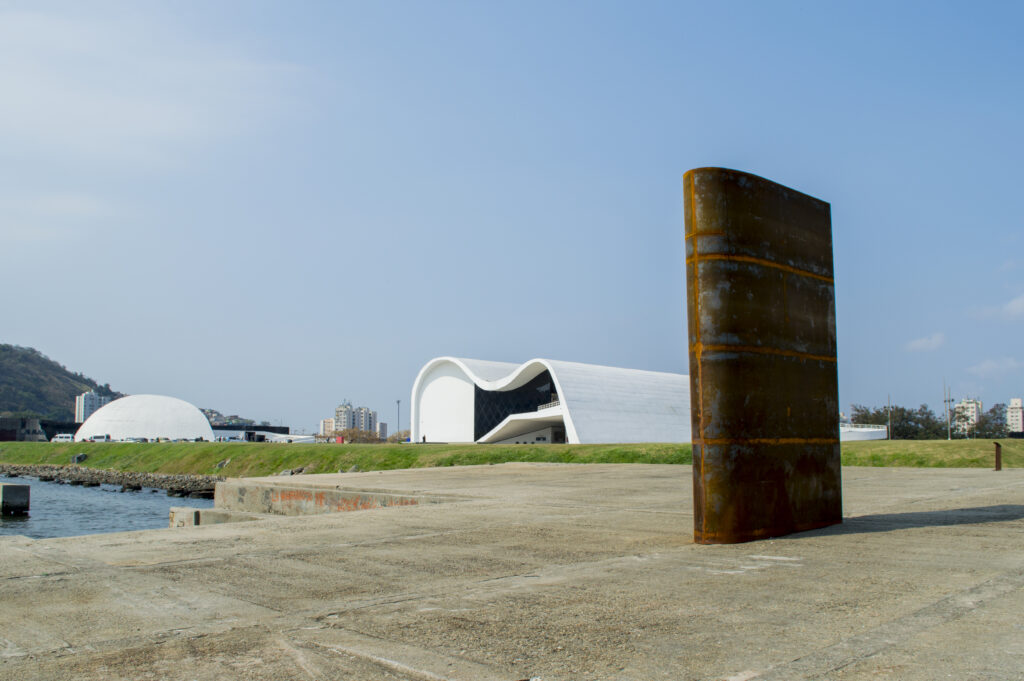
It’s important when it’s important, when the work demands it. In a work where I talk about things that are gigantic, monumental, and that are difficult to measure, there’s something interesting, and even a certain trickery, in hiding a thing that’s so big. It was curious that I wanted to make the largest sculpture in the exhibition, while it was also the most difficult to find. In that sense, I liked this game of, as they say in English, “hidden in plain sight.” It’s there for everyone to see, but it’s hidden. It’s for whoever wants to see, for whoever is willing to look and observe. In other works, I talk much more about presence, about being there, about the conviction that the work of art exists with dignity. So, for me, the work of art can try to hide, as Escala Humana does, or it can seek to present itself in such a powerful way that it wants to compete with the landscape, for example. These two tensions exist. For example, the work Monumento ao horizonte [Monument to the Horizon] is the exact opposite of Escala Humana in that sense, and these are two works from the same year. In Monumento ao horizonte, I placed a Corten steel tower 4.8 meters high and weighing one ton, in front of Guanabara Bay. I challenged myself in this work to create a dialogue with a really magnificent landscape. How does the work present itself to the world with dignity, strength, and presence, in the face of such a powerful landscape? I have worked with the MAC Niterói (Museum of Contemporary Art of Niterói) many times, and I would say that it is a very difficult museum to work with because you are always in competition with the landscape. You already start off at a disadvantage when compared with the landscape; you have to take that into account from the start because the backdrop of Rio de Janeiro is very powerful. When I created Monumento ao horizonte, I placed it alongside this presence, this strength of being in this landscape, in such a way that it was not oppressed by it, but it invited the public to be in it. To begin with, I don’t understand this object simply as a sculpture; I understand it as an observatory, a design object, an object created with the specific objective of observing the horizon, which unfolds into a poetic experience. But, in principle, it is a machine for observing horizons. I placed this Corten steel structure on a concrete pier on the Niemeyer Path, already within Guanabara Bay, and when the public arrives they climb the nine steps inside this structure, and focuses their eyes on a two-millimeter, 180-degree cutout in this Corten steel. There we have a very curious experience, in which the surrounding landscape is cut out, removed from view, and only this very small section of the horizon remains. And there is also an acoustic experience, of hearing the silence that the work proposes in this cutout of the horizon. Both works speak about scale, about measurements, about landscape, but one wants to disappear, the other wants to position itself in front of it. It’s fascinating to talk about very big things in a very small way, as in Human Scale, or to talk about very small and subtle things like the horizon in such a powerful, weighty, magnanimous, very present way.
Thinking about this group of works, can we talk about the work Progressão, from 2016? I think it also adds a political character to this line of thought.
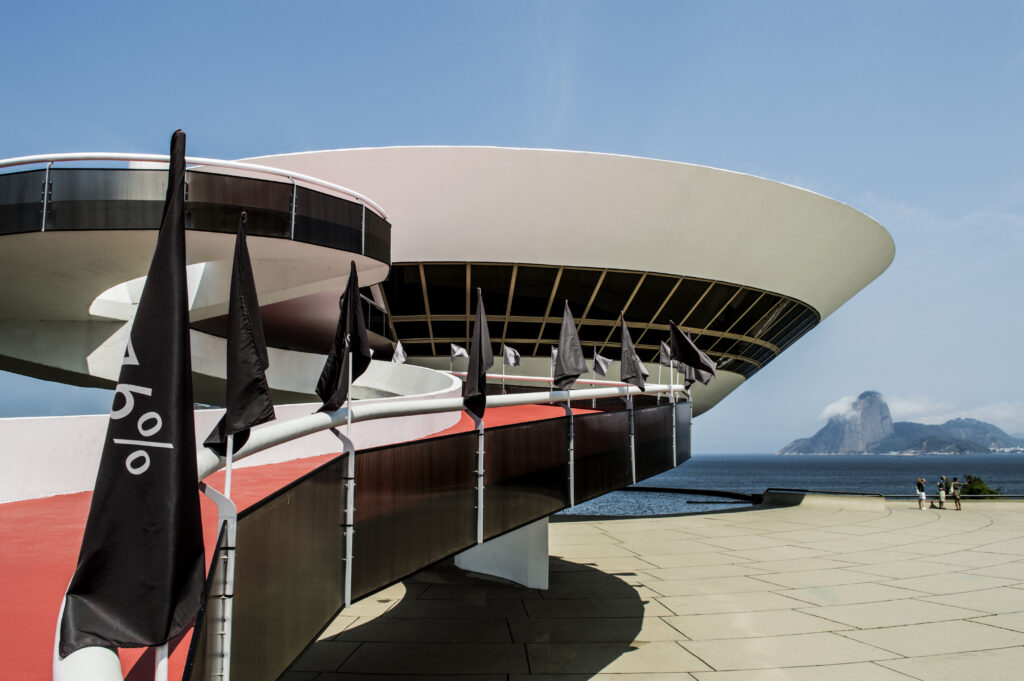
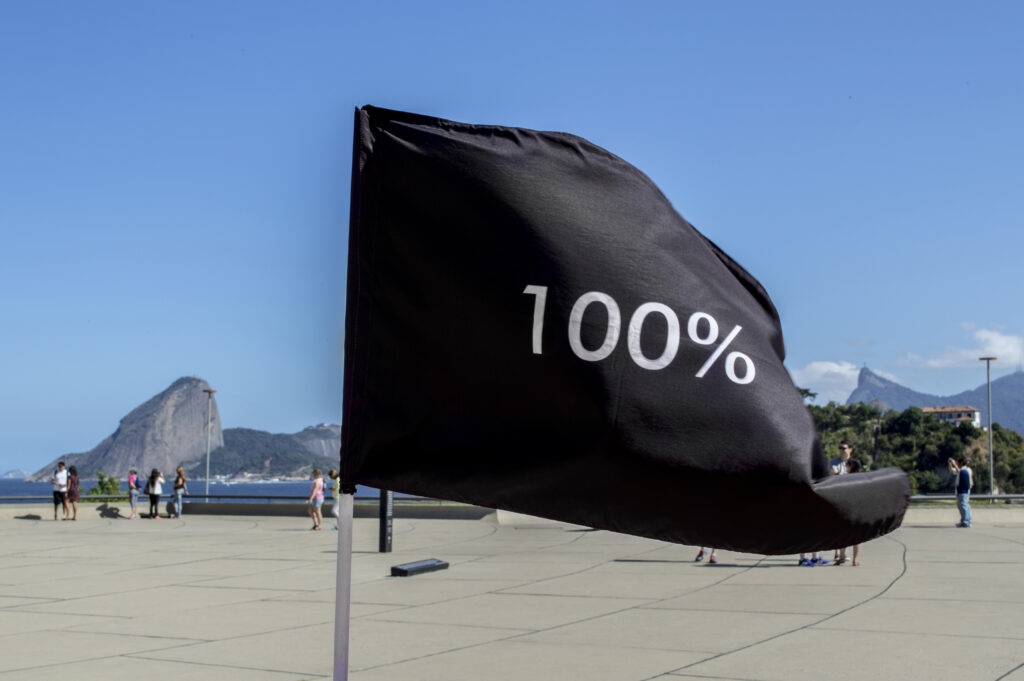
That’s interesting. I think all my works are very political. Over the years, works that I thought were simply poetic have become increasingly reflective. I think it’s important to say that the idea of a horizon only exists because the Earth is a sphere. In a time when some people still believe the Earth is flat, talking about the horizon is a political issue, a discussion about civilization, about what we believe civilization to be, what it means to be in community, and what premises we believe in. One of them is that the world is spherical. Talking about the horizon, therefore, becomes a political issue, which includes a fight against obscurantism and ignorance. So it’s a work that talks about landscape, but it’s also a work that speaks about knowledge.Progressão [Progression] was the first work I made at MAC Niterói, a museum that has been a significant part of my life, so I already had a fascination with it, precisely because people perceive it more as a viewpoint than a museum. It’s an environment with incredibly powerful nautical winds that occasionally tear the acetate panels off the museum. I thought about making flags, and this was exactly during the Olympics in Rio. The Olympic torch was passing through Brazil, so thinking about flags at that moment was also a very political matter. I placed these 26 flags on the ramp of MAC Niterói, and this row started from 100% black to 0% black. It went from black to white, each flag 4% lighter than the other. The percentage of black in each flag was written in white. So, when you were in the middle of the transition, around 48% or 52%, you could hardly see the printed number, which blended into the background. It is a work, then, that also speaks about the differences between one extreme and another, the possibilities of chromatic, political, social, and intellectual gradation that can exist from one extreme to the other, between alpha and omega. This work, even though it speaks of this rigidity, this gradient, this transition from black to white tones, is also in constant relation with this soft fabric, which is being traversed by the wind, unraveled by the wind, scorched by the sun. It was very interesting how, at the end of two months of the exhibition, the black of the flags was brown, the white was dirty, the gray was greenish. It is a work that stemmed from this very controlled notion of science, mathematics, design, and industrial formatting, industrial conformation – since this work can only be done using a digital printing technique, through which I have total control over the color – but which is placed in direct contact with entropy, with the notion that everything is inserted in a complex system. And, as in any complex system, there is chaos. This work, which is presumed to be very conceptual, rigid, and harsh, is confronted by time and the elements; it’s in constant combat with the sensuality of the Rio de Janeiro landscape. During the Olympics, I even heard people passing by the MAC (Museum of Contemporary Art) saying that there were flags from so many countries, but none from Brazil. And I started thinking about how the simple fact of being a flag already carries a symbolic, political charge and a presumption that it speaks about territory. My idea was never to talk about territory, but these comments made me think: “Well, maybe I am talking about territory” – the relationship between a territory that is conceptual on the one hand, harsh and industrial, and, on the other, is a geographical, political, sensual, sinuous, and absolutely breathtaking territory by virtue of its beauty.
And do you consider this work site-specific because, conceptually, it can be adapted, it can be presented in other formats, in other spaces? But, listening to you talk about the museum, about the ramp, there’s also a site-specific element to this work.
I think all work is site-specific, because every work will be transformed by the environment in which it is inserted. Even the difference between the white cubes will alter the work being shown. However, it was essentially conceived as a strictly site-specific work. I designed it for that site, for that wind, for that sun, for that architecture, and for that landscape. But it was a work that generated a lot of buzz. I ended up showing it in several other sites. At one point, I showed it at the Cerveira Biennial in Portugal, in a historic building. Then, I had a solo exhibition in 2018 called Proporción [Proportion] at the EAC [Espacio de Arte Contemporáneo] in Montevideo, Uruguay, which was a former prison. So, having those flags on the wall of a prison also makes it site-specific, but as a result of the relationship it created with that specific space. Flags that transition from black to white in a breathtaking and sublime landscape, like that of Guanabara Bay in Niemeyer’s architecture, is one thing; flags that transition from black to white on the wall of an old penitentiary are something completely different. In these two contexts, you can’t help but talk about the history of democracy in Latin America, for example, about how all these Latin American countries were traversed by very violent dictatorships. So, this work, transposed from the State of Rio de Janeiro to Montevideo, also speaks in some way to this history of democracy. These flags that we all carry, which are an almost universal index of national representation and political coefficients, will have a completely different meaning depending on where they are. From the moment the work takes place in a penitentiary, the new notion of this work also contaminates the previous one, also contaminates the image of these flags in the MAC Niterói. They gain another layer of interpretation, because the work is alive while it is happening in the world. I’m very interested in thinking about that Yoruba aphorism that says, “Exu killed a bird yesterday with the stone he only threw today.” The work is always transforming, modifying itself, and each time it appears, it’s a new work. Therefore, it’s always site-specific.
When thinking about Progressão and about Escala Humana – these works can be observed by people of diverse languages, as you yourself explained, in various political and historical situations and contexts, which certainly brings a different way of dealing with, talking about, and thinking about, the work. Is this universality a goal, or something that happens naturally in your artistic practice?
It’s always a subject for me. Universalism can trip me up sometimes, it can be a dead end, because nothing is universal. That’s the premise.
Mas me interessa a ideia de um trabalho que poderia acontecer em qualquer civilização. Não necessariamente universal, porque nada é universal, todas as experiências são muito únicas, cada pessoa vai ter uma experiência muito própria de cada trabalho. E, sem a minha presença, sem a minha fala, sem o meu legado conceitual sobre aquele trabalho, a leitura também vai ser diferente. Então, eu entendo que o universalismo é uma tentativa falha por excelência, mas ainda assim eu tento. Me interessa pensar essa ideia de que aquilo poderia ter sido feito por um artista de qualquer civilização.
(Translation: But I’m interested in the idea of a work that could happen in any civilization. Not necessarily universal, because nothing is universal, all experiences are very unique, each person will have a very personal experience of each work. And, without my presence, without my voice, without my conceptual legacy on that work, the interpretation will also be different. I understand that universalism is a failed attempt par excellence, but I still try. I’m interested in considering the idea that this could have been done by an artist from any civilization.) Monumento ao horizonte itself has a very simple form. It’s like a book standing upright. It’s two parallel lines that meet at a curve, and you enter these nine steps. The Egyptians could have done this, the Incas could have done this, the Saxons could have done this, the Mexicans could have done this, but it was done in Brazil in 2016. Although it could have been done by any civilization, the question is: “Why did this happen at this moment?” I try to arrive at a form that is not understood by everyone, but that is as devoid of excess as possible. It’s almost a process of conceptual distillation. What is the essence of Monumento ao horizonte? It’s the opening in the metal so you can look at the horizon. In that sense, this very simple solution could have been done by any civilization. I think that, more than the universal, these are ancestral questions. They are questions that have always existed, questions that will always exist. My work speaks, essentially, about the sublime, the unknown, those situations that are so magnanimous, so grand, that we lack the verbal, emotional, and intellectual vocabulary to deal with them. In any civilization, the horizon is something of the order of the sublime. The scale of human beings, the scale of time, is of the order of the sublime. In that sense, I am not interested in putting many details of my civilization there, inscribing ornaments. I want to arrive at the absolute minimum possible so that it can be read in many different contexts, so that this work on the human scale can have the force – discursive and spatial – that it had in Rio de Janeiro, in any other place and at any other time.
I want to bring Samba exaltação (2021) into our conversation because I think it has an extremely introspective, extremely private quality, because it was made in his apartment. It touches on the sublime, because it also has this interference with the horizon, but from a point of view quite different from what we have been talking about so far.
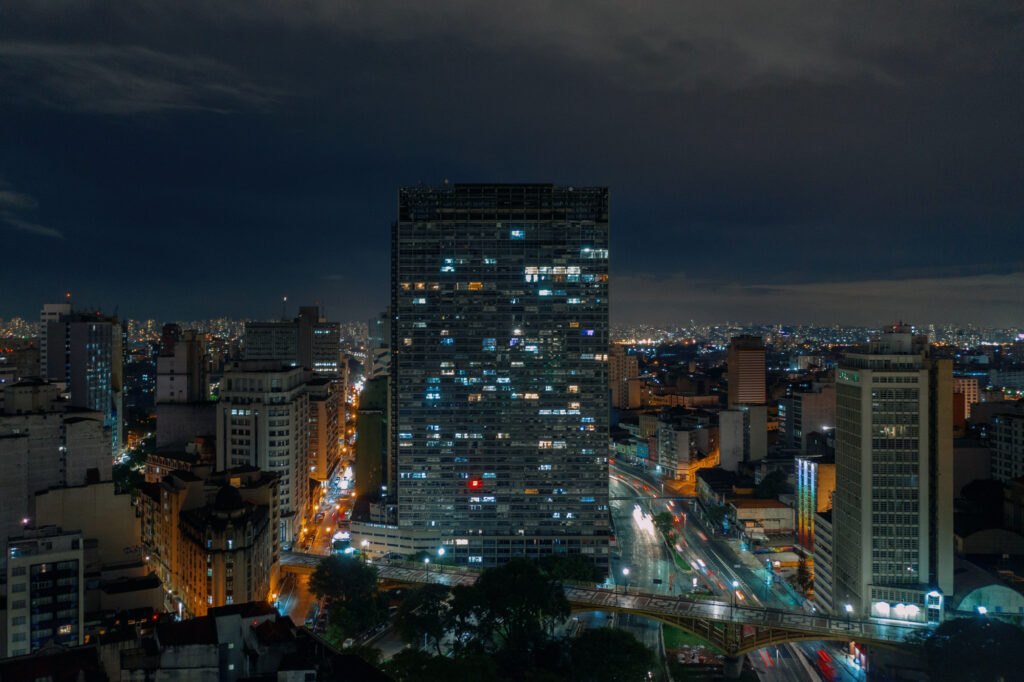
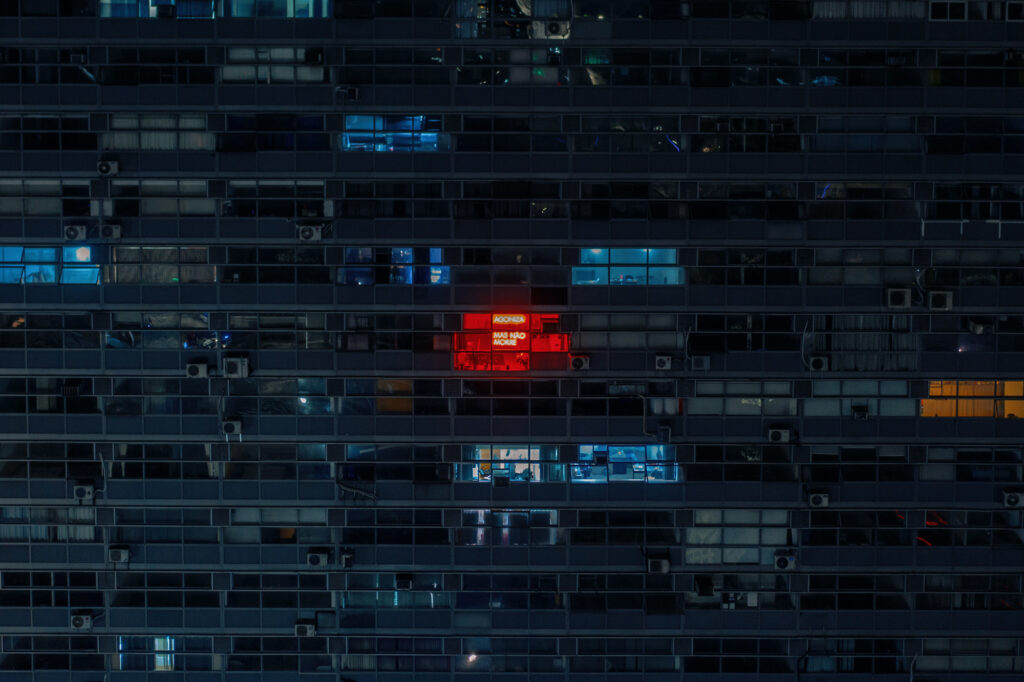
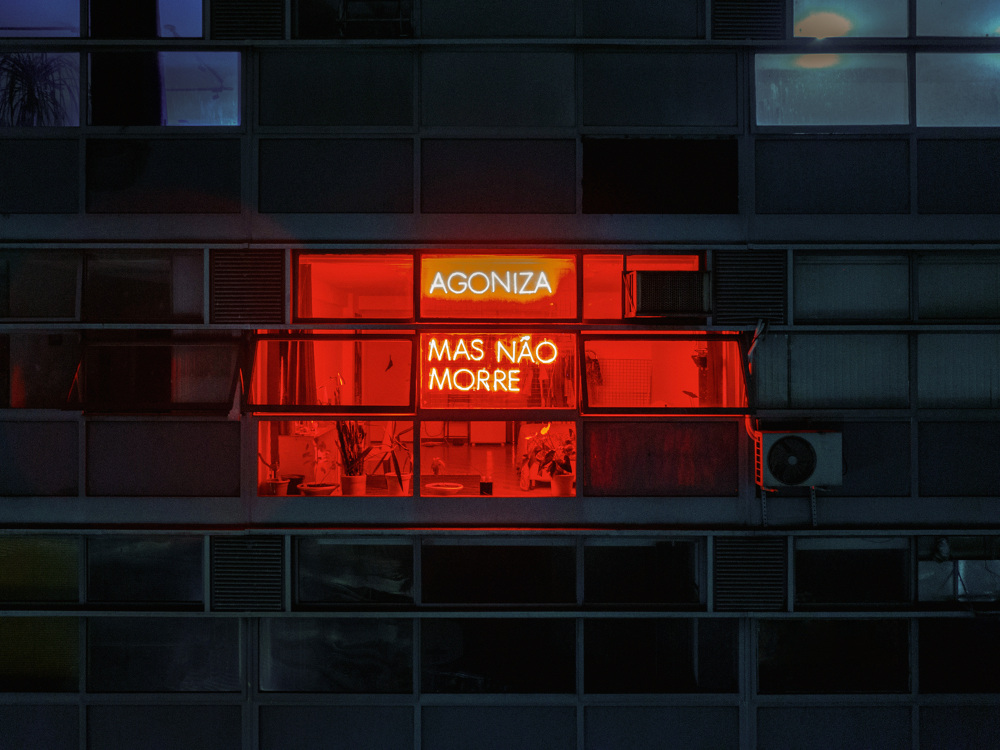
Samba exaltação [Samba Exaltation] is a work that deeply moves me to talk about because it’s very personal. It’s a very personal work precisely because it tries to address the universality of the pain we were experiencing at that moment. The pain of death, of going through grief, the pain of the plague… but also the resistance, the survival, the experience of overcoming it and seeing that we are greater than what diminishes us. And I understand that what we went through – the Covid-19 pandemic – will be something that will resonate in our civilization for a long time to come. I understand that in all these works, including Samba exaltação, I use my main working material, which is thought, and contemporary art is my technique.It begins on Carnival Friday of 2021, the Carnival that didn’t happen, at the moment when we would have been celebrating that rapture of bodies in the streets, and ends on Easter Sunday, after Lent. In total, it’s 52 days of work, and every 13 days I changed the neon sign that was in the window of the place where I was spending the quarantine, during the second wave of the pandemic, which was horrible, a moment of great global mourning. At that moment, when I put the neon sign in the window, I thought it was a work concerning neon lights talking about samba on an urban scale. Later, however, I understood that it was in fact also a performance piece, a work including art and life. I felt like I was in an aquarium, looking at the city, speaking those powerful phrases to the city, phrases that were echoing inside me, letting them out, while at the same time inviting that same city, each of those passersby, each of those citizens, to look inside my window, into my intimacy, into my psyche. The lyrics of the songs written with the neon signs were from the songs I was listening to inside my house. At a time when we were so separated, so distant, I was creating a bridge from music and light with the people who were passing by below, on the Santa Ifigênia viaduct. I was trying to speak to the whole city, to the whole country, to the whole planet in a way, to speak to all people but from an individuality, from my pain and my survival. How is this individuality, this thing that is so sensitive and so intimate, also universal? When certain songs are played – like “Baianidade Nagô,“ for example – how come so many people sing them, so many people are touched by them? There’s a certain universality to that. It’s about trying to find, in the polis, a common intellectual space where we can meet; in a historical moment when we are so divided, I understand the work of art as an aggregating factor, showing us things that we all have, things that unite us.
When we think about the interaction between the artwork and the public, there’s a response, some kind of interaction that you, as an artist, can perceive, can touch. But, in the case of Samba exaltação, there’s a lot of interaction that you can’t observe. How was it for you to execute this work alone?
Actually, once we put our work out into the world, we have little interaction with the public. In fact, in an exhibition at a large museum you’ll only talk to a tiny fraction of the people who will see that work. I understand that I, as an individual, as a conscious being, don’t need to be there to have that dialogue with people.
O trabalho é embaixador do meu pensamento. Ele vai até as pessoas, ele vai portar, de maneiras que até eu desconheço, camadas do meu pensamento que nem eu sabia que eu tinha e que vão ser acessadas por outras pessoas. Então, é interessante pensar até como o inconsciente é atravessado pelo outro, como ele se abre através do outro.
(Translation: The work is an ambassador of my thoughts. It reaches people in ways that even I am unaware of, carries layers of my thinking that I didn’t even know I had, and that will be accessed by other people. It’s interesting to think about how the unconscious is traversed by the other, how it opens up through the other.) There are things in this work, underlying notions that I myself can’t grasp. The dialogue happens even without my presence.But there was something curious during the Samba exaltação project, which was that we experienced a new revolution on the internet during the pandemic. There was the phenomenon of live streams, this explosion of everything happening through Instagram – relationships, documentation, etc. At that moment, especially, I understood Instagram as a support for the artwork as well. An artistic support, a means of making art. The work was already happening outside the window, but it also happened on Instagram. It also happened as a documentary record of that. For me, from the beginning of my career I’ve always understood the recording of the work, the photographic, videographic, and phonographic documentation of any work, as an essential part of the artwork, perhaps one of the most important parts of it, because I, as a Latin American artist, studied the history of art through images. Obviously, I would have liked to have seen a Mondrian in reality during my education, but I didn’t. I also don’t think it made that much difference to the importance of Mondrian in my life, because I know that the record of that work was very relevant, and the work came to me through that record. So, when I show the video of the drones, of the neon lights, when I show the images from the window, that is also, for me, the work. The work isn’t just the neon, it’s this organism, this ecosystem of relationships. And there, on Instagram, there was this very intimate relationship with people. Many people would pass by the overpass, see the neon lights, research them, and discover what they were. Many people discovered them through Instagram, and this work was on the cover of Folha de S.Paulo on Mardi Gras, the Carnival that didn’t happen. So, there’s a historical significance to it as well. Because this work appeared on the cover of Folha de S.Paulo, it also shows how this work enters the world as an insertion into ideological circuits, just like Cildo Meireles’ work. The work isn’t just the neon light in the window; it’s the neon sign in the window, it’s the image of the neon sign in the window on Instagram, it’s the image in the newspaper, it’s the relationship with people that happened online, in the documentation, in the live streams, in the encounters with people later on. In this conversation of ours, the work is still ongoing. Once it’s out in the world, I no longer have control over it.
From an access standpoint, was this a project that had a significant impact on you as an artist, one that greatly marked your career?
Without a doubt, because I think there was a historical turning point there as well, an interesting thing about doing the right thing at the right time. Since we didn’t have exhibition spaces, nobody could leave home, nobody could hold exhibitions, I thought: “Well, I need to work, I need to pay my bills, how am I going to be an artist?” Besides that, beyond the mundane question of how to survive, it’s a very important historical moment that I, as an artist, can’t let pass. This is one of the great moments in life when artists are called upon to give their opinion. In great moments of civilizational crisis, it is the artists who we have to ask: “Where are we going? What is this? How do we deal with this?” Having an understanding of the importance and urgency of artists’ work, I couldn’t myself refuse to speak, and to as many people as possible, about these very pressing things that were happening. Since I didn’t have an exhibition space, it was going to be the window of my apartment and Instagram. A private space, belonging to a private company, became a public space. People who previously didn’t have access to my work were able to see it. People who perhaps didn’t go to contemporary art spaces, didn’t go to museums, didn’t go to independent spaces, but were on Instagram. And this work touched them. Then I asked myself: “Isn’t this exactly where artists need to be right now? Isn’t this the environment we need to use to express what is urgent, what is so important at this moment?” Without a doubt, that moment gave a different dimension to the reach of my work. Since I already had a long career (by now, I have had a 15-year career; at that time it was 12 years), this also gave me a foundation, a certain recognition and access to some media outlets.
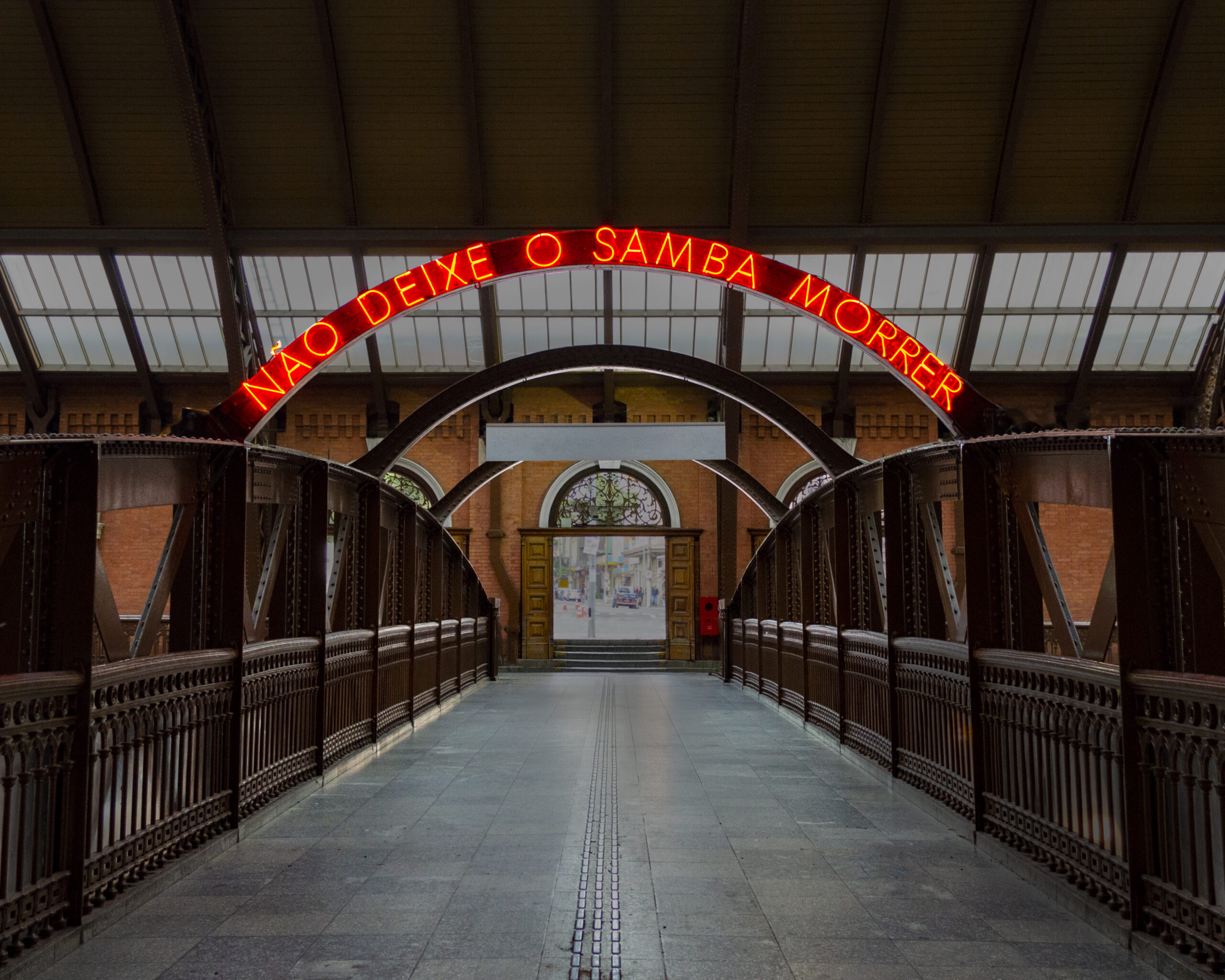
This work deals with the universality of the songs I chose, the situations, the excerpts I selected. I never intended for everyone to know the lyrics, or the songs, or for the lyrics to lead people to understand the songs. But they are all very well-known songs from the Brazilian repertoire. And many people know where “Agoniza, mas não morre” [“It agonizes, but doesn’t die”] comes from, where certain phrases originate. So, in a way, the work had this vocation of accessing the collective unconscious. I wanted, when people read these phrases, that they would hear the music playing in their minds. After the window of my apartment, which was the first phase of Samba exaltação it unfolded into other situations. The work later took place at the Mário de Andrade Library, at Luz Station, at the MAC Niterói, and, at Luz Station, for example, I placed the phrase: “Don’t let samba die.” In the artwork, the last word, “die,” became “end” so it constantly alternated between “Don’t let samba die” and “Don’t let samba end.” It was a space frequented by people arriving for work or leaving for home after work. There, we also saw the fallacy of Brazilian social isolation: how poor people, workers, had to live their lives, facing work and exposure to the virus as if nothing was happening. Underneath the neon sign, the boarding platforms of Luz Station were all crowded with people, most of them wearing masks, but it was a situation that laid bare the fact that there was no social isolation. Most people, when they read the sentence, already hear Alcione’s voice singing, deep in their memory, and it’s an environment where absolutely every type of person passes through. What is the target audience of this project? There isn’t one. It’s everyone who is there. There is no class, gender, or age distinction – it’s for absolutely everyone. In this case, it’s perhaps all the people who can read. So there is also a certain universal appeal, of trying to access, through a shared cultural element, a very specific feeling that is achieved through that music and Alcione’s voice.
When I present these sambas, my intention is precisely to lead people to this place of cultural recognition that Brazilian samba proposes. For me, samba is more than just a musical genre that permeates Brazilian culture. The various types of samba, just as there are various origins of samba, are also Brazilian ways of thinking, a way of doing Brazilian philosophy. In Western philosophy many poems are considered philosophical, like the poem by Parmenides, which is considered one of the fundamental texts of Greek philosophy. I understand the musical and poetic legacy of Estação Primeira da Mangueira as a philosophical school. I understand Nelson Sargento’s legacy as that of a philosopher. I understand Paulinho da Viola, and his contemporary production, as a living philosopher, working, writing, and leaving his legacy of reflection and thought. These works are a portal for emotional access, but they are also thought. They are an invitation to understand how we are who we are, as Brazilians, through these songs, through this way of thinking, which is thinking by singing and dancing.
Interview conducted on 10th September 2024 remotely via Zoom.
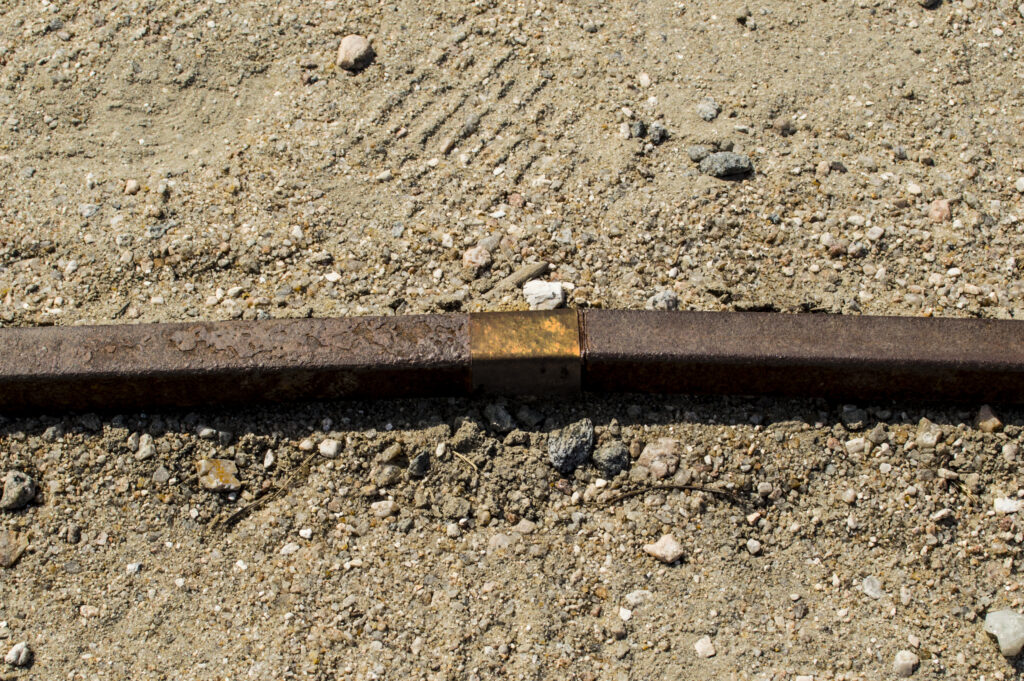
Steel and Brass
1200 x 1200 x 2 cm
2016
Corten Steel
490 x 90 x 300 cm
2016
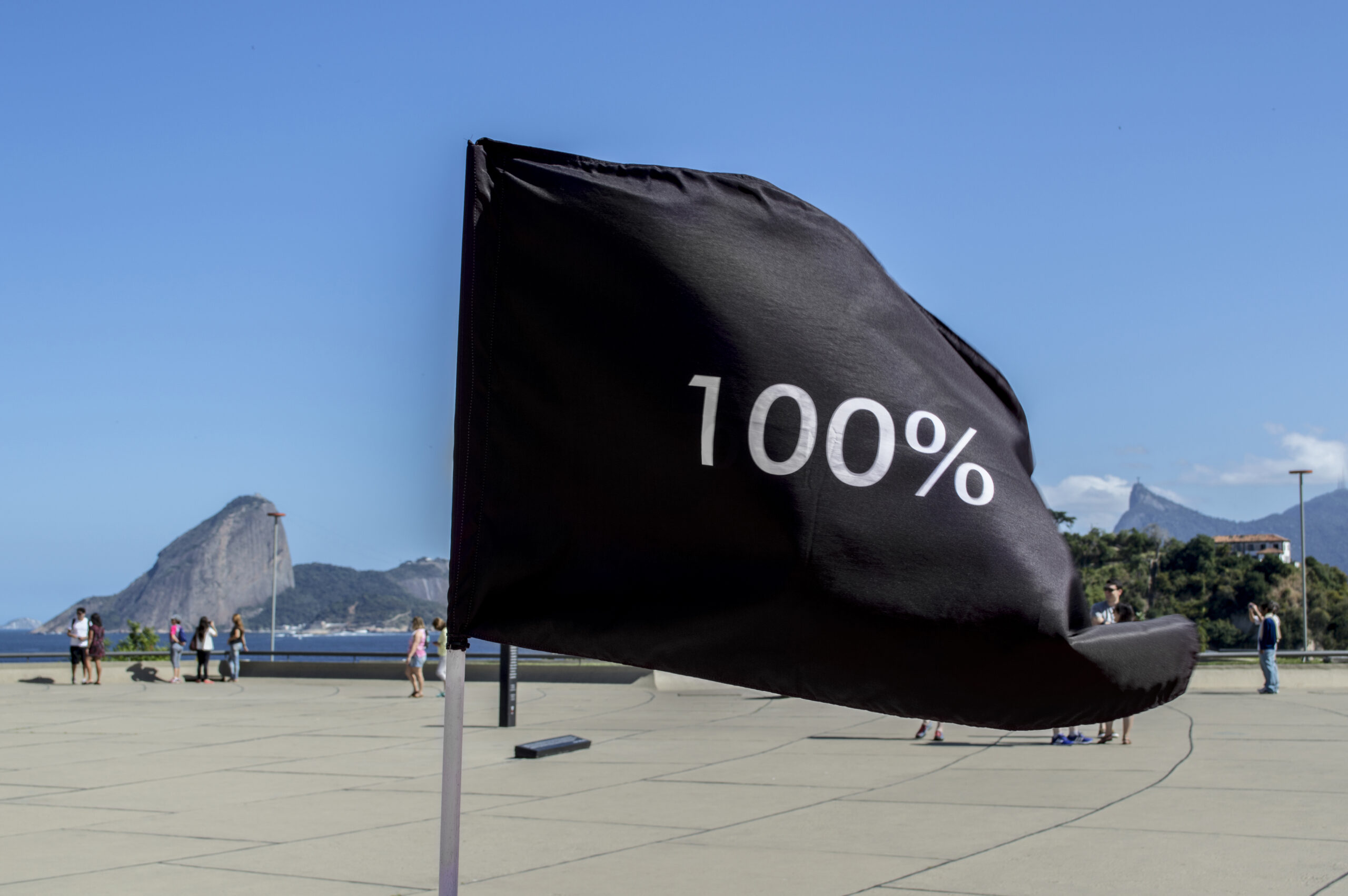
Sublimation on Plyester and Wood
70 x 100 cm each flag
2016
Neon
| Variable Dimensions
2021
Frame
2021