

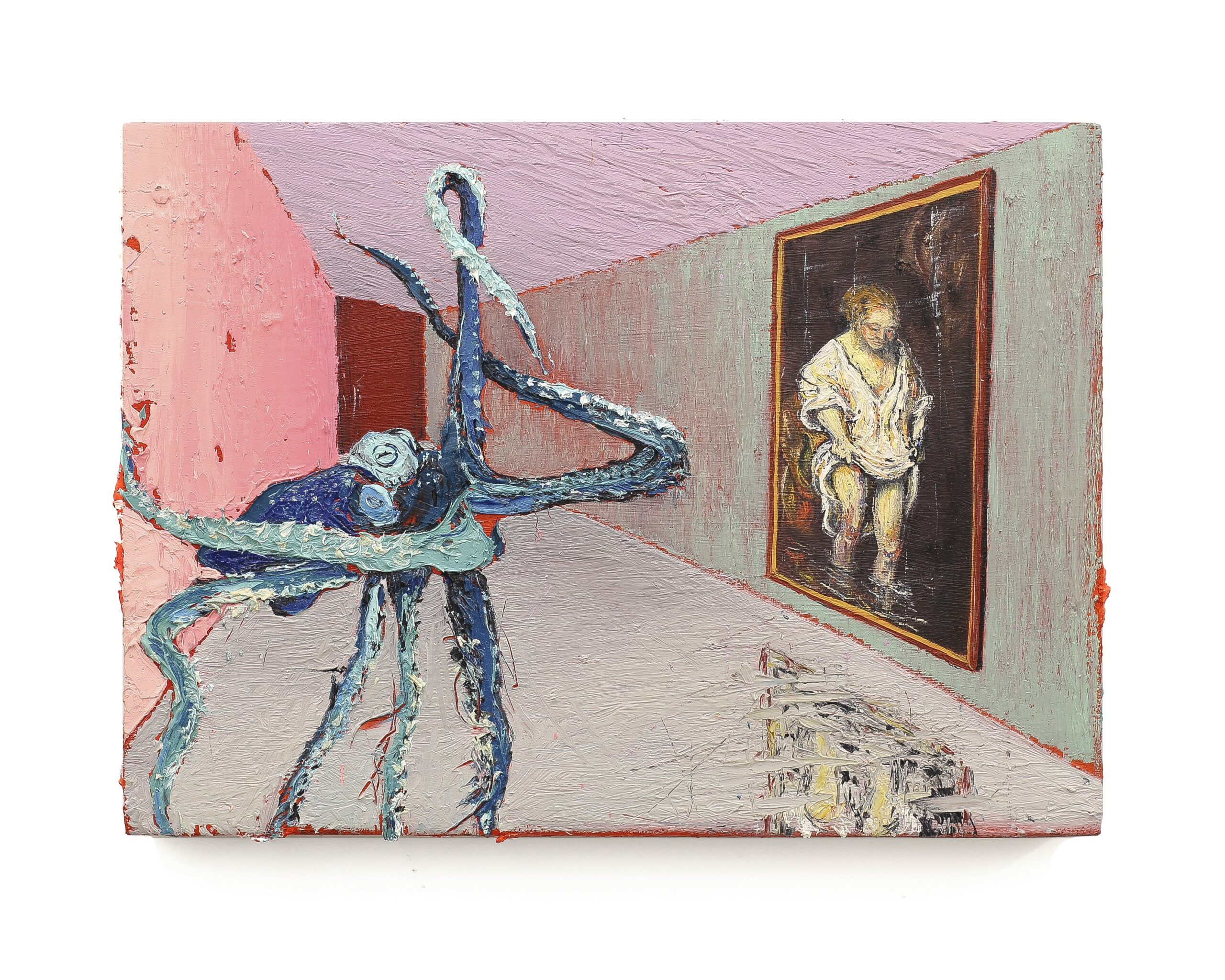
Mauricio Adinolfi
Maurício Adinolfi (Santos, 1978) presents an artistic practice that balances art, philosophy, and education. Adinolfi considers these collaborative experiences to be an essential part of his creative process. In his practice, the artist develops both painting in his studio and collective art projects in communities, especially in urban and peripheral areas. In the interview, Mauricio explains the dynamics between his studio work and his community interventions, illustrating how his experiences as a teacher, philosopher, and visual artist influence his perception of social interactions and public space. Check it out:
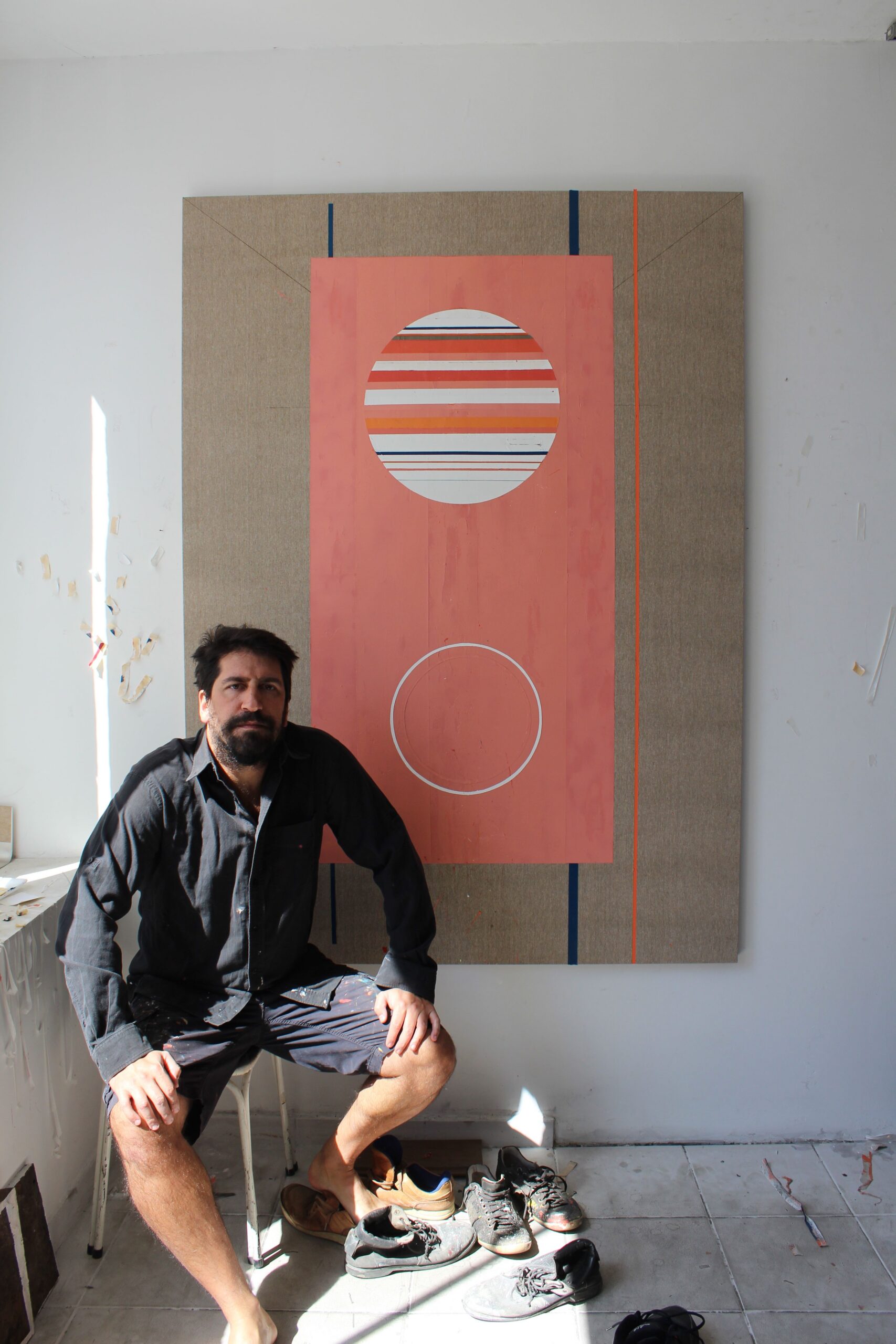
Maurício, thank you for being with us today. I’d like to start by asking you to introduce yourself, including any information you think is relevant, thinking of an audience that may not yet know your work.
My name is Maurício Adinolfi and I’m from Santa Catarina, so a lot of my work also comes out of living on the coast. I have a degree in philosophy, but I’ve had a studio ever since I started university. Before college I was already painting, and during college I continued creating, but I also had this interest in philosophy and in working with education. I’ve always divided my time and work between philosophy classes and art, but art has always been the centerpiece. When I was studying philosophy, I turned mainly to aesthetics, a little out of an interest in its origins, and in the creation of works, which is reflected in all my painting. Today, I have a studio in República. I’ve lived in the center of São Paulo for 20 years. Since I moved here, I came to Copan and never left. The projects make me travel a lot around Brazil, and abroad. Working in the studio is one thing and working with the community – on collective projects, actions, site-specifics that take you into the geography, into the space, into the community – has another character. I have these two interests, these two desires that guide me.
Where did this interest in projects and actions come from?
It came from practical action, and then it appeared in the work. The link between painting and projects is the action and practical work of teaching. Teaching is a collective position, one of interaction and joint construction and I understand that my interest in it also stems from this. In philosophy, I could suddenly have chosen to go academically into the visual arts, or some other field, but my interest in philosophy is in search of a certain breadth, or the possibility of dealing with various subjects and, above all, having interactions. Working on collective projects began in 2007 or so. I came to São Paulo in 2003; before that, I was very much into my production, my understanding of materials, and painting. In 2007, I did a residency for a project called Atelier Amarelo, in São Paulo, which was in front of the Estação Pinacoteca, in the Luz area [2007 Residency Grant, for the Atelier Amarelo project from the São Paulo State Department of Culture. The project was discontinued]. It was a collective studio, a call out that invited artists to work or live in this space – especially artists who came from outside São Paulo. As I was already living here, I used it more as a studio, but I turned it into a place for research, and there I started working with ordinary carpenters, who built fruit carts and CDs in the center of São Paulo. In the same street as Atelier Amarelo, there were small joinery shops where these workers created their carts and other things by collecting wood and using found materials. I worked with them and then built an installation inside the Atelier Amarelo space. That was one of the first times I worked with other people, and these other professionals became part of the work too. In 2008, I was invited to work at the Vila Gilda Dock in Santos, which is the largest stilt slum in Latin America, located in São Paulo, and which few people know about. I was invited by the community leader, Dona Helena, and the Instituto Arte no Dique, which operates in this area, in the north-west of Santos. These are neighborhoods and communities that have been strengthened, but with all the problems of this type of occupation, because it’s not just a cultural occupation. In Santos, it was fishermen who occupied the space initially, and today it’s a more critical situation of being a slum, of just surviving. Anyway, together with the leaders, and together with the people there, we came up with this collective work project for the emergency recovery of the houses. The timbers are sheets of wood measuring around 2.1 x 1.3 meters. We paint them as a joint effort, and then replace those in the houses that need it. In this mix, the houses become large paintings. I began to develop there this work of spatial painting, which, again, is site specific. My work developed in a more forceful way there. It was also a project that got me very involved with call outs and cultural policy. It was a project supported by FUNARTE, initially the Ministry of Culture, at a time when the Ministry was working directly with artists.
The project, called Residências Artísticas em Pontos de Cultura, began in 2009 and, according to what we had proposed, it was supposed to last the whole year. However, we managed to get partnerships with Tintas Coral, Santos City Hall, and the Housing Department. What was initially a project between the artist and the community developed into other partnerships and continues to this day. I realized that art could make these channels, and I began to create other partnerships until we arrived at this painting collective which, with recent activities, has held a few exhibitions in Santos. It is still a work linked to housing, but it has also extended to painting in other spaces, through a partnership with SESC and other citizens’ organizations. The last exhibition we did was with wood painted in the Botanical Garden, which then went back to the houses, so there’s this relationship that I think is very constructive, between artistic action and direct action in the public space.
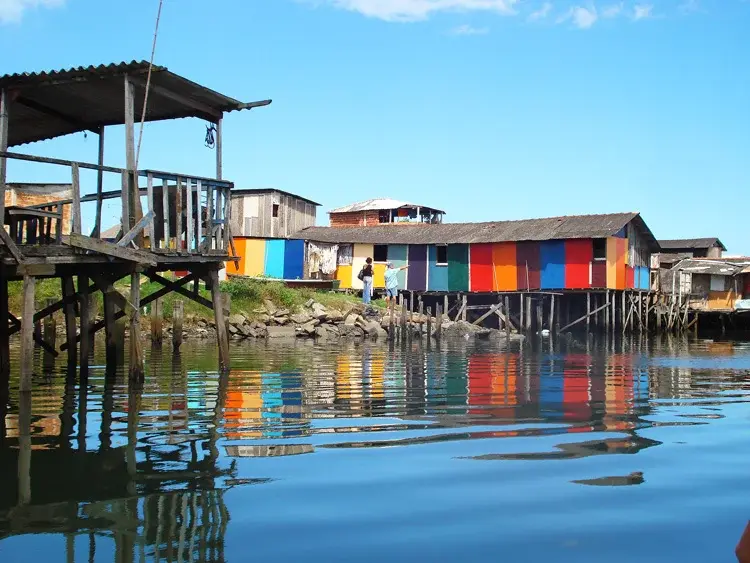
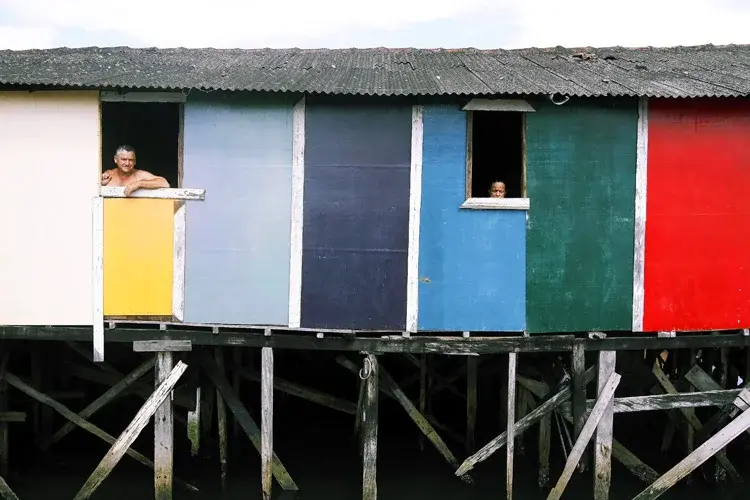
Does your work as an educator also influence your collaboration with these communities?
Yes, the project has various formats, but it always initially takes the form of workshops and meetings. We begin with meetings, which I won’t call classes as such, but in which there is both technical and theoretical training. We start by studying a bit about painting, art history, relationships with other public projects, and other collective projects. We also work in practice, because the Institute has many vocational courses and training courses. Over the years, some have been very practical training courses, so participants learn how to handle wood, waterproofing, painting with enamel, and varnishing. We try to turn wood, which is not a long-lasting material (in our case because we work with madeirite), into a more resistant material. Nowadays, the Instituto Arte no Dique has a carpentry workshop where we hold meetings and workshops. The aim lately has been to form groups, like this collective, which has been taking part in these projects for a few years. These are groups that already have a working skill, that are developing, so we don’t always start from the basics. People already know how to work with paint, they already know how to mix it, they already know the process of painting with enamel paint and with the sealers and bases we use.
In the beginning, when we started working at the Dique, I said: “I’m a philosopher and a painter, these are the two specialties I have to work with here, to offer, and to be together with”.
Então, aconteciam tanto os debates, as conversas, as referências, reflexões, quanto a parte prática mesmo. E ouvindo sempre o que a comunidade propõe, seja nas partes mais simples, como escolher a cor, fazer mistura, escolher tonalidades, quanto na própria engenharia – como é que vai construir a casa que fica mais distante, precisa de um barco, de cinco, dez pessoas? Quando eu entrei, eu não tinha ideia de como faria uma reforma nessas casas que estão no meio do rio. Então, a comunidade traz essa engenharia, traz esse conhecimento e propõe. É um trabalho de troca, de escuta, de proposições.
(Translation: So there were debates, conversations, references, reflections, as well as the practical side, always listening to what the community proposed, be it in the simplest area like choosing a color, mixing, choosing shades, or in the engineering itself – how are you going to build a house that’s further away, that needs a boat, is for five or ten people? When I joined, I had no idea how to renovate these houses in the middle of the river, so the community brings this engineering, brings this knowledge and proposes things. It’s a work of exchange, of listening, of propositions.) When I joined, I had very specific objectives I started by proposing, “let’s do a tonality, let’s go for a more abstract type of painting, fields of color” but I gradually realized that the process only worked collectively. For example, I would often propose a color palette, because at the start of these paintings we worked a lot with color plates. At the time, Wanda, who was a manicurist and also worked a lot with color, completely changed the configuration, and it turned out very well too. This is the kind of work that has to happen in collective actions.
Sometimes, we receive an invitation from a certain place, as was the case with Estação Cidadania, and the participants of the collective themselves take the lead and propose the theme, which is also what we experience in the world, in our lives, not just in art. Everyone has their own knowledge, their own wisdom, their own experiences. This is artistic material, regardless of any technical skill.
And your studio practice happens at the same time?
There isn’t really a rule. In painting, I work a lot with series. Sometimes painting consumes you. Sometimes I’m obsessed with painting and I have to be in the studio every day. I try not to lose focus and do each job in its own time.
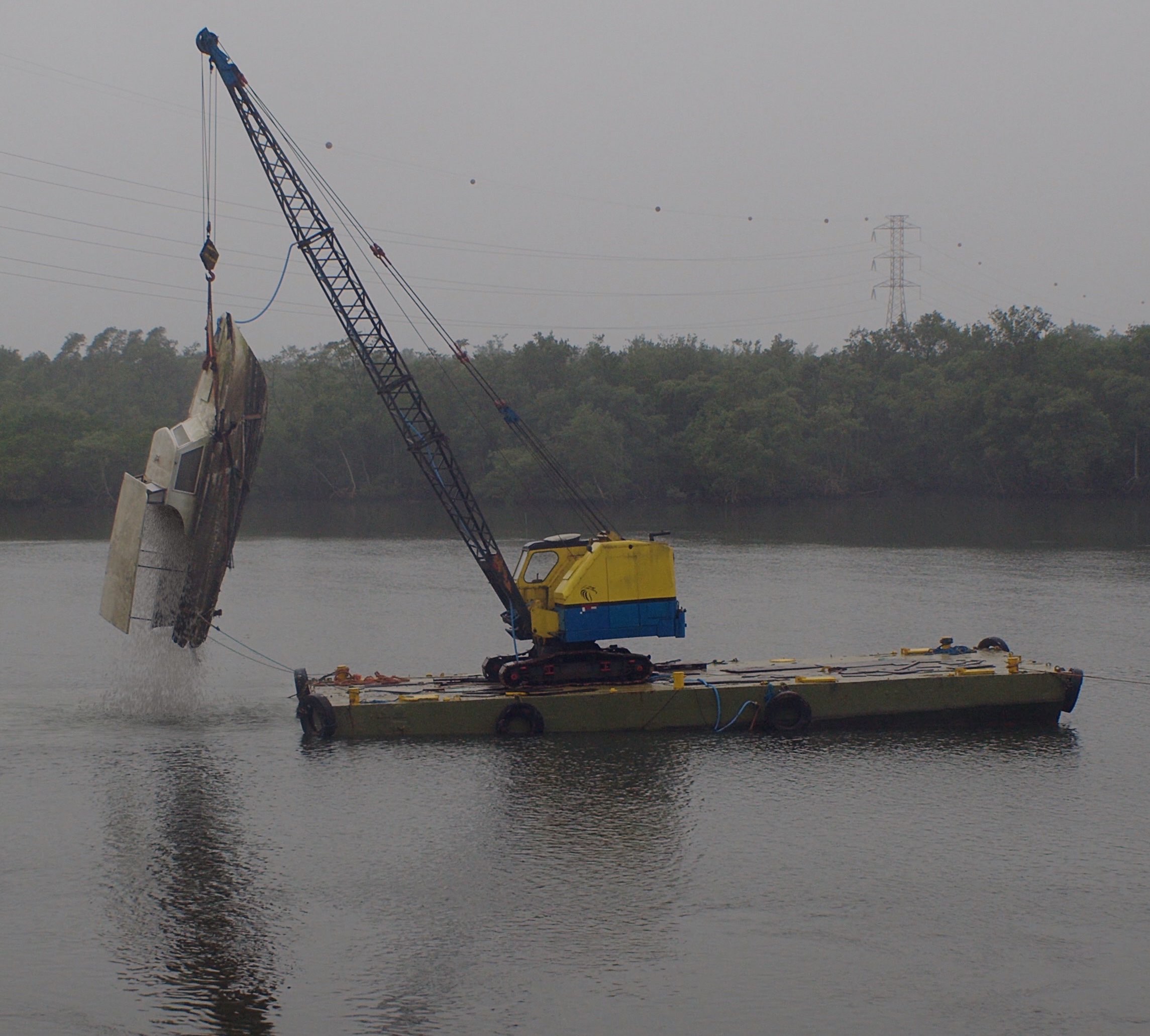
At the end of 2023, I did another intervention, which was a site-specific piece using a boat, a raft, and a crane, which was part of the work I was doing in 2009, on stilts, and which led me to work with shipbuilders and wooden boats. This project in Pará was closely linked to painting boats, which is reflected in my more traditional painting, in the physical sense, working with linen, oil paint, canvas, two-dimensional. However, my interest in carpentry and wood led the project to the construction of boats, and installations with boats as a motif. This installation was extremely labor-intensive. It took me around two or three years to realize it, and it all blends together in that routine. I’m in the studio, but I have to talk to the crane operator, so, at a certain point in the day, I dedicate myself to that and then I go back to painting. But when the work has to be finished, it’s that crazy dedication. You have to be in the space, you have to be in place, you have to handle a raft, climb a boat, dig up a boat, all that stuff.
It’s curious to hear you talk about these two practices, because the way I see it, even in painting you have two practices – figurative and abstract. How do you see abstraction and figuration, and how do you negotiate and transition between them?
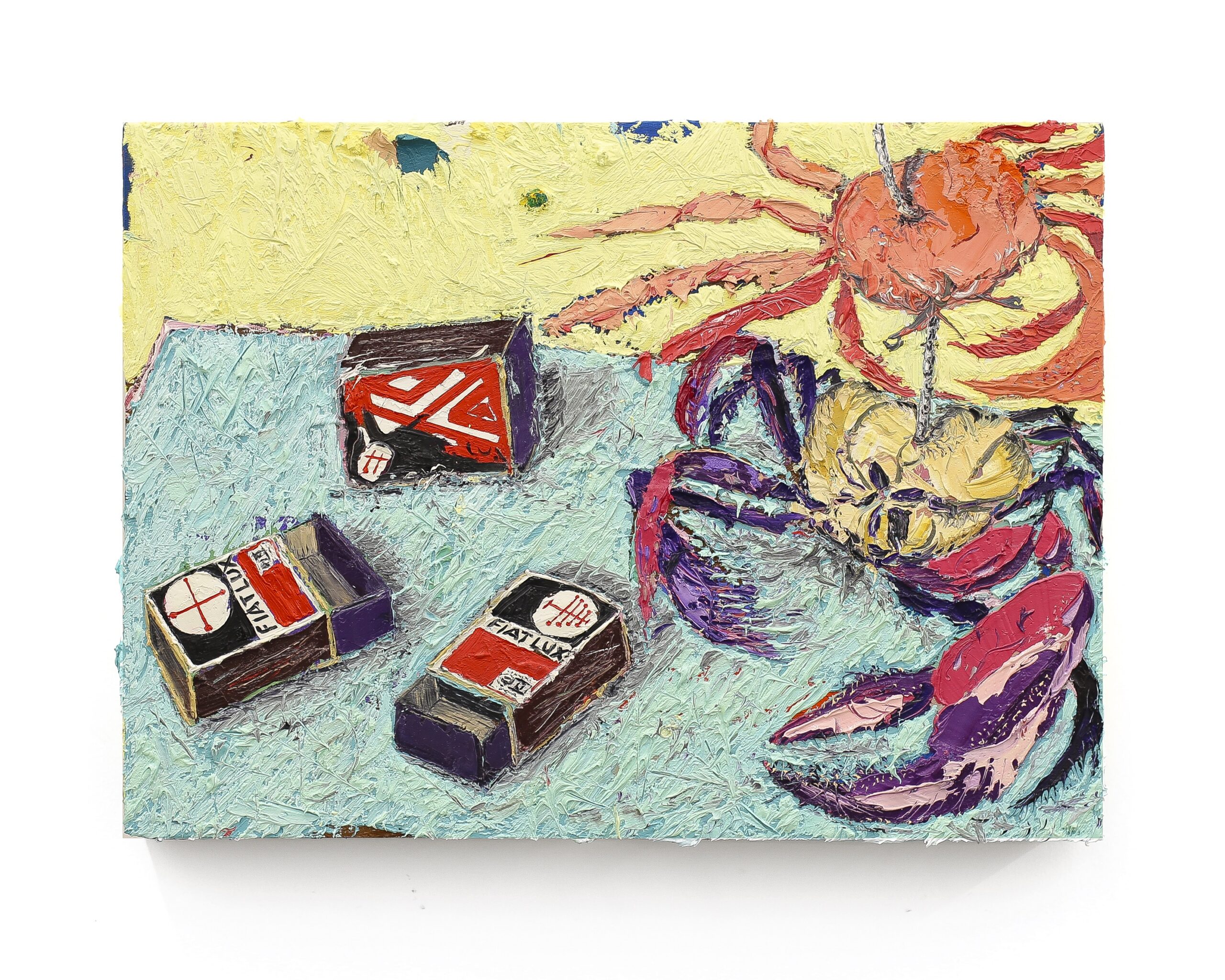
I don’t think this is an issue for painting today, because it’s almost a contradiction to talk about a difference between the figurative and the abstract. Artistic action is already an abstraction of the world, it’s already a form of subjectivity, of understanding things. I think that the painting I’ve been doing over the last two years has largely discussed this. The series of paintings Cão em liberdade [Dog in freedom], which I did for an exhibition [Bolsa de Arte, São Paulo, 2023], are already figurative paintings with abstraction. Putting it very simply, abstraction doesn’t require a recognizable object, so these works already have this in the painting itself, in the material load, in the brushstroke, in the accumulation of matter, in the treatment of color. I think there’s also a mixture of abstraction and figuration in this latest series. At the same time, I had an exhibition in Porto Alegre called “Teoremas” (2023), which consisted of abstract, or geometric-abstract, paintings, but with the same material charge, with the presence of making, of clashing, of pictorial work. The two exhibitions opened at almost the same time.
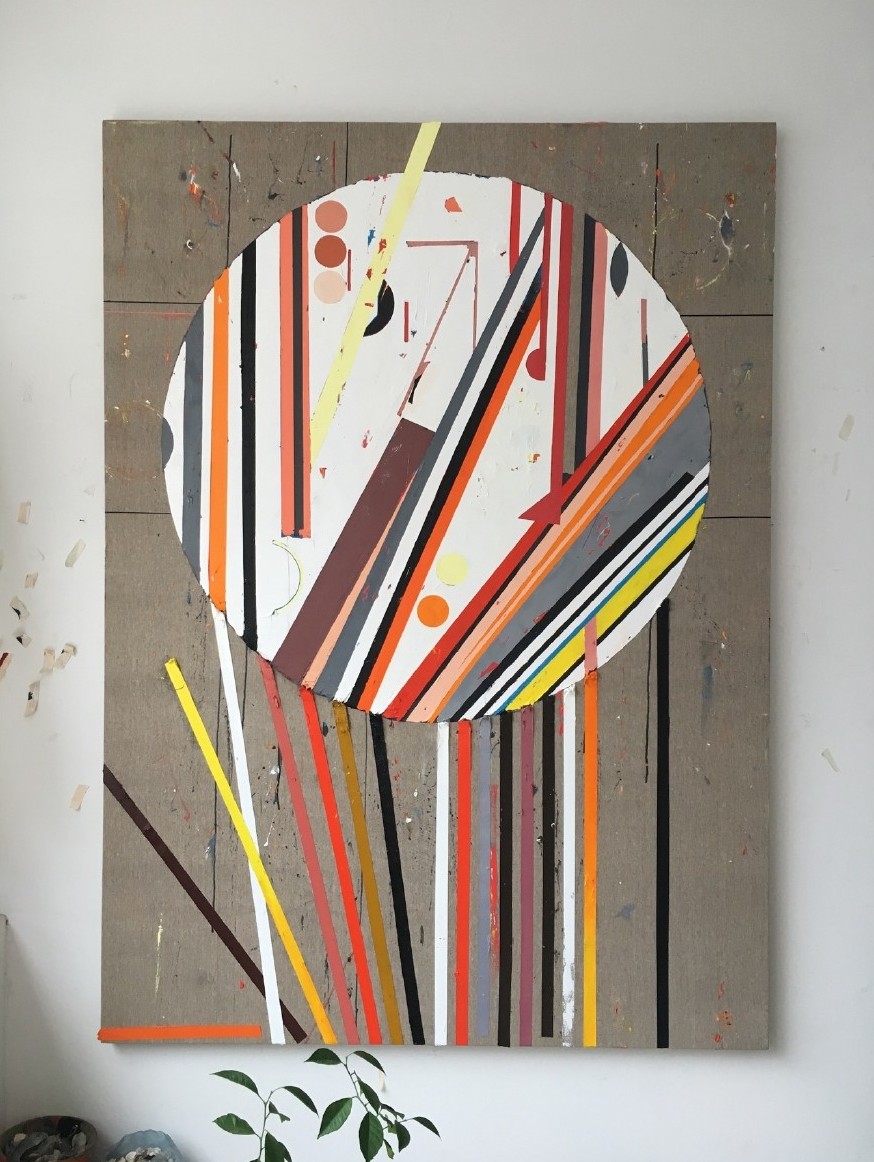
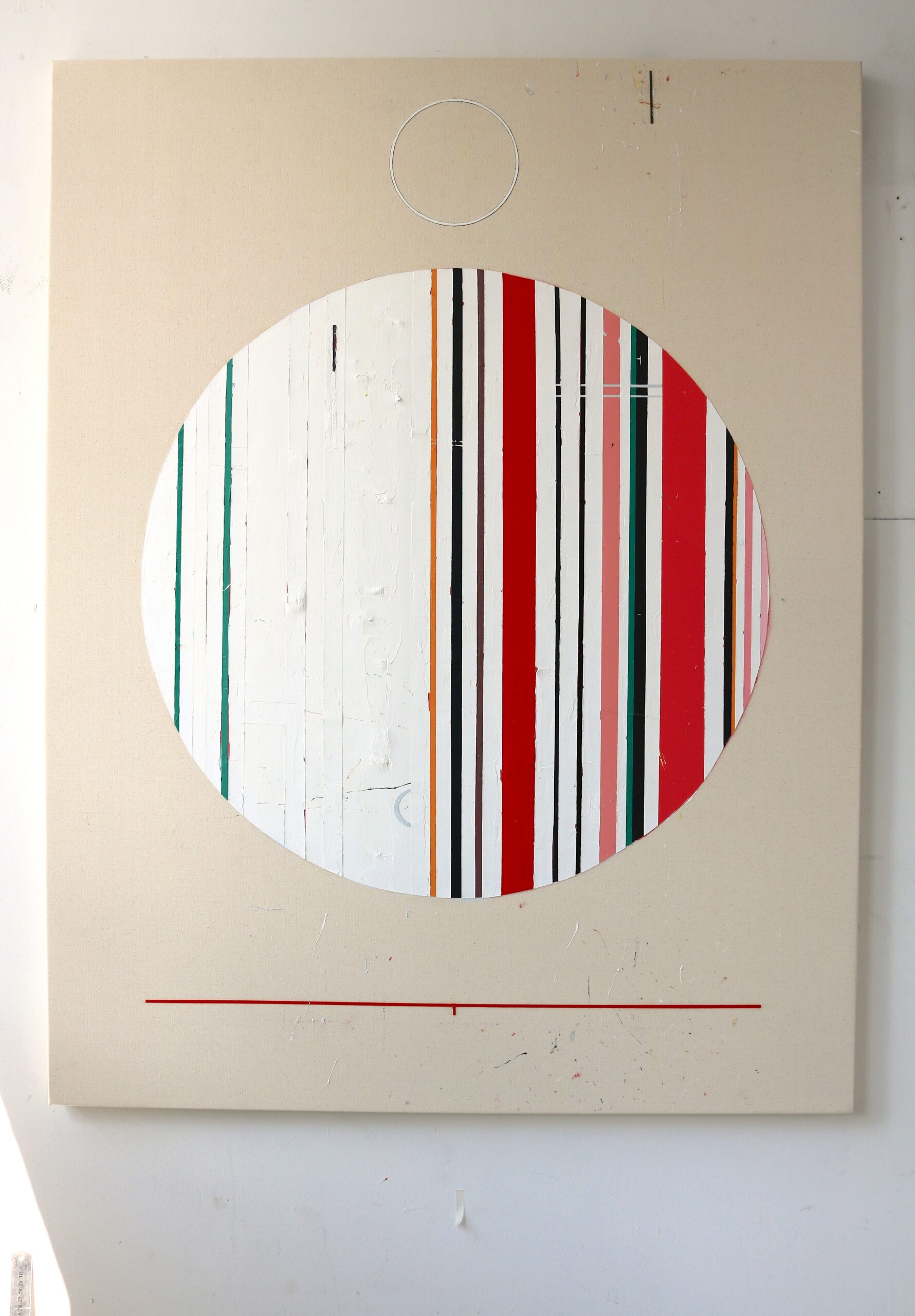
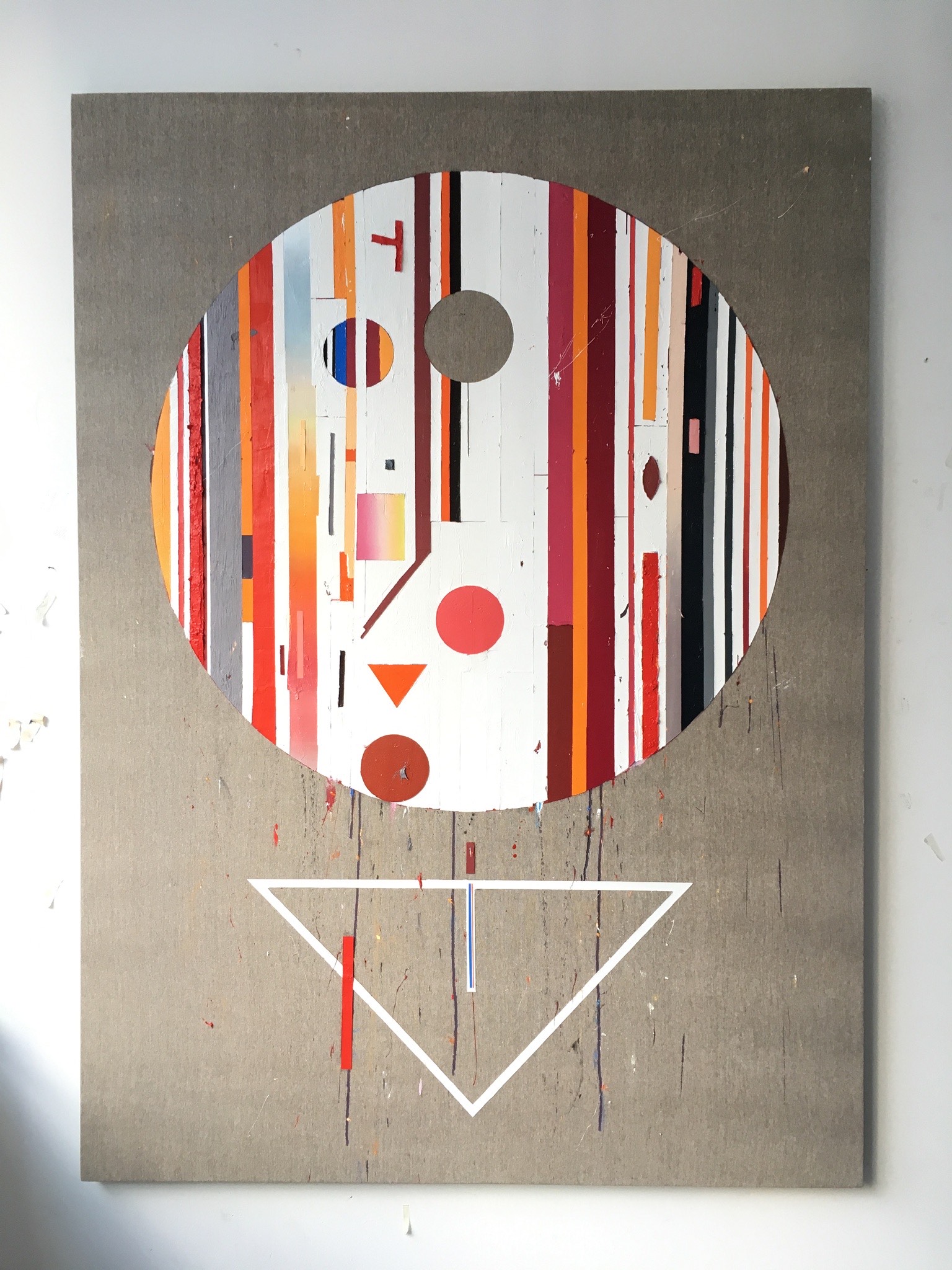
I spent two or three years working on the theorems. They also come from a dialogue with ship paintings. At the time, I was researching the iconography of ships around the world. I worked in Portugal, where I did a sandwich doctorate with a research grant from Capes [Fundação Coordenação de Aperfeiçoamento de Pessoal de Nível Superior], which allowed me to stay in Portugal for a year. I developed the work I had done in Marabá, and then in other cities here in Brazil. There is a lot of geometric abstraction in the maritime iconography of boat builders and painters. And the work in Marabá was also a work of geometric abstraction, but very much linked to the history of our country, the relationship with the body painting of some native peoples and how abstraction, or geometry, appears in popular culture. When I say popular culture, I mean in the sense of how it appears on the door of a hotel, on the carpet of a house, on a window, on the façade of a house. I think all this is present in the world and that’s why I say it’s difficult to talk about abstraction and figuration, unless we look at the Russian constructivist project but, even then, if you take an artist like Kazimir Malevich, he always worked with abstraction and figuration. Mondrian also spent a lot of time doing this. When we theorize and create a historical line, we can make these distinctions, but in actual artistic practice, I don’t believe so much in these separations. In Brazil, it’s also like this. We have this strong movement in Concretism and Neo-concretism, with Concretism trying to create rules and then Neo-concretism mixing everything up, adding the body, adding carnival. No wonder Oiticica says “the museum is the world” and goes on to make the Parangolés. But all this before was in an extremely specific geometry.
Malevich talked about Suprematism with a certain metaphysical idea of the world, in the midst of a workers’ revolution. At the same time, as he wanted that painting to go into space – he would later go on to create that architecture, paint electric cars, or the library – it was part of a Suprematist thought that didn’t really have anything to do with the geometric abstraction that we know from art history. It was part of another reflection, of other intentions, and if you think about it, is a square more or less abstract than the shape of an animal? An abstraction can be very concrete. Anyway, these are thoughts that interest me a lot.
This comes from our uncertainties, anxieties, and certainties, in artistic creation, and I respect myself a lot in that sense. I understand other artists who have work that is defined by just one path, but by analyzing my personality and my being in the world, I allow myself to function in this way.
Eu me interesso muito por entender o meu trabalho, tenho muitas conversas com outros profissionais das artes, seja da área crítica, da área histórica, e entender o meu procedimento. Então, ao mesmo tempo que fui identificando que eu trabalhava dessa forma, essas outras pessoas também me ajudaram a entender quais são as ligações que há entre esses trabalhos.
(Translation: I’m very interested in understanding my work. I have a lot of conversations with other art professionals, whether in the critical or historical field, about understanding my procedure, so at the same time as I was identifying that I worked in this way, these other people also helped me to understand what the links are between these works), between a work with vessels and the more abstract and geometric painting of the theorems. The other step I took was when I started painting primates, and rats, in this last project, which was Dog in Freedom.

Are there any challenges you have today or have had in your practice that you’d like to share?
Well, the challenge is constant. My current challenges lie in painting, in a series of paintings I’ve been making. The question of painting, for me, is always a question of matter, of construction, of development, of a materiality that has, at its surface, the work and reflection that I think is necessary for painting. At the same time, I’ve been researching and practicing something in my painting that refers to the existence of mosaics and to a construction of color, but which goes back to a practice that is very much based around reflecting on our origins. I think this blends with philosophy, which is about human formation, what the human reality is between its animal being, its physical and political existence in the world. These are the challenges that my painting always carries.
One work I did, CARONTE – Monte Cabrão (2024), was carried out in a specific region of Santos, in the Bertioga canal, and it took up a lot of my time. One of the challenges is that the work has been growing in scale in these installations and site-specifics. That would be another challenge. These are works that are heavier – in the material sense, with the boat, the raft, the crane, for example – and at the same time lighter, but this lightness also gives me a lot of work. There are several challenges to doing this kind of work, from being able to afford it, to being able to market it: marketing not just the sale of this work, but how it can exist in the institutional art system as well. These are always the challenges, as well as other issues. It’s no coincidence that it’s called Charon; it’s going to talk about life and death, it’s going to talk about other challenges of our existence, of our reflection.
It seems to me that your starting point comes a lot from your background as a philosopher, but also a lot from your social engagement. Where do you find inspiration for your projects and paintings?
The other day, I was talking about the word inspiration, and how it can be interpreted in many ways.
Eu entendo mais que a gente está vivo e fazendo coisas, então me interessa a criação. Tudo isso faz parte do processo artístico, seja a pesquisa, seja a vivência, seja o trabalho propriamente. O trabalho te inspira ao trabalho, a vivência te inspira à vivência e ao trabalho, e isso tudo se mistura, se conecta e reconecta nesse movimento que é a vida.
(Translation: I understand more that we are alive and doing things, so I’m interested in creation. All of this is part of the artistic process, whether it’s research, experience or the work itself. The work inspires you to work, the experience inspires you to experience and to work, and it all blends, connects and reconnects in this movement that is life.) When I work with boats, with shipbuilders, with other people, it all instigates and inspires me, but my work in the studio is also very much crossed by this, whether it’s my dedication to painting or what happens during painting. It always creates its own needs. Often it’s me solving things and often it’s the painting itself, the making, this movement of making, which can also inspire other actions, other scales, other materials, other subjects to be tackled. I feel a great need to work on direct actions, which can be thought of as social, political, or interventionist. I have this urge, this desire and, as I’ve been doing this for a long time, it’s something that’s already part of my practice, of my existence.
Pictorial work, studio work, leaves me very free, I can do whatever I want, but I think that all art reveals politics, it reveals the artist’s social position. It’s impossible to disconnect the artist, like any human being, from social and political issues. At the same time, when I dedicate myself to certain projects that are, in practice, social and political constructions, they fulfil me, and I make work on this anguish of social existence. Painting, even though it is a political action, allows me to make specific choices about what I want to do that are in line with this other work front, but with characteristics; a character and a nature that are very specific to individual work, to creative work in the studio. If you think about it, there’s the politics of fairs, biennials, international exhibitions, and galleries. It’s impossible to escape the political and social situation surrounding art. It’s surrounded by the luxury market, by exploitation. This world is totally politicized, it’s totally made up of social scales. We can’t escape this in our artistic practice.
When I say that I’m fighting for public policies, for well-written, targeted, thought-out calls for proposals, it’s because I’ve been feeling all this in my collective work, which depends on a range of professionals. The work I do often doesn’t just come from my will, my intention, but comes from an invitation from a community leader, from the existence of a call for proposals, like the one in Marabá, or it’s linked to public policy, to the public university, to the existence of support for research. I’m not naive at all. My work in the studio is also linked to this. As much as I think that my creation depends on my research, interests, and dialogues – and it does – it is linked to other artists, other professionals, and to life. Part of it is created there, and part of it is linked to a whole art system. It’s a good thing that, nowadays, all this is much discussed.
Interview conducted on 05th February 2024 remotely via Zoom.
Oil on solid wood
30 X 40 cm
2022
Oil on solid wood
30 X 40 cm
2022
Site-specific and installation
2023
2008
Oil and resin on raw cotton
130 x 100cm
2020