

Goia Mujalli
Goia Mujalli (Rio de Janeiro, 1985) is a Brazilian artist based in London. For the past 12 years, she has dedicated herself to the practice of painting, exploring a variety of techniques and materials. In this interview, Goia recounts her journey in painting, exploring the figurative to the abstract with constantly evolving techniques and materials. She also presents her influences, which stem from botany, and examines her intuitive approach. In yet another creative vein, the artist has been exploring music production and how rhythms and musical sequences connect with her work. Check out the full interview:
Goia, I’d like to start by asking you to introduce yourself. How would you describe your work and practice to people who may not yet know you?
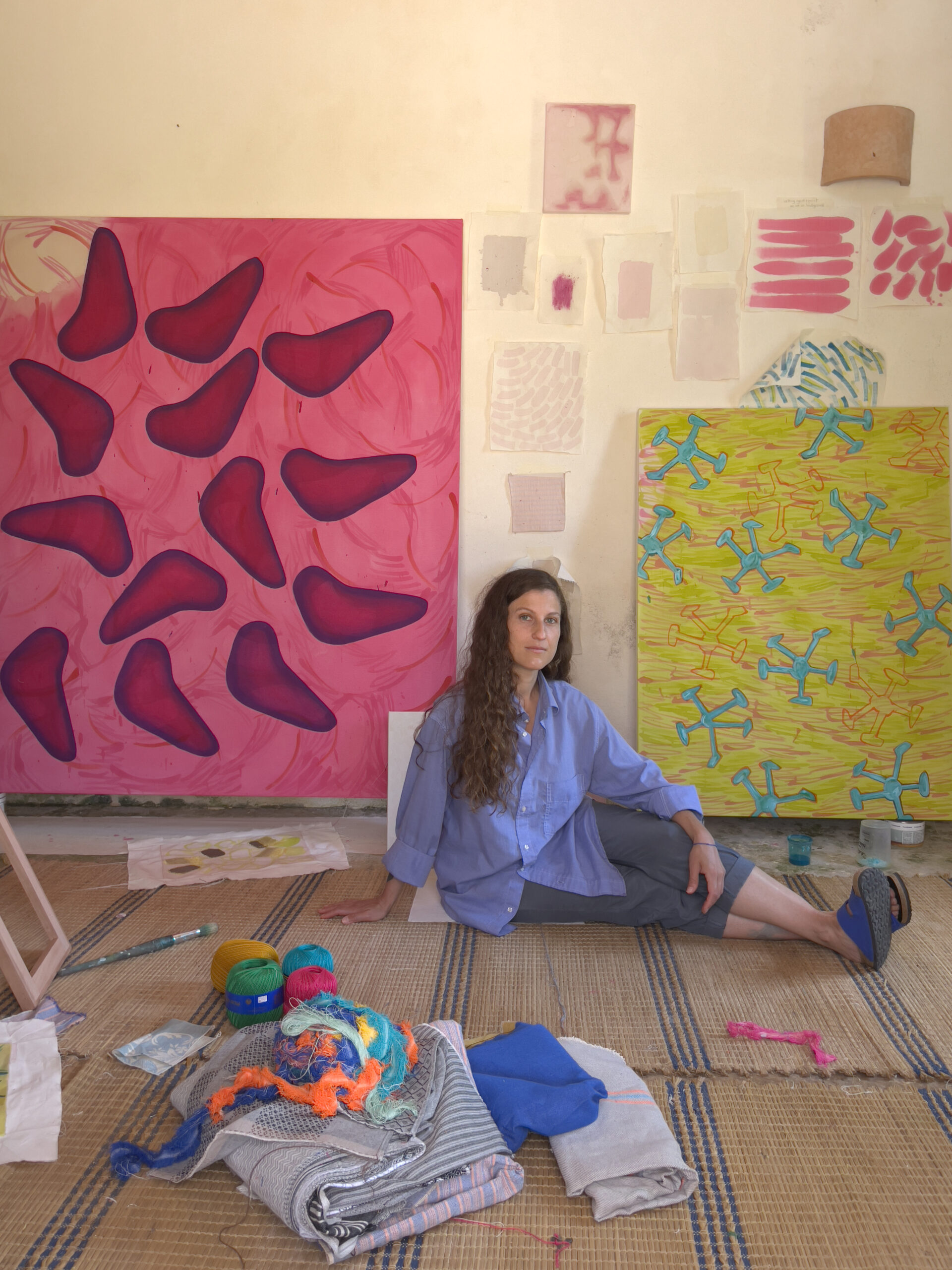
I’m an artist, and I’ve lived in London for 12 years. I grew up in Rio de Janeiro, where I studied industrial design, then did another degree in painting and an MA in painting in London. Today, I teach painting at two universities in England. I’ve been on this journey with painting for 12 years or more, if you consider the painting courses I took at Parque Lage during school. I discovered there that I loved painting, which was my starting point. I came to London with the aim of distancing myself from my own culture, putting myself in a zone of discomfort in the unknown, and exposing myself to another culture about which I had no notion. This also motivated me a lot in terms of artistic production. I discovered a passion for painting and immersed myself in it while studying at the Slade School of Fine Art, where I produced much and learned a lot. My work ranged from the figurative to the abstract. There was a period when I used screen-printing a lot. Through erasing, the painting looked like silkscreen and, through silkscreen, I had an image that looked like sewing, and then I started sewing. My process takes me to the next step, and I always like introducing new techniques. Now, I’m doing a lot of embroidery, machine sewing with fabric, and painting. I’m reintroducing some figurative elements that existed in my work about 10 years ago, and they’re gradually coming back in a different form in the process. Seeing this was so nice because I wanted to return to this element, but I didn’t know how to.
And speaking of the process, thinking about techniques and materials, did you consider bringing in these other elements at the beginning? Or was it something you developed over these 12 years?
I’ve been developing it over the years. There has always been a repetition of symbols, like sequence and repetition. Before, I used brushstrokes as a repetition. I began to think that wasn’t enough, that I needed to use shapes from somewhere that told a story. These shapes came from botany. During the pandemic, I remembered that I had already incorporated botanical forms into some paintings I had done, mainly of Brazilian flora and, during the pandemic, I developed an archive of symbols taken from plants. For me, the cool thing about the painting process is that I don’t know what’s going to happen. It guides me, sometimes it takes a year, sometimes a week, three months – painting has its own time. Sometimes, the painting never ends. However, I’m always adding elements. The complexity and depth of the layers and textures are elements I’ve been developing and this vocabulary of forms, this archive, has begun to expand. New forms began to enter the process, such as aquatic forms, so not only is the tropical part of the work, but also other forms from nature too.
Do you have a specific interest in Brazil or the Amazon in relation to the development of archives? Or is it wherever you are, including England? How does this geographical interest in the archive work?
For a while, I focused on tropical plants, specifically those from Brazil. I made a connection with deforestation, such as the extraction of land, so this idea of abstraction was related to that. Even sewing is a form of repair, mending, sewing and correcting holes and mistakes. During a residency in Italy, I happened to be drawn to flowers and tropical shapes. In parallel with this, there is research into migration and colonialism, which I’ve been investigating in my work, studying the origin of the plant and where it came from, out of curiosity. Sometimes, this research is just research, not necessarily incorporated into the work, but in the case of this residency, I used the petals as bougainvillea pigment and that became a project that I’ve been developing. I went to Rio and did another series of this work, which has been saved and is still in progress.
It’s also interesting to think that flora and plants have an almost abstract character. Especially when you see them together, looking at the colours and shapes. I think there is a path from form to the abstract, which we can observe in your work. Do you carry out any kind of prior planning or do you depend on the canvas and the space to make your drawings? How does this process work?
I draw pictures as studies. I use marker pens and small stencils. From these drawings, I develop a process of layering and overlapping. I follow an initial plan, but that plan changes. At the same time, I have tried to reproduce drawings, but the work’s aura is in the drawing, and the painting becomes a reproduction of that moment. I like to maintain spontaneity in my work, to leave the process open to chance and surprises. I think this has something to do with life. No matter how much we plan, there are things that are out of our control.
You mentioned that you experimented in Italy with using flowers as a pigment, too. How do you go about this research?
The bougainvillea flower made a lot of sense at the time because it has a history. It was found in Rio de Janeiro by Jeanne Baret, a French woman who embarked on an expedition dressed as a man because women weren’t allowed on expeditions. They thought she was having an affair with one of the men on the boat. Jeanne Baret discovered the flower in Rio, but the name was given to the head of the expedition, Louis Bougainville, and she wasn’t remembered. I suppose it didn’t look too good for her after they found out she was a woman. For me, this flower carries that story, so using it as a reference made sense.
How do you see your research influencing and shaping your painting, or not? How do you bring your research to the canvas?
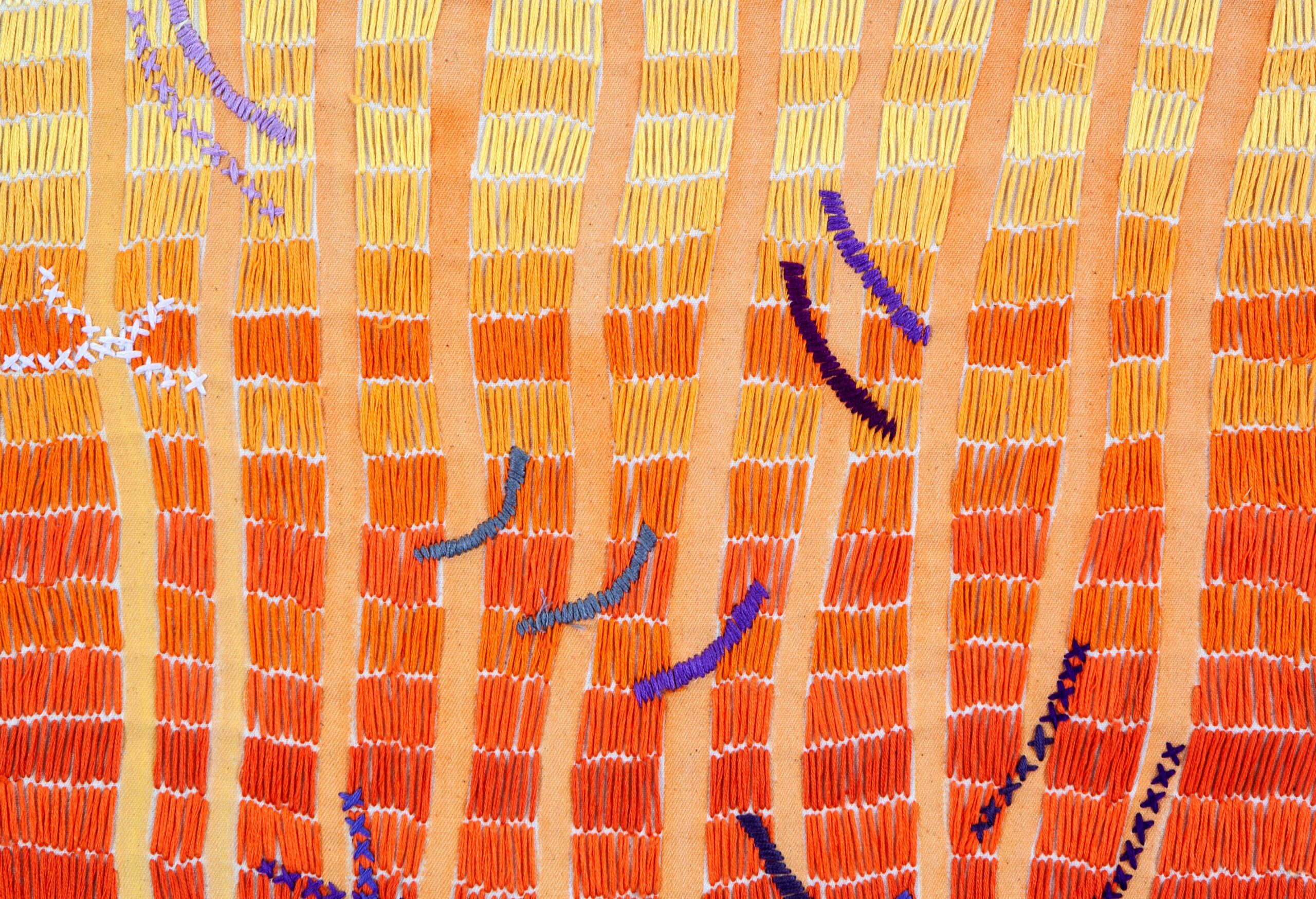
The feminine is present in the work. It’s not necessarily evident in a literal way but through sewing, embroidery, and the representation of plant forms that can appear erotic. These sewing materials carry a history of feminism. Women used to get together to talk and sew because they weren’t accepted in the artistic world, as well as in other occupations. I believe that the feminine is present there, telling these stories. As for the stories of migration and colonization, they are transmitted through the forms of plants. It’s not direct or obvious but codified in this realm of symbols.
The interpretation of abstract art can vary, depending on each person’s points of reference. Some may recognise some forms, while others may not, or interpret them differently. The perception of abstract painting is ultimately influenced by the person confronting it.
Yes, and there are shapes that are almost recognisable, too.
Now, on to the next question. I’d like to know the main challenges you’ve faced throughout your career as an artist. Are there any specific situations you’d like to share?
Wow, difficult question (laughs). Actually, I’m always searching for something when it comes to work. This search becomes a desire to find something meaningful. However, it’s an eternal search and a constant desire to discover something new. I have this need to keep the work fresh. Introducing new elements to keep me motivated.
Estou sempre construindo o trabalho. Vou desenvolvendo, sempre inserindo elementos novos e tentando complicar cada vez mais o trabalho. As respostas e essa busca… Se um dia encontrar as respostas, acabou (risos). Me mantenho nesse desejo e nessa busca. O não saber é o que me leva a produzir.
(Translation: I’m always building the work. I’m always developing, inserting new elements, and trying to complicate the work more and more. The answers and this search… If I find the answers one day, it’s over (laughs). I keep going in this desire and in this search. Not knowing is what drives me to produce.)
It’s very interesting to think about it, because the way you describe it, it’s in a very living, changing way, and it’s not just about developing, it’s about continuing to change, continuing to become the next thing that it is. It’s very interesting to think about how some artists are the exact opposite.
It’s more about using painting as a way of investigating ideas. There are painters who use painting as an idea, just executing an idea, applying a layer, and that’s it.
Existe a pintura que você vai descobrindo através do processo, e não se sabe muito o que vai acontecer. É uma pintura intuitiva. A minha pintura, no caso, ela reflete muito essa questão de estar em constante movimento e mudando. Sempre coisas novas vão acontecendo, e estamos em constante mudança com a nossa pessoa.
(Translation: There’s the painting that you discover through the process, and you don’t know what will happen. It’s an intuitive painting. My painting, in this case, reflects this question of constant movement and change. New things are always happening, and we are constantly changing ourselves.)
Your work also has a rhythm, as does the way you arrange the elements within the space of the painting. How is music entering, or already part of, your life, and how does it influence your work?
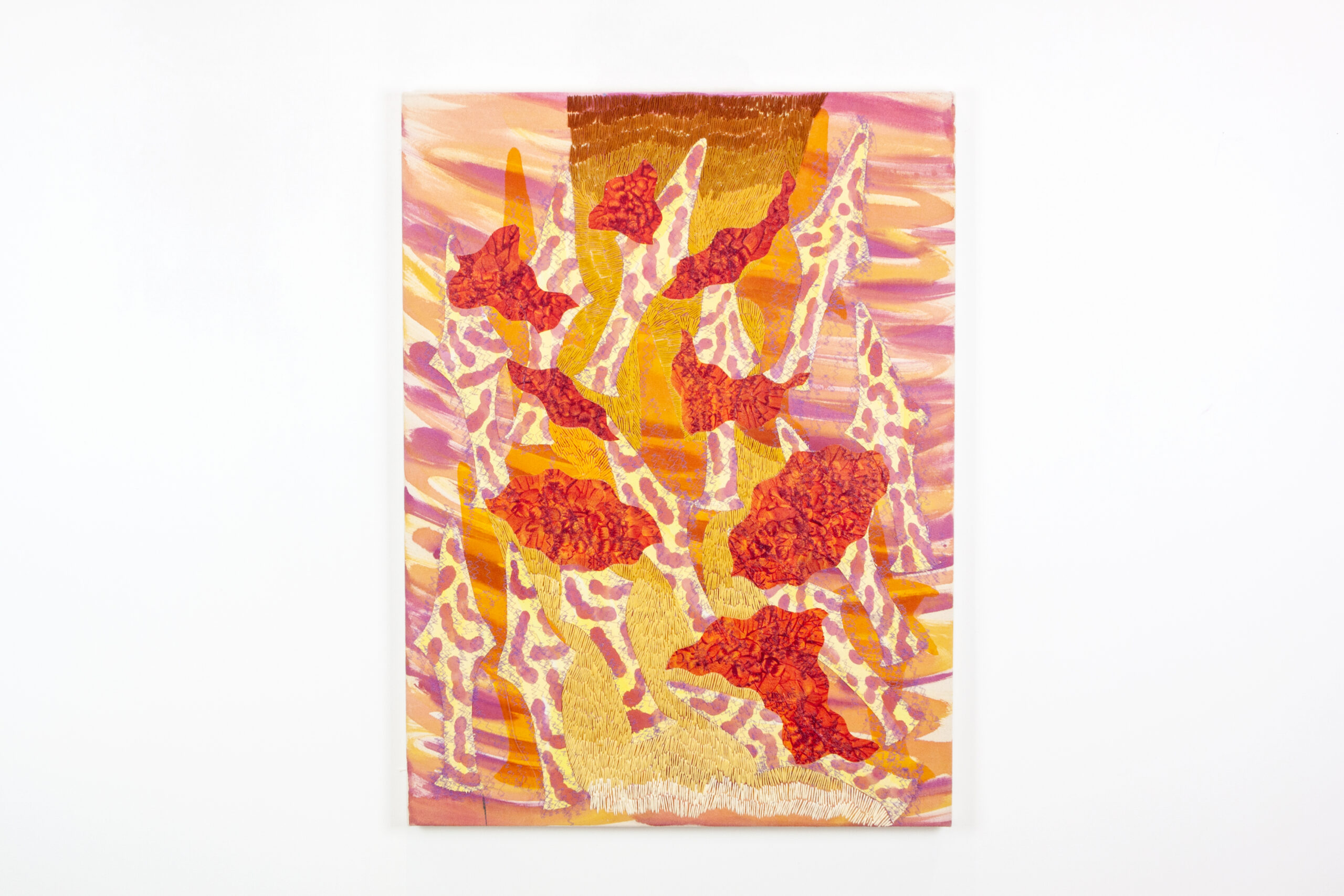
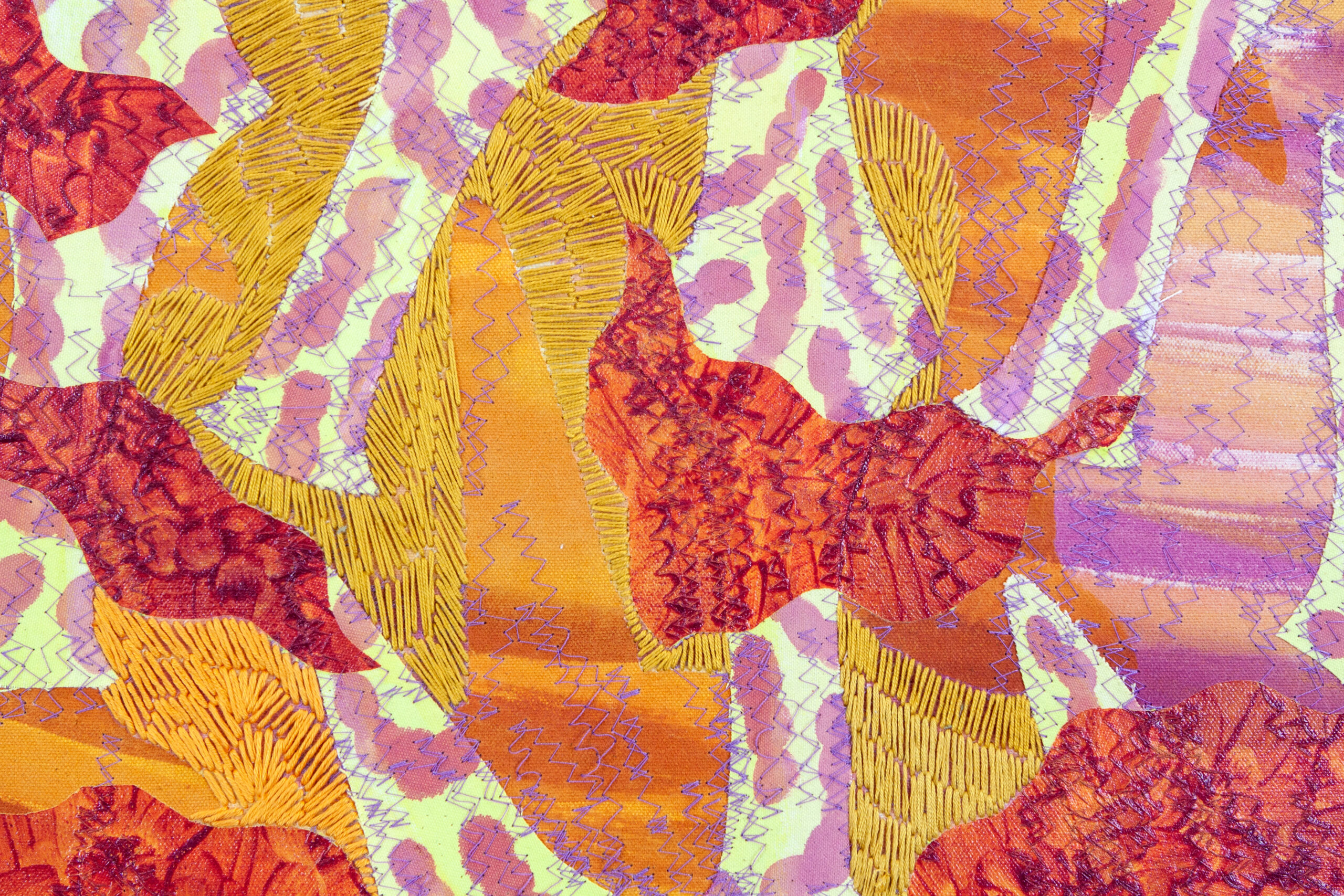
During my master’s degree, a professor advised me to use the language of music to describe my work because there was this question of rhythm, repetition, and sequence. I decided to go on a DJ and music production course that year. I didn’t expect to dedicate myself to music production, but, to my surprise, I liked this area more than the DJ part. I realised that music production is similar to my painting because it uses the same sequence, rhythm, transparency, and depth as electronic music, for example. The larger the space, the more echo and depth the sound has. There are also layers of sound related to the layers of painting. The beats and the shapes I use also have a certain sequencing. I fell in love with music production. I’ve been developing it and don’t know what will happen yet.
Goia, where do you find your inspiration? What are your starting points for continuing your research and creating your work?
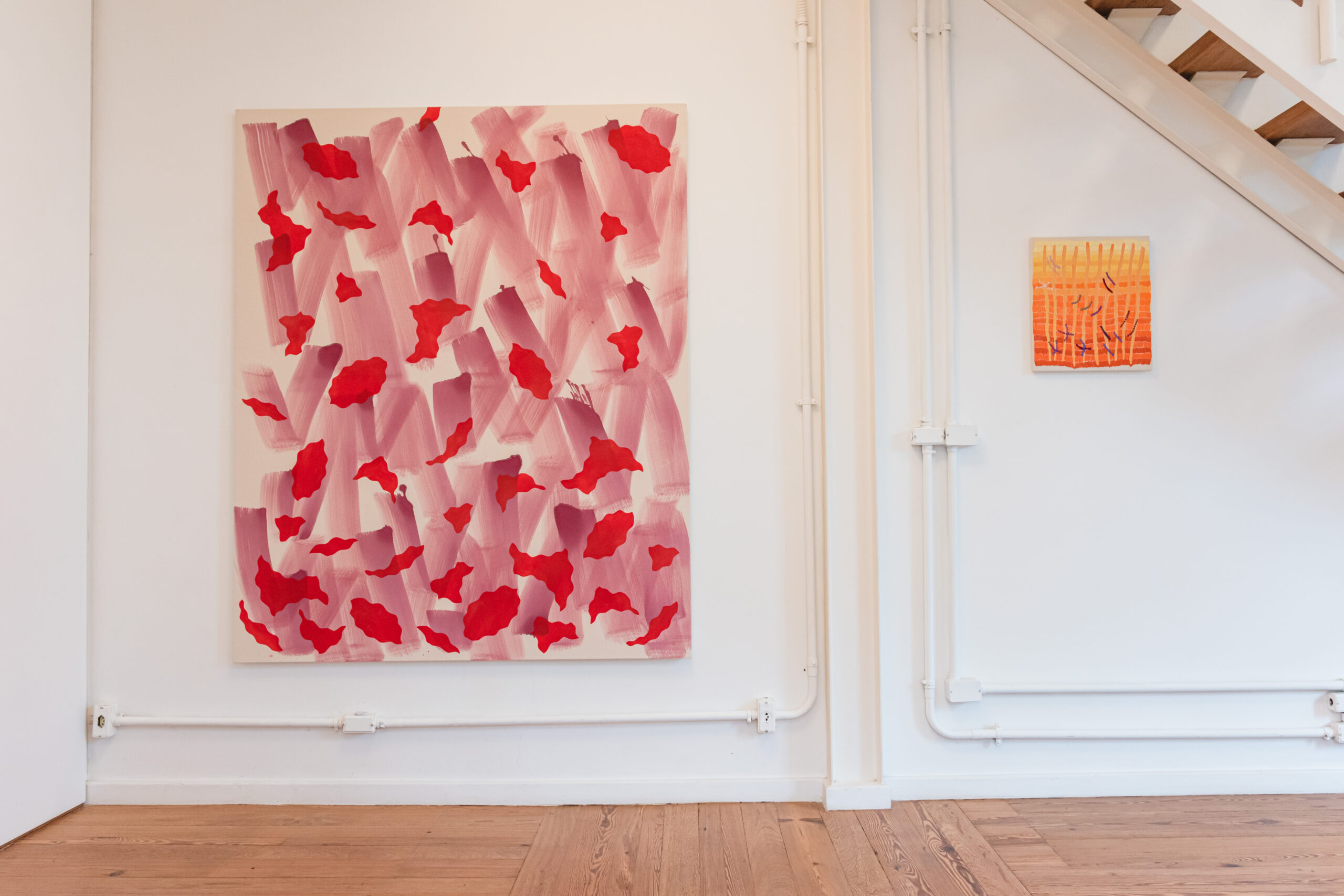
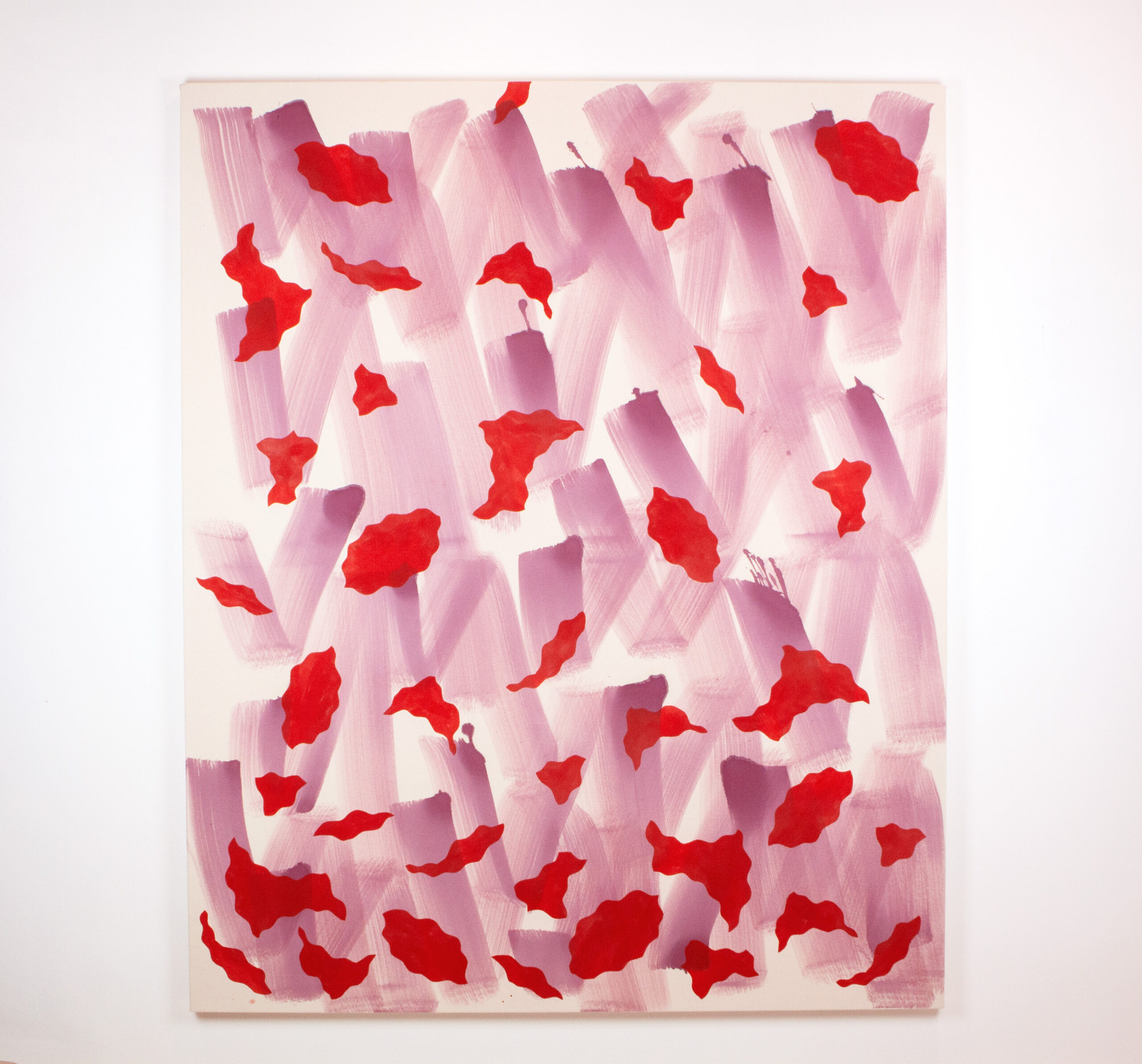
I use botanical books, visit botanical parks, and have many plants in the studio. I went to the Burle Marx Park, in Rio, where I discovered a tree that takes 30 years to flower, and as soon as it flowers, it dies. I kept thinking, “When is this going to happen? I need to be there. I need to get the seed of that flower!” (laughs). There’s also the bromeliad, with textures that, when seen up close, look pixelated, almost like a fingerprint. I see a connection between nature and the digital world. I feed off that, and my experience with books and literature. The present way of producing is when there is magic in the process, which happens when I’m very immersed in the process and start to connect everything in the world, for example with literature. Last year, I was reading Clarice Lispector’s An Apprenticeship and The Book of Pleasures, and a part of the text talked about the character Lori, who considered herself chosen by the trees for the leaves to fall on her. In this passage, she picked up a dead leaf that she had kept – because one day it fell on her – and threw it away because she didn’t want to carry anything dead, knowing that more leaves would fall. The moment she throws the leaf away, another leaf falls on her face and eyelashes. Immediately after reading this passage, I left the house, went to the market and, on my way back, a leaf fell on my face. Then I thought: “Clarice? Are you talking to me?” (laughs). I went home and kept thinking, and regretted not having taken that leaf home. When I looked at my studio’s work, I realised they were falling leaves. It was there all the time. I didn’t need to look for anything. That moment became the name of the exhibition, “The flesh of the leaves”, which is part of Clarice’s text and talks about the inside of the leaf like little green flesh. The work is made up of falling red shapes. I used this stencil again in an exhibition I had this year at Kupfer Projects, with these shapes flying.
And nowadays it’s difficult because more and more of us as a society are focused on production. What’s the next thing you’re going to do? What’s the next thing you’re going to achieve? And that gets in the way of the creative process. In reality, we’re all creative.
Yes, I think everyone is creative. You just have to develop.
Interview conducted on 6 October 2023 remotely via Zoom.
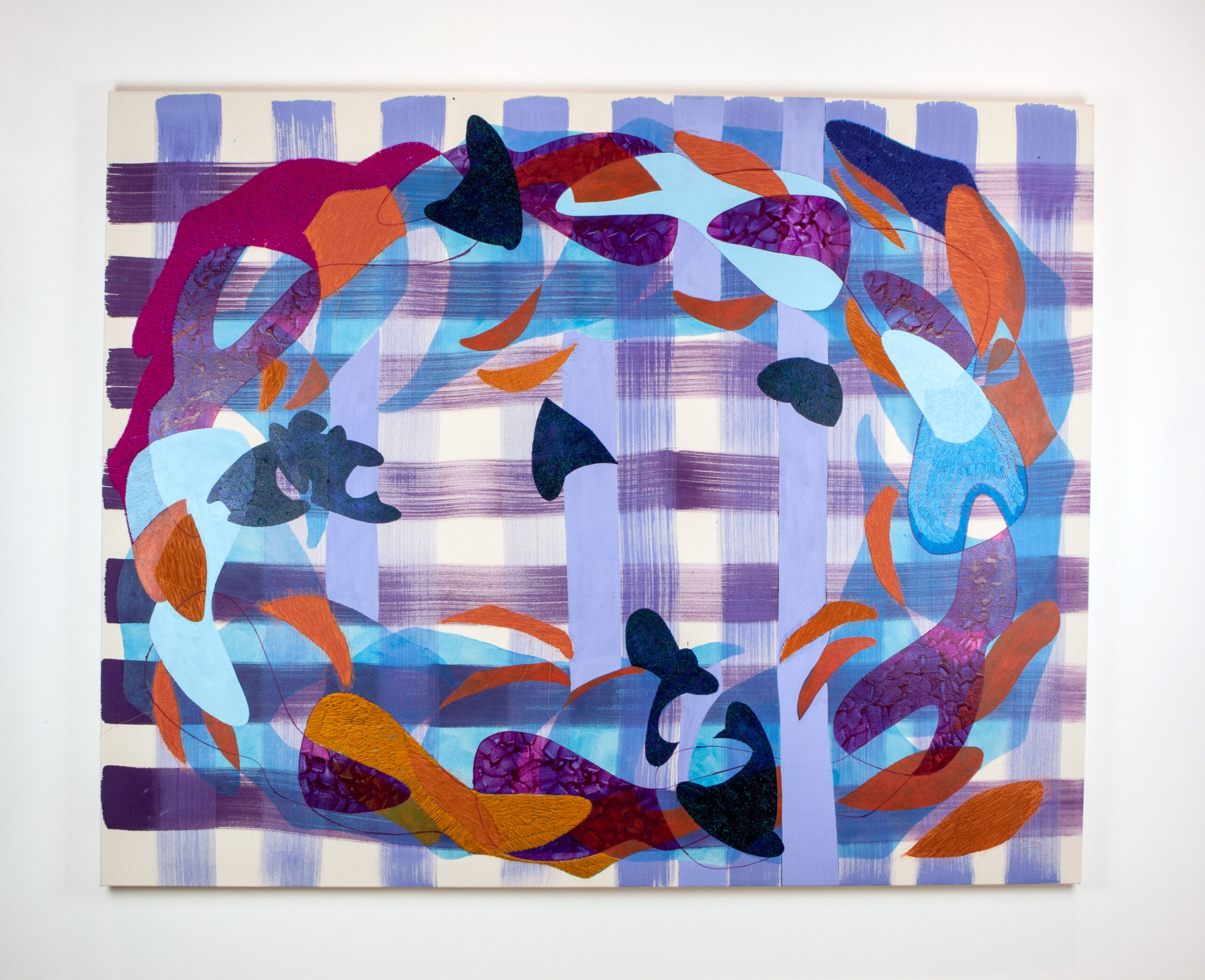
Acrylic, textiles and embroidery on canvas I 140 x 175 cm
2022
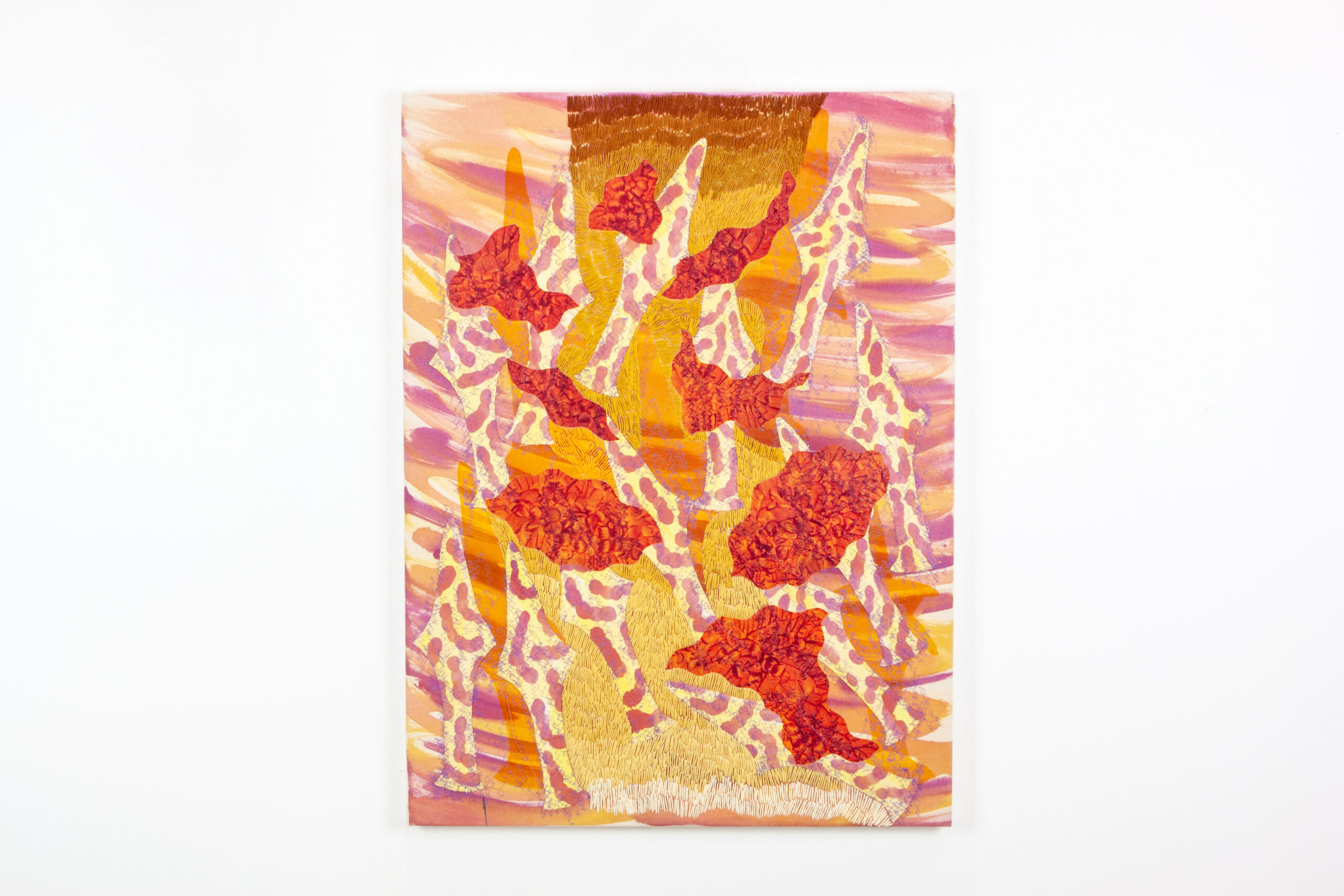
Acrílico, tecido, bordado e costura sobre tel I 81,5 x 61 cm
2022
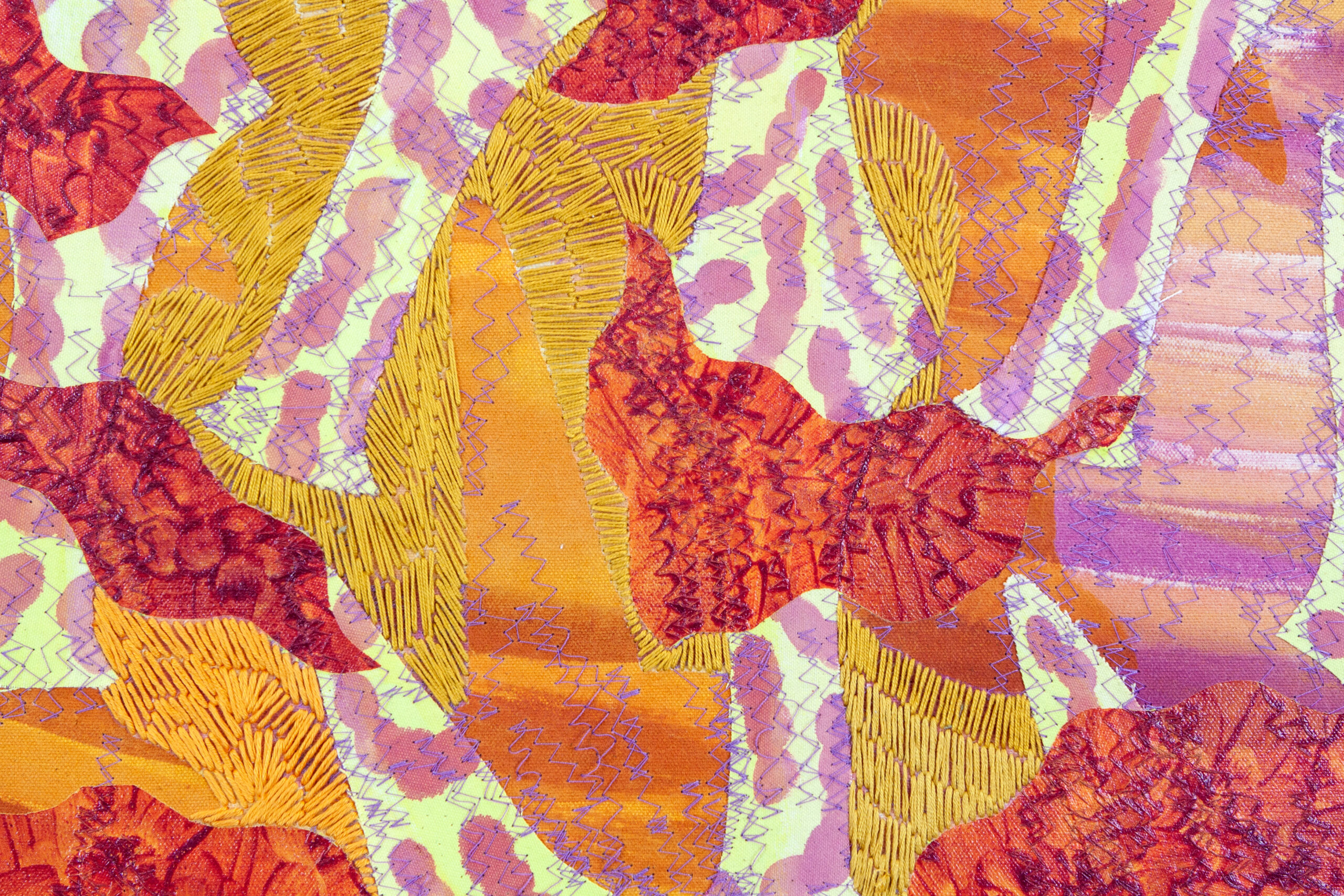
Acrílico, tecido, bordado e costura sobre tel I 81,5 x 61 cm
2022
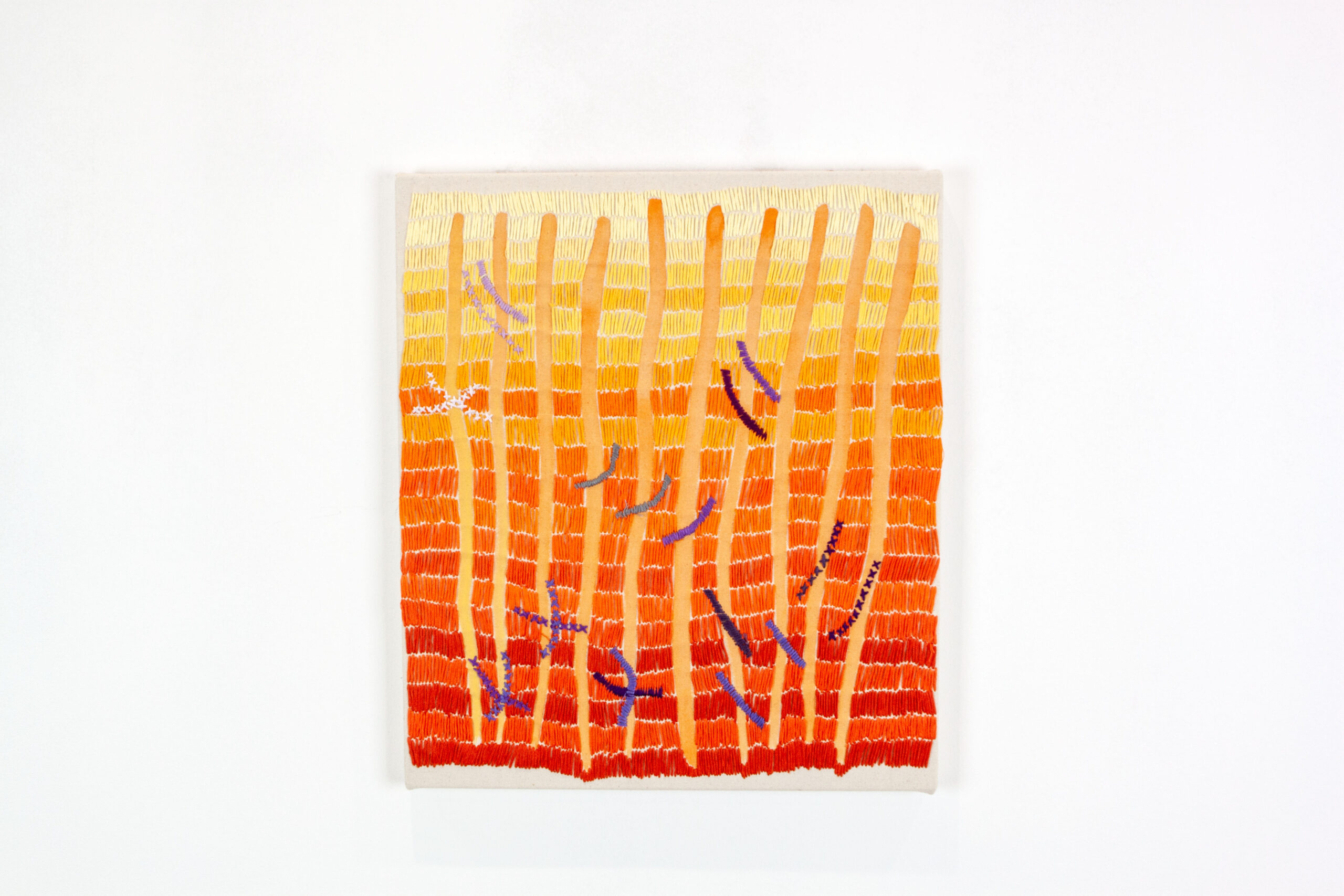
Acrylic and embroidery on canvas I 40.5 x 36 cm
2022
Acrylic and embroidery on canvas I 40.5 x 36 cm
2022
Acrylic on canvas I 167.5 x 137.5 cm
2022