

Guilherme Peters
For Guilherme Peters (São Paulo, 1987), the limitations of the body and the unpredictability of the environment are fundamental elements in his performances, films, and videos. His works are conceived as tests or challenges, where uncertainty and chance play crucial roles. In the interview, the artist reveals how his work is in dialogue with Brazilian history, especially in contexts of political tension, and how he seeks to create friction and transform historical references in a non-didactic way. Peters investigates the way in which violent processes, whether historical or contemporary, mold society and individuals. In his performances, this violence is re-signified, becoming a language that provokes reflection on the mechanisms of control and submission present in everyday life. Check it out:
Guilherme, first of all, thank you for being here with us today. I’d like to ask you to introduce yourself, with any information you think is relevant, thinking of an audience that may not yet be familiar with your artistic practice.
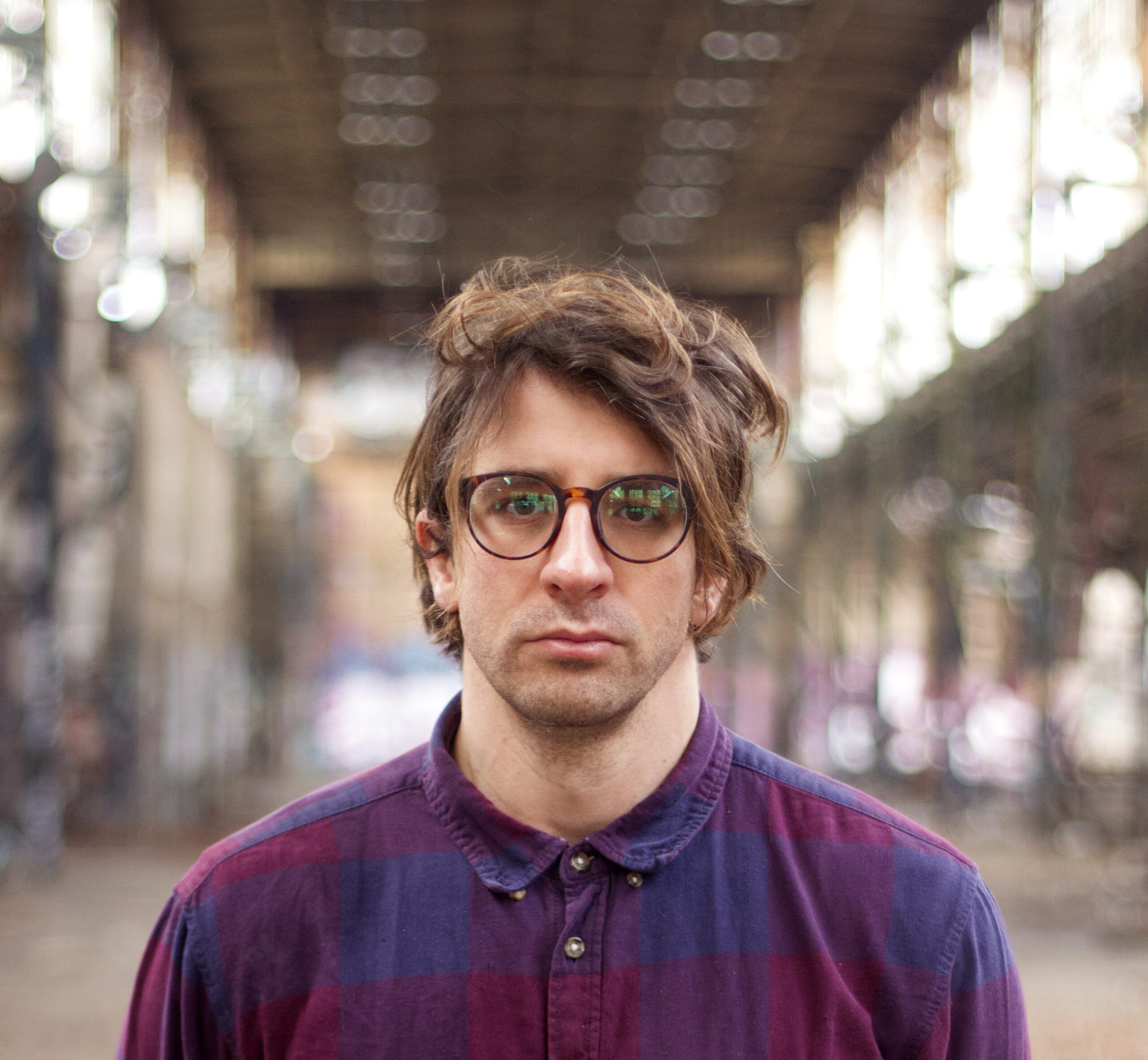
Guilherme: I’m Guilherme Peters, I’m 36 years old and I’m a visual artist. I was born in São Paulo and I’m Brazilian. In my artistic practice, I start from the premise that in order to generate form it is necessary to expend energy. My performances, videos, films, and installation objects make visible the efforts that go into their realization. These efforts can be identified as sound waves, sound, electrical current, my own breath, or some physical effort in relation to creating a form.
Cada trabalho funciona como uma tentativa de construir uma espécie de metabolismo próprio, que funciona como um circuito, tanto físico quanto simbólico. Esse circuito se alimenta de referências da cultura popular e referências históricas, políticas, e eu tento usar isso como um tipo de material de trabalho, não só como citações.
(Translation: Each work functions as an attempt to build a kind of metabolism of its own, which works like a circuit, both physical and symbolic. This circuit feeds on references from popular culture and historical, political references, and I try to use these as a kind of working material, not just as quotations). These references are subjected to a kind of entropic cycle of repetition, loss, and transformation. In some cases, these metabolisms, these circuits that are kind of metabolic, operate in a catabolic logic. They consume, self-destruct, and sabotage themselves.
The first work of yours I saw was ETROM UO AICNÊDNEPEDNI (2022), which is “independence or death” written in reverse. Thinking about this work, what is your creative process like?
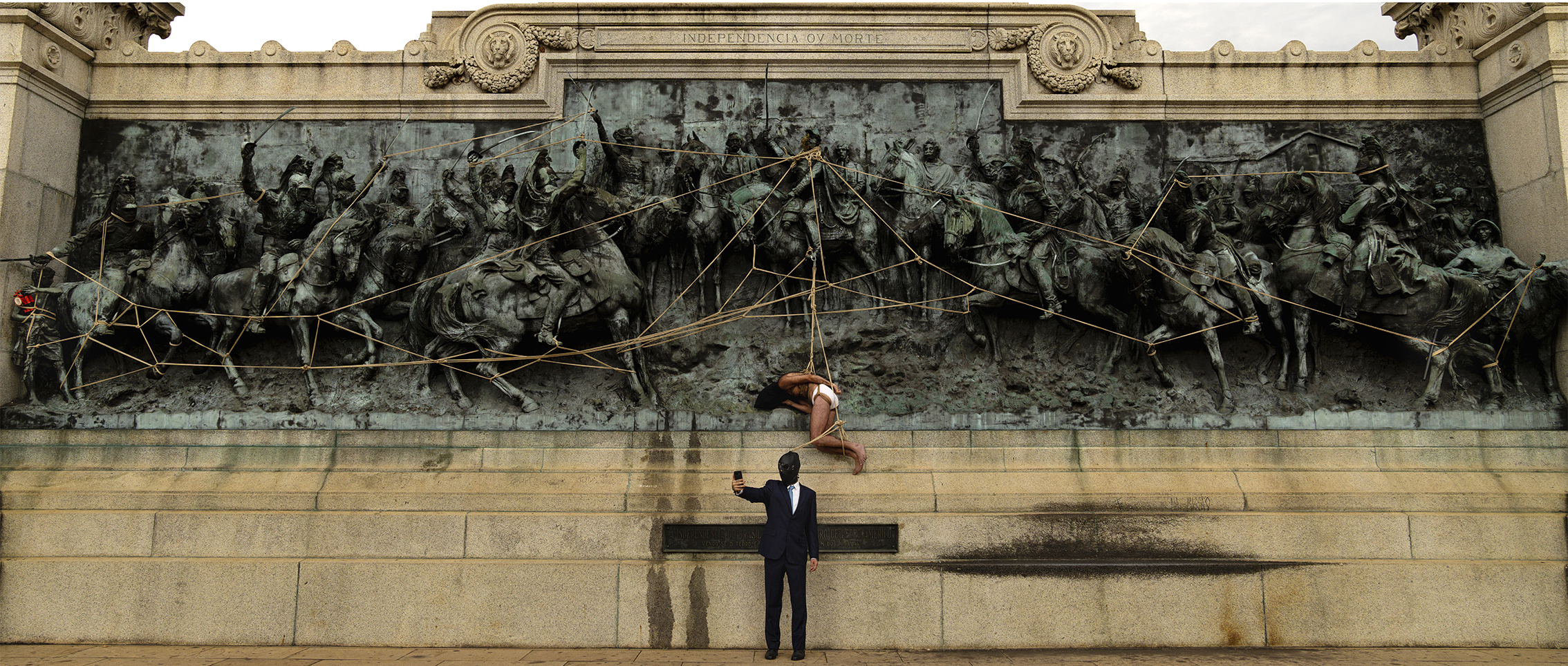
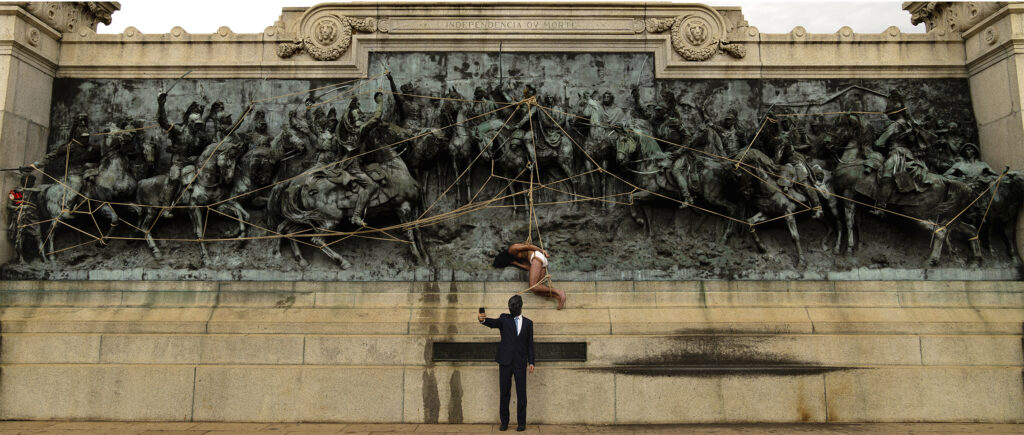
Guilherme: I’ve been practicing shibari for some time and one thing that interests me a lot about this practice is that it’s always creating a kind of circuit of tension and counter-tension. In this practice, every form is created through a scheme of forces, opposing vectors of tension. I had already worked on this monument [Monument to Brazilian Independence] some time ago, but I wasn’t very happy with it. Even so, I kept it in my head, with the relief inspired by Pedro Américo’s painting, Independência ou morte, and I had some possibilities in my head in relation to it. And the shibari came precisely with this idea of creating a symbolic and physical contraction in the monument. The whole monument is centered on the figure of Dom Pedro. The movements of the knights, horses, and soldiers point to the figure of Dom Pedro. I realized that if I tied Dom Pedro, and all the ties started from the central figure, this would invert the force vector. If all the movement goes towards Dom Pedro, when I tie a rope and make its tension against him, the rope seems to be pulling the rest of the figures and forcing them backwards, as if they were all pushing against the central figure. This idea of tying came about to subvert the movement of the sculpture through a simple gesture.I had been working with Brazilian history for some time, trying to appropriate it in a way that would create some kind of counter-tension to the tensions we were experiencing in the present. Since the coup that Dilma suffered, and the pre-election Bolsonaro government, Brazilian history was being revised and reminisced about in a way that was very strange to me. I began to appropriate Brazilian history, but in the way I always appropriate stories, which is in an ambiguous, contradictory way, to create tension, to create friction, not in a didactic way, or in the way that a historian would appropriate it. I appropriated this figure of Dom Pedro – this history, this situation that never really happened, and this independence that was never really seen – in a creative way. I always try to bring to art some personal experiences that are intense and transformative, but from the point of view of my body, which, in the case of this work, is the shibari; both the experience of tying people up and being tied up. I wanted to bring this experience into art in some way, and I saw that it made sense to mix it with certain historical processes. In this binding, there were also other elements besides the symbols of the relief and the sculpture themselves, which created a kind of symbolic plot. There was a time bomb without hands, placed in the lap of a young figure, a figure wearing a suit with a disfigured mask, in which the mask itself fitted into the binding and the circuit, while the figure sadistically took a selfie. Together with that, there was another figure who was in a kind of situation of torture and submission, all linked to these other pre-existing elements that already carried a narrative.
The work interferes in a strongly physical way, not just a symbolic one. A practical question: was it easy to get the authorization to interfere with the sculpture?
No, it was all 100 per cent underground work [laughs]. I was about to move to Berlin at the time. The idea for this work came very quickly and I didn’t have time to ask for authorization. When I looked into it, I realized that, as it’s a federal monument, it would be a very bureaucratic process and applying for permission would take a long time. I come from a skateboarding background, so I’m used to appropriating public or private spaces in a clandestine way. The work itself was very difficult to do. Hanging there to create the bindings was a kind of Herculean effort. While I was climbing and tying, some park rangers came to stop me and even called the Military Police, but as we were intervening in a federal monument, it was the Federal Police who had to arrest us, not the Military Police. When talking to the MP, we said we were going to break it up. After I said I was going to undo it, we made the image as quickly as possible and then untied it.It’s well known for being a spot where a lot of people skateboard. I think this methodology of appropriating an obstacle, projecting your body onto that obstacle, comes from a logic of growing up skateboarding in the city. It’s always a physical experience with the body. One thing that interested me a lot about appropriating this kind of monument is bringing a new kind of colonization to it, for example, with the figure taking a selfie in a kind of sadistic way. One of the things that interests me most about this subject is the colonization of thought, language, gestures and customs that social networks and technology companies are doing very effectively today. I think this is a subject that is little discussed, despite its importance. It has a huge cultural impact. The colonization mechanism of these companies is very similar to that of the European colonizers in the Americas. By banning the local language and imposing a new language for the people to speak, they begin to communicate through this new language, and language in one way or other molds thought, so by imposing a new language, you impose a new structure of thought. On social networks, for example, there is a whole structure that limits, moderates, and regulates how we use language, suggesting ways and means of using it. If you control the way people communicate, flirt, and share information, you control the entire socialization process. The control is in that rhythm that makes people dance without realizing what music they’re dancing to.
In a way, your work illustrates these ideas of cultural imposition that result in violence.
Yes. From the beginning, I wanted to make work that dealt with the idea of violence in some way, but not in a negative or pejorative sense. At first, I made paintings and drawings, but I felt a bit frustrated for some reason. Whenever I see work that I think is good, it has something that destabilizes me, makes me think until my mind bleeds. I think I value aesthetic experiences that somehow violate my subjectivity. There’s a kind of violence in this process and I didn’t think that the work I was doing was capable of that. So, out of frustration and the acceptance of a kind of artistic failure, I started making some works that have gestures and elements that can be read as violent, in the sense of using sound in an aggressive way, bringing in skateboards and other things that provoke a kind of catharsis in the space, making this catharsis have a violent impact on people’s bodies: identification or empathy with a body that is present and self-destructing, with the physical effort to create form, or with the sound frequency that invades the ear. I’ve always been interested in investigating violent processes of social transformation, such as revolutions, genocides, or historical processes that aggressively formulate, or reformulate, the notion we have of the concept of “society.” There is something inconceivable, absurd or inexplicable about these violent processes of social transformation, as if there were no language to describe them. Perhaps art can somehow provide this “missing language,” giving form to everything that seems impossible to form.
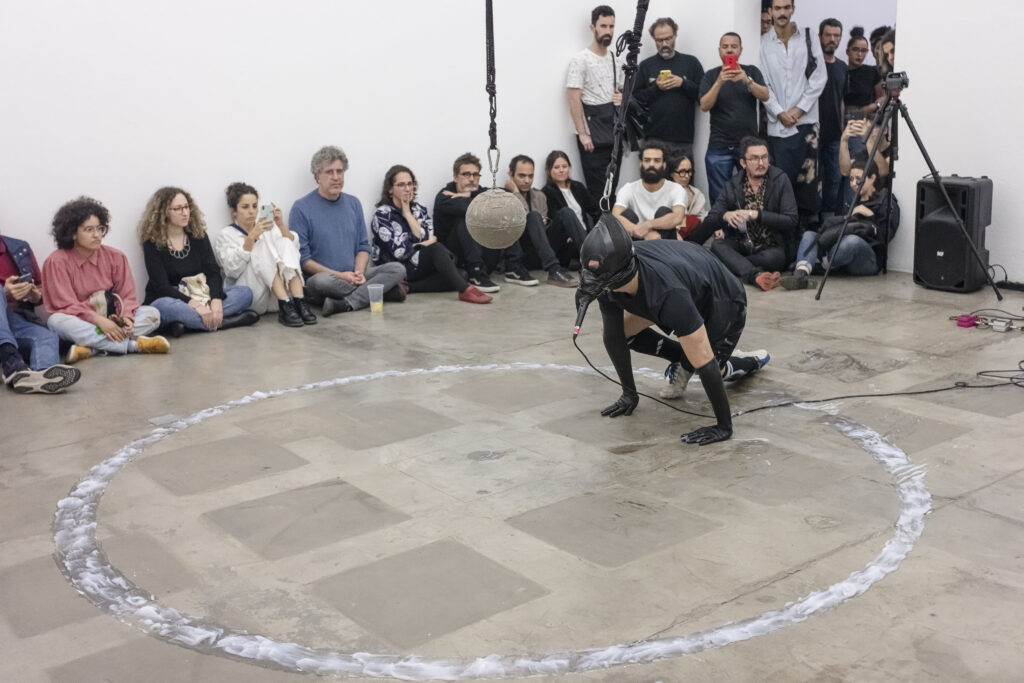
It’s interesting to see this in your work, The submissive body trying to play with the libidinal economy (2023). There is physical violence, but also mutual violence in the system. By being submissive to this system, the ball breaks and the rope begins to weaken. The first thing we understand is the violence to the body that is happening right now.
In recent works, I’ve enjoyed confusing the figure of the executioner with that of the victim, placing these roles in a kind of friction and confusion all the time. Who is the torturer? Who is the tortured? I bring a lot of experiences from the body, and the body often betrays itself, so when I create these mechanisms, they contain something of self-sabotage. Often in our experiences as human beings, we put the body in fragile, vulnerable, or violent situations on purpose, whether in sports practices, sexual practices without reproductive purposes, recreational drug use, or any other situation that seeks to test certain limits. Through my work, I try to investigate the reasons why we put ourselves in particular situations. From this investigation comes the putting of this place in dispute and, at the same time, by mirroring, the figure of the tormentor and the figure of the victim. In the case of The submissive body trying to play with the libidinal economy, there is a violent process with my own body. People end up identifying with the work because there is a human body present in the space, placing itself in a situation of limits.
There’s a lot in these works that I bring from my experiences within the BDSM universe; for example, within this place violence is always re-signified. It’s language, not just a specific sensation. All violence is transformed into meaning and into narratives that constitute specific dynamics. What is the reason for it? How is that pain caused? Why is that pain caused? It’s not just a game of sensations, it’s a symbolic game, a soap opera carefully constructed by the “personas” involved.
E eu acho que isso, do ponto de vista de transformação política, é onde me interessa. Não do jeito que eu quero fazer isso, mas de um jeito de fascínio mesmo, de entender que mudanças sociais são feitas através desses mecanismos, na maioria dos casos, muito cruéis. E nesse caso era isso, uma espécie de violência onde um corpo é colocado dentro de um mecanismo com um objetivo, mas que não pode ser cumprido, e a partir disso um jogo é criado.
(Translation: I think that this, from the point of view of political transformation, is where I’m interested. Not in the way that I would want to do it, but in a way that it fascinates me, understanding that social changes are made through these mechanisms, which in most cases are very cruel. In this case it was that; a kind of violence where a body is placed inside a mechanism with an objective, but which cannot be fulfilled, and from this a game is created). The game ends when the ball is destroyed and no goal can be scored. I think this has a little to do with the situation we find ourselves in today. For example, in the case of social media, we’re in a structure that, in itself, is a bit obsessive, but because of the system none of its promised goals will be achieved. It’s a sadistic game that deals with the manipulation of desire and the frustrations and repressions created from it – it deals with hope, despair and other affections that are beyond our control.
Sadism can be described as games or structures where the participants are, in a way, aware and they consent to take part. It’s erotic and there’s a clear desire to participate. However, when we consider the police, history, or even the economy, the perception of this awareness is quite different.
Yes, it’s different. Institutions, whatever they may be, don’t ask for consent when they act violently against their own population. But, for example, everyone who has a social network has signed a term of use and these terms of use are written in such a way as to confuse you – they’re long and designed so that you don’t fully understand what you’re signing, but there is a kind of agreement there. In many instances during the colonization of the Americas, there were similar situations: the Europeans arrived with a kind of agreement, buying land for extremely low prices. The native peoples didn’t understand the concept of private property, or even the meaning of money, and the Europeans couldn’t conceive of any other form of intelligence or organization of thought that wasn’t shaped by the idea of capital or social hierarchy. As a result, the disparity between languages was cruelly instrumentalized by the Europeans, and this cruelty formed what is geographically called America today. Of course, native peoples were not always in this sphere of false negotiation – in many cases there was outright extermination -but I’m saying this because there are some situations in which these online agreements are created in a very strategic way, with a similar process to that used by European colonizers. In the case of social networks I think this is very clear, because we are conditioned to think that we need to use them to be able to exist socially in the world, we have no idea what exactly our data is being used for, let alone the tragedy we may be exposing ourselves to. Who is responsible for the traffic in disinformation created to make the climate crisis unreal? Who is responsible for spreading the disinformation that mobilizes certain social strata? Who is responsible for circulating the hatred that destabilizes politics and builds authoritarian governments? If our behaviour is quantified, if all our impulses can be calculated in advance, perhaps our future has been privatized, just like our subjectivity. That being the case, I think it’s a process very similar to the tragic process of colonization in the Americas. But yes, it’s completely different in the cases of these other practices where consent is clear, evident to all parties. Historical processes don’t have consent to take place, but the point I made about BDSM practices is not about the question of consent, but about the symbolic value that violence has in these places, and its transformative potential.
There is a certain consistency of materials and themes in your work. Do you have a group of materials that you always prefer to use, or does it depend on the work?
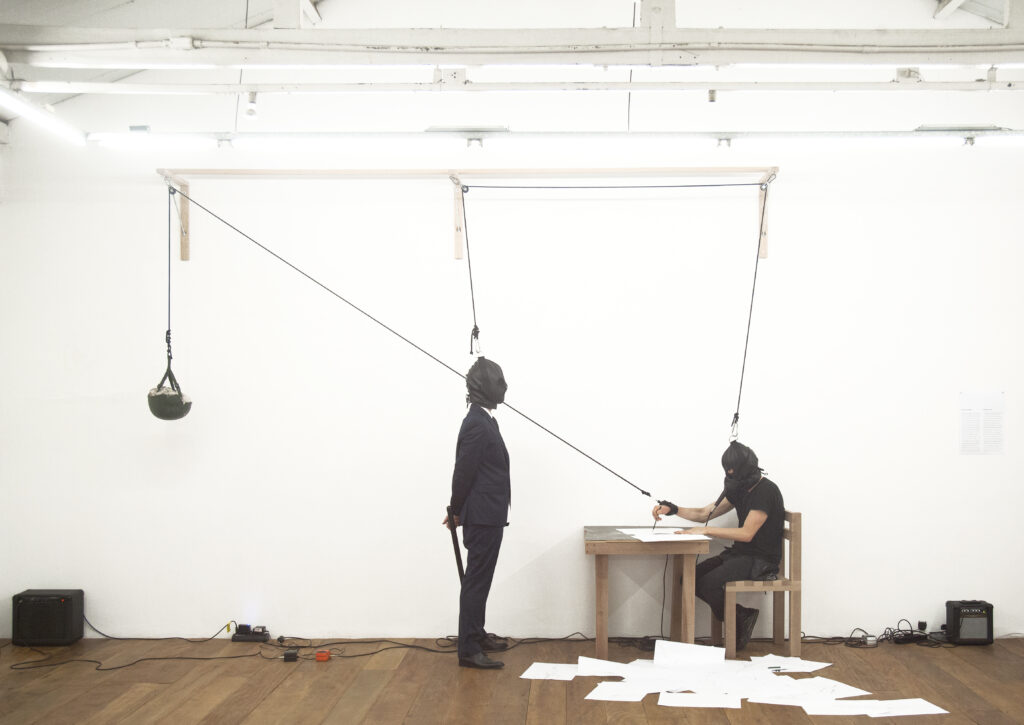
I think it depends on the work, which function as a kind of circuit – a circuit that works in itself, but sometimes connects with other circuits I’ve made. The historical and political quotations are material, just like the materials that make up the works. My body is also material, as is my breath, as is the effort: the body at work is also matter. Furthermore, these materials always go through a circuit of wear and tear or transformation. In the case of The submissive body trying to play with the libidinal economy, Vaseline was interesting to me because, when it comes into friction, it becomes more liquid, as well as being a material used both in sculptural processes and on the body for sporting or sexual practices. From the moment I started walking over the Vaseline and slipping on it, it was spreading through the space and transforming itself. At the beginning of the action it was visible, demarcating a space. Towards the end, it became more translucent, lubricating the entire floor of the space. The goalposts demarcating the goal were made of oxidized iron sheets, showing the action of time on that material used to demarcate a symbolic space. The concrete ball hit the ground, showing its weight and rigidity until it began to break, to crumble, exposing a certain fragility in its weight. It is precisely the resistance of the ball’s material that determines how long the work lasts; once it shatters, the game is over and the body is released from the weight that previously held it.
I also have a lot of works with oxidization, which explore and experiment with the wear and tear of the material. This takes time because it has to go through an entropic process. Everything for me must be within the logic of this symbolic circuit, even if I don’t understand its mechanism very well and I’m trying to understand it. So this wear and tear, this entropy, must be part of this symbolic circuit. It’s not about having a well-explained, didactic reason for why it exists, but rather that it makes sense within an internal logic, even if that logic is absurd and often inadequate. For me, it’s all material – the signs, the situations, the narratives, I have to treat everything as material. I don’t see any difference between the meaning of oxidation and the matter of oxidation itself, or the meaning of Vaseline and the physical reason for it being there. Everything is so interconnected, and everything needs to make sense, just like in the human body where one organ functions internally but is connected to another organ. If one organ fails, everything else starts to fail because everything is connected.
Have you worked with other actors or artists to help you with this more dangerous part of the performance, or is it always you, your body, that is put at risk?
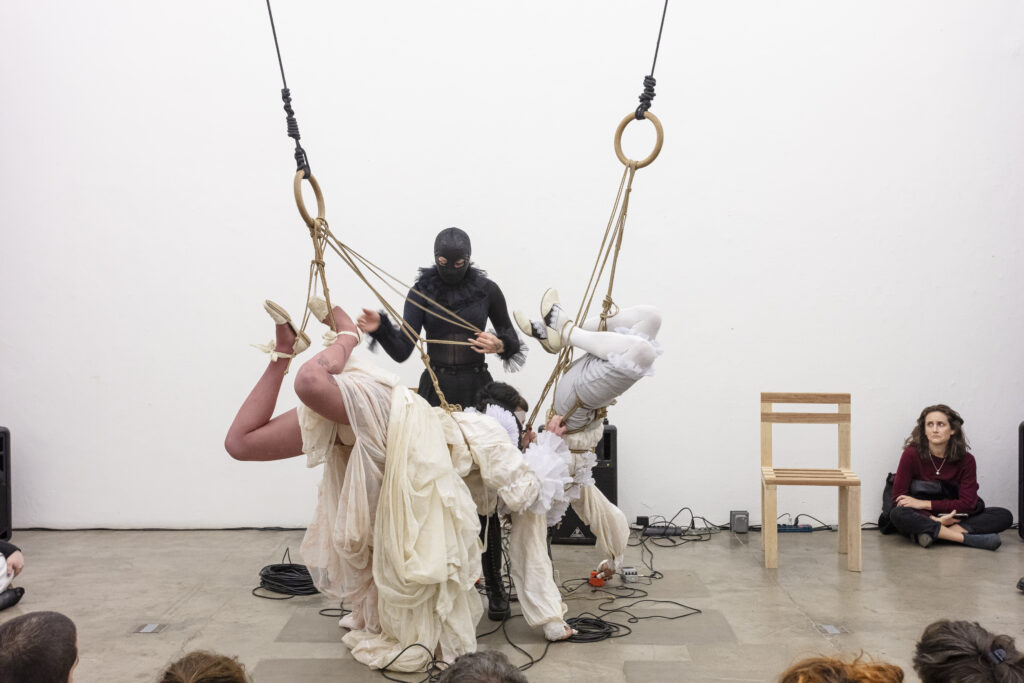
In 2022, I did a performance with three people – myself, Sansa Rope and Luisa Callegari, called Cadafalso. We did a kind of SM noise opera with other bodies involved. It was very difficult to deal with, at least for me as I’m used to always putting myself at risk alone, so it was a specific experience. Even so, there was a lot of rehearsal, but there was also risk for all parties, and everyone was aware of the risks. For this particular job it was important that the two bodies, however separate, were connected at all times through a system. The work began with a conversation that culminated in a kind of circuit binding. From there, the bodies connected and began a clash.
This negotiation is always difficult, between this third party that you bring into the work and how to mediate with the body.
Yes. I don’t think I’d ever do the things I do directing someone else and that’s one of the reasons why I perform. This particular work was written by three people, so they were all proposers, but I think I have an ethical problem with directing another body going through a situation like that. In my work, I endeavor to go beyond a certain limit, and this is visible to the people present. Directing a body trying to reach that place creates a hierarchical relationship that I wouldn’t know how to deal with – perhaps if it were a joint work, with proposers all in the same position, without having to direct anyone. As I’m getting older, and more brittle, and things like the fact that I hurt my knee in the last work are going to cause wear and tear, it’s getting difficult for me. At some point, I’ll think about getting closer to the theatre and directing other people, but I think the job would change completely.
You often create a situation that is then influenced by the impact of chance. For example, even though you knew that the Vaseline would become liquid, during the performance there is always an unpredictable element about how the system will behave together. Were there any challenges or unexpected situations you faced during the performance?
I bring a lot of intense experiences with the body. They come from my experiences with sport, or activities like that, in which I deal with improvisation. I find it fascinating how the body adapts, especially when you talk to someone who is an athlete, a dancer, or who practices some intense activity with the body. The body adjusts – even if you don’t know how to do a movement, even if you don’t have enough strength, skill or breath, somehow it adapts, even if in an unexpected way, even if it gets injured. I see my work like that.
Não gosto de fazer muitos ensaios para performances, porque entendo as performances como uma espécie de prova, de desafio. Eu arquiteto a situação, mas não quero arquitetar a ação.
(Translation: I don’t like to do a lot of rehearsals for performances because I see performances as a kind of test, a challenge. I design the situation, but I don’t want to design the action). I encounter many challenges along the way – I get hurt in various unexpected ways, I fall in ways I didn’t plan, or the strength of the material isn’t what I imagined because I didn’t test it first. I prefer to let things happen on the spot and let people watch the body’s intelligence in adapting to chance. In The submissive body trying to play with the libidinal economy, the ball broke faster than I expected (I had made something very solid, thinking it would be difficult to break, but it broke very quickly), I got hurt early on, in a way that I didn’t expect either. There have been other instances, in other jobs, where I’ve hurt myself badly, even breaking my arm.
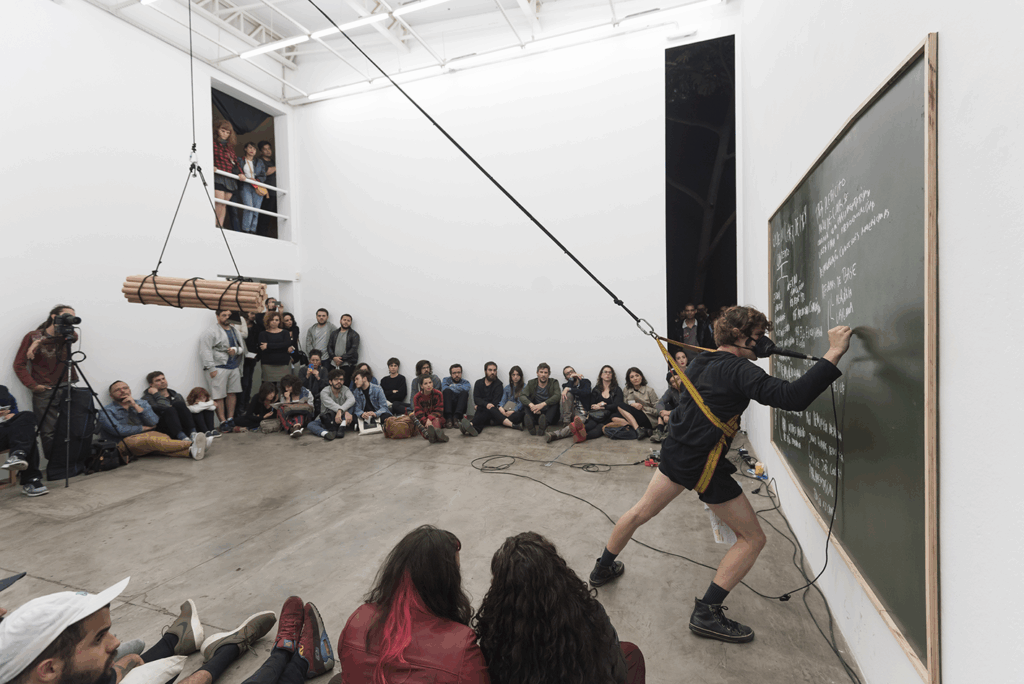
I come from that place. I never studied dance, theatre, or anything within the performing arts; I come from the field of sport itself and it’s from there that I bring these experiences. There have always been unexpected situations that I’ve had to adapt to, and I think that’s recognizable to the people who watch my work. That’s the fun of doing these things. It’s always a kind of adventure, challenge or rite of passage – a hero’s narrative. I don’t want to have too much control over the action because it’s important that it happens live, that the obstacles are real, that the failure is real. I think this sincerity is important for the work, especially to establish a counterpoint to how things are done today. You can train for it, but when it’s for real you never know what’s going to happen. When I look at art history, what stands out for me are the works that carried a certain risk: both a physical risk and a symbolic, conceptual risk. When I look at what is done today, I don’t see many works that seek to take risks. Even though I’m aware of my supposed insignificance, this is how I’d like to contribute: by bringing risk back to art.
Interview conducted on 14th February 2024 remotely via Zoom.
ETROM UO AICNÊDNEPEDNI
Guilherme Peters and Sansa Rope I Vídeo and photography
Frame
2022
Blackboard, bundle of firewood with an axe, and video I Variable dimensions
Frame
2017
Performance
Frame
2019
Performance
Frame
2023
Guilherme Peters, Luisa Callegari and Sansa Rope I Performance 60’
Frame
2022