

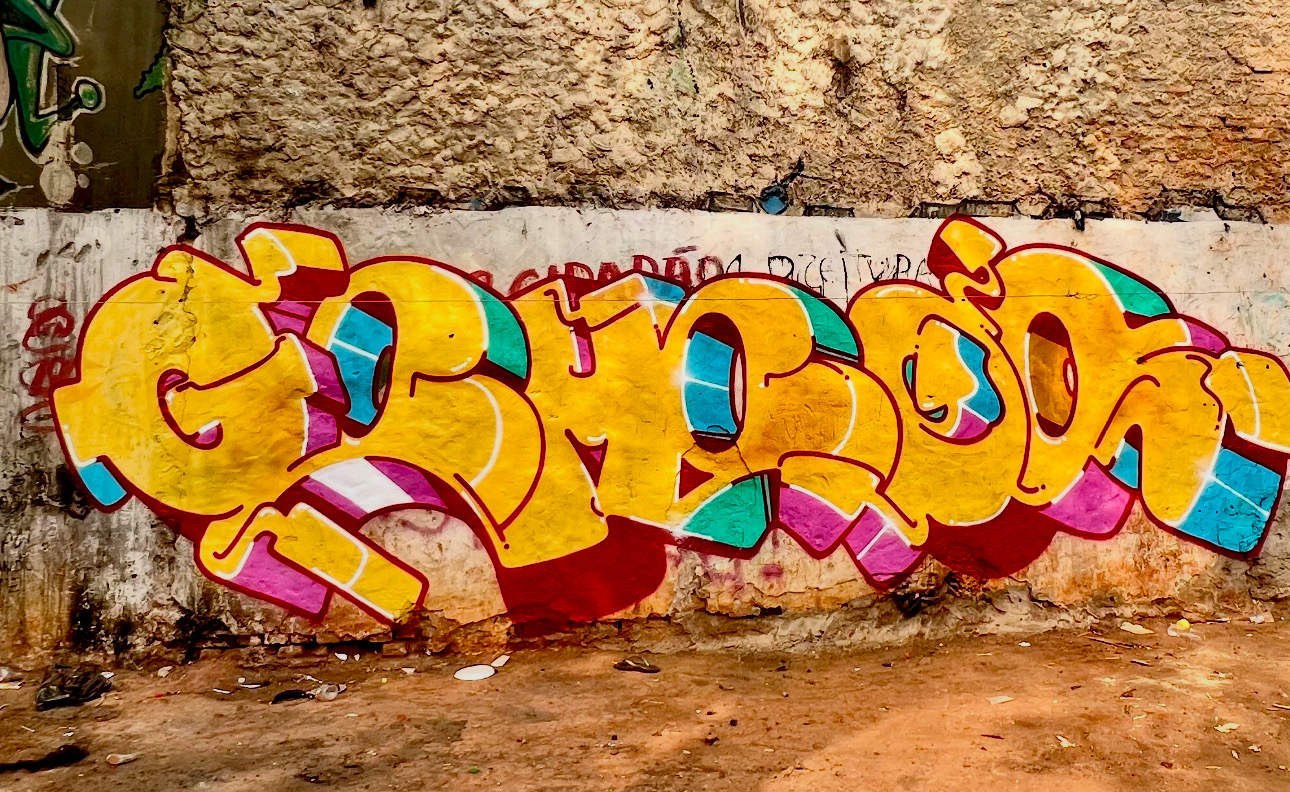
OSGEMEOS
In this conversation, OSGEMEOS reveal how two twin brothers (Gustavo and Otavio Pandolfo) from São Paulo built a parallel universe, a world they access “24 hours a day” and which transforms white walls into portals and 60-story buildings into windows to other dimensions.
From the street as a university, to recognition in museums worldwide, the brothers speak about resistance, about keeping doors open for new generations, and about the power of art to break down barriers. As they say, “Art is stronger than that.” Beyond their practice as artists, we also discuss their work with music and their curatorial practice – concerning themselves and other artists – where everything converges into a truly unique and collective imaginary.
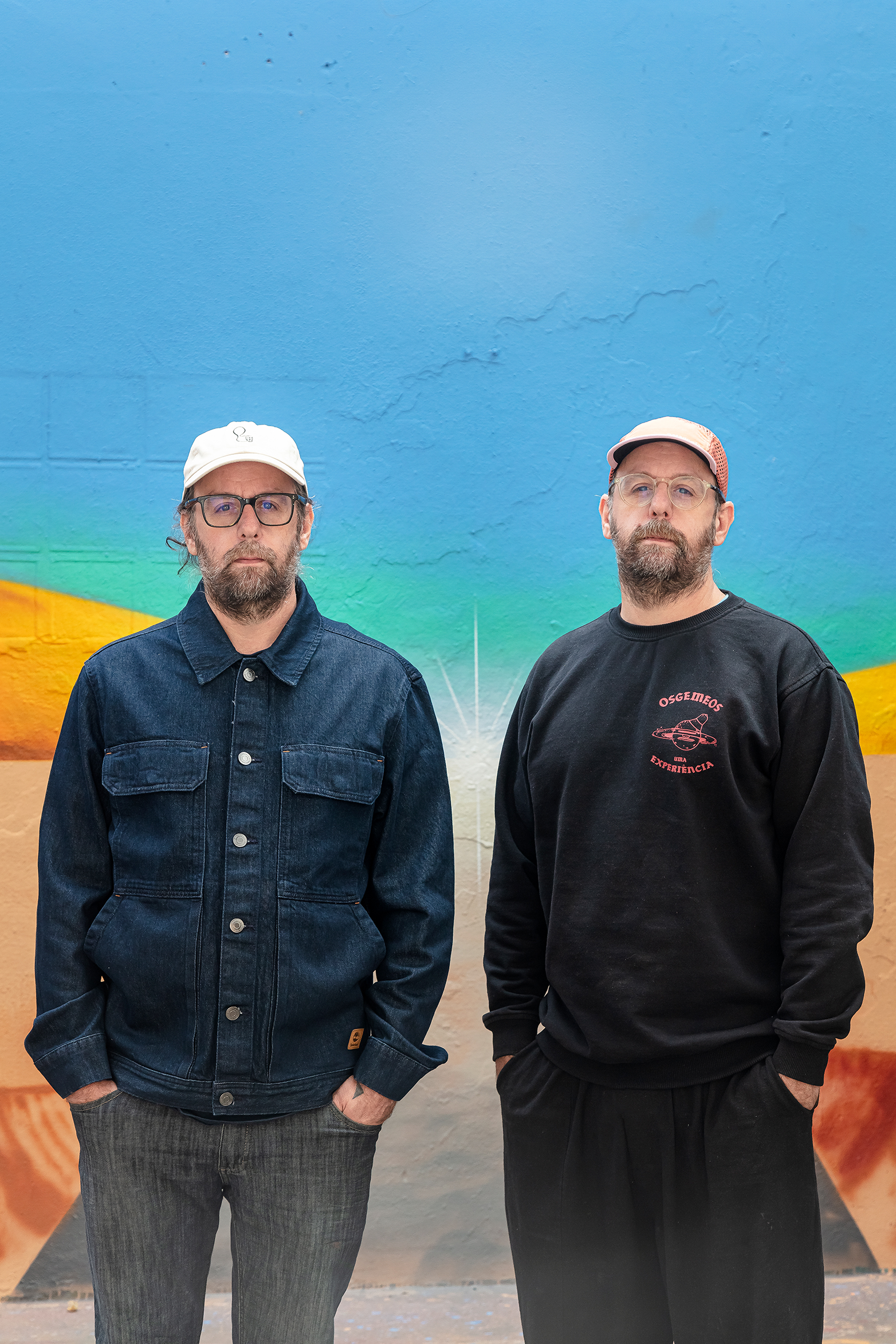
Thank you, OSGEMEOS, for agreeing to be here with us today. It’s a great pleasure to talk to you. I wanted to start by asking you to share a little about your creative process. How does this process begin, and how do you decide which medium each work will involve itself with?
Gustavo: Something that has happened in our lives since we were very young is that, instead of each of us having our own paper to draw on, we chose to draw on the same piece of paper – or, if we were going to transform a toy into a sculpture, as we used to, we would do it with the same toy, together.
This creative process happened in a very natural way, from very early in our lives, coming from this need we always had to materialize our dreams, the ideas that we had together. It was one of us complementing the other to be able to make material the drawing that we made, using the purest essence.
Otavio: We discovered this universe in which we draw in conjunction, and when we found the key and opened the door, we dove into that universe together. Everything we draw and paint comes from that place.
Thinking about the transformation of the works in the installations that you create, how do those changes occur?
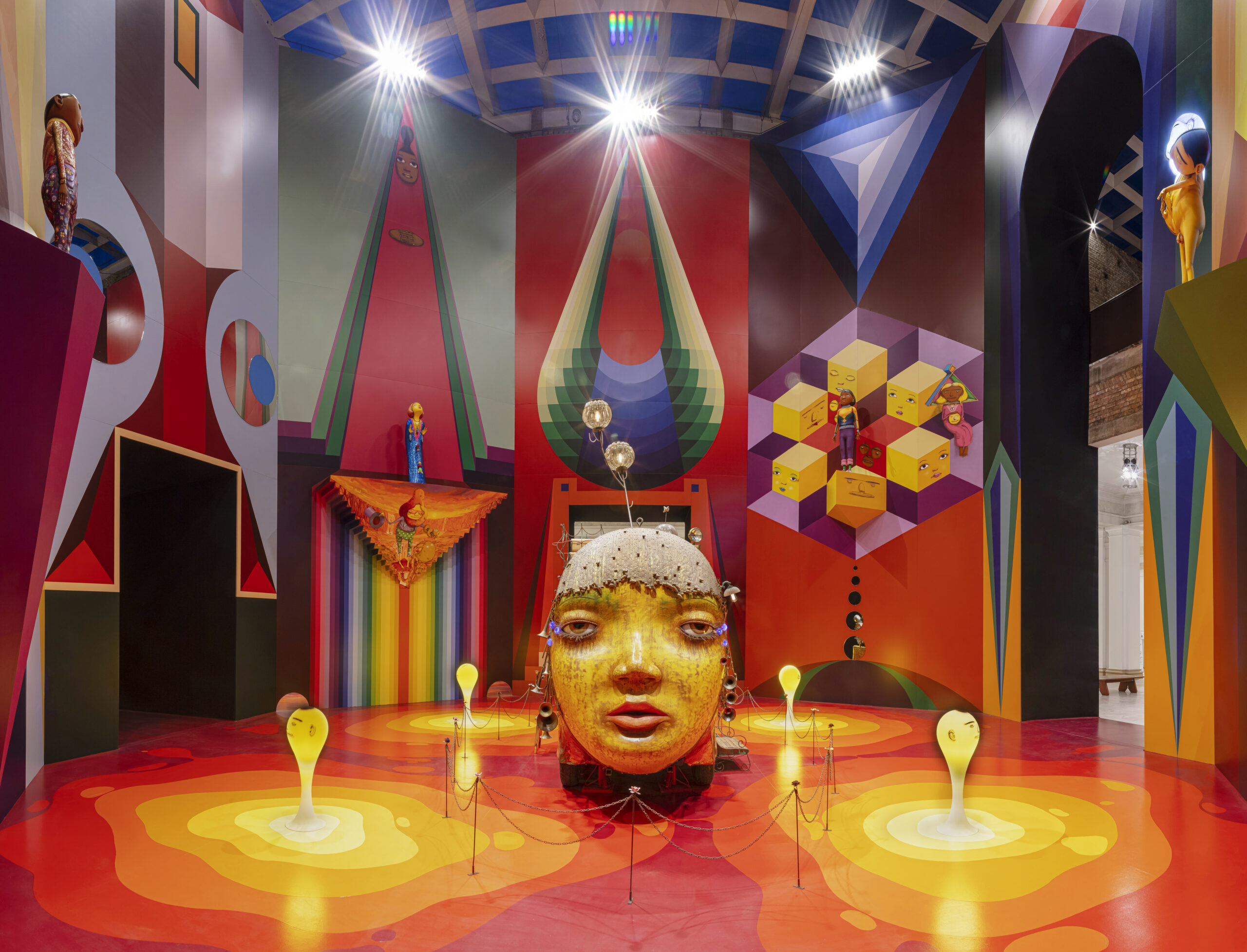
Otavio: The way we played at our parents’ house already had this aspect of installation, of transforming the environment, of making us feel good inside our room and in the way we perceived this universe that we were drawing. We always really liked challenges, taking an environment, a white room, and not seeing it as white – we saw it in the way we see our own universe. It’s also an opportunity for us to bring people into this world. That’s why we explore other techniques; not just painting, but sculpture, installation, video art, music. I also think all of this helps to elucidate things more.
Gustavo: I think it stemmed a lot from that idea of making art without knowing you were making art, also. Other people would say, “They’re artists, they like to draw, they like to paint,” but for us it was a way we found to feel good, to be comfortable with making, and to communicate with each other, with other people, with family, with friends.
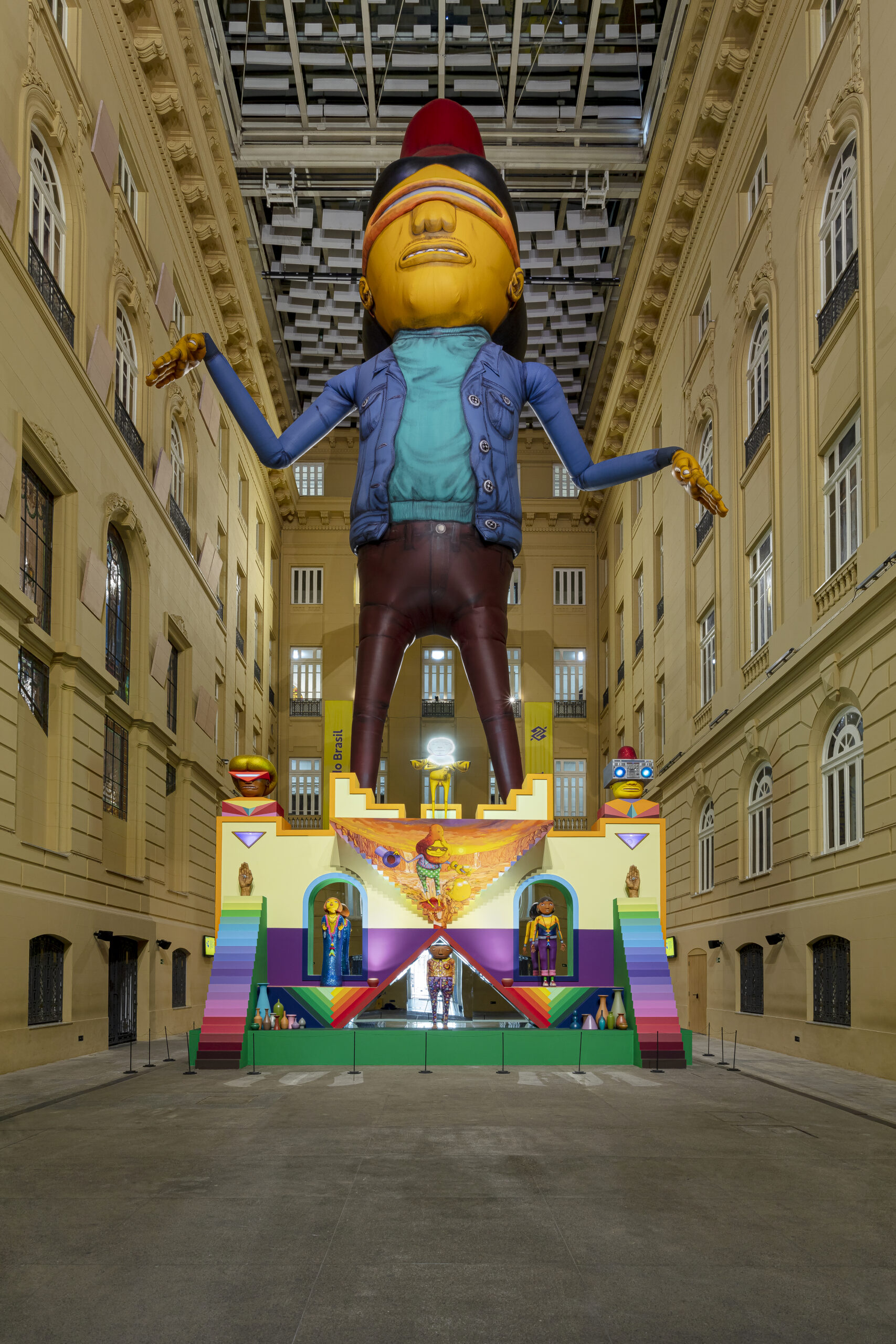
What is the process like of having this encounter – thinking specifically about the institutional exhibition, but also here at the fair – what is it like to encounter this white wall and start thinking about an exhibition?
Otavio: Every place is a place. And it also depends a lot on what we want to say at that moment. We perceive the world this way. We don’t see a tree, perhaps, in the way we usually understand them, we see our own playful, different tree. We try to transform everything into our own universe. It’s this need that we’ve always had to materialize what we’re experiencing together, in dreams, in imagination; we live this 24 hours a day.
Gustavo: It’s like opening windows. Whether you’re painting a canvas, a picture, or you’re painting the side of a 60-story building, we see everything as a portal. You open a portal to another dimension, a dimension we’ve lived in for many years. And since we accessed it very early on, our greatest desire was to show it to other people, as if you’ve seen something so special that you can’t keep it to yourself – you have to share it. And this works on our imagination, so we find new paths, new techniques, new languages for our work.
Otavio: And it’s about believing in, and enjoying, what you do. We started drawing in the late 70s and 80s, from the age of three or four. So from that time we already knew what we wanted to do, which was to draw together, regardless of whether we would one day become artists, or successful. We never really thought about that.
The world that you two have created, and then needed to expand, involves working with people to make those projects a reality. What was it like sharing these dreams?
Gustavo: In the 80s and 90s, it was all very much just us. We always got our hands dirty. Following an invitation to make an exhibition in a museum, we came to understand that it was possible to transform a space into an immersive universe for people. We could use light, sound, create new rooms, to really transform the space.
Otavio: I think that, even before then, there was a moment when we understood that we needed to expand our universe. The way we did that was by going out into the street and painting in the street. We shared the same room, which became our studio. We started studying drawing in our room, painting the backyard, but we realized it was too small there. We needed to expand and refine our style, to study drawing, to study painting.
We learned all of this on the street, using the street as our canvas. We grew up in the Cambuci neighborhood, in the central region of São Paulo. We started doing a lot of things on the street, initially to understand techniques and develop our drawing style. Faced with many other artists who were already making work, we wanted to focus on studying a specific style. We preferred not to go to college at the time; it was better to lock ourselves in our room and spend four years studying.
Gustavo: It’s crazy to think that, back then, we didn’t have a broad view of the contemporary art scene. For us, it was a parallel and distant universe. Another factor is that, in reality, there weren’t any open doors for artists who came from the street. Art was a closed business. That’s why we used the street a lot as a way to expand our studio.
We discovered São Paulo through graffiti, and wanted to paint as much as we could. It was – and still is – a learning experience. Every graffiti artist knows that the street is a university: it’s a place where you can’t make mistakes, where you need to respect other artists.
Otavio: And it’s one of the best galleries out there because it’s public, it’s free. You end up bringing the work to people who are living on the street – this place is home to many people.
Gustavo: Having undertaken all this kind of artistic training, we then had no idea how to get our work into a gallery or a museum – it never even crossed our minds that it was possible. This recognition happened naturally in our lives. It depended a lot on our efforts. We are very dedicated to what we do, especially in terms of studying, but things happen over time – and time is very important for the development of an artist. We understood very early on that what we wanted was to be together, drawing, regardless of where it would lead. We were happy there, drawing on paper, or in the street, on a train, on the wall of a building, and that took us down other paths. It was really cool, because it was something we didn’t expect.
The energy that you’ve developed and created over all these years of experience is very present in the exhibiting. I think that’s very powerful. Perhaps the time it took even helps to maintain that energy and to not completely change your style, or adapt to the expectations that an institution might have.
Otavio: First came the desire to have an authentic style, something that, when people looked, they could recognize it as our work. This comes from the street, from graffiti, from this requirement of those who paint graffiti: when you pass by a wall, you know whose work it is.
We did countless jobs to try and earn some money, but making a living from our work in the 80s and 90s was difficult because there weren’t many opportunities. Those opportunities started opening up little by little, so much so that we started working outside of Brazil, and then we came back here.
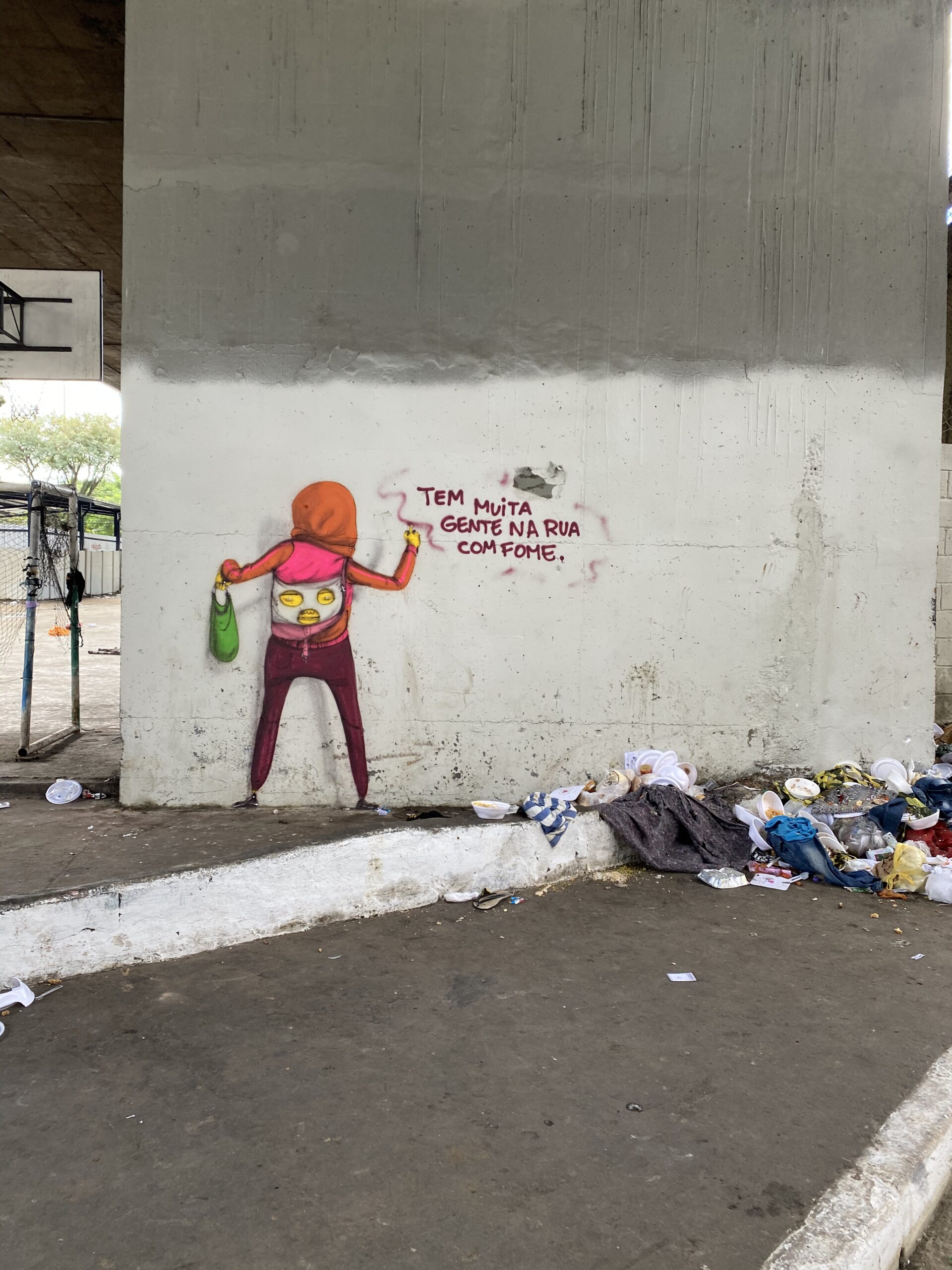
What was it like sharing this personal world, which contains a lot of elements within the Brazilian popular imagination? And how was it to share it with international audiences and gain recognition?
Otavio: It all started because of the amount of things we were doing on the streets in the 90s. Artists from abroad were already noticing what was happening here. After a Miami-based magazine published an article on our work, it sparked the curiosity of an artist in San Francisco named Barry McGee – who’s also from the graffiti world, with several museum exhibitions behind him, and who is very well known in the field of contemporary art. He came to São Paulo in 1994 and saw our work. From then on, he started drawing attention outside of Brazil to what we were doing.
Gustavo: When we met Barry, he told us he was coming from San Francisco to do an exhibition and live off his art. At that time, we were working in a bank – nothing to do with art – because we had to work to help out at home. We thought: “Look, this guy is coming here to do an exhibition… how incredible! He lives off his work.” But one of the first artists who really awakened us to this possibility was Speto, from São Paulo – a very important figure in our development. He’s always lived off his art and gave us a lot of advice. He lived off drawing, did illustrations for newspapers and magazines, and ended up opening many doors for us – giving us opportunities to do a job here, another there, always with drawing. This showed us that maybe we could leave our jobs one day and live off what we really loved. When we saw Barry McGee’s work, in an exhibition at the Lasar Segall Museum if I’m not mistaken, we realized something essential: it’s possible to take a space – a closed cube, a room – and completely transform it. This idea of transformation is what made us really pay attention to it.
Otavio: We were already doing this without knowing it, and Barry was working with Jeffrey Deitch in New York. When he went back there he ended up talking about our work with Jeffrey – and that’s when his curiosity to meet us also arose. At that time, we had never left Brazil. In 2005, we had our first exhibition in New York, and in 2006 we did one here with Fortes. Do you see how much time passes? The first exhibition abroad was in 2005, and we had already done a lot in São Paulo before then. After that, we never stopped.
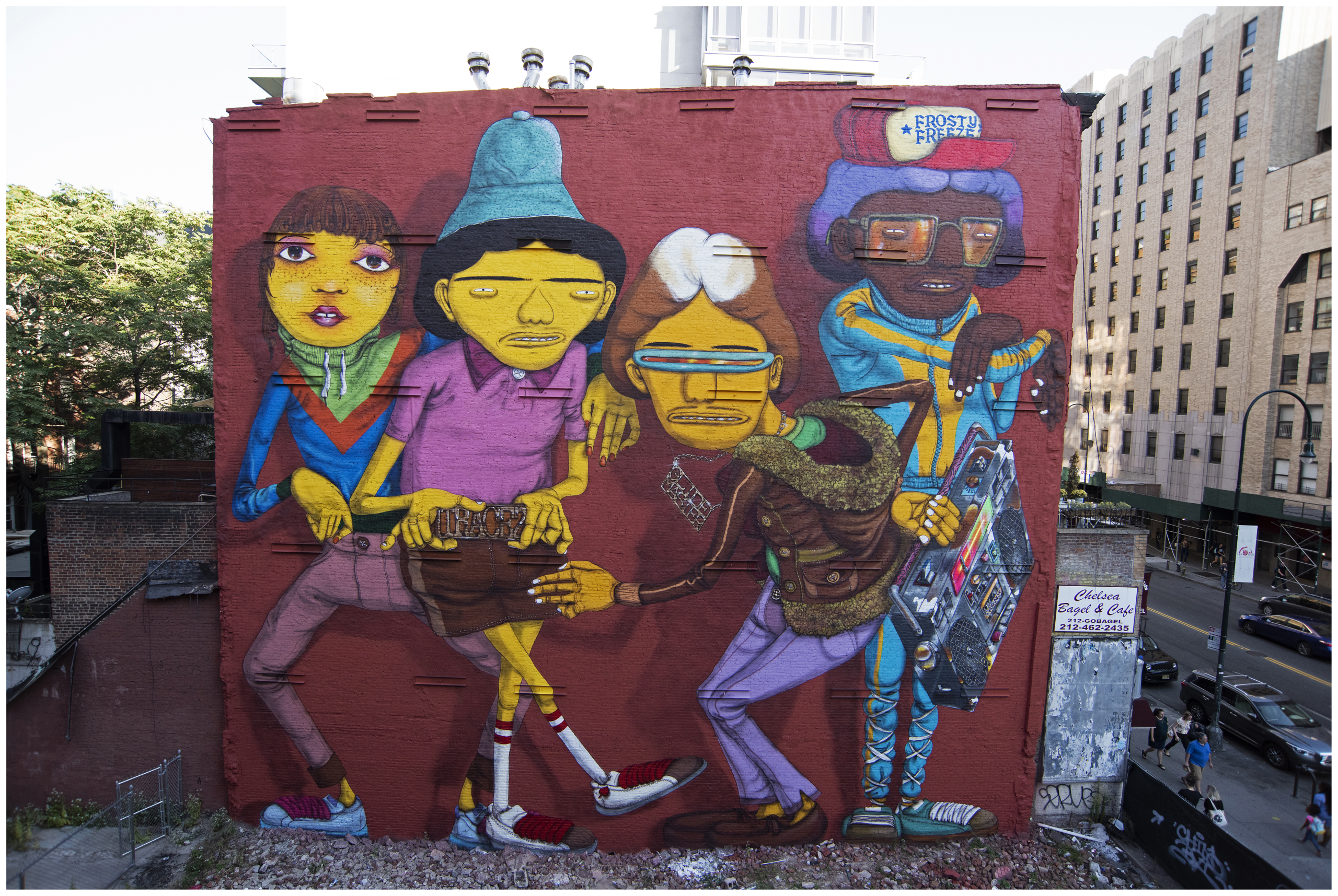
Have you ever encountered any kind of resistance? Have you ever thought, “I want to do something I can’t do”?
Otavio: It’s crazy, because even today there’s resistance, and I think those barriers need to be broken down. We’ve always believed in people’s talent, in the talent that each person has, regardless of their background. I believe we have a certain responsibility in this: the fact that we managed to enter into this world also means leaving the door open for future generations. We’ve always believed that the recognition of one artist is an open door for another. And it’s important to keep it that way. Resistance is part of it. We’ve encountered barriers in everything, but art is stronger than that.
Quando você acredita no que faz, supera essas dificuldades, você está tão focado no seu trabalho, no que quer transmitir através dele, no que quer materializar através dele, que essas paredes acabam caindo. Essas portas acabam abrindo e as chaves se perdem, elas ficam abertas, porque acessam outro paralelo nas pessoas. A arte tem esse poder de acessar isso.
(Translation: When you believe in what you do you overcome these difficulties; you’re so focused on your work, on what you want to convey through it, on what you want to materialize via it, that these barriers end up falling away. These doors eventually open and then the keys get lost, so they remain open because they access other parallels in other people. Art has the power to access that.)
Thinking about the notion of breaking down barriers, your work has global recognition, and I think various audiences respond in very similar ways. Do you believe that this public response is truly a connection to your world?
Otavio: I think everyone has a playful side, a universe within themselves. It’s up to each person to access it – or not – and I think that’s what we provide. We live within this universe of ours 24 hours a day, and we paint this universe. Many people identify with it, sometimes just by looking at one of our works and saying: “This has to do with me. I don’t know exactly what it is, but it does.”
Gustavo: It’s also a matter of energy, of feeling. We’ve had several experiences where people identify with the work without being able to explain it, and they become emotional. What we do is very pure, very transparent. When we paint, we are very committed to the work.
I think that when you express something purely, people feel it. It’s an exchange – you’re sharing it with them in some way. It’s 100% love and I think, for us, the purest way to represent love happens through painting.
The floating sculptures often create an unusual encounter. Someone might go there to see a different exhibition, to have a different experience, but suddenly they have this encounter with the sculpture. How do you see these unexpected encounters? What is it like to create these floating sculptures?
Otavio: When we’re setting up an exhibition, or installing things, inflating the giant structure, we’re so immersed in it that we don’t even stop to see that other side. We just need to deliver what we want to make real.
Gustavo: We see our characters like that: in 3-D. They have a life of their own, they talk, walk, dance. They are three-dimensional in our minds.
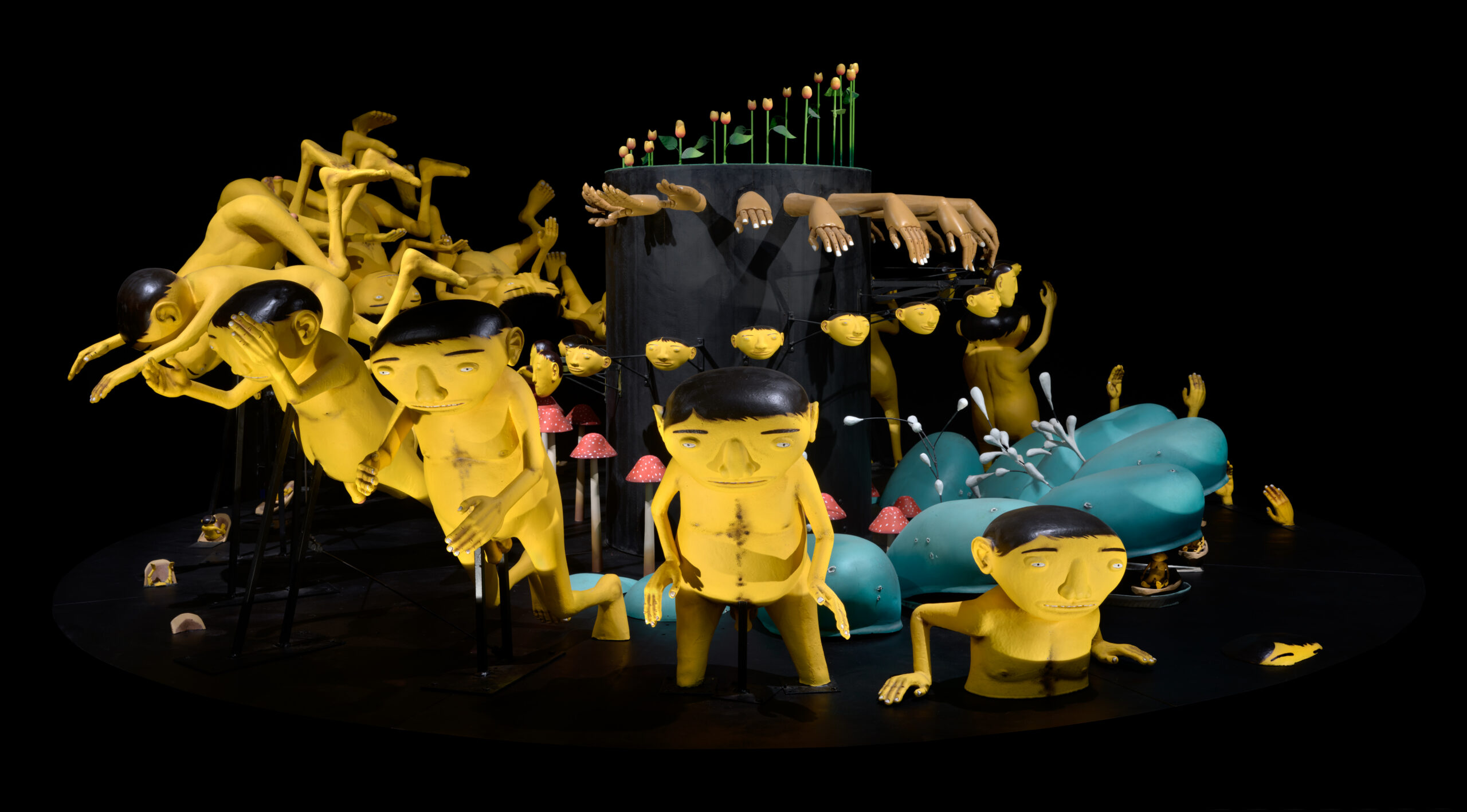
And this connects with all the possible mediums you use. Tell us a little about the work Zoetrope.
Otavio: This project was challenging because we had the idea of building something that would recall somewhat the beginnings of the animation process. A zoetrope is a disc that, in the past, was small and had little figures. When you spun it, and shone a light on it, flashing at the same BPM as the disc, those images will become animated. We had never done anything like that before, so we decided to do it, but on a grand scale, and we needed some space to be able to do that.
Gustavo: We had gone to Burning Man, a festival in the Nevada desert, and we saw something similar. It became a puzzle in the studio, together with Arnaldo, Coió, Isaac, all of us trying to solve the work, how to align the movement, the speed of the disc with the flashing of the strobe light, to animate it We even made a small model – and it worked – so we thought if it worked with the model, it would work with the big one too. We tested everything only on the day before the opening of the exhibition. We set up the whole show, with the sculpture ready, without knowing for sure if it would really work. For every exhibition we do, we make a model beforehand. This is to understand the space, how to divide things, how we can create, and to what extent we can transform the place.
Otavio: But it all starts with the drawing. The first idea is the drawing; it’s scribbling on paper.
Out of interest, do you keep the scale models?
Gustavo: Yes, we have the models.
And, considering exhibitions, I wanted you to tell us a little about your role as curators of your own work.
Gustavo: We’ve always been curators of our own work, ever since we were little.
Otavio: Curators and critics: I am his, and he is mine. But I think that, after we did the retrospective of our work at the Pinacoteca, which Jochen curated, he passed that responsibility on to us.
Gustavo: And he said, “No one is better than you yourselves to do this curation. You know this exhibition very well, all the items, the traveling exhibition, you’re going to do it.” We said, “Okay, let’s do it.” That’s also how our interest in curating began.
Otavio: The Pinacoteca exhibition with Jochen was very important because it made us stop and see what we were doing, and to examine what we had already done up to that point. I remember him going to the studio and saying, “Hey, have you guys gone back and opened the drawers of drawings? Let’s see this, let’s see what you have there.” And we started opening up things from ’82, ’83.
Gustavo: We weren’t concerned with stopping and going back to the 80s. We wanted to do the next drawing, the next mural, the next project, the next exhibition. So it was good – stopping and talking to ourselves about what’s important to show in an exhibition, in this retrospective sense, and what’s not important, or what secrets are cool to reveal. To arrive at our style, we’d gone through more than 20 styles.
And it also seems like it was a learning experience; the research process of rediscovering the work.
Otavio: And accumulation too. It’s important to keep your work. Our family kept some things – my mother, my father, my sister, Arnaldo, uncle, aunt, grandmother. We had to go and fetch these things from people’s houses.
Gustavo: Our mother kept a lot of things – she was also very responsible for all of this, for us being here today. She, our father, our sister Adriana, and Arnaldo, all being close, understanding what we wanted from an early age and giving us the freedom to produce and create.
Considering your role as curators, I wanted to ask about the process of curating the HIP-HOP 80’sp – São Paulo na Onda do Break exhibition with other curators involved.
Gustavo: During the 1980s, we were introduced to hip-hop culture very early on. We were part of the whole culture – breakdancing, doing graffiti – and when we had the exhibition at the Pinacoteca, there was a wall dedicated precisely to telling the story of our transition through hip-hop culture, with elements of hip-hop, photographs, drawings, hand-painted clothes. That’s where we started thinking about, and designing, this project, and realizing that we needed to create an exhibition that told what it was like to live the hip-hop culture in the 1980s in São Paulo – and how it got to where it is today. So we started studying and sketching out the idea: “First, let’s tell how it all started in New York, and then how it arrived in Brazil in the 1980s – a difficult time, under military dictatorship – and how we absorbed all of that.” It’s funny, because the exhibition took place at Sesc 24 de Maio, which is practically where hip-hop culture began in São Paulo, so there’s that connection too.
We’ve been collecting a lot of things since then: clothes, all kinds of memorabilia related to hip-hop culture, lots of newspapers, magazines, books, and I found friends who also had collections at home.
Otavio: We felt the need to put on this exhibition and assembled a great team of curators who also have their own collections, and who lived through that history from the very beginning. The main idea came from us and Rooney, who is also an artist from that era, who did breakdance and is a DJ, a rapper, and a graffiti artist. As for the curation, the three of us started, and then ALAM Beat joined, who is also a figure from the old school of São Paulo: Rose MC, Sharylaine, who are two MCs, and KL Jay, from the group Racionais, and Thaíde.
Gustavo: And here’s an interesting fact: the exhibition contains over 3,000 items from the 1980s related to hip-hop culture. It’s fascinating to see.
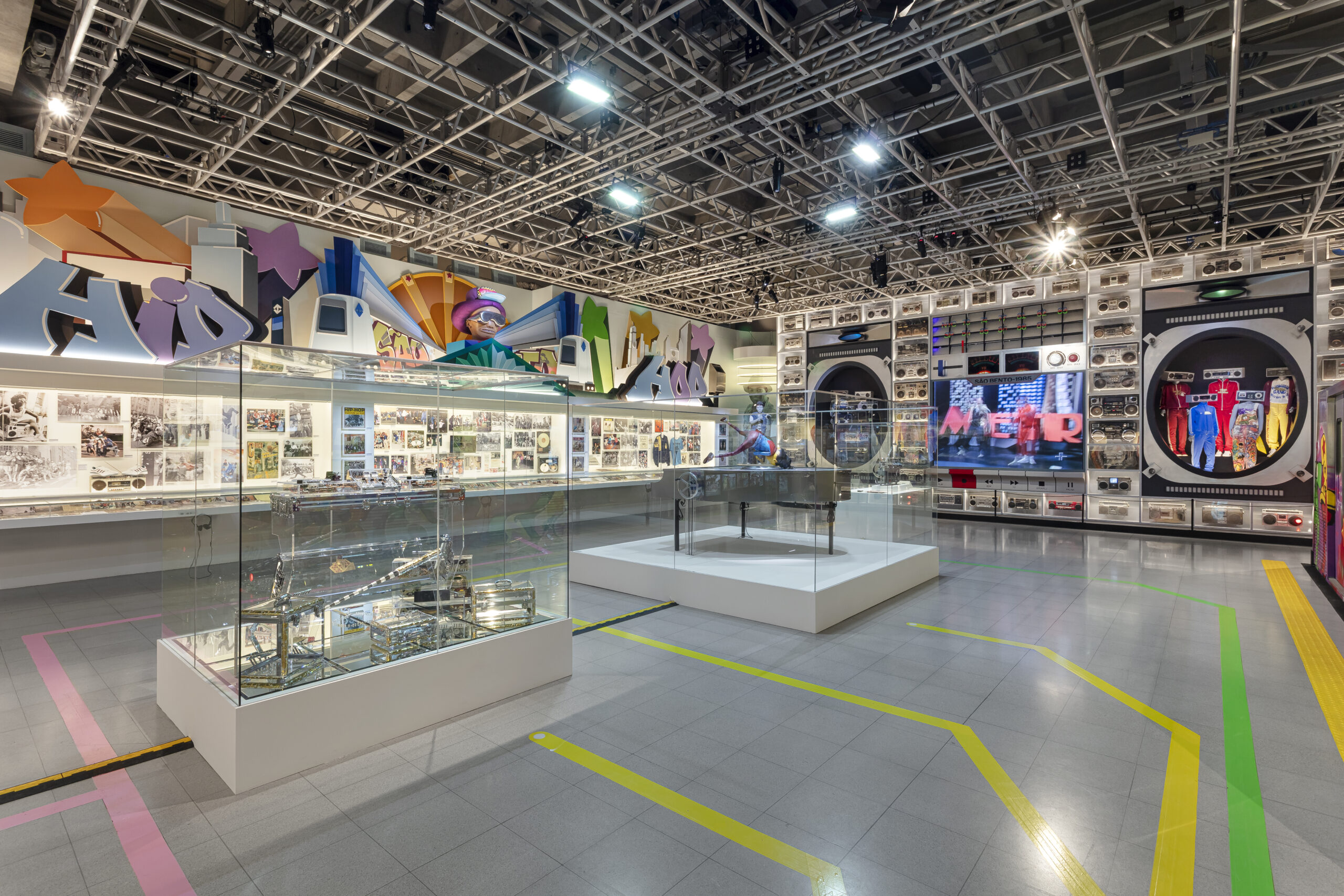
The exhibition is super engaging. It includes a lot of information that I didn’t expect, and it makes new connections. It’s very important to learn about.
Otavio: Especially for today’s generation, who sometimes have no idea what the 80s were like for those who lived through those years. What was it like to do graffiti back then, what was it like to put a big piece of cardboard on the street, turn on a radio-cassette player and dance, what were the first rap songs like, how were they made? There’s something about awakening that playful side of that era.
And also the mix of these cultures, because sometimes we think of Brazilian culture, American culture, but in reality, especially after television, everything became very mixed.
Gustavo: The exhibition focuses on São Paulo, but in one part we talk about Rio, Curitiba, and the Amazon, which had tribes that danced breakdance at the time. The interesting thing is to see how we absorb this information – which is North American information – but how we do it in a Brazilian way, in our own original way. You see Nelson Triunfo, who comes from the city of Triunfo, which already has frevo and maracatu in its blood, and he comes here in the 70s, mixes it with soul music, mixes it with funk – the old funk – and then breakdance. Brazilians have this talent for mixing cultures and doing it in our own way, which ends up being celebrated around the world. We wanted to show that too, how we absorbed a culture that was born in the United States, but that we made our own way with it.
Otavio: It’s a research project spanning over 40 years, of researching, collecting material, preserving things. These last three years have been spent putting this exhibition together full-time.
Music plays a very important role in your lives. Tell us a little about this new exploration you’re undertaking in the field of music.
Otavio: We’ve always been very connected to music. We’ve always listened to music in order to draw, but in a very eclectic way. I listened to opera with my grandfather, progressive rock with our brother, new wave with our sister. I’d take all her records and scratch with them, and I ruined them all. There was hip–hop in the streets, too. We’ve always seen our work as having a musical background as well. We’ve always seen everything existing with music, and we’d turn it into a music video in our heads.
Then comes the production aspect, of starting to produce music. We’re also DJs and we like to play music. We play music together and produce music so we can play it. We used to mess around in the studio for fun. We started playing music here and there, and there was always this connection with DJing. And now we’re doing it more consistently – mixing sound and image as well.
Interview conducted on September 11th, 2025 during the talk Mediating Practices at ArtRio.
Photo: Filipe Berndt
2023
Photo: OSGEMEOS
Photo: Martha Cooper
2017
Photo: Filipe Berndt
SESC 24 de Maio, 2025
Photo: Filipe Berndt
2020
Photo: Rick Coulby
2024
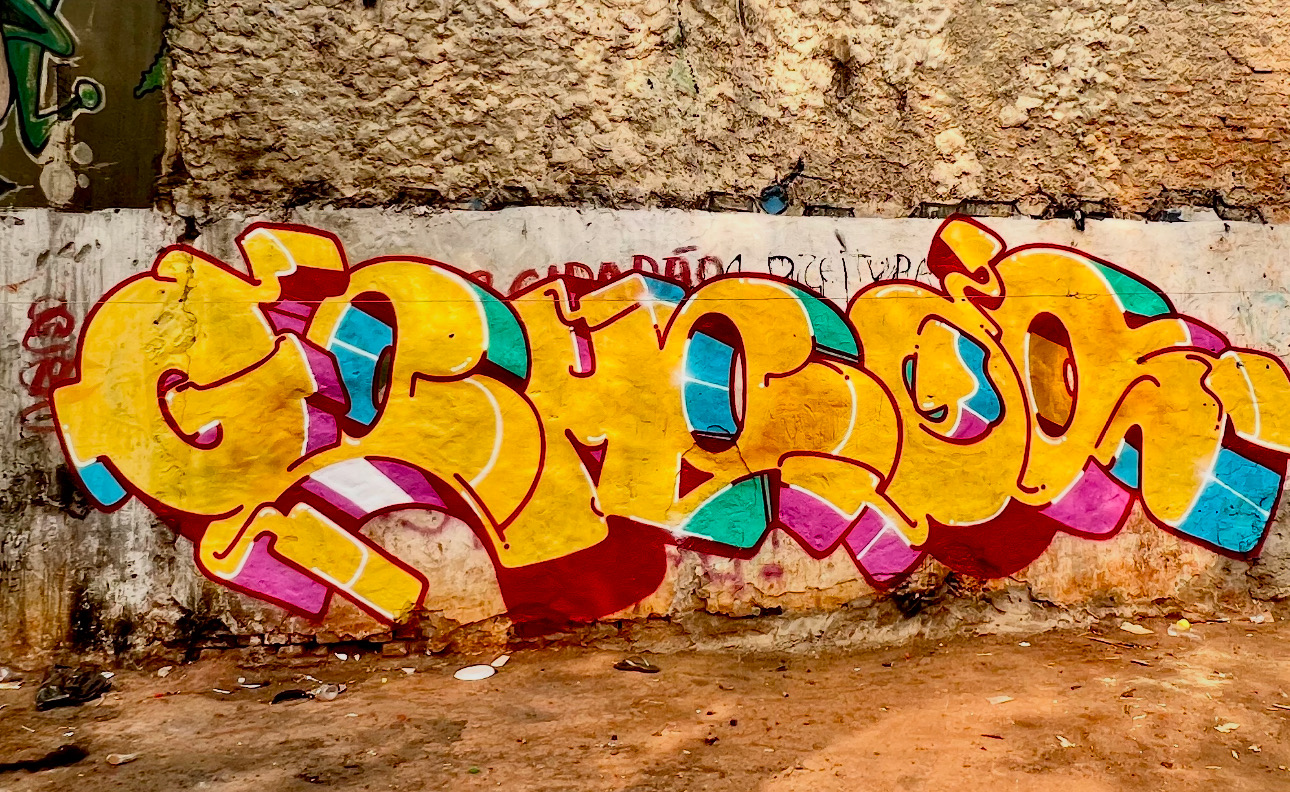
Photo: OSGEMEOS