

Edu Silva
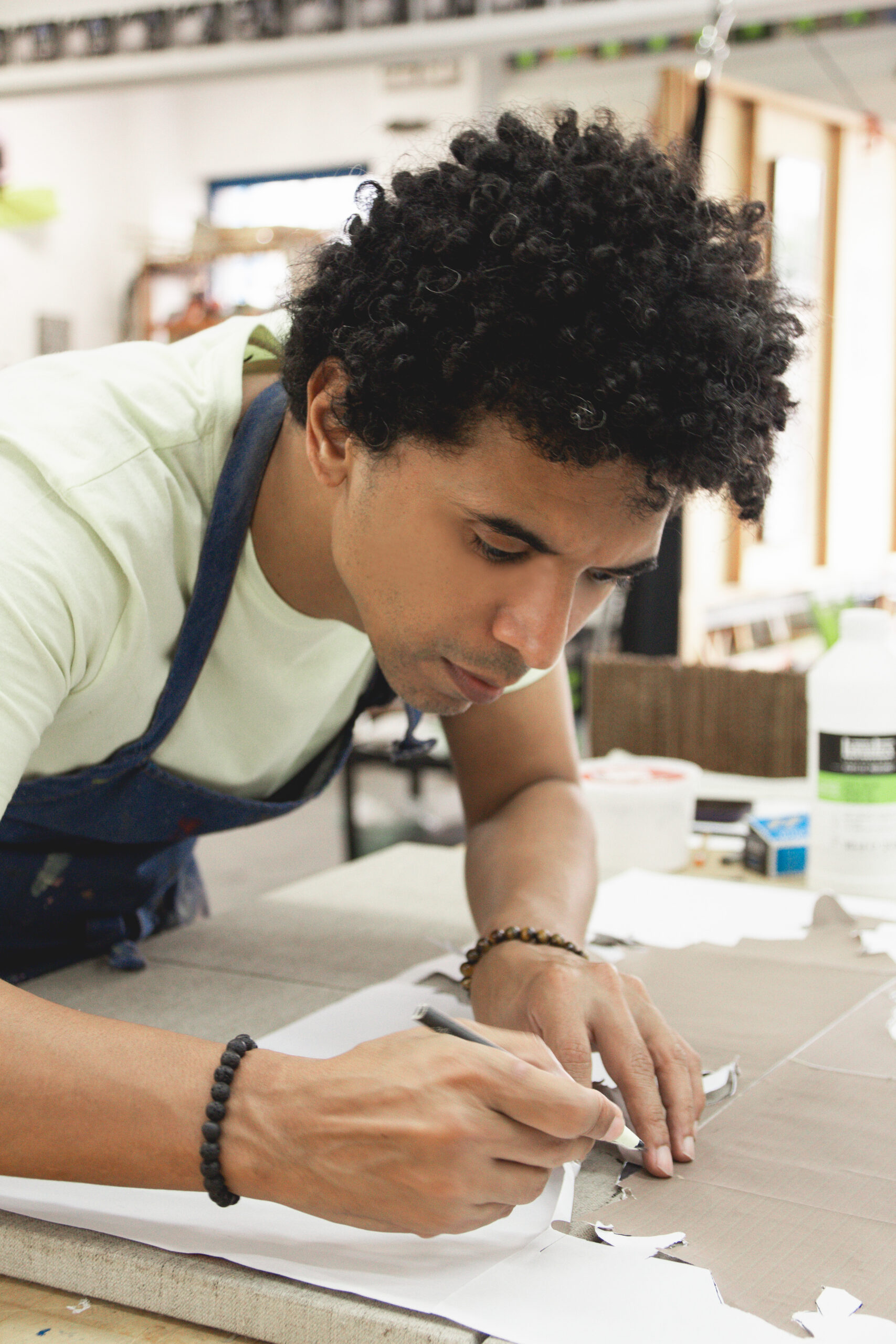
Edu Silva (São Paulo, 1979) develops his work from a perspective that is both intimate and grounded in materiality. His work emerges from personal experiences – the place where he grew up, the displacements that moulded his perception of the world, the way art entered his life – and then extends to broader issues. What looks like a formal decision is actually a process of critical overlap, in which the materials are not just supports, but agents that carry their own history. Between colour, matter, and surface, his compositions reflect social contrasts, invisible hierarchies, and the mechanisms of exclusion and belonging that operate both in art and in everyday life. In our interview, the artist takes us through fragments of this journey, from his first intuitive contacts with painting, to a deeper understanding of his artistic practice. Check it out:
Edu, thank you very much for agreeing to do this interview. I’d like to start by asking you to introduce yourself, with any information you consider relevant, thinking of an audience that doesn’t yet know your work.
I’m Edu Silva, I’m 45 years old, the son of northeastern parents. I was born in São Paulo, but grew up in Embu das Artes, in Greater São Paulo. The neighbourhood where I lived was right on the border between Embu and the capital, a place that seemed to be forgotten by the city councils. It was as if it was on the fringes, without fully belonging to either side. As a child, I thought it was fun to play with this idea of being in two places at the same time, but years later, when I was already working in art, I understood how this notion of borders ended up appearing in my work.
My first contact with art was through ceramics and pottery classes. That’s when I discovered that I had a certain manual ability, but at the time, aged 12, I wasn’t mature enough to even think about being an artist. In my family, we didn’t talk about the profession in that way, but I always liked drawing, making up stories and creating narratives. As a child, I spent hours playing with those juice and chocolate containers that came with parts to cut out and assemble. I also loved jigsaw puzzles. I was never that outgoing child who played in the street – and when I tried, I often ended up coming home crying because the more experienced boys in the street didn’t take it easy with me.
It was only later, already immersed in art, that I began to look at all this more closely and to realise how these references from my childhood, and my experience on the border between two territories, were reflected in my painting.
And how did this interest in the materials grow?
My family has always been very ordinary, very Brazilian – the beans and rice thing – so I didn’t have much encouragement to explore the making skills I discovered as a child. What I always heard was that I needed to work, have my own money, have a job, in other words, contribute to making someone else’s dream come true. And that’s fine, I don’t see that as a problem; however, it was all I had as a reference. As a teenager, between the ages of 15 and 18, I started to move away from the peripheral culture. There were local discos, but I was never much of a clubber. As I grew up in Embu, the cultural venues in São Paulo – such as the Pinacoteca (São Paulo State Art Gallery) and MASP (Assis Chateaubriand São Paulo Art Museum) – seemed very far away, a real journey. I didn’t have any friends who went to these places and, at school, I didn’t go on excursions there either, so I hardly knew these museums existed. It wasn’t until later, when I began to study English and Spanish, that I met a class of people with a very different cultural background to mine. And then, at university, I had an Art History teacher who was super strict about giving marks. At the end of the first semester, he said that if we went to the Pinacoteca and recorded our impressions, we’d get three points towards our average. I went, and that’s when everything changed. I was mesmerised! I think that was the start. Then I started going to MASP and other museums in the city.
Although Embu das Artes has a strong cultural scene, with naïve painters and ceramicists, I was never that interested in it. When I was at university, my gaze was totally focused on this Euro-centred culture. I thought that was “culture,” while what I saw on the periphery was just my day-to-day life. Only later did I realise that it was another culture – different, but just as rich. Even so, I remember the impact of seeing an orchestra, or going to the theatre for the first time. I would go into a trance listening to an orchestra at the Sala São Paulo, or the Municipal Theatre. It fascinated me and made me want more.
I didn’t finish that first degree. Around the age of 29, I started a relationship and had a strong desire to leave the country and get to know other cultures. My partner was super upbeat and loved travelling. I worked in an advertising agency and still had that adolescent desire to have a car, a motorbike – in the reality of where I grew up, this represented status. I managed to get some money together and started a second degree in Multimedia Production. It was at this time that my partner asked me if I wanted to go to Europe. For her, travelling was normal, but for me it was a distant dream. I took my money and chose to travel. We spent a month in Europe, travelling through eight countries and about 18 cities. For me, that was my master’s degree.
Before the trip, I read a lot about art and already knew which works I wanted to see in the museums. It was a very intense and personal experience, without anyone guiding me. I was seduced by the great masters – Henri Matisse (1869-1954), Pablo Picasso (1881-1973), Mark Rothko (1903-1970) … I used to devour those little books from Folha newspaper’s Great Painters Collection. In Rome, I was mesmerised by the size of the doors and the architecture. Everything seemed magical. That was just the first of many trips. When I returned, my outlook changed completely. I began to better understand the architecture of São Paulo, the collections of the MASP, the Pinacoteca, the MAC (Museum of Contemporary Art of São Paulo). My curiosity only grew.
During this period – second college, office work, travelling – I was already flirting with digital work. I’d go to a lot of exhibitions, both in Brazil and abroad, and I’d write everything down in a little notebook, make little sketches, almost as if I was “stealing” fragments of these works. My visual interest was very much in modern art, especially Cubism. I created works on Photoshop and Illustrator. For one of my college assignments, I had to make a re-reading from images. I did it on Photoshop, printed it out on a nice support and handed it in. The teacher looked at it and said: “You’re going to get a 10, but I’m not going to give this back to you, I’m going to put it in my house.” Those words fuelled me. Until that moment, I thought I just needed to work, earn money, pay bills, but then I realised that maybe there was another way to live.
Soon after, I travelled to Europe and there I met a Chilean artist who had been naturalised in Belgium. I showed her my notebooks and she asked me, “Why don’t you paint?” It didn’t make sense to me – paint was expensive, and I’d never thought of it as affordable. The next day, she turned up with a giant bag full of acrylic paints and said to me: “Now you have no excuse not to paint.” That moved me.
Voltei para casa e pintei horrores. Foram uns vinte e poucos trabalhos, quase como registros visuais do que eu tinha visto e vivido naquele um mês. Eu ainda morava em Embu, num quartinho com um banheiro, sobre a casa dos meus pais. Pendurei tudo na parede, como se fosse uma exposição particular.
(Translation: I went home and painted a lot. I made twenty or so works, almost like visual records of what I had seen and experienced that month. I still lived in Embu, in a little room above my parents’ house. I hung everything on the wall, as if it were a private exhibition). One day, a friend came to visit me, listened to my travel stories and asked: “Why don’t you do an exhibition?” I replied that it was just a record, but he insisted. Visually, the works had a very modern art feel, a kind of synthesised cubism, with well-defined colours and geometric figures. I took two of them under my arm and went to the Embu Cultural Centre. The curator looked at them and asked: “Do you want to exhibit them next month?” I was amazed.
Looking back today, I realise that, when something is already ours, the universe finds a way to deliver it. Perhaps the opportunity will pass by you at another time, but sometimes we’re not ready to receive it. I didn’t study art, so I didn’t have that “HD” [hard drive] full of theoretical references. But I wasn’t afraid of making mistakes either.
The curator started calling me Edu Silva – until then, I hadn’t even thought about how to present myself artistically. And things started to happen. The exhibition had a lot of visibility because Embu is a tourist town. From then on, I received invitations to exhibit in other places. My partner helped me a lot – we’d put the paintings in the car and just go. I didn’t know anything about the art market or galleries, but I got to know people and talked to other artists. Until a moment came when I thought, “This is getting serious, and fast. I need to study.”
In the beginning, your relationship with painting was very intuitive. At what point did you begin to see your work as part of a larger discourse within art?
I started taking some courses that covered European Art History, and one of them was with Rodrigo Naves. Through him, I learnt about Paulo Pasta’s work. At the time, I was in my thirties and very hungry for learning. Rodrigo himself sent my portfolio to Paulo, who accepted me onto his “Painting and Reflection” course. It was a very rich experience. Everything was new to me and Paulo has this very generous relationship with his students. Little by little, I built up a network, but in a natural way because those who attended the classes became friends, and I and a few other artists from the course formed a group of artists who met to talk about art and organise exhibitions. That changed everything. I started attending contemporary art exhibitions, visiting galleries, and getting to know alternative spaces. My tastes and references broadened. It was a very intense experience.
This course was a driving force. I met the people from Casa Contemporânea, in Vila Mariana; a space for culture, exhibitions and debates on art, created by Marcelo Salles and Marcia Gadioli. I admit it was raw. It didn’t have an organised timeline on the history of art, but there we had so many debates that, to this day, I still participate in a group with them. I feel that my existence as an artist began to be consolidated there.
At that stage, my painting was already changing. They were compositions that alluded to favela houses, built from the brushstrokes themselves. During the Pasta course, I broadened my references. When I look back, I see that my painting today is almost a zooming in on those brushstrokes.
Without even realising, I already had an unconscious desire to talk about class differences. At first it was perhaps more direct and figurative. As I matured, I began to look inwards. It sounds clichéd, but when you investigate yourself, things start to make more sense.
I already knew that my relationship with art was linked to colour and painting. I developed my technique with acrylic paint. I like it for several reasons: it’s synthetic and, in a way, some relationships are also synthetic, superficial. My first colour field works were called Estudo sobre mestiçagem (2016). I would have a red field and a yellow field, and between them a new colour would emerge, the result of mixing the two. I created some production rules.
O interessante é que, ao mesmo tempo em que o trabalho se chamava Estudo sobre mestiçagem, quem olhava via dois campos predominantes, um maior que o outro. E nas relações com curadores e críticos, considerando minha história e existência, surgia a ideia de um embate cromático: uma cor tentando ocupar o espaço da outra. Aos poucos, meu trabalho foi absorvendo camadas e se tornando mais político, abordando questões de classe.
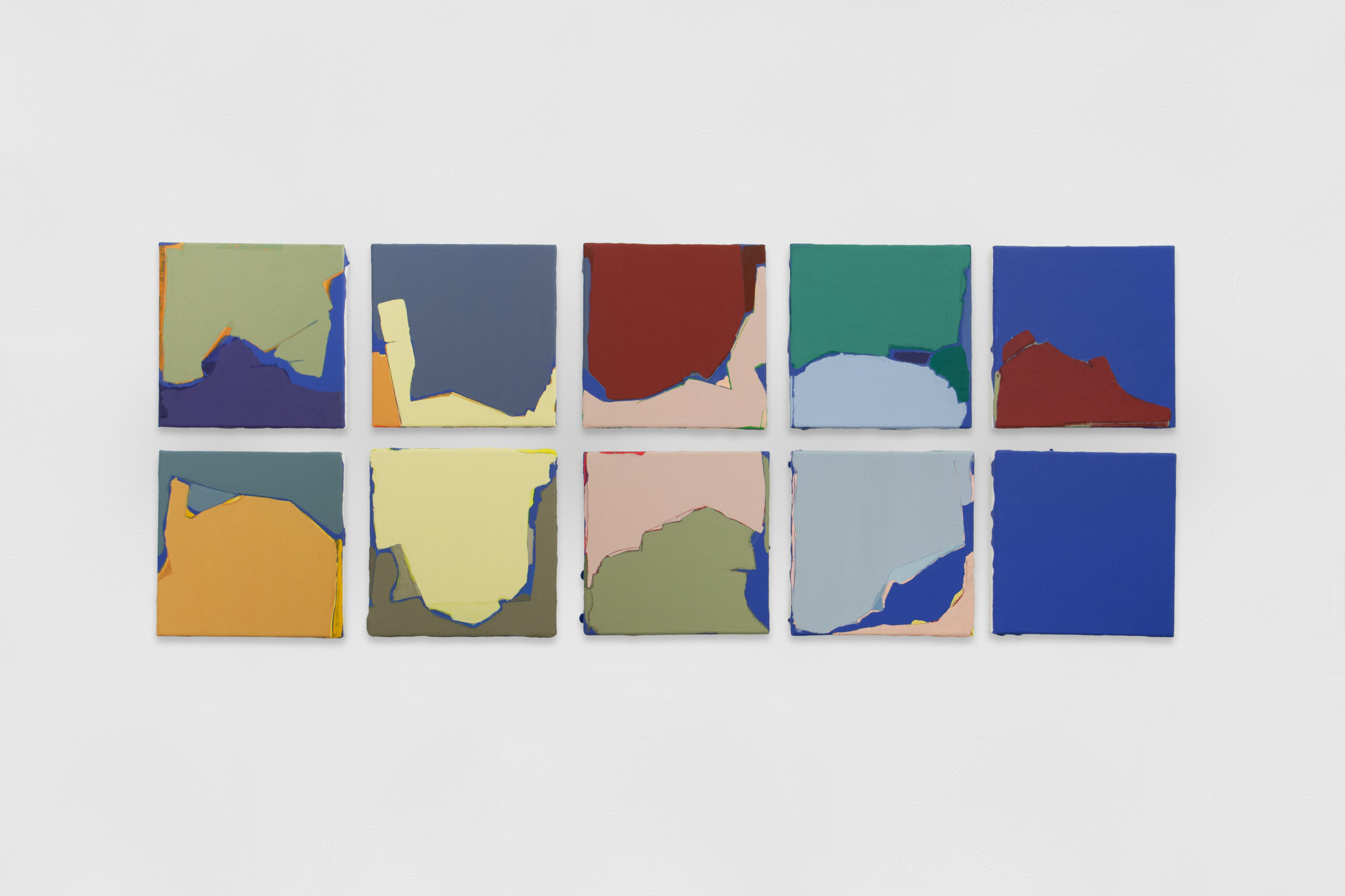
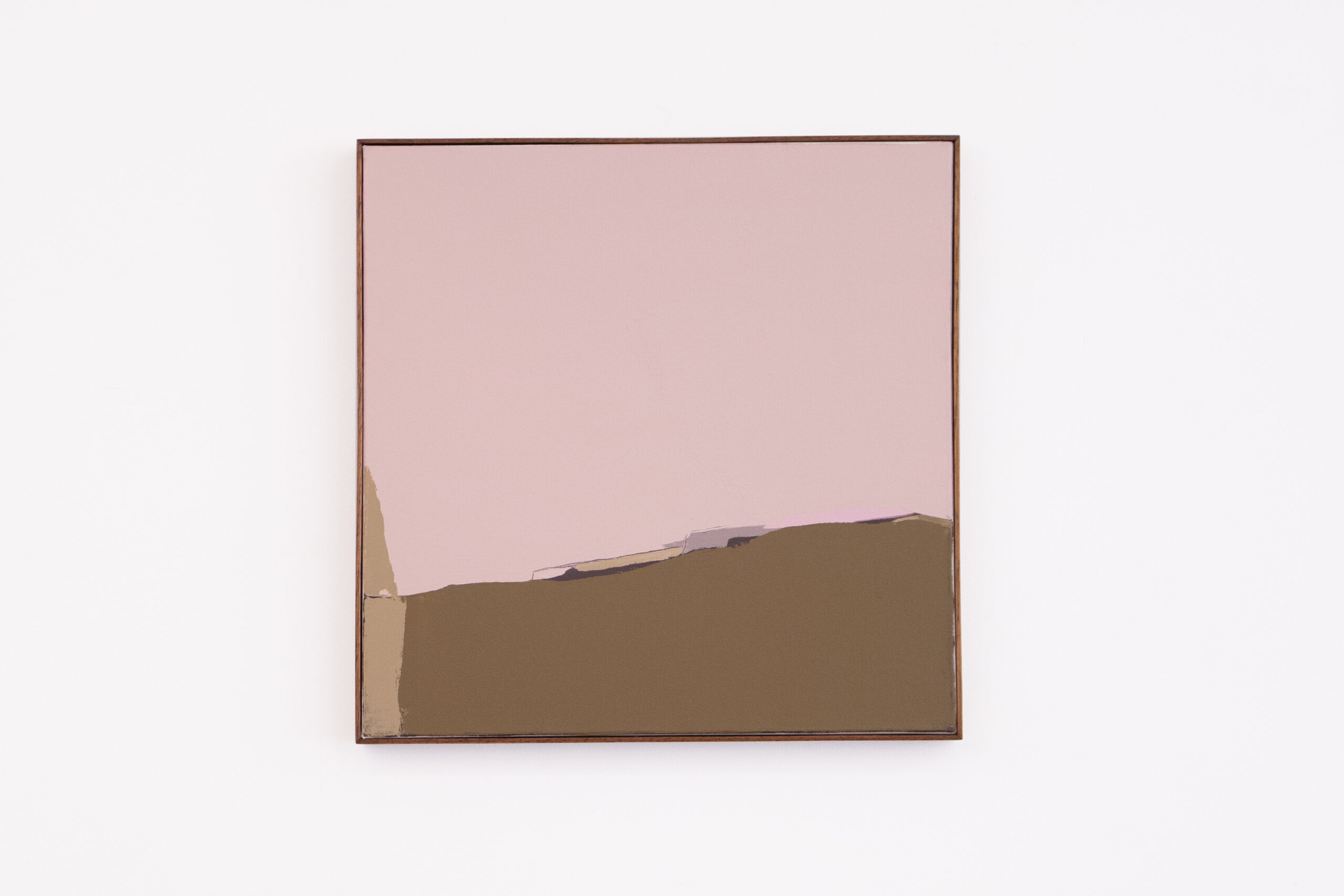
(Translation: The interesting thing was that, at the same time as the work was called Estudo sobre mestiçagem (Study on mestizaje), the viewer saw two predominant fields, one larger than the other. In conversations with curators and critics, thinking about my history and existence, the idea of a chromatic clash emerged: one colour trying to occupy the space of the other. Little by little, my work absorbed layers and became more political, addressing class issues). Because it’s non-figurative work, it’s always been very generous with me. It’s open and allows people to approach it in a very personal way. My works are basically studies of colour relationships, investigations of light, rhythm, and contrasts. As I’ve given interviews and talked more about my work, I’ve noticed issues that have always been there. For example, the idea of a territorial border, which is reminiscent of cartography – my work suggests this visual relationship of a map, of an aerial view. There’s also the question of the route. When a border crosses the work from end to end, this has to do with displacement.
I’ve done exercises in thinking of a map of a quilombola territory [settlements created by escaped enslaved people] and abstracting it, without referring directly to it. This becomes an extra reason to paint. Then I began to understand these borders as drawing, in the broadest sense. I look at these lines and relate them to various issues. Painting, for me, is always this space of discovery and connection.
It’s very interesting to think about these possible amplifications or analyses of the field of painting, which come up in Art History, but also in politics, and in landscape. These are all paths you’ve travelled in your personal life and in your career as an artist.
The very process of making art is also inspiring. I think I’ve reached this place of realising what I’m doing, and why I’m doing it. In making art, you also see ramifications. Sometimes, doing painting and dealing with colour means that the work can’t take any abuse. I start from an idea: I want to work with blue and yellow, but, suddenly, the tone of each one might suggest the addition of an ochre or an orange. If one colour comes in, the other starts to complain, it loses contrast. Then I change the other colour. This dialogue between me and the painting opens up possibilities, it makes me more intimate with the process. I’m creating along with this artistic endeavour, expanding my vocabulary.
I’m also getting closer to the research of other artists, like in the studio I share with Fábio Menino and Alan Oju. Fábio, a figurative painter who uses oil paint, always jokes: “I don’t know how you achieve what you can get out of acrylic.” There is a certain prejudice among painters about acrylic paint because it is synthetic, shiny and newer than oil. In the opinion of some traditional painters, oil is greasy, oxidises and ages with dignity. Acrylic paint, on the other hand, is vinyl, plastic, and has a dynamic that interests me. When I understood this prejudice existed, I appropriated it and started working with linen. Linen, a noble, weather-resistant material, is used as an element of colour. I paint it with white acrylic paint. Once, in a study group, I showed a piece of work and someone commented that I had “spoilt” the linen. I replied that I hadn’t, that it was there as a material, in contrast to the white of a cheap acrylic paint. This sparked a debate about painting, but also social and racial issues.
In 2017 and 2018, I started flirting with objects and became interested in the materiality of cardboard, even before I learnt about the concept of “pardo e papel” [this refers to the use of brown craft paper in the works of Maxwell Alexandre, and the use of the word ‘pardo’ in Brazil to describe mixed-heritage and afro-descended identities]. I’ve always had identity issues, because I grew up in the 1980s and 1990s, when the ideal was not to be black. The further you moved away from that, the more accepted you would be. That was the social imaginary. In films, cartoons, and soap operas, black people were portrayed as thieves, vagabonds. Today, this has changed, but there’s still a lot more to achieve. I didn’t even think I’d be alive to see this movement towards acceptance of blackness. Back then, I straightened my hair, I wanted to fit into the mould of whiteness.
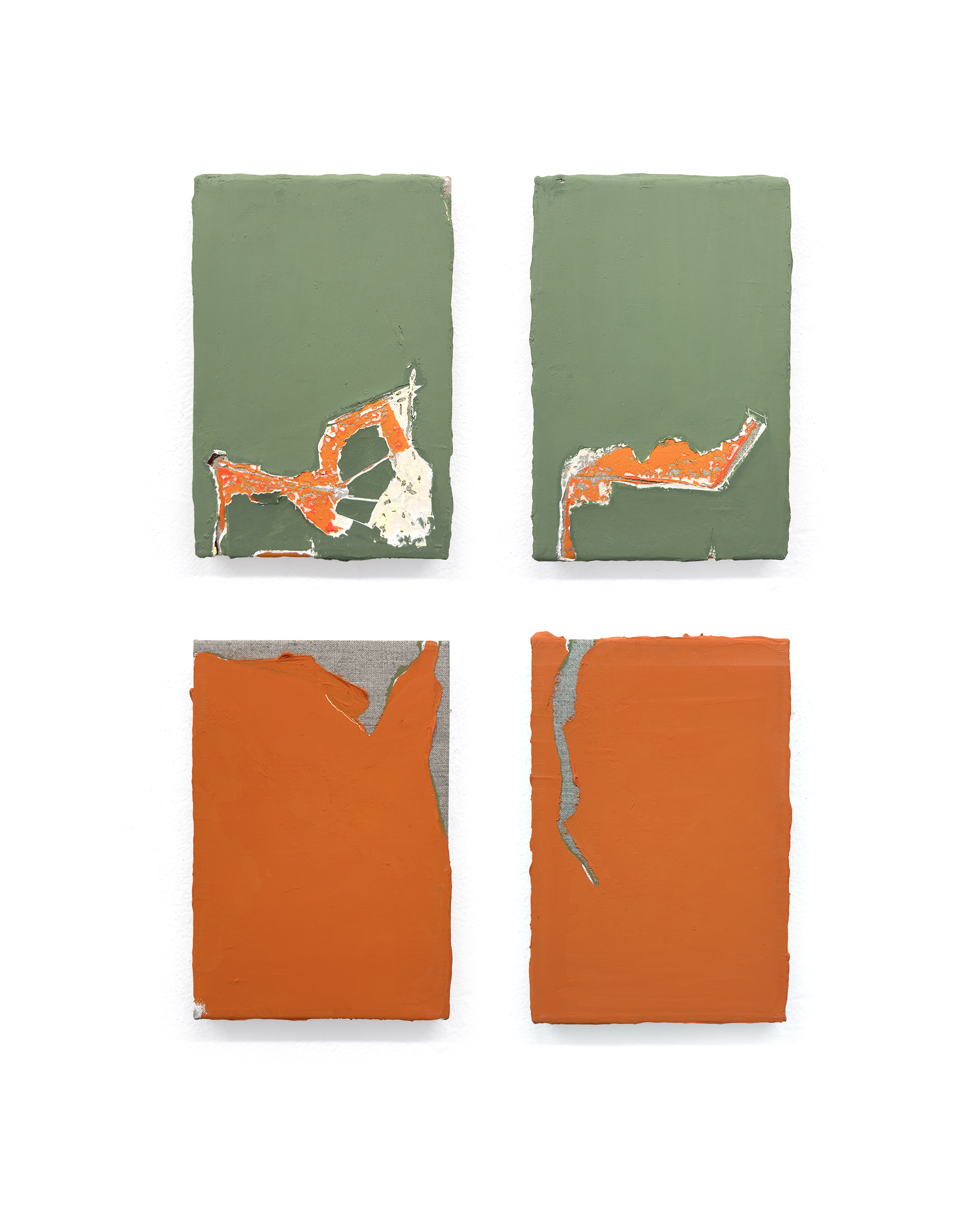
When I started working with cardboard, I would overlay it with white paint, which was then peeled off, as in the work Self-Portrait 40 (2020). I was realising that the brown person is a character created by the myth of racial democracy that weakens a political struggle and offers false rights. Following the reasoning of colourism, a light-skinned black person may have more access than a dark-skinned person, but they never come close to the privileges of a white person. This maturity was difficult to achieve. When I recognised myself, I realised that the work portrayed this identity oscillation: removing the white, revealing what’s behind it and taking it on. The work has this passage and opened me up to exploring other materialities.
In the same way that I looked at linen, I started to examine marble as a symbol of nobility, thinking of sculpture. Visually, I saw marble as white, cold, clean, heavy. At the time, I was reading Cida Bento’s The Pact of Whiteness and created the Pact series (2023). These are blocks of marble set against sheets of cardboard. The weight of the marble presses down on the cardboard. The materiality speaks for itself. Even without a caption, anyone who looks can see: “white on top of brown? The amount of brown is greater, supporting the white.”
My father always worked with marble and wasn’t literate. There is a cultural gap between us. I used his labour on a project. When I told him the price of the work, he thought it was expensive. I asked him why. “Because it’s just a piece of marble with cardboard.” I teased him. Little by little, he began to see: “That sounds like society, doesn’t it?” If you have to catch a crowded bus in the morning, raise children, and put food on the table, who has time to develop sensitivity?
When I think about my journey, about the social differences that run through my life, I realise how this is all present in my work. My first job took me from Embu das Artes to Avenida Faria Lima, and I didn’t even realise that it was one of the richest places in São Paulo.
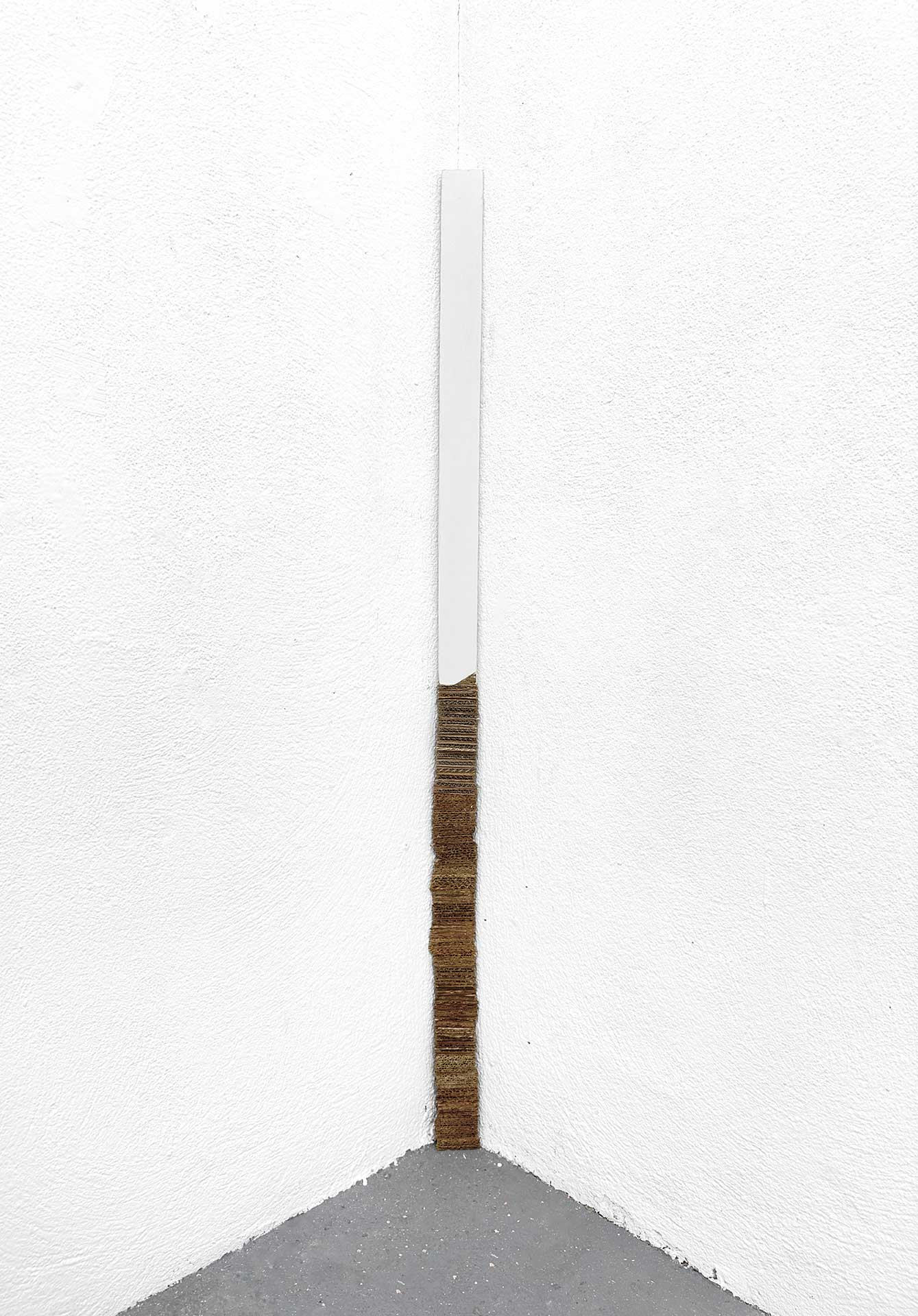
Maybe it’s my interpretation, but in the Self-Portrait series (2019) there’s not only this contrast, but also the harmony of objects meeting. In your painting, I think there is a celebration of this space between, the more malleable, this space of coexistence.
Totally. Even though the choice of materials, or the division of the colour field, presents a contrast, there is somehow a search for harmony, for beneficial coexistence. As Milton Santos (1926-2001) once argued, “We need to look for similarities between people and peoples, not just differences.” It’s not just about contrast, it’s also about looking for possibilities of harmony, of existing together. Both the paintings, and these objects, in addition to all these issues, contain, materially and formally, issues that are of interest in the making of art – a rough or smooth surface, the tensioning of this, the process of repetition.
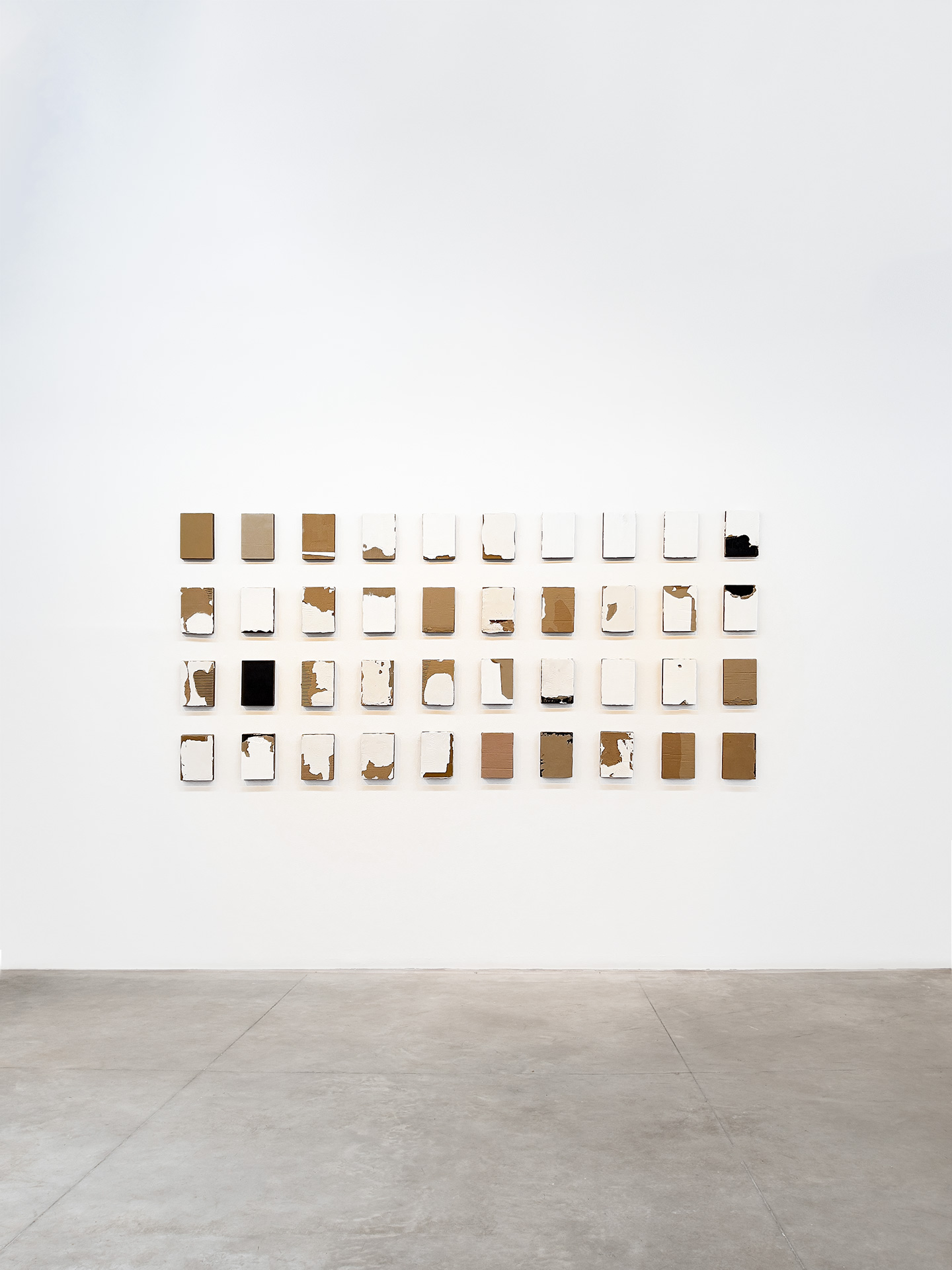
Your work isn’t just painting, it’s an extremely conceptual work that is resolved in painting, but which has these different forms of observation, of approach.
As my work is visually non-figurative, often these issues that we’re talking about here aren’t delivered in an obvious way. For example, I had made dozens of paintings, all of which were called Studies on mestizaje (1, 2, 3...). But as I expanded my knowledge and expertise, I realised that I didn’t want the title to give too much direction, I didn’t want to close off the work, so I started simply numbering the works. After that came several more – I painted over a hundred. As I matured and went through the process, I realised that a single painting often doesn’t cover everything I want to say. So I think in series, in polyptychs. When I make a work with ten parts, I think it brings about more of this idea of continuity.
I recently did a piece I call Trading (2024), when the titles started to come back, just “giving hints.” In all the backgrounds, I use a mestizo blue that I create from various combinations. I’ve noticed that some colours enhance this blue, others detract from it, and some coexist harmoniously with it. For me, this work shows this shifting of blue in relation to various other colours and, if you like, you can see that I’m talking about personal relationships.
I have a bit of a problem with the term “abstract” because, in art history, abstract doesn’t mean anything, it’s just form. In my case, there’s a desire to bring these colour relationships into the contemporary, to put a strain on something. Sometimes I think the term “abstract” doesn’t do this.I did a piece called Project Standardisation (2024), a series of portraits in which I worked with marble, marble dust, and cardboard. It’s an image-free work, but full of meaning and criticism. It was not assembled sequentially, but made in a more dynamic way. Calling this work Project Standardisation is essential for me, because I start from a rectangle of marble with the idea that it should be replicated, standardised, but then it comes out differently. Like Rothko, who used colour to provoke sensations and reflections, I think this is the culmination point of an artwork.
Interview conducted on 26 July 2024 remotely via Zoom.
Polymer emulsion and acrylic gesso on cardboard panels Polyptych | 21 × 15 × 3 cm (each)
2020
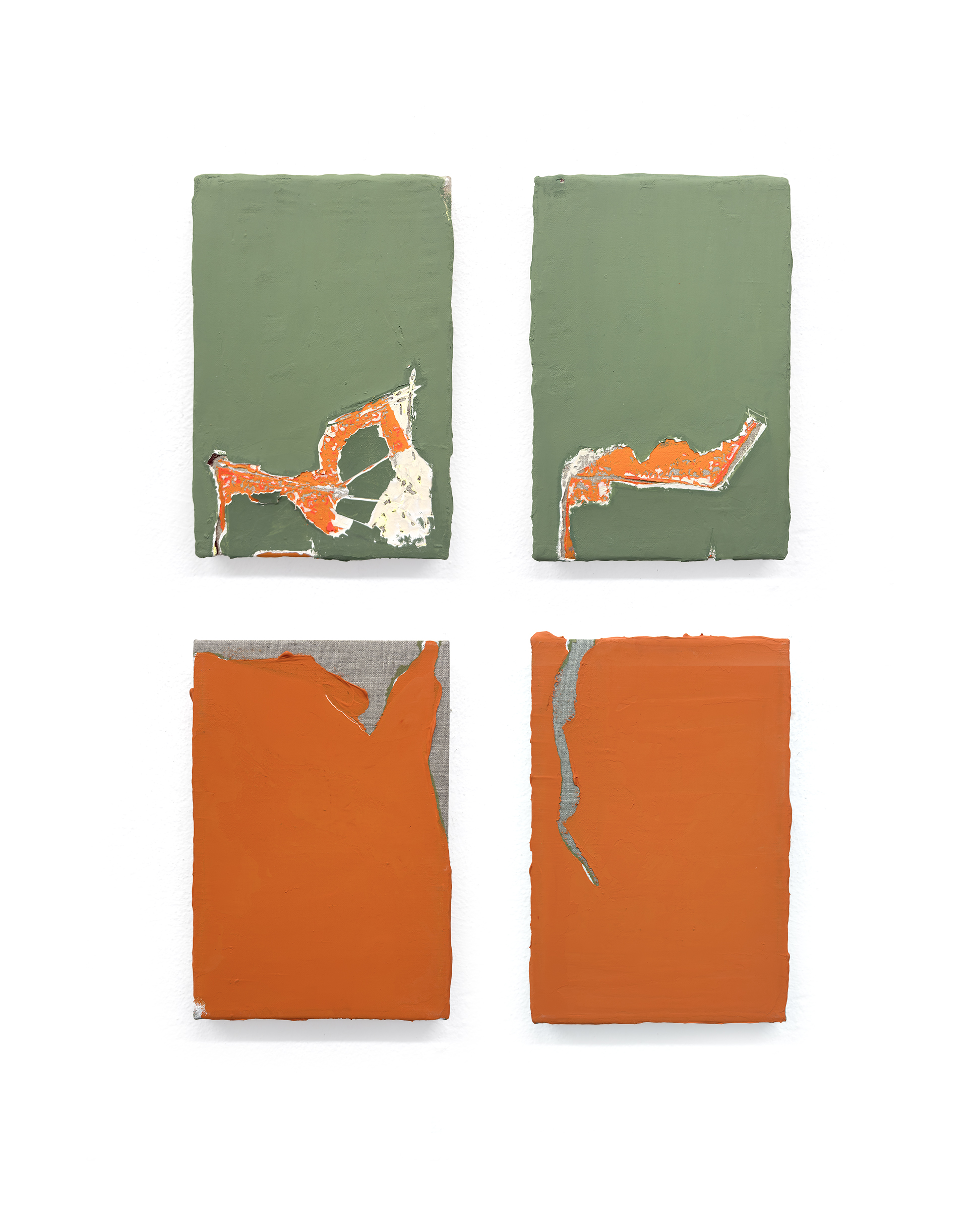
Acrylic on linen I 30 × 20 × 2.5 cm (each)
2024
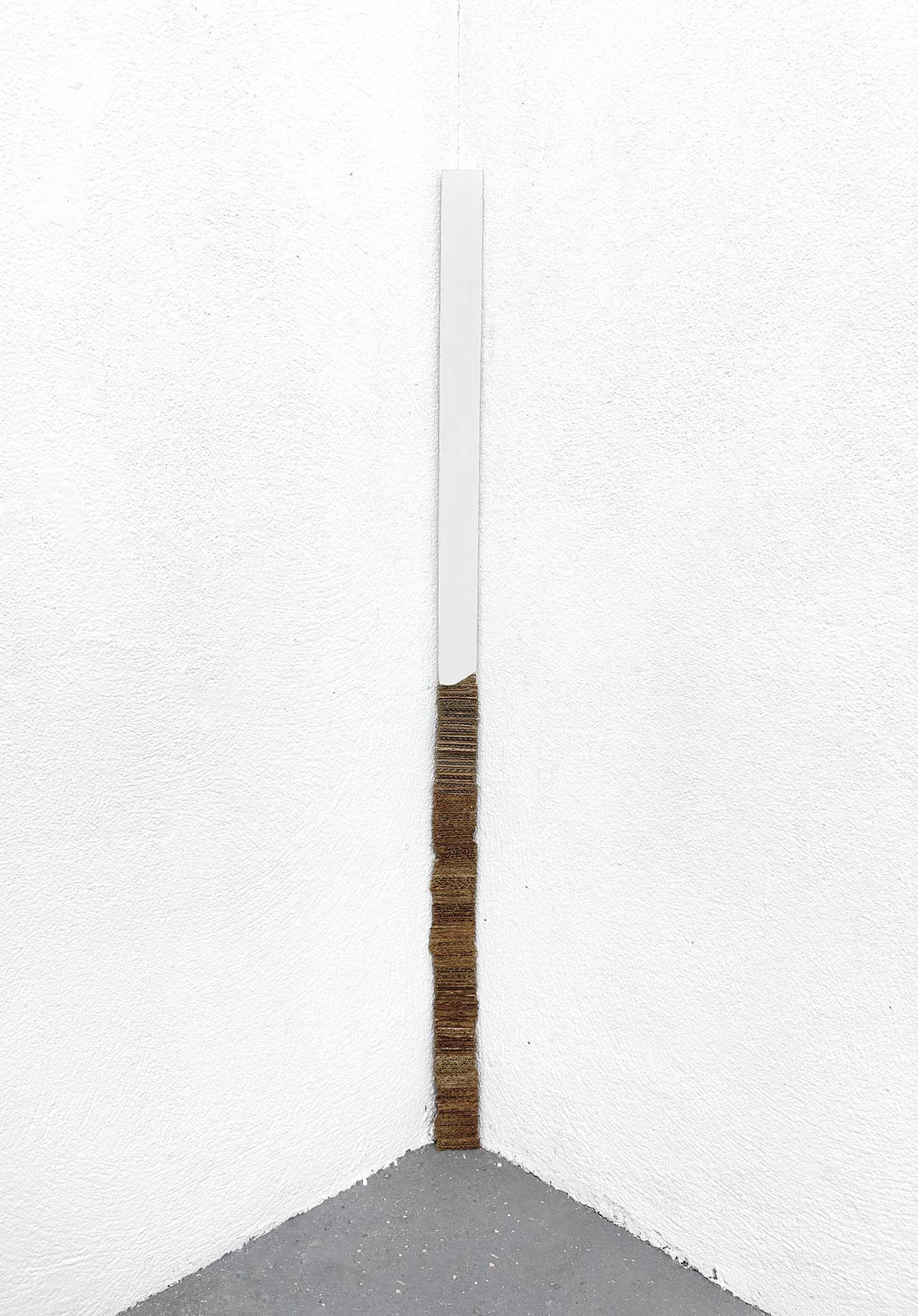
Marble and cardboard I 141 × 7 × 3 cm
2023
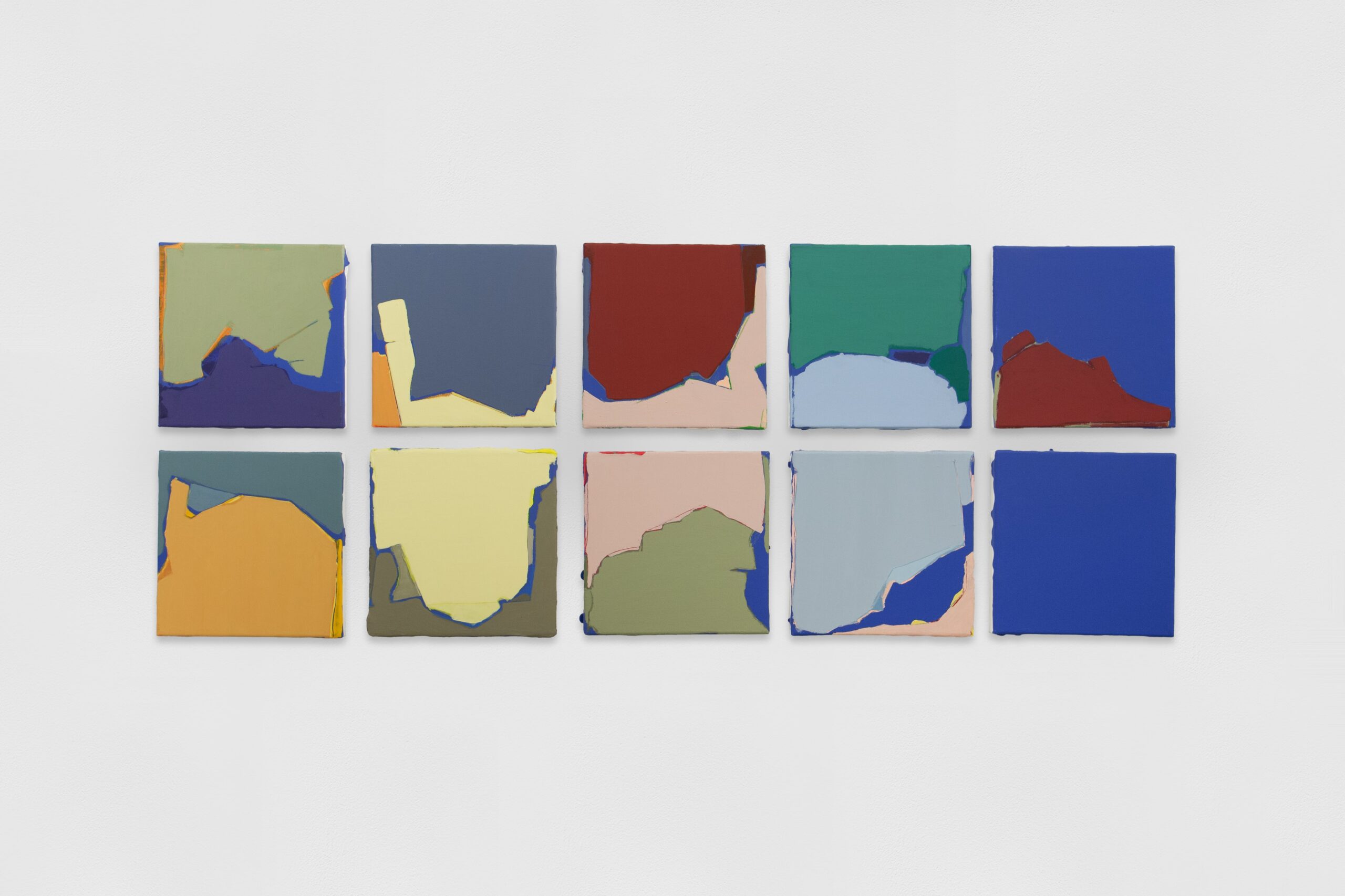
Acrylic on canvas I 24 × 24 × 2 cm
2023
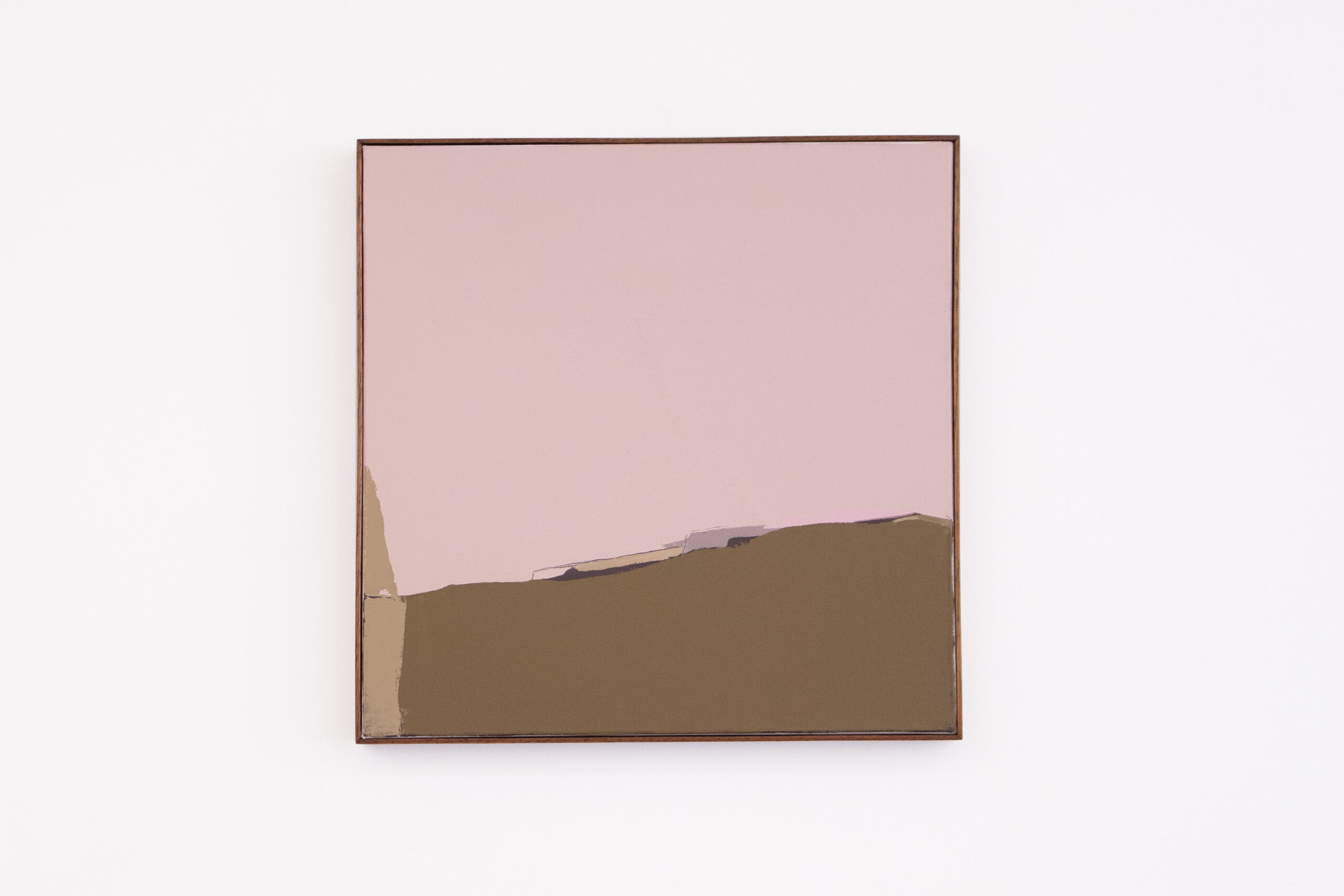
Acrylic on canvas I 40 × 40 cm
2016