

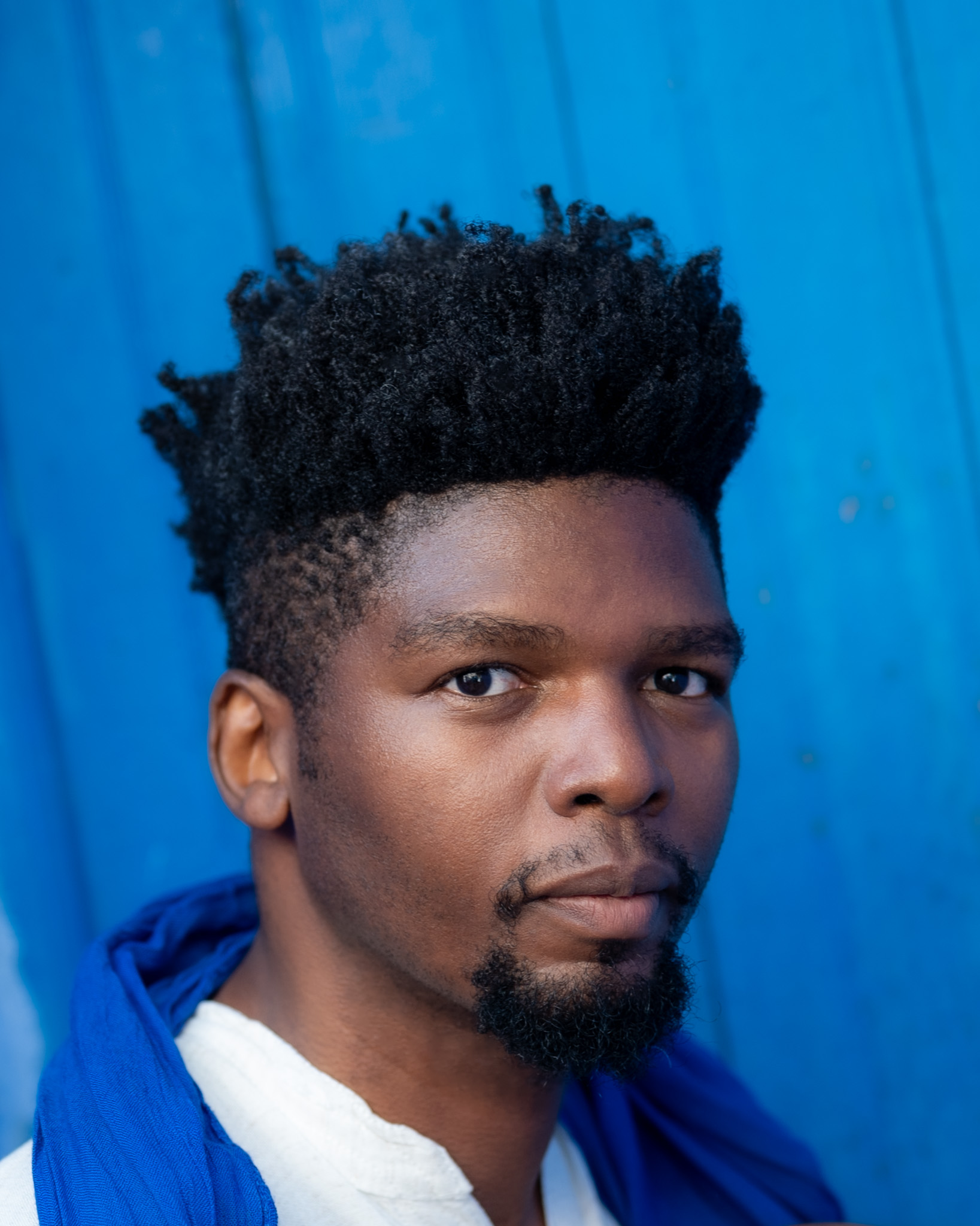
Adriano Machado
Visual artist Adriano Machado (Feira de Santana, 1986) uses photography, video, the construction of objects, and the writing of short stories, to bring to life “Afro-inventive territories,” a concept he created to describe spaces where black people construct the politics of life and freedom. Adriano sees these territories as places where everyday Afro-diasporic culture, freedom, and fantasy intertwine, allowing for the creation of new narratives and identities. In this interview, the artist discusses his creative process and reveals a deep commitment to the memory and identity of the people around him, using art to claim spaces of existence and resistance. Check it out:
Firstly, I’d like to thank you for taking the time out of your day to talk to us and ask you to introduce yourself with any information that you think is relevant, considering an audience that may not yet know about your artistic practice.
I’m Adriano Machado, I’m a visual artist, and I work with the languages of photography, video, the construction of objects, and the creation of narratives through short stories and texts. I’m from Feira de Santana, in Bahia, Brazil, and my research into image and visual arts is interested in themes such as territory, identity, memory, fictions, all understood as ways of trying to construct or make visible what I call Afro-inventive territories. My research revolves around the way people from the diaspora construct a politics of life and relates, in general, to the people with whom I have a relationship of affection, and a sense of family. My work comes from my own backyard. From there, I build images that exist between a fictional, fantastic place, and in everyday life. I’m interested in people’s memories, their working gestures, the ways in which they build spaces with their hands where there is no oppression, where they can create a freedom for themselves, an emancipation. And this in their daily lives, from their jobs, living with their children, their family, their relationship with animals, with things that are sacred and invisible. My research is also very concerned with photographic processes and how the figure of the photographer is understood.
Eu estou desenvolvendo alguns trabalhos que questionam esse lugar de poder do fotógrafo, pensando nesses movimentos coloniais que a fotografia também organiza e nos modos de construir imagens que operam no mundo.
(Translation: I’m developing some works that question this place of power of the photographer, thinking about these colonial movements that photography also organises, and the ways of constructing images that operate in the world).
Tell us a bit about the neologism Afro-inventive.
It’s a term I created from reading – Milton Santos, Achille Mbembe, Frantz Fanon, Azoilda Loretto da Trindade and other thinkers – examining this notion of how I talk about my territory from a fantastical movement. These territories are physical or non-physical spaces where black people construct gestures of life politics. When I talk about a life politics, I’m referring to the thinking of Pâmela Carvalho, a historian from Favela da Maré in Rio de Janeiro, who defines it as ways of guaranteeing the existence of Brazil’s black population, aimed not only at dignity, but also at movements that expand the rights to live, which have been restricted for black people by the historical violence that has taken place in the country. These words define my way of constructing images, objects, and my thinking about these narratives. In general, my images are presented as photographic series, or installations, conceived in slow time and telling a bigger story, with various possibilities of entry and crossings. This term Afro-inventive points to how the way black people exist is a game using tools to build a territory, a space.
Thinking about a specific work, perhaps we could talk a bit about Baratino (2018).
Baratino is a very popular slang term in Bahia that can mean deception, when someone is telling a lie or making up a very absurd, fantastical story, or trying to trick you, we say that they are “de baratino” or “you are de baratino on me.” For this series of images, I invited William, my cousin – I always photograph my cousins, most of my work has this relationship of trust with them – and I built portraits in which a man, who has something hiding his face, holds an animal in his hands. In this case, there are eight images that were made over two years, so there are several modifications. It’s not a work that follows the rules of a photographic portrait series, in the manner of its construction, but it creates a tension within a theme that interests me a lot, which is the still life. It’s a work that I’m doing by building a kind of stretching of what still life is.
For example, there’s a photo in which my cousin William is holding a rooster, and his eyes are covered by a raffia sack, which is a sack used at the market. Through the woven red you can see my cousin’s eyes, and the animal is put in a very powerful position. In the other portrait, he is affectionately holding a sheep and his eyes are blindfolded by a yellow band that the civil defence uses to isolate an area when, for example, there is a landslide in Salvador. These animals are also in a liminal space because they are farm animals that are cared for with affection, but they are also animals that we eat. And this has a lot to do with my family’s relationship with these animals. The work also points out – perhaps as a criticism of the traditional school of portraiture in photography in Bahia – the black body, the relationship with food, with animals and the sacred – visible and invisible – that exists in Bahian culture. Some people approach the work with an interest in religion, because the images refer to offerings and other things, while others find a way in through the colour, because of the red, while others enter through the framing, but I’m very interested in this thinking about still life painting that is transferred to the layers of the photographic portrait.
I think a lot about the narrative context, the fantastical, so much so that I write short stories about these images. At the same time, these photographs speak to me about how difficult it is, and how imperative it is, to try to organise and build a living space for oneself.
It’s interesting to think about these images in the tradition of still life, and in the tradition of Dutch painting.
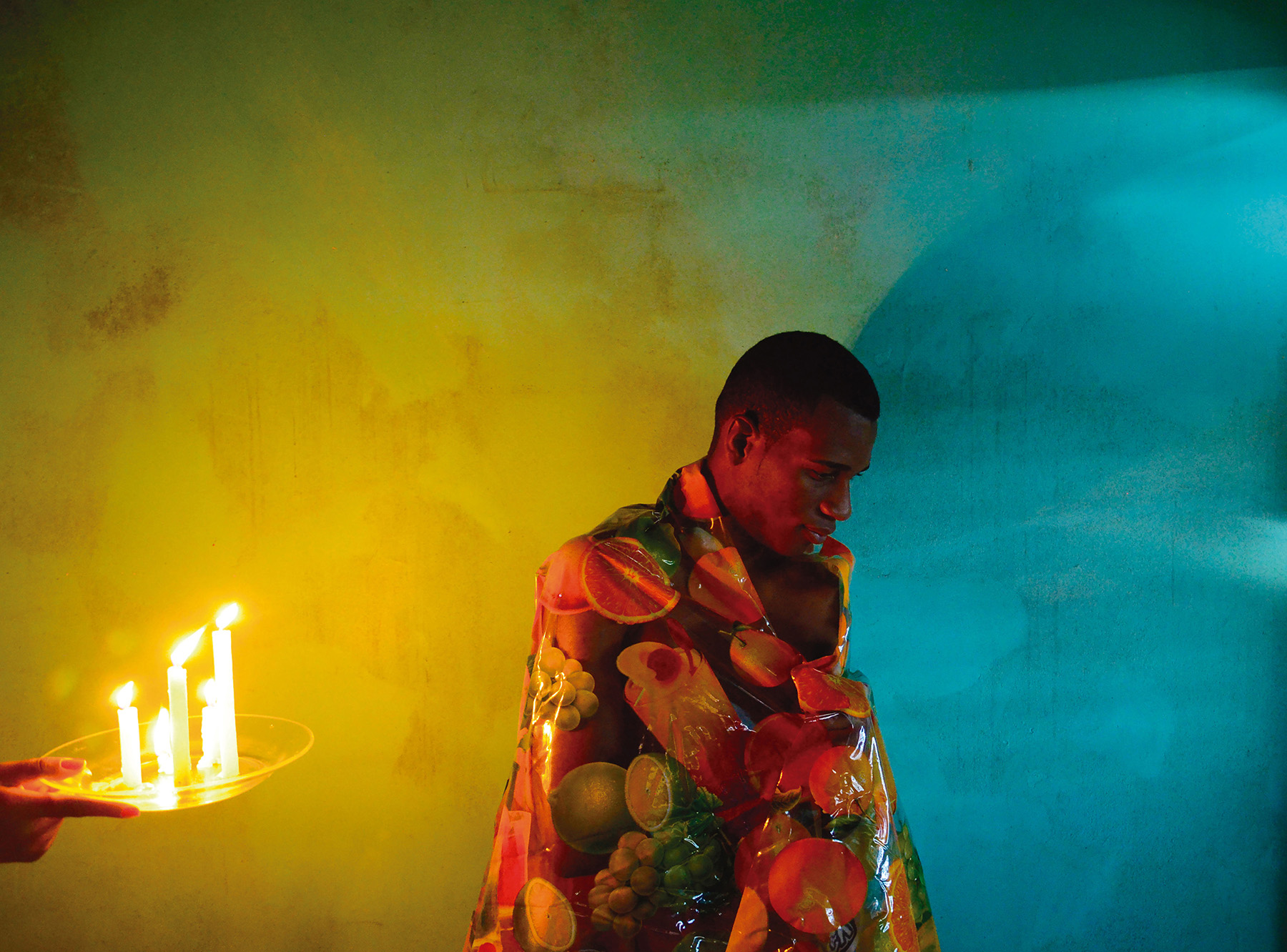
I have another body of work, of still life studies. These began before Baratino and is a series of photos in which I pursue my obsession with the plasticity of still life, and start thinking about the great painting collections. For example, you could go to the Pinacoteca do Estado de São Paulo and find a whole room with still lifes by Brazilian painters, and there are black painters who were great masters of still life painting, such as Estêvão Silva. Then I started building these portraits in which my cousins, and my friends, are covered in plastic tablecloths full of fruit, which are what we can understand as being every day, contemporary still lifes: the dishcloth, the tablecloth, the hyper-realistic plastic print. This is very much part of the Brazilian imagination and everyday life.
É como se essas pinturas, que remetiam ao poder, o que se pode comer, à fartura de uma elite de uma época, hoje fizessem parte da representação de fartura de uma família comum, cotidiana.
(Translation: It’s as if these paintings, which used to refer to power, what you could eat, the abundance of an elite at one time, are now part of the representation of the abundance of an ordinary, everyday family).
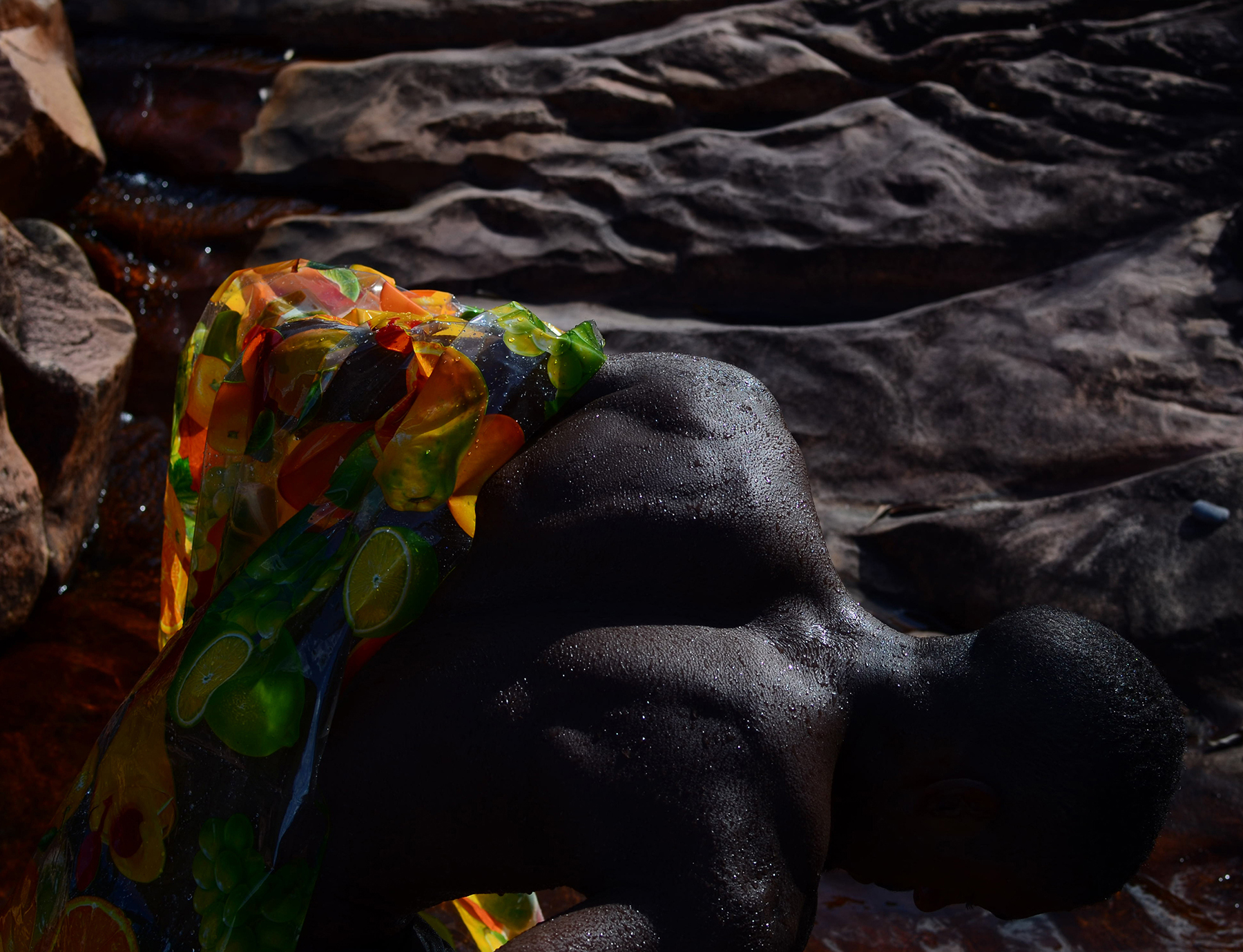
As I produced these works, I came up against questions such as the presence and absence of the black body in museums, or why still lifes were seen as lesser painting, unlike portraits. I’m interested in shuffling these positions (portraits, landscapes, still lifes) and, at the same time, questioning this tradition in the history of art, in which the black body appears or disappears – very often disappears – and is present in a certain way – stereotyped, sexualised, or violated. This research aims to confuse, or tries to construct, portrait, landscape and still life all in the same image.
One thing that interests me a lot is the nature of things. Everything is a single thing: the body, a stone, the plastic, all materials end up being thought of as a single thing. Sometimes it’s camouflaged, sometimes it’s apparent, sometimes it looks like there’s a person wrapped up in it, but it’s just the plastic, sometimes the person and the plastic hardly appear at all. That’s why the series is called Still Life Studies (2015-2020). I spent a lot of time making these works as if the images were studies for a painting, or studies for the construction of a still life painting.
In this series, there is a connection that goes back and forth between the social and the visual. Still lifes are still attractive, even if they are very idealised representations.
I really like Brazilian dishcloths because there’s always a still life and a phrase. Before, it was a big painting of a very rich, powerful person in their house, etc. Today, it’s a painting of a lady in the kitchen, cooking for her children. After she’s finished, she covers the cooker, the place where she makes the food, and leaves that prettiest dishcloth on the top. It’s also a social transfer of the place to show off one’s abundance. It’s a desire for abundance, like a prayer or a call. I think living is also fantasising and idealising life. I have a strange relationship with the word ‘desire’: sometimes I’m interested in repelling it, sometimes I want to investigate desire as an invocation. The important thing is that desire doesn’t hurt the people around it. I think still life also captures this idealisation through the desire for prosperity.
And where did this choice to start from your family environment to create the images come from?
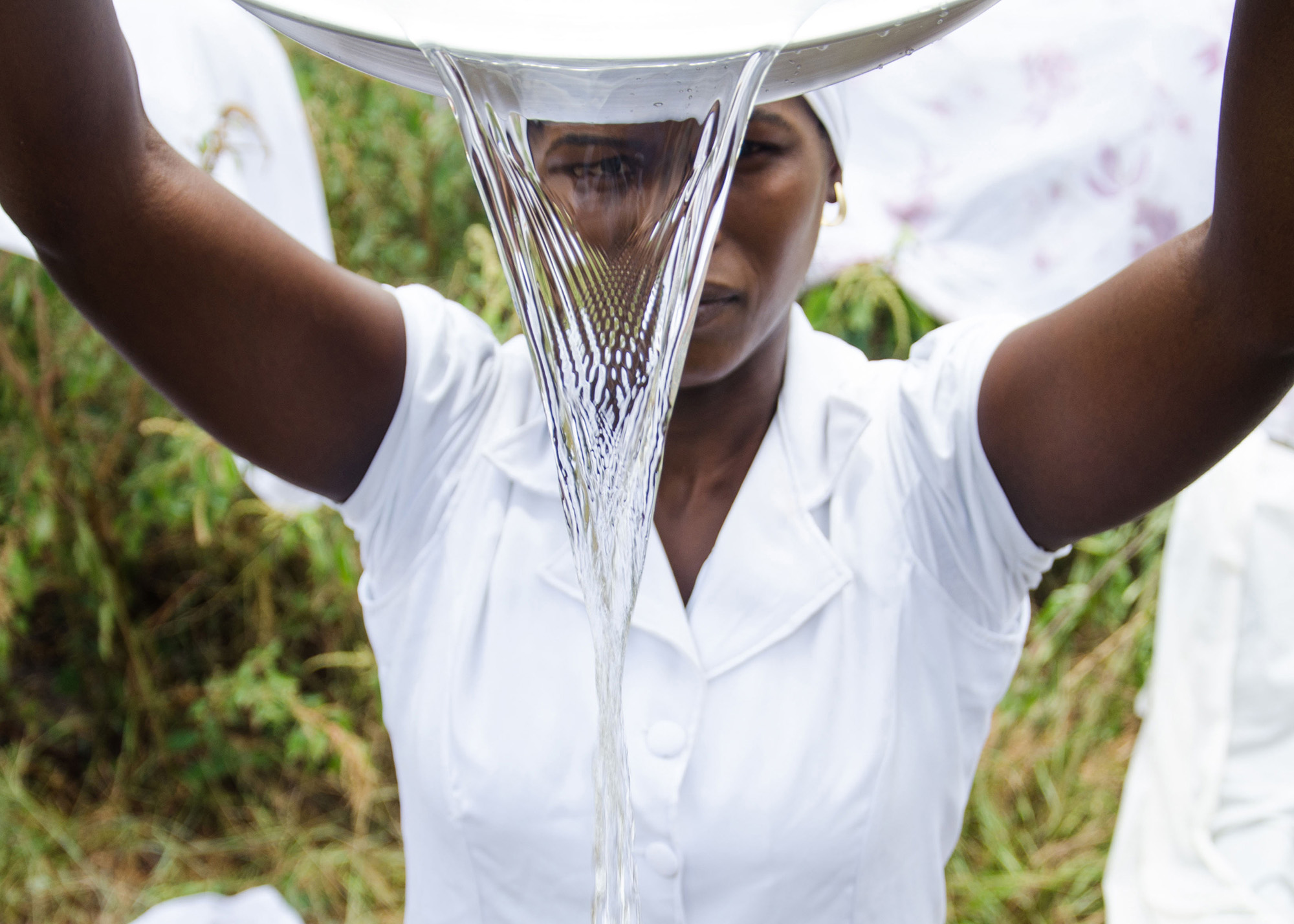
This is something I came to realise after I’d already made about four series of works. In fact, curators began to point out the importance of this relationship in the work. I was trained as a photographer, which made me think that these questions surrounding the image shouldn’t be mentioned. Sometimes I didn’t even say they were my cousins, but I began to realise that it was interesting that it was them, because, firstly, they always reappeared, and for me it was important to say their names. The work began to emerge from an invitation involving affection, with my cousins coming to take part in the work to help me. This culminated in the series called Cobra verde (Green Snake) (2013), about the memory of my grandmothers, in which I tell their life story. I consider this my first major work, and it was difficult to do. It was my final project for my degree in Visual Arts at the Federal University of Recôncavo da Bahia, and I wanted to do a piece about my family.
I started researching and realised that my family history didn’t start with my parents’ marriage, so I began to want to tell the lives of my grandmothers. One of them died when I was 15, but I have an aunt who is the oldest member of my father’s family, and my maternal grandmother is still alive; she’s 82. She was a market trader, selling prawns, chestnuts, charcoal, and onions, and my paternal grandmother was a laundress. I asked the two oldest women in the family to tell me their life stories and I realised that it was all just one narrative, because their stories bridge the gap to when my parents got married. Then I invited my cousins to help tell the story of these women and men through photography.
My cousins aren’t professional models – they’ve never done any kind of work in the field of art. We created a dynamic from our relationship. Since then, whenever I thought of a piece of work, an image, an idea for a portrait, one of my cousins would automatically come to mind. The images I narrate are permeated by the memory of the person being photographed. It’s necessary for the person to accept being in that image, to accept telling that story, to feel at ease, to be comfortable. And my backyard is the place where all my imagery springs from. I think I still reproduce that gesture of the little boy who is enchanted by the sliver of light that passes through the window ajar, by the colours of the yard, by the marked walls. All these places are still my places. The memory of my grandmother putting clothes out to dry on a green lawn in her backyard – all these gestures of affection.
I once did a residency and was asked to photograph people I didn’t know. It was quite a shock. A man asked me why I was going to photograph him. It didn’t make sense to him, and I told him he was right, because it didn’t make sense to me either. I wasn’t his family, I wasn’t part of that story. And there I learnt to question the place of the image-maker and to understand how an image makes sense to me. During my residency, I practically lived with a family in Teresina, Piauí, and one of the family members showed me all the trees his family had planted. What he wanted to show me was how much that forest around his house, that little habitat, was their family. On the last day of my residency, I took a photo of them. Then I realised that my connection with people, and making an image that makes sense to them, is important in my working process. The gesture of creating images with people is a delicate one, especially because black people are often photographed without their authorisation, without them knowing where the image is going, and often these images create various stereotypes. For me, it’s important to create a bond with people so that they feel comfortable with this image. One of the latest pieces of work I’ve done is an image disclaimer.
Is this connected to your residence in Chicago?
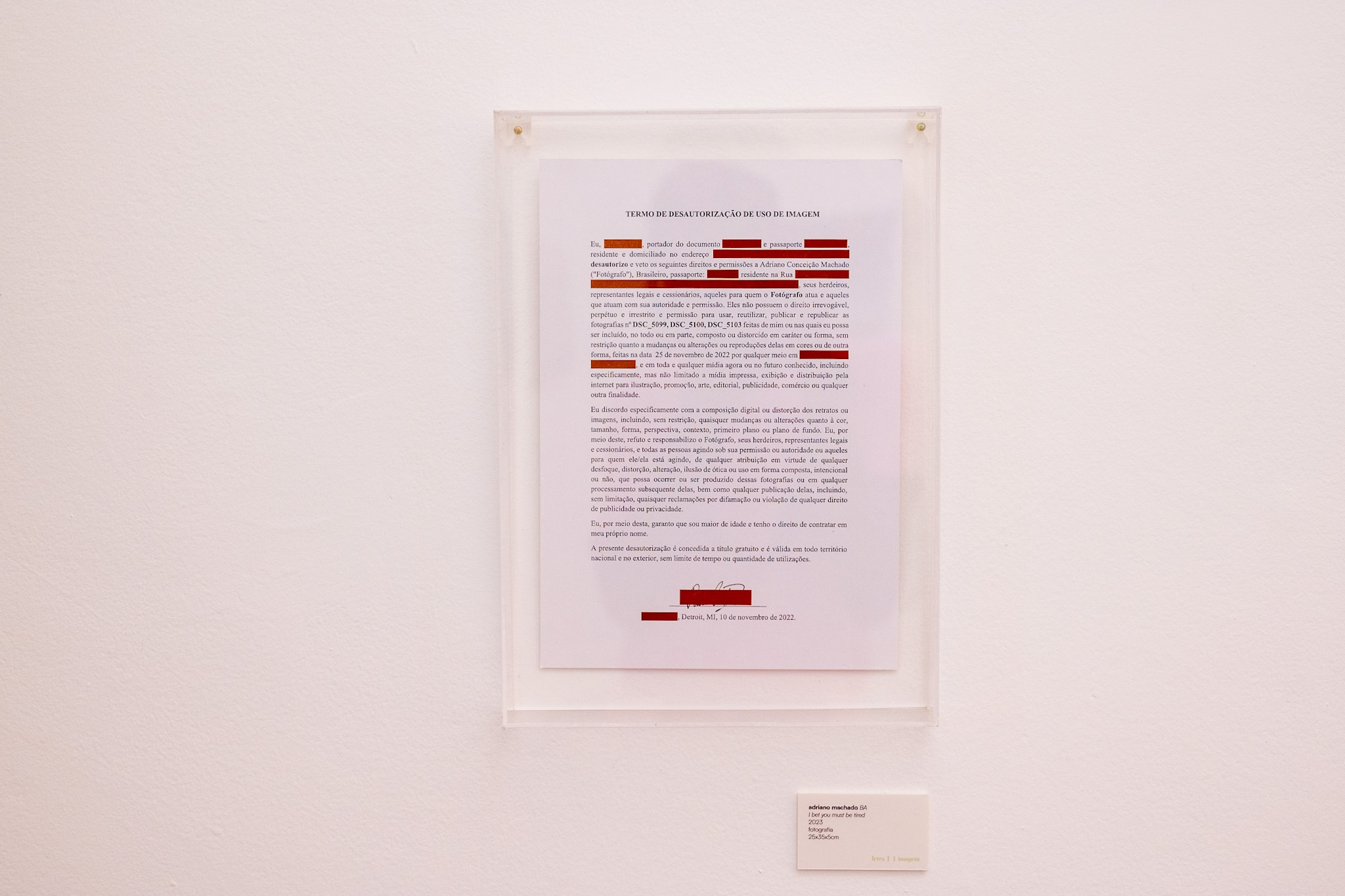
It is connected. I’m going to tell the story I can tell, because there’s a legal limit that forbids me from saying everything. I made some images and then the person deauthorised me from using the image. It was a bit of a shock for me, even though I was already thinking about the authorising of the use of images, questioning how photography also reproduces stereotypes of the black population, etc. Talking to Fábio Gatti, who is my doctoral supervisor at UFBA [Federal University of Bahia], he said: “Why don’t you create a document and put this in writing, so that the person is comfortable?”. Then we thought: “Let’s make a de-authorisation form for the use of the image.” I took an image authorisation form and wrote everything backwards.
The legal form was part of the exhibition. It uses many words that talk about emancipation, freedom, autonomy, freedom of being, of the body, the right to freedom, which is something that interests me. But at the same time, it’s within the artistic loop. This work generates a second discussion, because I’ve drawn up a deauthorisation form, the person has signed it and this guarantees that their image won’t be used, but then I put the form inside an acrylic box and turn it into a separate work. It becomes a new capturing, a recapturing of the process. I put it in an acrylic box to make this provocation, because now that’s it, it’s an item that can be exhibited, serialised, because now it’s become an art object. There’s this discussion about the very notion of freedom, the very notion of capture. I create an escape, but the system itself and the circuit create another form of capture. So what do I do? I hide the name and create another gesture of freedom for the person. In the future, art historians who are interested enough can find the archive, or find more information, and capture the person again.
Me interessa muito essa relação de confiança e de permissão, de recusa de um desejo de captura. É importante que as pessoas que estão na imagem não sejam só modelos sem nome, sem identidade, só um corpo negro esvaziado. Elas têm uma autonomia, elas têm uma identidade, são pessoas e têm uma relação direta com o processo. Essas camadas de humanidade do fotografado são cruciais ao trabalho. People co-participate in the creation.
(Translation: I’m very interested in this relationship of trust and permission, of refusing a desire to capture. It’s important that the people in the image aren’t just models with no name, no identity, or just an empty black body. They have autonomy, they have an identity, they are people, and they have a direct relationship with the process. These layers of humanity in the subject are crucial to the work).
As much as there is a social, economic, and legal system that permeates these relationships, perhaps there is a relationship with your cousins not only of affection, but also of trust, which works better than any written contract.
The legal permissions come later. I even think that people have the full right to their images, even if they’ve signed a contract beforehand. At the end of the process, if they feel it offends them, it’s not fair for them to be stuck with that piece of paper. It’s not about documentation, it’s about a will, it’s about my relationship with my cousins, which allows me to build these images, and the authorisations, the documents, happen after the process. What we’re doing is an artistic process which, just like the first images I made, we haven’t imagined where they might end up, we did it because there was a non-predatory human relationship between people, which happens together, before any bureaucratic construction. A friend once asked me if I’d ever thought about giving up being an artist, and I thought quickly and told him no, because I don’t know how not to do it. Even if I never exhibit my work, I’ll always be making it. The artist will always be producing, building their work. Then, when the work leaves the house, it takes on other shapes, it takes on a frame, it takes on paper, it takes on other things that will make the work go places. But the core of artistic creation springs forth and it grows and breaks through the spaces of the house, sprouting through the floor, the ceiling, everywhere in everyday life. I think my relationship with my cousins rests in this germinating space of the backyards, and then it becomes a 90 x 60 cm print on cotton paper.
How do you see the elasticity of these private stories when you take them to other contexts?
With the exhibitions, I’ve come to realise that people enter, or don’t enter, the work based on what they themselves contain – their memories, their stories. My work has layers that are often not revealed. For example, in Cobra verde, my cousin restages the image of my grandmother sitting on a pile of charcoal holding a fan. When I tell the story behind the work, the image takes on different guises, because it’s a super-mystical story of a day when my great-grandfather pretended that he was ill in order to make my great-grandmother, who had already separated from him, come home with my mother, who was then a child. My grandmother tells one story, my aunt tells another, my mum tells another, and the stories get more and more fantastical. In one of them, they say that my great-grandfather threw the embers on the ground and made a circle of fire. He held my mother, this child, together with my grandmother, and the three of them spun around inside this circle of coals and embers. My grandmother said that he spoke words that she doesn’t remember, and that she also spoke other words, like a counter prayer, and finally got him to let go of my mother, and they left and never came back.
My grandmother tells another story about a day when she was selling coal, in the 1970s, in Bahia, and went to settle a quarrel and emerged all dirty with coal. When she looked, her hands and feet were all covered in coal, and my grandmother was always a very vain, beautiful person. In the photo I made, my cousin is holding a shaker over a circle of charcoal with her nails very well done, wearing a gold earring and adopting a haughty pose, her face up towards the sun and, in the background, there’s a sheet that makes a kind of studio, but it’s still visible that it’s a sheet.
These images have several prompts, and I’ve taken part in exhibitions where people have come up to me crying. They didn’t know anything about the story of the image, but they said they remembered their own grandmothers. I began to realise that the game of the image has several levels. Sometimes it appears, sometimes it disappears, sometimes it flies, sometimes it dives, and that these are natural movements in stories that run very deep. This is because my grandmother, for example, told me her whole life story but she wrapped it up in many mysteries, with some things she didn’t want to tell me. I like to think that particular work has invisible layers. When I’m invited to talk about my work, I tell parts of these stories. The artist and curator, Alexandre Sequeira, once told me that perhaps my work was migrating towards speech, towards being a work in which I would only speak, because many stories are hidden in the images and are revealed by my voice in these narrations, but I also believe that these concealments of the narrative layers are to allow for openings, because it is very interesting when the public plays with the image and, from a small prompt, brings their own story to dance with the work.This transparency, so to speak, of the image is very interesting to me. For a long time I wondered how these complete narratives would fit into the work. For example, Baratino and Orimar (2019) are works about which I wrote short stories, which became my dissertation for my master’s degree. Before, when I was invited to talk about my work, I would explain the photos. Nowadays, I show two photographs and read an extract from the short stories, which ends up creating a more expanded image experience.
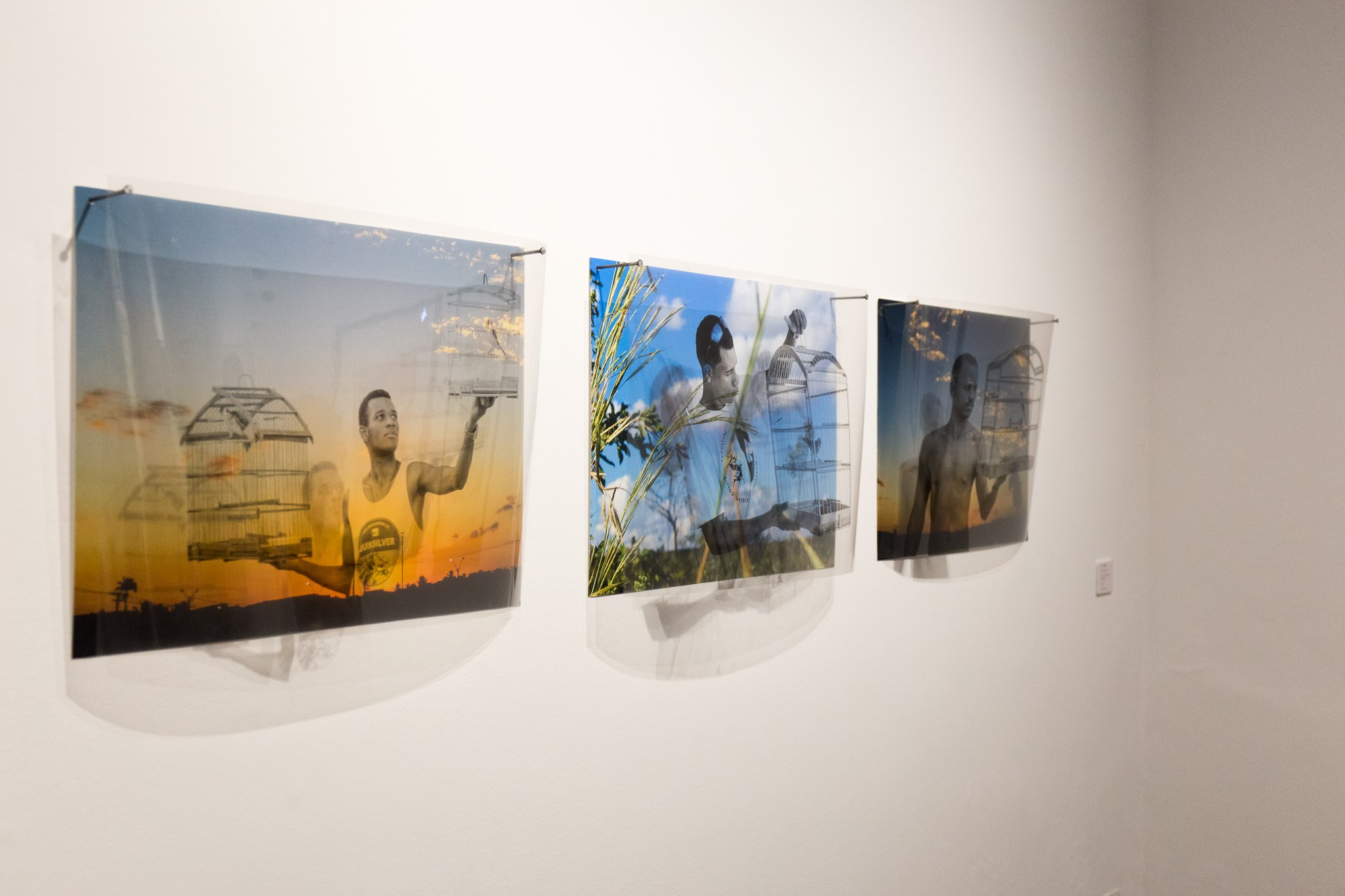
I’m going to read a passage about Orimar:
“Depois de ter virado imagem, voltou seu corpo à transparência, sabendo que seu sentido final era ser luz, preto e translúcido ao mesmo tempo. Quisera conseguir entender o motivo de seu corpo parecer vazado pelo ar, sentia que suas formas ganhavam o tom da paisagem e questionavam quais desafios tinha que cumprir para que pudesse entender o que estava acontecendo. Agora que, enfim, tomara consciência de homem preto, não tinha mais um peso pequeno para carregar. Sua pedra era grande, porém leve. Seu corpo de plástico e invisibilidade é quente e forte. Brilha e ofusca o que vem atrás e aquele que toma sua frente. Escuro, invisível e luminoso, é essa a tal essência da figura que anda ao vento. Orimar vivia cerceado, mas não sentia medo algum. Perder o medo é um contratempo maior do que se possa imaginar. É como estar desprovido do assalto, não ter previsão do que virá. A ausência do temor em sua alma não lhe permitia hesitação alguma, o que se tornava uma vantagem. Seus olhos de caçador passeavam atenta e lentamente numa espécie de desvio do tempo. Finalmente, Orimar nasceu, com seu sorriso largo e sua mente flamejante. Os olhos de lince se abriram preguiçosos, semicerrados. Ao contrário do esperado de um guerreiro, os olhos não se abriram rápidos e brilhantes, mas com lentidão. Não era como se não estivesse ali ou não desejasse o mundo, apenas tinha a paciência pura de um caçador. Na verdade, despertava de um descanso que um dia haveria de merecer. Às vezes, a proposta parecia mais uma exumação, um lamento fúnebre do ocidente; outras vezes, a poesia das palavras se lançou entre a saudade incompreendida e um sufocante banzo. Cabe ver que seus passos apresentam os trajetos percorridos e um pensamento que não se recusa a sentir-se impressionado com o porvir. Continuar andando pelo mundo, sem medo de existir nesse território e identificar nas andanças as pedras certas, para lançar nos alvos, e as folhas que curam, para vencer a morte”.
(Translation: “After becoming an image, he returned his body to transparency, knowing that his final meaning was to be light, black and translucent at the same time. I wished I could understand why my body seemed to be leaking through the air, I felt my forms taking on the tone of the landscape and wondered what challenges I had to fulfil in order to understand what was happening. Now that he was finally aware of being a black man, he no longer had a small weight to carry. His stone was big but light. His material, invisible body is warm and strong. It shines and dazzles those behind it and those in front of it. Dark, invisible and luminous, that’s the essence of the figure that walks on the wind. Orimar lived under siege, but he felt no fear. Losing fear is a bigger setback than you might think. It’s like being deprived of a mugging, not being able to foresee what’s coming. The absence of fear in his soul allowed him no hesitation, which was an advantage. His hunter’s eyes wandered attentively and slowly in a kind of time warp. Finally, Orimar was born, with his wide smile and his flaming mind. The lynx’s eyes opened lazily, half-closed. Unlike a warrior, the eyes didn’t open fast and bright, but slowly. It wasn’t as if he wasn’t there or didn’t want the world, he just had the pure patience of a hunter. In fact, he was waking up from a rest that he would one day deserve. At times, the proposal seemed more like an exhumation, a funeral lament for the West; at other times, the poetry of the words flitted between misunderstood longing and a suffocating homesickness. It’s worth noting that his footsteps show the paths he has travelled and a mind that doesn’t refuse to be impressed by the future. To continue walking through the world, without fear of existing in this territory, and to identify in his wanderings the right stones, to throw them at the targets, and the leaves that heal, to overcome death”).
Listening to the text, but also looking at your images, they position themselves in a place that is not one of false optimism, but also not one of hopelessness. It’s a recognition of reality, but it’s hopeful.
I know that I’m of a generation that is split between artists who reproduce images that re-enact violence, or re-enact a place of denunciation of the way black people exist, for example, or of racialised people, or immigrant people etc., and those who are in a place where their images try to point to a certain Afrofuturism, a positive uprising. It seems that my work lies between discomfort and joy, because I see myself as a ‘slow man’, not exactly in the context that Milton Santos coined it, but as a person who organises the possibility of not using the images of others, but for displacing desire, for transforming life into an object. I like to think that the image can eat away at you a little. You’ll see that image, you’ll be attracted by the beauty of the colour, the aesthetic beauty, but there’s something there… It’s not just the beauty, it’s as if there’s something strange about it. I once wrote that the work was like having one foot on the ground and the other suspended in the air. So it’s between understanding where you’re stepping and lifting your foot to feel the air and create a fabulation, to propose a territory or live in another territory, which is often almost refused, almost prevented from existing, but which does exist – it’s there. I’m interested in the images being in that in-between place, between beauty and that which cuts.
Interview conducted on 16 February 2024 remotely via Zoom.
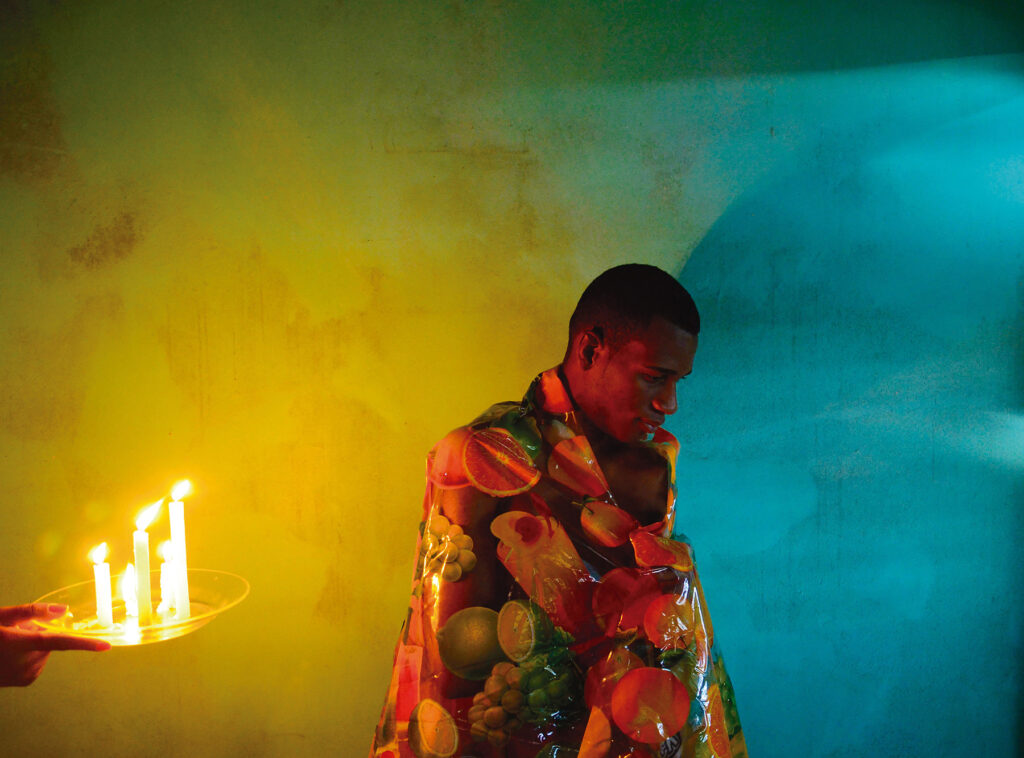
Photography | Mineral pigment on cotton paper | Variable dimensions
2015–2020
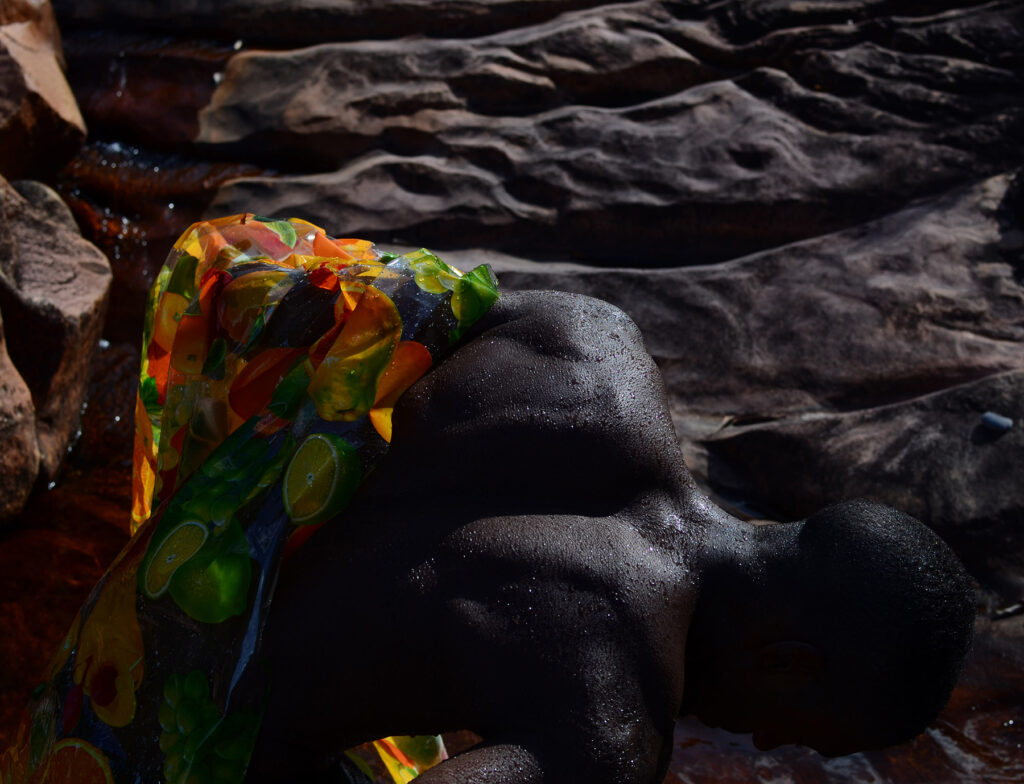
Photography | Mineral pigment on cotton paper | Variable dimensions
2015–2020
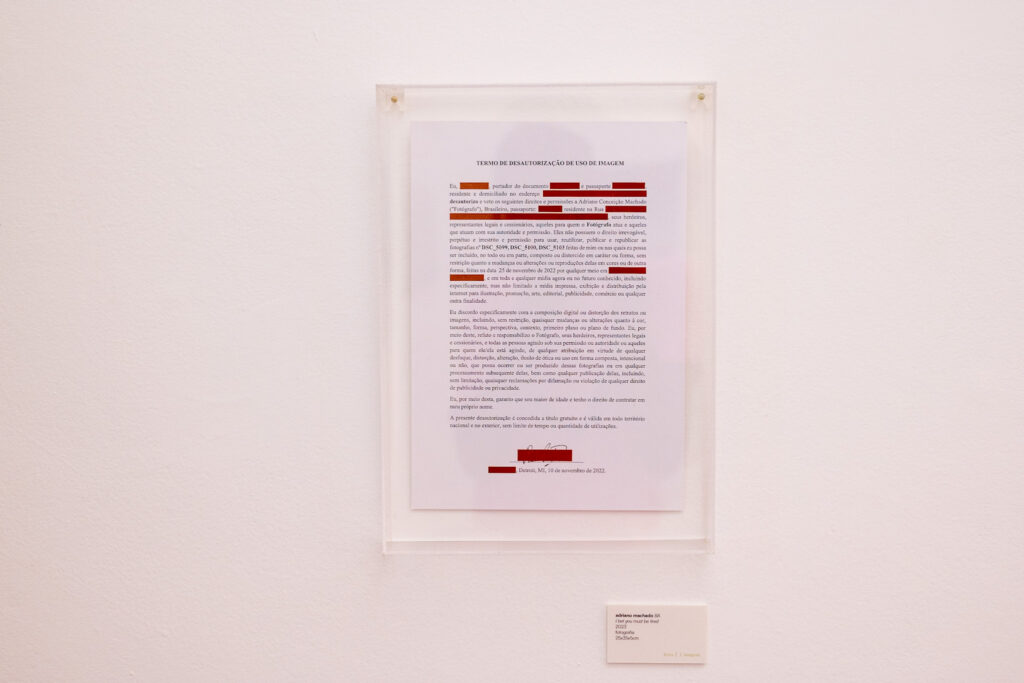
Photography | Inkjet-printed document | 21 x 29.7 cm
2023
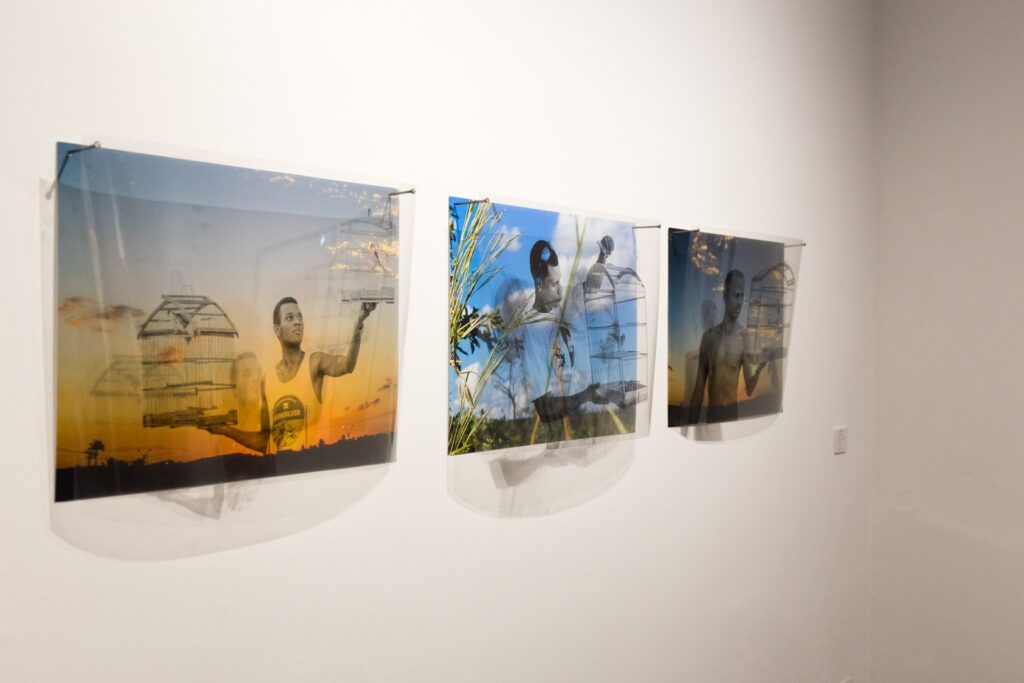
Photographic print, transparency, and nails | 55 x 45 cm each piece
2019
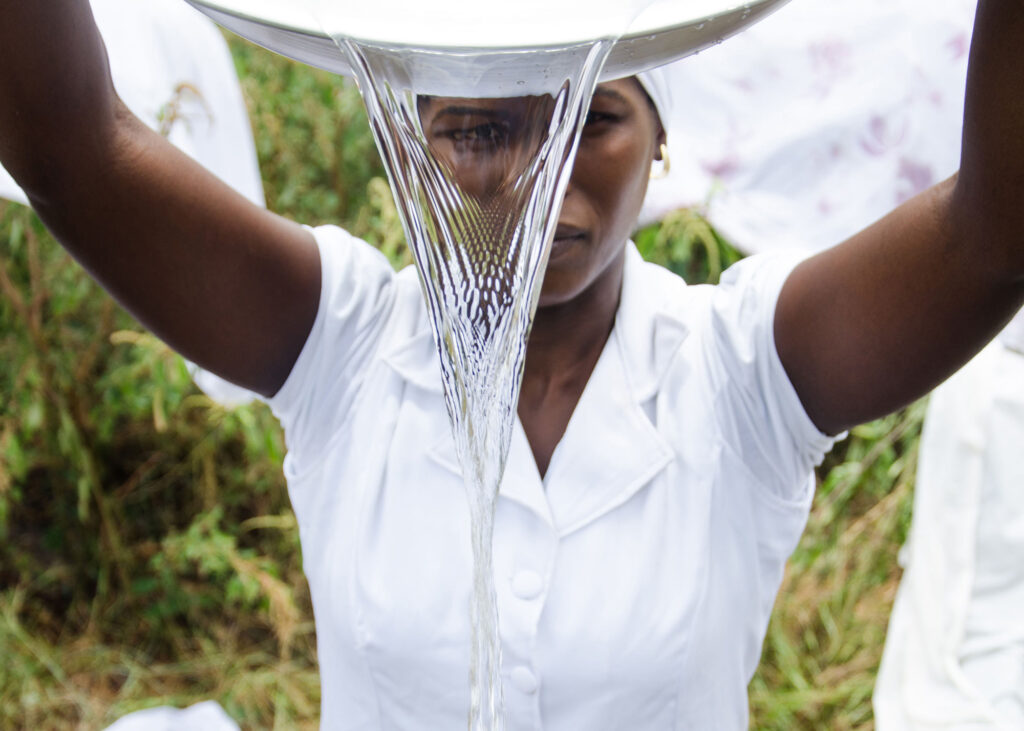
Digital photography l 0,50 x 0,70 cm
2014