

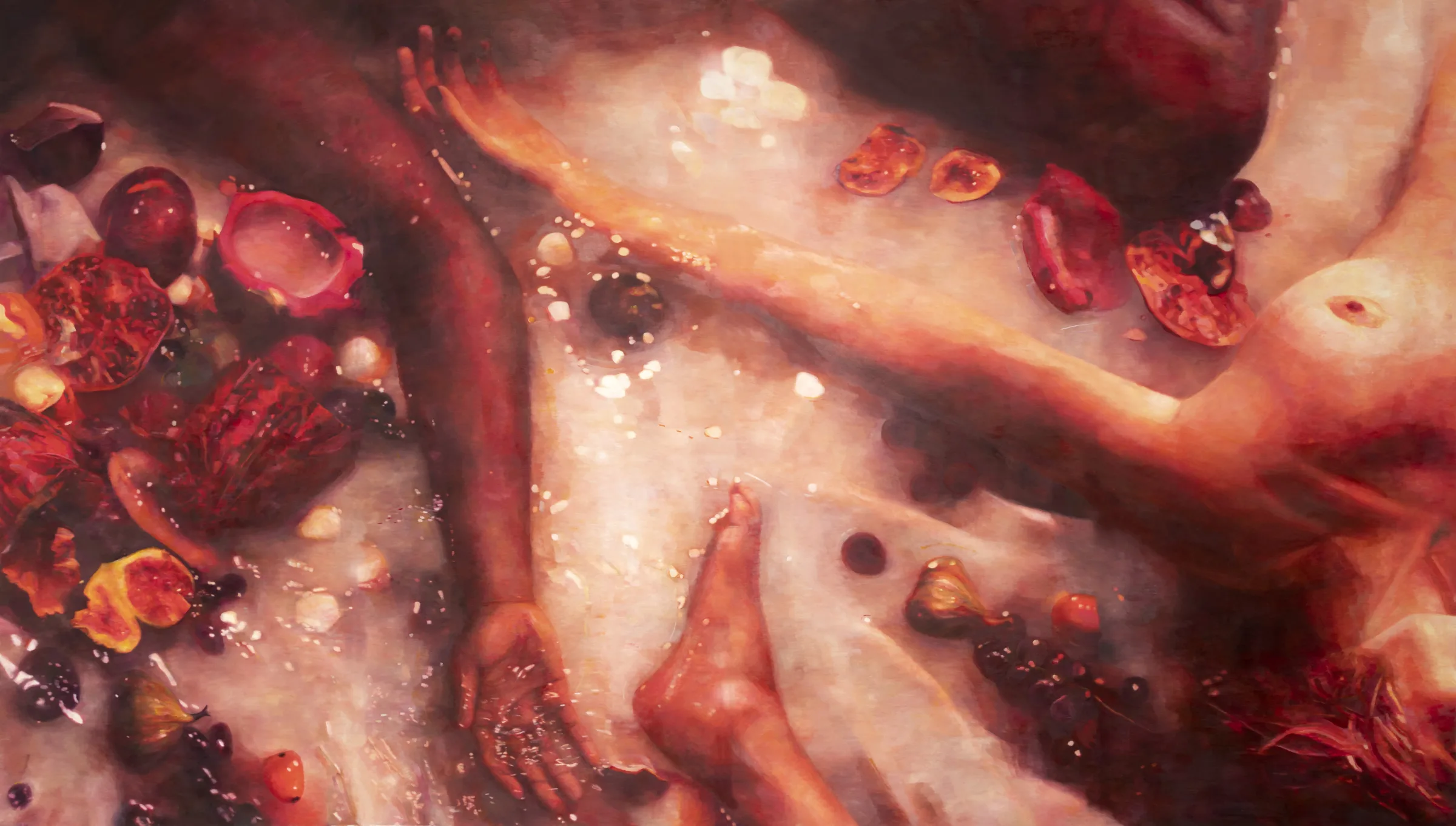
Regina Parra
Visual artist Regina Parra (São Paulo, 1984) dedicates her research to exploring the body – especially the female body – and its various representations and interpretations. Whether through painting, video, performance, or neon installations, each of Parra’s works seeks to create a critical dialogue between the ancient and the contemporary. The artist details her quest to portray the female body as a space of affirmation and power, exploring themes such as oppression, resistance, and identity in a deeply intimate and provocative way. Check out the interview:
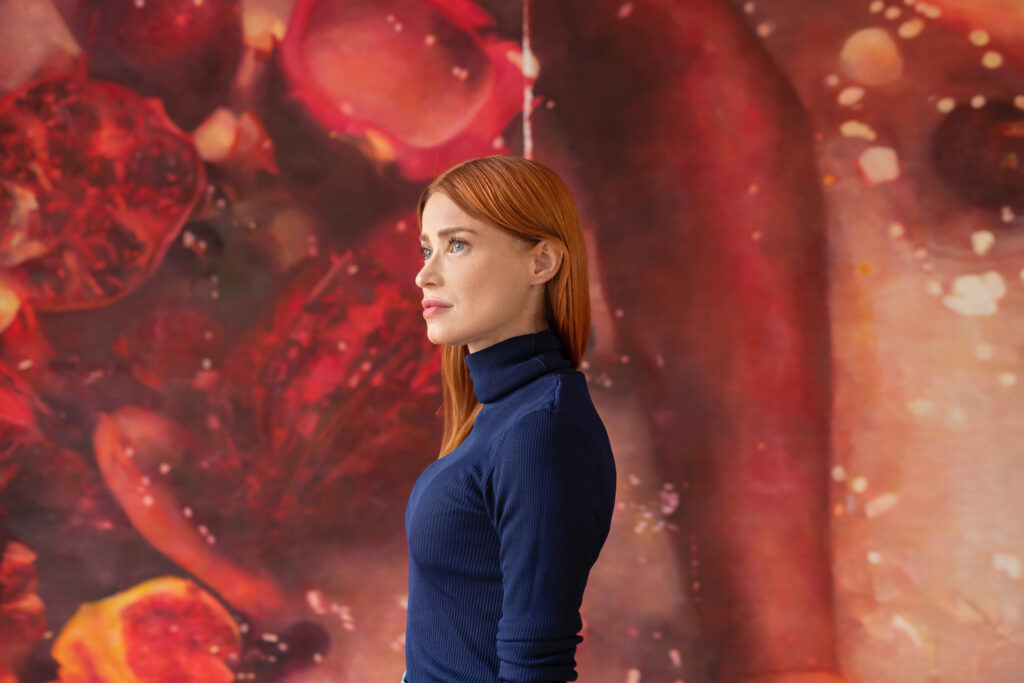
Regina, first of all, thank you very much for taking the time out of your day to talk to us. I’d like to ask you to introduce yourself with any information you think might be relevant, thinking of an audience that might not yet be familiar with your artistic practice.
My name is Regina. It’s a pleasure to speak to you here, Brunno. I’m a visual artist, I work mainly with painting, not because it’s a priority but, because painting demands more time, I spend most of my time painting. I also work with other forms: video, performance, neon sign installations. My first training was in the performing arts. I worked with Antunes Filho (1929-2019), a theatre director, for three years, and that was very important in my training. My background is in theatre, but I’ve always moved between different disciplines such as theatre, film, and dance. I think this crossover is also part of my artistic practice, and I’ve been trying to bring it more strongly into my recent work.
And when did this career change happen?
I’ve always drawn, like every child. When I was 11, I started painting, then I went on a very unpretentious course. I’m from the East Zone of São Paulo, and this course was above a market, with little ladies painting dishcloths and porcelain. Some of them were more ambitious and painted tiles, and I started painting some tiles too. We basically copied other people’s paintings. I would have loved it if we had copied the great masters, but we were copying paintings that, for some reason, the teacher thought were good paintings. Nobody in my family works in, or has any training in, art or culture, so for me it was always a hobby. I never thought I could be an artist, or that painting could be a profession. I only understood being an actress or working in the theatre could be a profession. I continued painting as a hobby and went on to study performing arts at ECA (School of Communications and Arts at the University of São Paulo).It was through theatre that I understood that the visual arts could be a profession. Antunes had a way of working that was very integrated with all areas: we researched cinema and visual arts and went to exhibitions with him. That’s when I began to understand more about contemporary art, but I only thought about becoming a professional artist after I left Antunes. We did the play Medea and, when it finished, I decided to leave the company. I was in a very junk phase of my life and decided to start over. By coincidence, at that moment my father was going to live in Rio de Janeiro for work reasons, and I decided to go with him. In Rio I worked as a waitress from 4pm to 10pm – which was great because I basically had the whole day free – and I started taking various courses at Parque Lage with a lot of great people such as Wilson Coutinho (1947-2003) and Paulo Sergio Duarte, doing courses in theory and practice. Then I went back to São Paulo to study at FAAP (Armando Alvares Penteado Foundation).
And then, during university, did you start exhibiting? What was that phase like?
I was very lucky, especially seeing how Brazil is now, and how the world is. Fine arts was my second degree, so I came into it older, with a certain amount of experience too, something that helped me stick it to the teachers. I was very stubborn, like: “I’m going to make this thing happen”. FAAP has a program called Anual de Arte, which gives students a scholarship – at the time, I was working at MAM (Museu de Arte Moderna de São Paulo), so I needed the scholarship – and it’s also something that highlights the artist. Gallery owners and lots of people would come to the event to see what the students were producing, so I then started working with galleries, and started selling work.
You work with painting, but also with video and installations. It’s a very open practice. Could you tell us about A perigosa, from 2019?
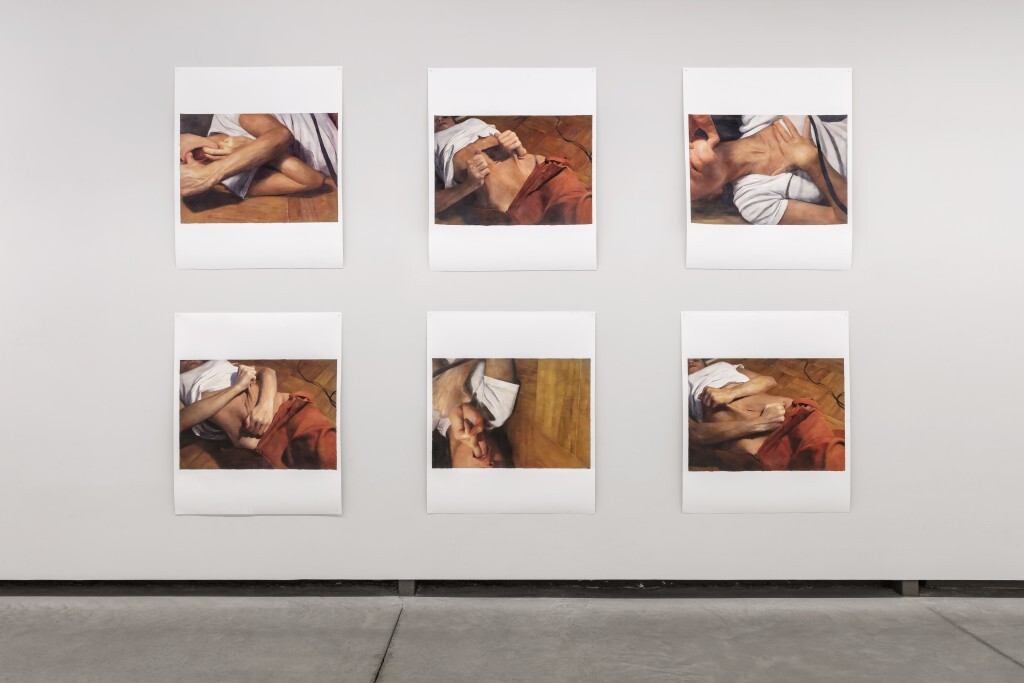
This is a series of paintings that was in my 2019 exhibition at Galeria Millan in São Paulo, called “Bacante.” Because of the theatre, I’m completely in love with Greek tragedy, Greek mythology and the classics, and it’s something I always return to, but I also try to bring something more contemporary. The bacchantes were the followers of Dionysus, who is the god of theatre, the god of wine, and the way they paid homage to Dionysus was through a series of orgiastic encounters. They were very liberal women who went to the mountains to play music, celebrate Dionysus, take part in orgies, drink wine and, in short, throw themselves around. This idea of Bacchante, the Greek tragedy by Euripides, was the backdrop for this exhibition, where I showed this series of paintings. I remember that, when I was thinking about this exhibition, it was the moment Bolsonaro was elected in Brazil. So this wave of conservatism began in Brazil and the sexism that we have in the country became even stronger – we began to feel it more acutely. I thought it would be important to think about an exhibition that brings the bacchante, which is almost a utopian idea of a free woman, at a time when women in Brazil were beginning to see themselves as increasingly limited in terms of their bodies.
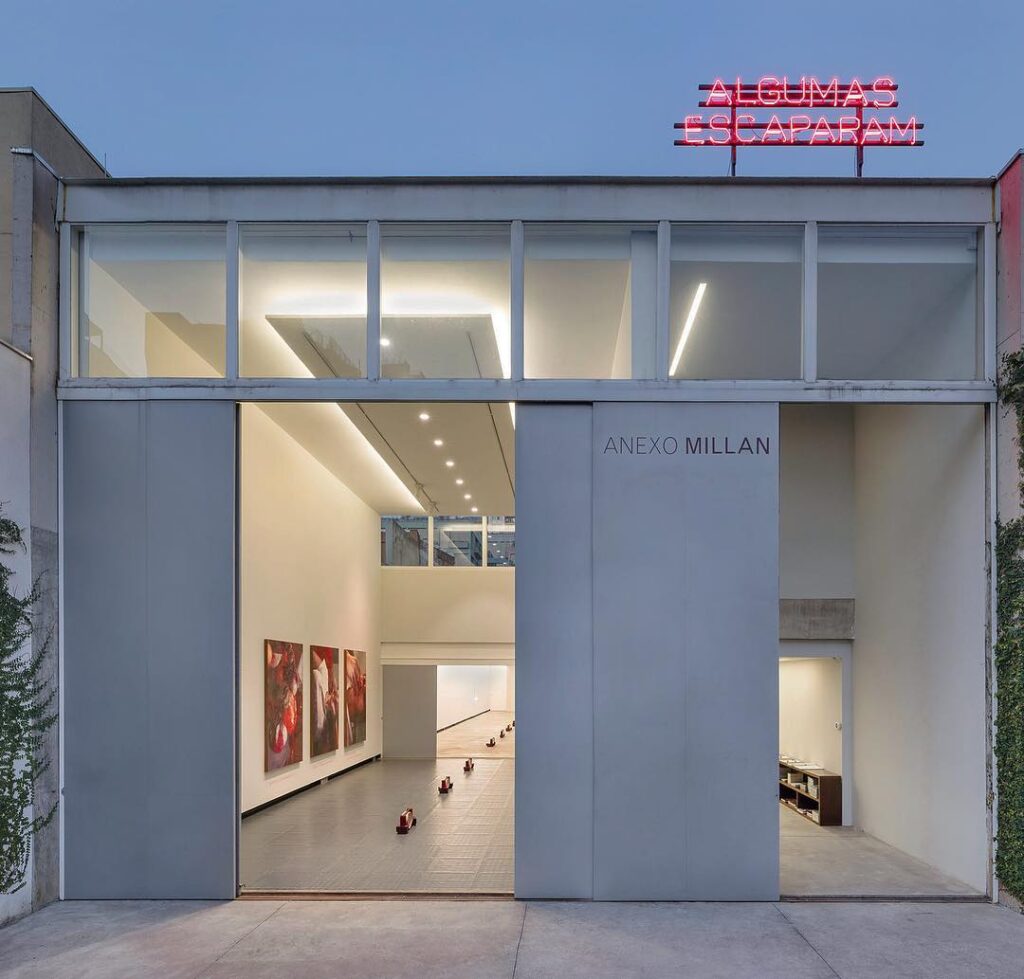
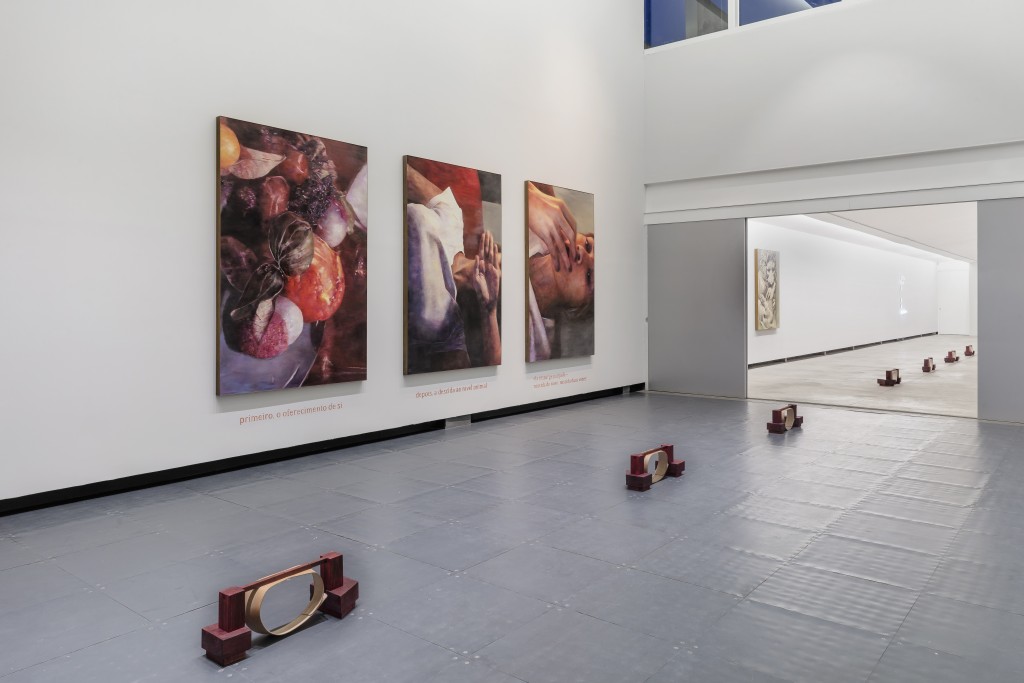
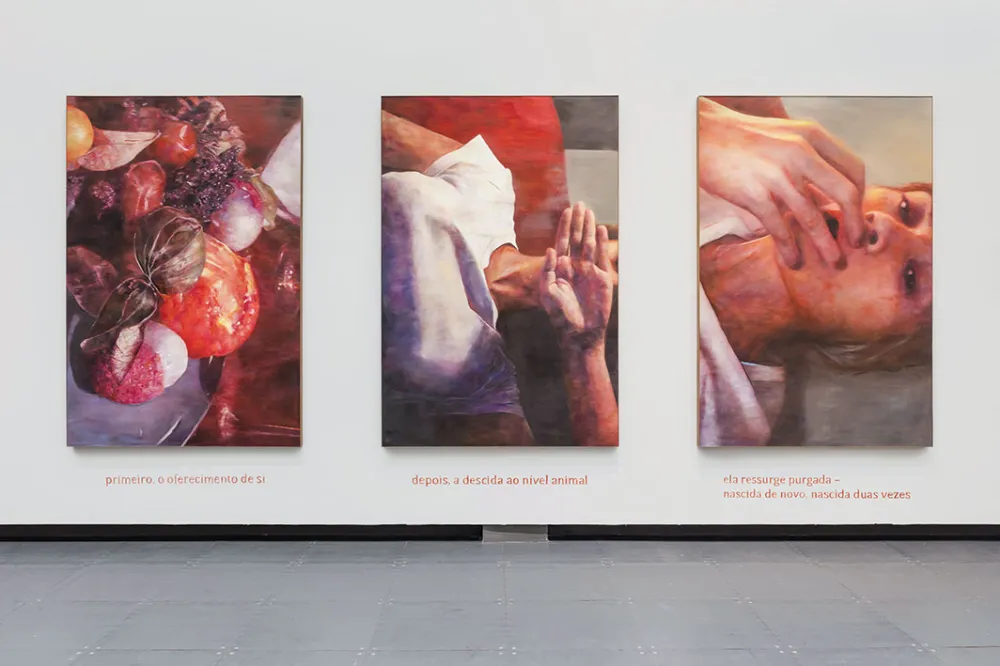
A gente vem de uma sociedade patriarcal de anos e anos, acho que desde o cristianismo, e que só piora cada vez mais. Uma sociedade patriarcal que tem muita dificuldade em entender a sexualidade, o desejo, ou mesmo o corpo que não é o corpo padrão, masculino, hétero, normativo. O corpo da mulher é um corpo que ainda é visto como tabu, como uma coisa perigosa. A gente pode pensar na Eva, que vai oferecer a maçã para a Adão; a mulher é sempre esse ser meio tentador, por isso A perigosa.
(Translation: We come from a patriarchal society that has existed for years and years, I think since Christianity, and that only gets worse and worse. A patriarchal society that finds it very difficult to understand sexuality, desire, or even the body that is not the standard, male, straight, normative body. Women’s bodies are still seen as taboo, as something dangerous. We can think of Eve, who offers the apple to Adam; woman is always this kind of tempting being, hence A perigosa [Dangerous Woman].)
And this series of paintings features images of fragments of bodies that can be used by more than one person – it’s not a biography, but it’s about several bodies – or that other people can identify with. It’s a body that’s in tension, but it’s not very clear what kind of tension. It’s almost as if the body was having an internal battle between pain and pleasure, which I think was the way I saw this moment we were living through. It’s a bit like this body is always wanting to be free, but because of social, external ties – but also internal ties, things we carry – we’re always in this struggle. These images are images of a body that writhes, squeezes, grabs. There’s a bit of that, of this desire to free oneself and try to reach that place of pleasure.
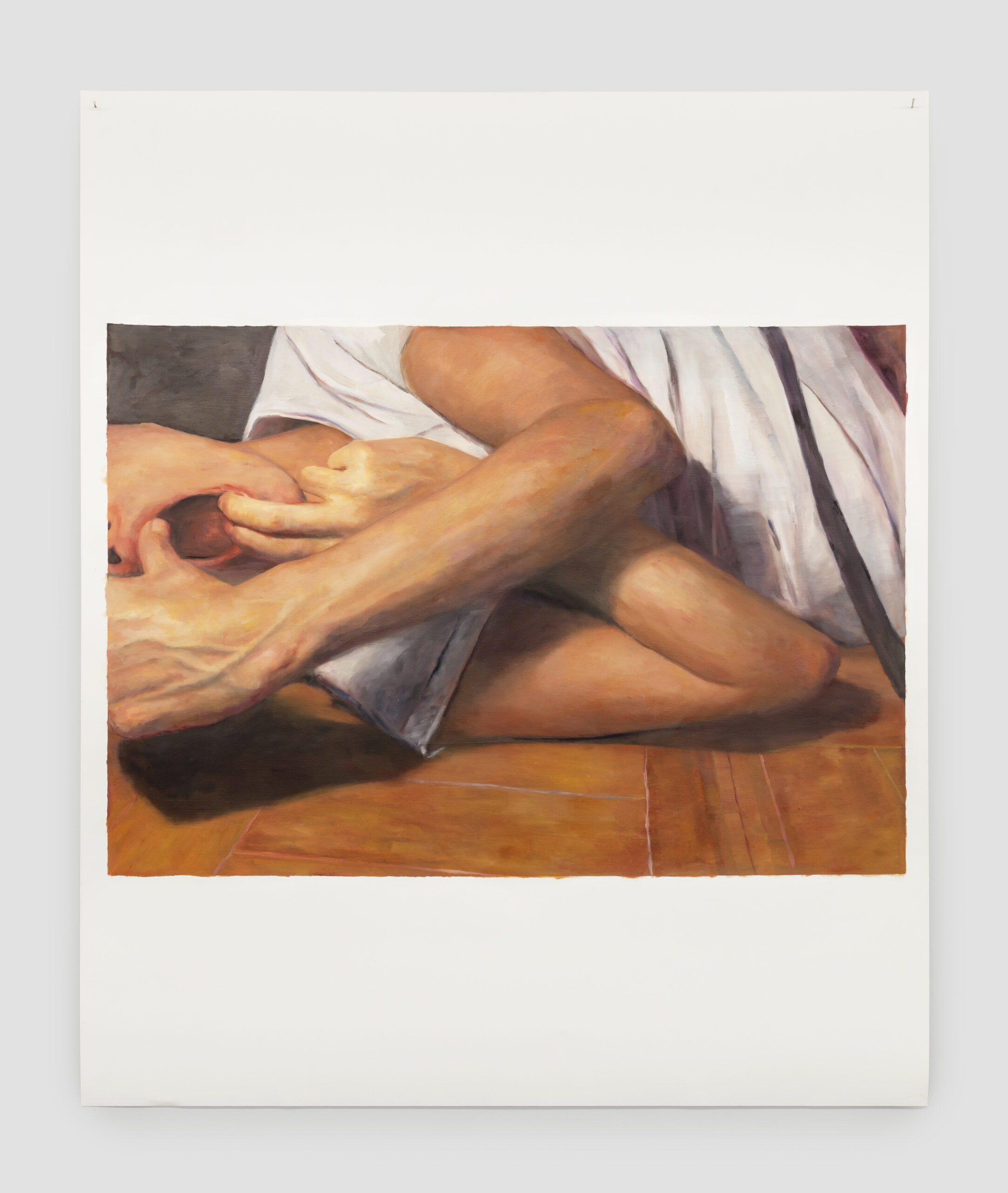
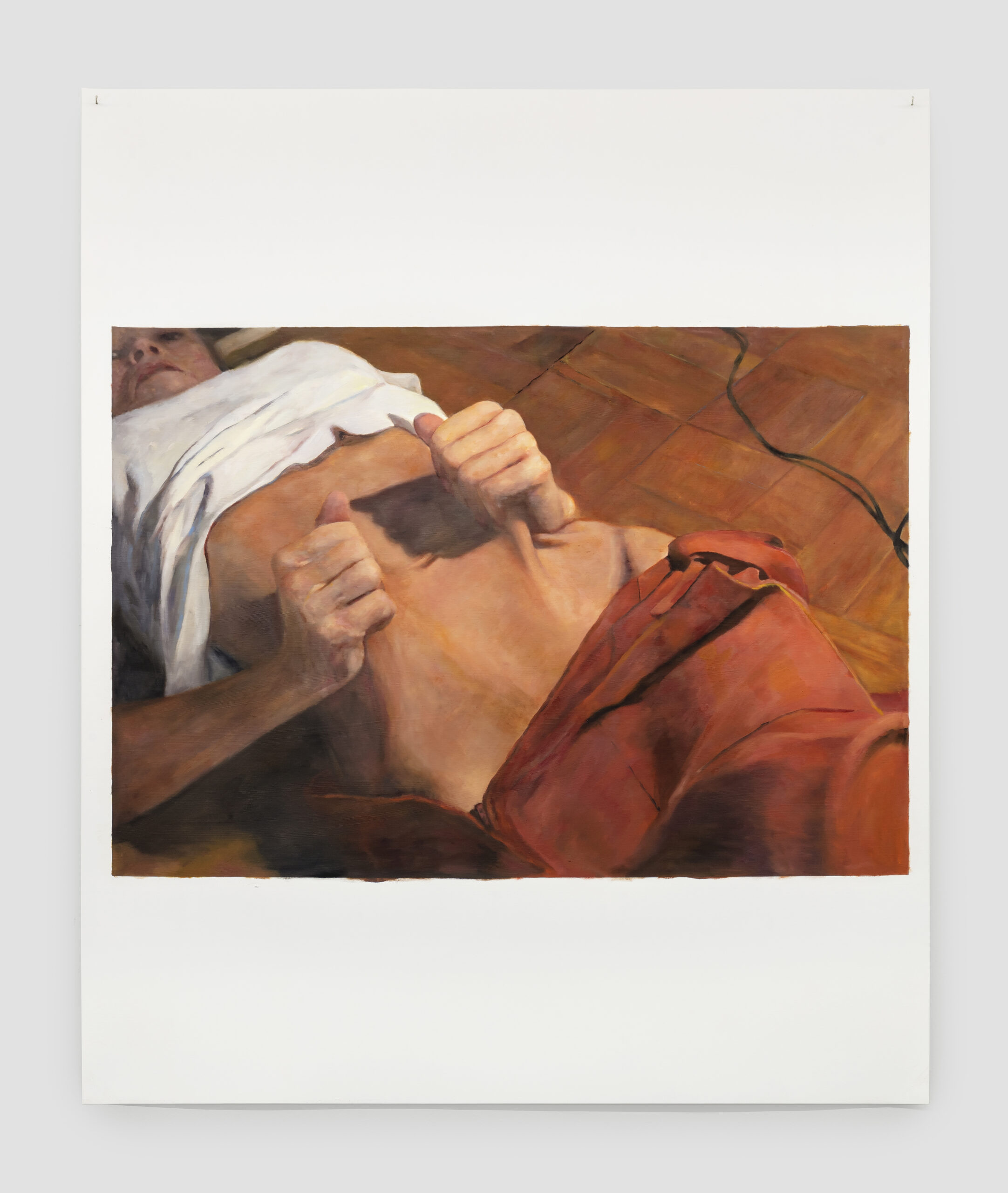
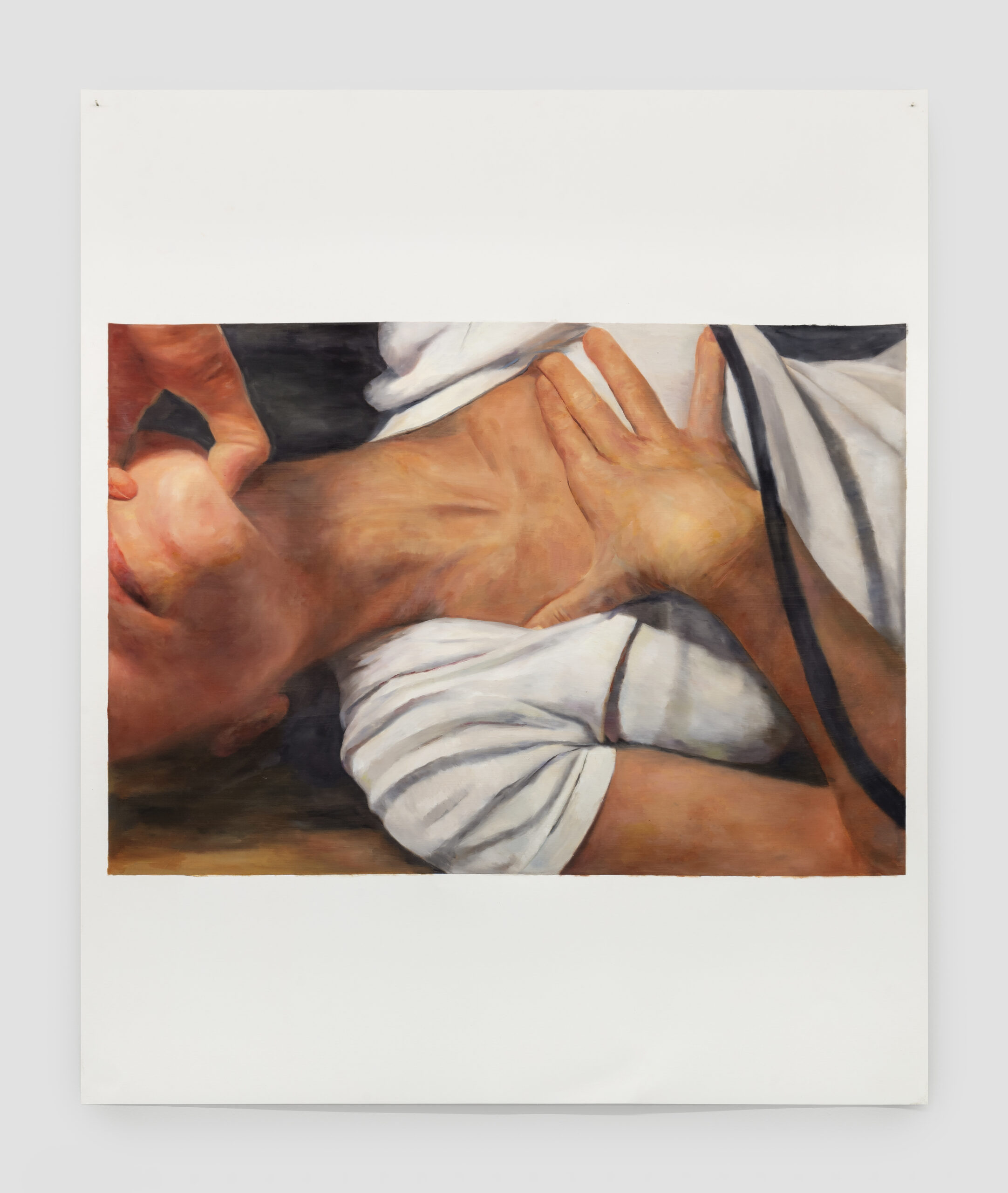
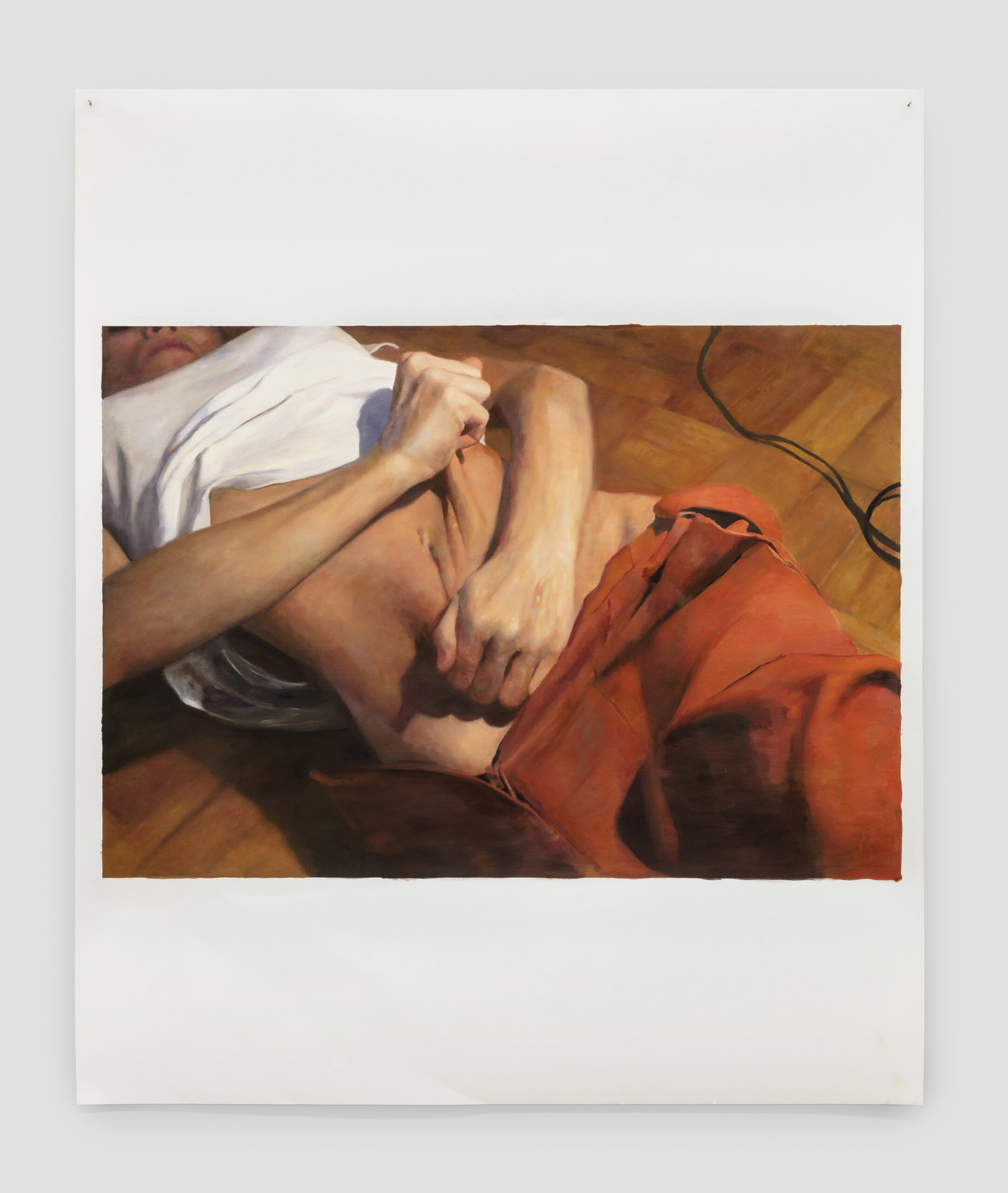
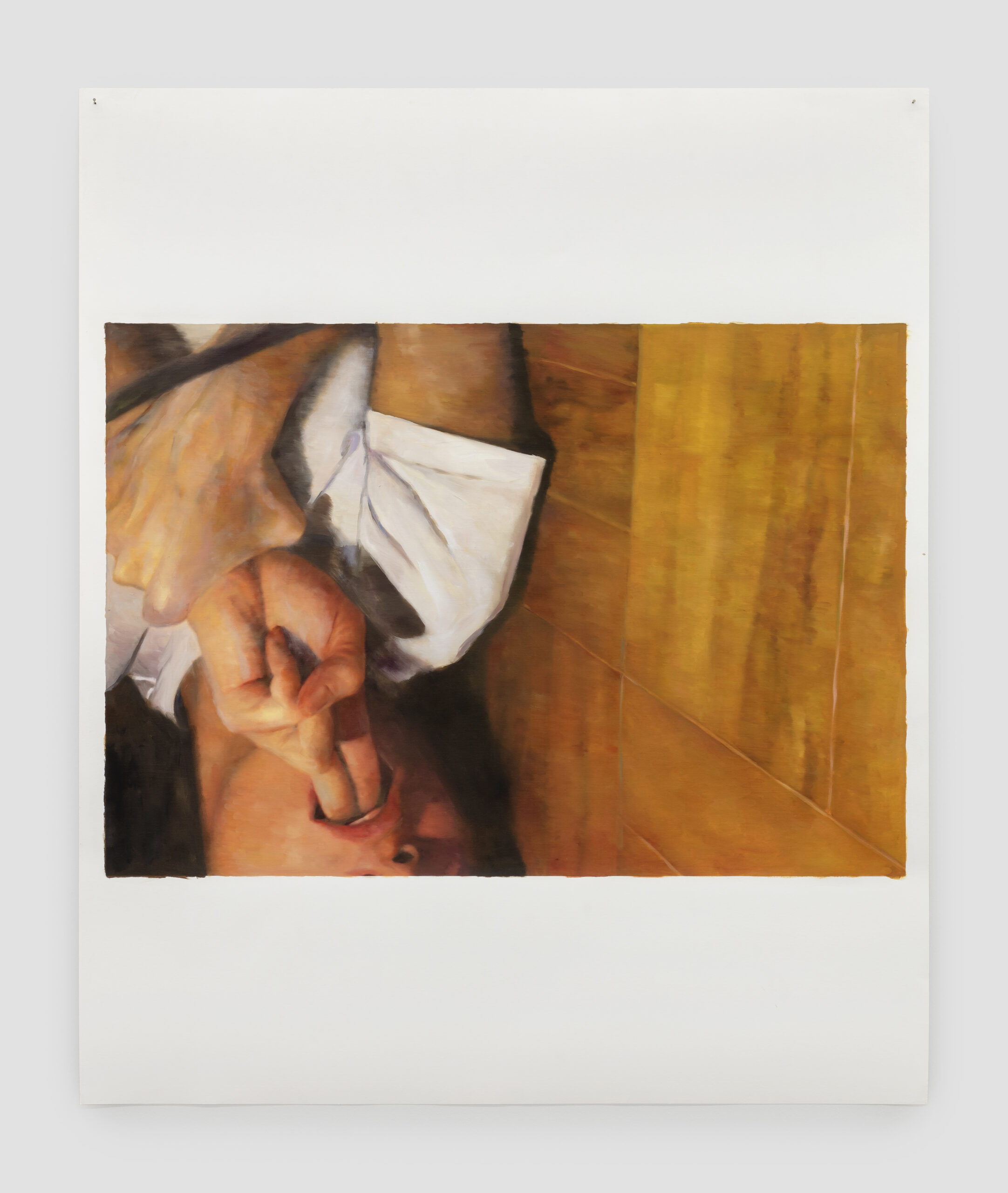
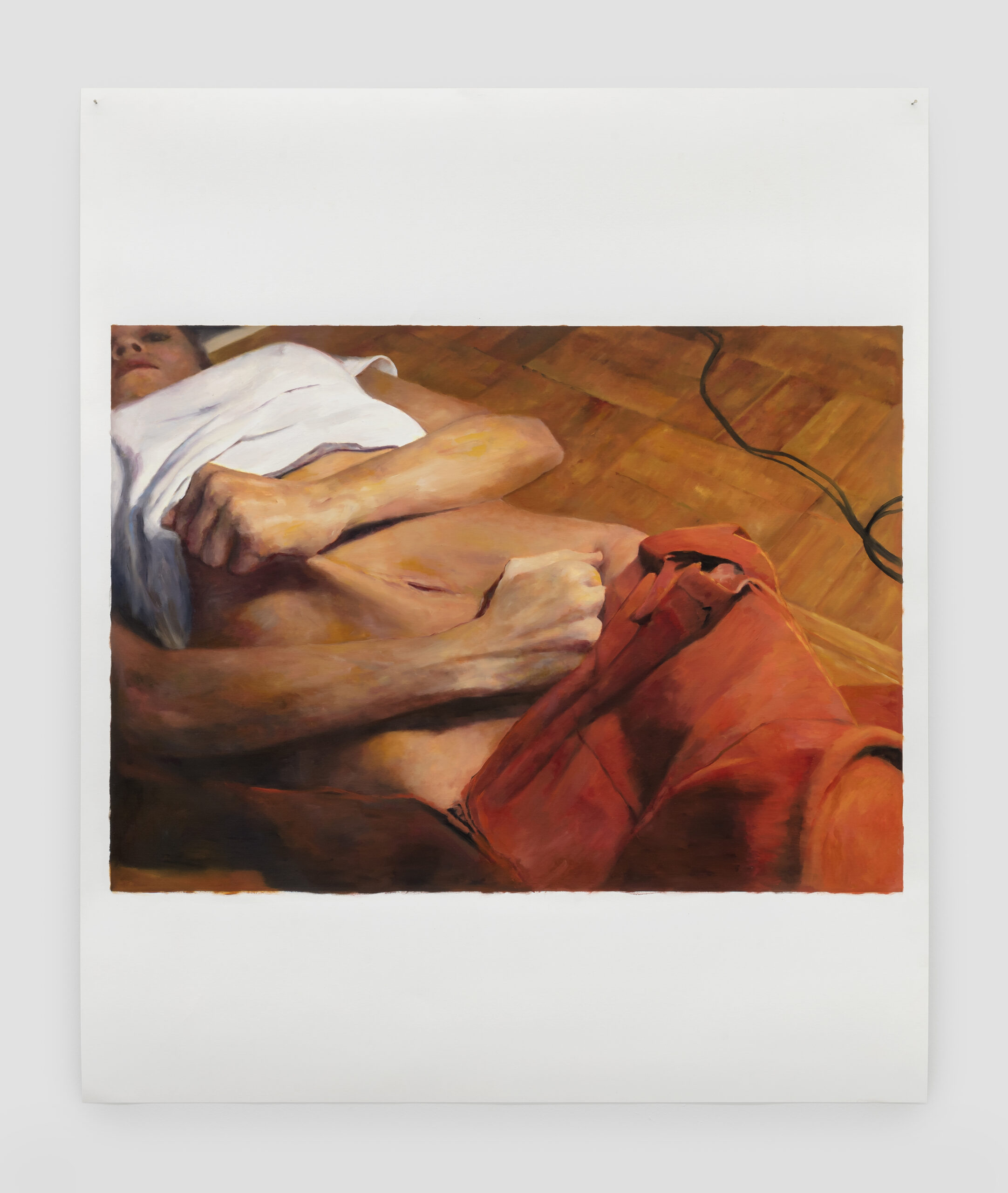
The female body is still considered a political site, and it has a very different starting point to the male body. Not only in the way we perceive the body, but also in the way we talk about it and how it can be used in art. One element that stands out in the background of the work is a cable. What is this cable?
The cable is the thread of my lamp, because the whole process is very amateurish, and I kind of like it to be amateurish. I always use videos or photos for my paintings. That whole idea I told you about – the bacchantes, Bolsonaro – that’s all in the background of the work. From the moment I know that I want to make a series of paintings, I don’t yet know what that image is. When I started making these paintings, I tried to work with a ballerina, and I tried to direct her to do some things, but I realized that I didn’t even know the movement I wanted, so it was very posed. Then I understood that what works for me when I do this kind of painting is to make a kind of performance with myself that I film. Then, from that, I select some movements that I think might work for the painting. It’s a performance that straddles the line between performance and acting, because I know I’m being filmed, I know I want it to become a painting, but I usually do it in my studio.
The wire you see in the painting is on the floor. I started the performance sitting down and then I went to the floor, where those photos were taken, and that’s why the wire appears. I thought it was interesting to have the wire because it’s a strange element. There are things that appear that I think are good. I set up a very rickety structure to try and take photos, because then, in the middle of the process, I understand how it happens. I had the floor and, as I needed a very strong light – light is important to give shade – and I didn’t know where the lamp was, I lit the scene with my mobile phone. Sometimes I even do it with my computer camera. For me, it’s good even when it’s not very high quality because that gives me more room to paint – I don’t want anything super-HD.
We can see that the color red is very important in your work.
I think red represents several things. It’s something that appeared and then, as it reappeared with great intensity, I tried to understand where it came from, because it’s a place I’m in and can’t get away from. If I think about references, there’s one that’s very strong for me, which I’m completely obsessed with, and that’s the frescoes in the city of Pompeii, all done with this super-intense red color. The walls of the Villa of Mysteries show scenes of a ritual to Dionysus that have this very red background and, because it’s a fresco, it’s a natural pigment. It’s something that exists just to drive me crazy because it’s a color that, even with oil paint, I’ll never be able to achieve. Oil paint isn’t that natural pigment on the wall that produces that vibration.
There’s a moment in painting when you start to see things, and it’s not even the thing you’re painting, but what the moment of the brushstroke suggests. I see flesh, I see muscle, there’s something of an internal organism, and I also like to think that red is the color you get when a part of your body is inflamed, or feverish. Inflamed can be a good thing, it can be bad, but it’s this idea that something is vibrating. It’s red, it’s hot. I’m still very into red and I need to find another obsession.
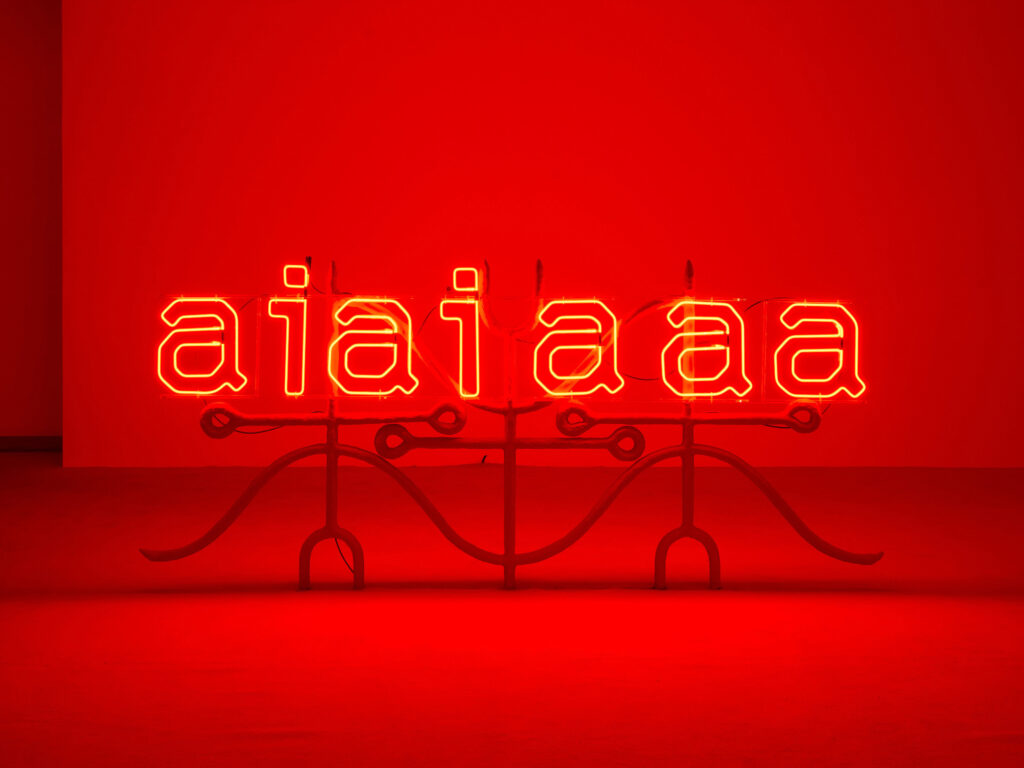
Thinking about these starting points of yours – mythology, the frescoes of Pompeii – what is it like for you to bring them into the world, and into the contemporary debate? Not only when thinking about painting, but also about the neons.
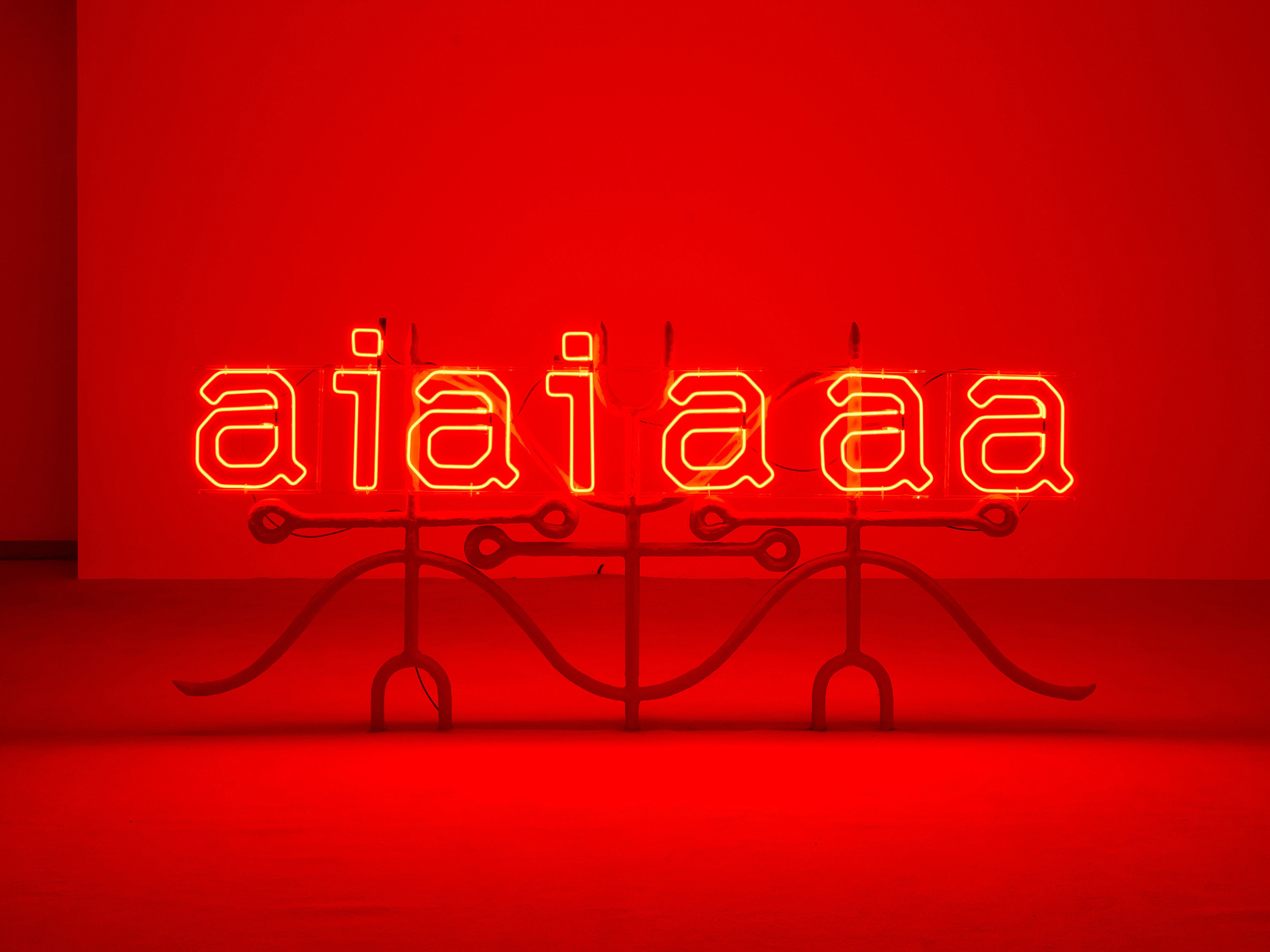
Neons involve a slightly different process to painting. For example, in my studio, around every painting I start there’s a pile of paper containing notes. There’s a whole universe there, and I write down everything; things I’m reading, quotes, things that have nothing to do with it, but that I think will. There are some phrases or texts that sometimes stick with me for longer. I try to bring this universe around painting into the title, or into the painting itself in some way, but sometimes it doesn’t work. Sometimes, there are phrases that haunt me in a way that painting won’t solve, and with that came the first idea for making a neon.
The first neon I made, The Zone, was in 2009 and is an extract from a poem by Arseny Tarkovski (1907-1989), father of the film-maker Andrei Tarkovski (1932-1986). It was a poem that I had in my diary and on the wall of my studio, and every time something happened in my life that poem came to mind. Then I thought: “It would be interesting to bring this to the city.”
What interests me most when I think of a neon installation is that the phrases are almost things you say to yourself, that you kind of whisper to yourself, in internal conversation, a very intimate conversation, but then, when rendered in neon, it becomes something public. Now I don’t think so much, but neon was supposed to be a vehicle for advertising things, trying to sell something, to say something.
No meu caso, a pessoa olha para o neon porque ele é grande, ele tem muita luz, mas na hora em que você o lê, ele não está te falando para fazer nada, pelo contrário. O neon te coloca num lugar de uma vulnerabilidade compartilhada de um jeito coletivo e inesperado. Isso que eu gosto de pensar, como usar essa ferramenta do neon, mas ao contrário da ideia dele. Ao invés de vender alguma coisa, o neon vai dizer: “olha, essa é a minha subjetividade, a minha vulnerabilidade. Talvez você encontre eco aqui”.
(Translation: In my case, you look at the neon because it’s big, it makes a lot of light, but when you read it, it’s not telling you to do anything. On the contrary, the neon puts you in a place of shared vulnerability, in a collective and unexpected way. That’s what I like to think about – how to use this neon tool, but in contrast to its idea. Instead of selling something, my neon says: “look, this is my subjectivity, my vulnerability. Maybe you’ll find an echo here.”)
The process is very intuitive. I have to be surrounded by these things, then a phrase appears, and then I start to understand the layout of that phrase. I see if it’s possible to install it and where to install it. I think it’s a process that’s kind of independent of my work.
The times I’ve seen the neons, they’ve usually been outside, always with a public art aspect. Is that intentional?
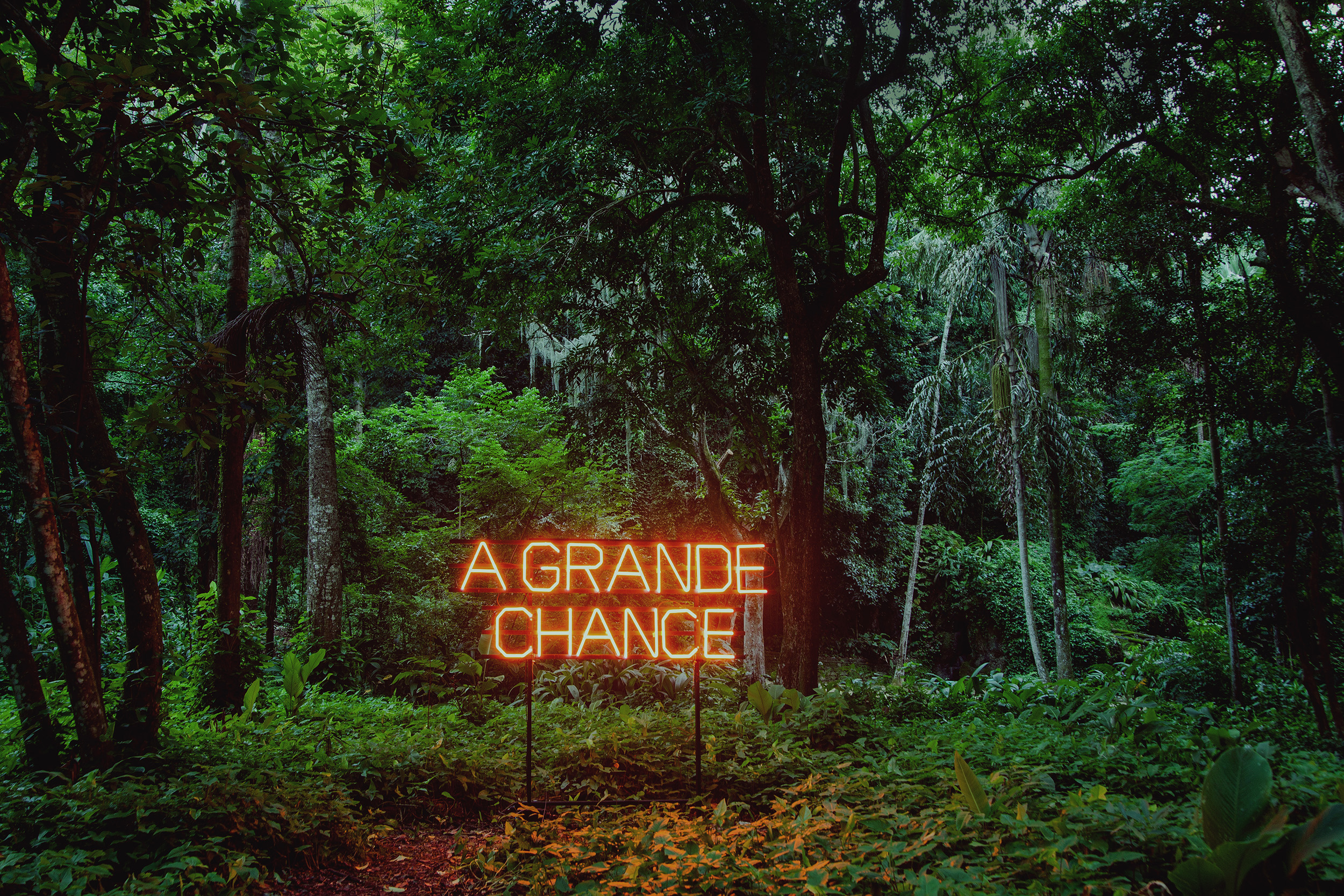
That’s one of the things I like best. I also have editions of neon – other phrases, other themes, another type of layout – made for internal space; whether internal exhibition space or a space inside a house, a collector’s house, or whoever’s house. My intention with the larger neons, the ones I put up in public spaces, is for them to be somewhat camouflaged in real life, to get out of that “this is art, this is not art” mindset. The neon I installed, for example, in Parque Laje (Rio de Janeiro), titled Chance (2015-2017), was made for an exhibition curated by Bernardo Mosqueira, and it was based on a proposition of his that made me say: “I think this will work as a neon.” Instead of installing the neon near the building where the works were displayed, I put it inside the park itself, where only people who are hiking and walking will see it. The public at the exhibition, if they knew about the work, would have to go to the park to look for it, but the idea was that people who were in the park hiking would come across the work and think: “oh, what a big surprise”!
I think it’s wonderful to be able to talk to a public who aren’t expecting it – it’s an idea of communicating with other people. The neon in Largo da Batata also had a stream of people around it. I like it when there is a flow of people who come across the work, and I like to observe the reactions and how people relate to the phrase. I find it fascinating when the work is very public, very out there.
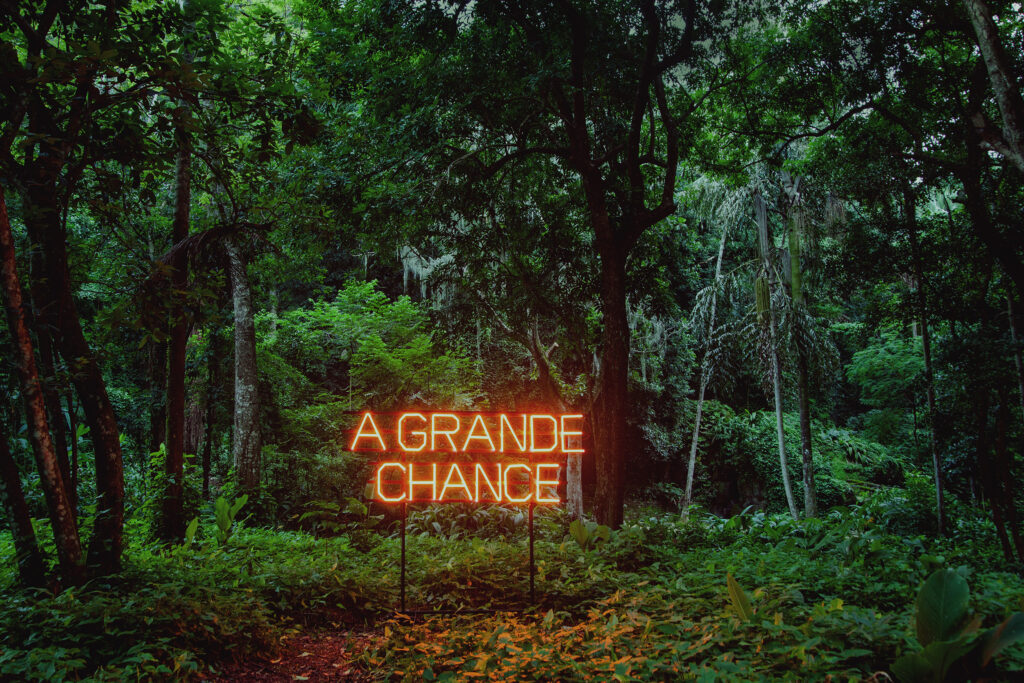
The starting points for some of your works are the history of women, the history of the social perceptions of women, such as your research into hysteria and the classifications given to the female body. How do these references and interests that you have reach the public in the final work?
I don’t know if people have access to all this, or if they need to. I think that this amount of research – for example, hysteria, the bacchantes – is more of a research process for me, one that I need in order to create the work. It’s almost a neurosis that is mine, and not the work’s. I think the work is always bigger than the artist. From the moment the work is created, I have no way of predicting how it will affect people, or at what point, and I don’t want to. I don’t want people to see this work only in terms of the oppression of women; if someone looks at this work and feels something completely different, that’s great too. My concern is to make work that affects people, but I can’t even ask for that because I think that would be authoritarian on my part. From the moment the work is in the world, it has its own life and is bigger than me. I also like it when people come and talk to me during the exhibition. It gives me the opportunity to see through the eyes of the people who come to share their stories.
Some of your works have been collaborations, for example the performances. How does this collaboration work?
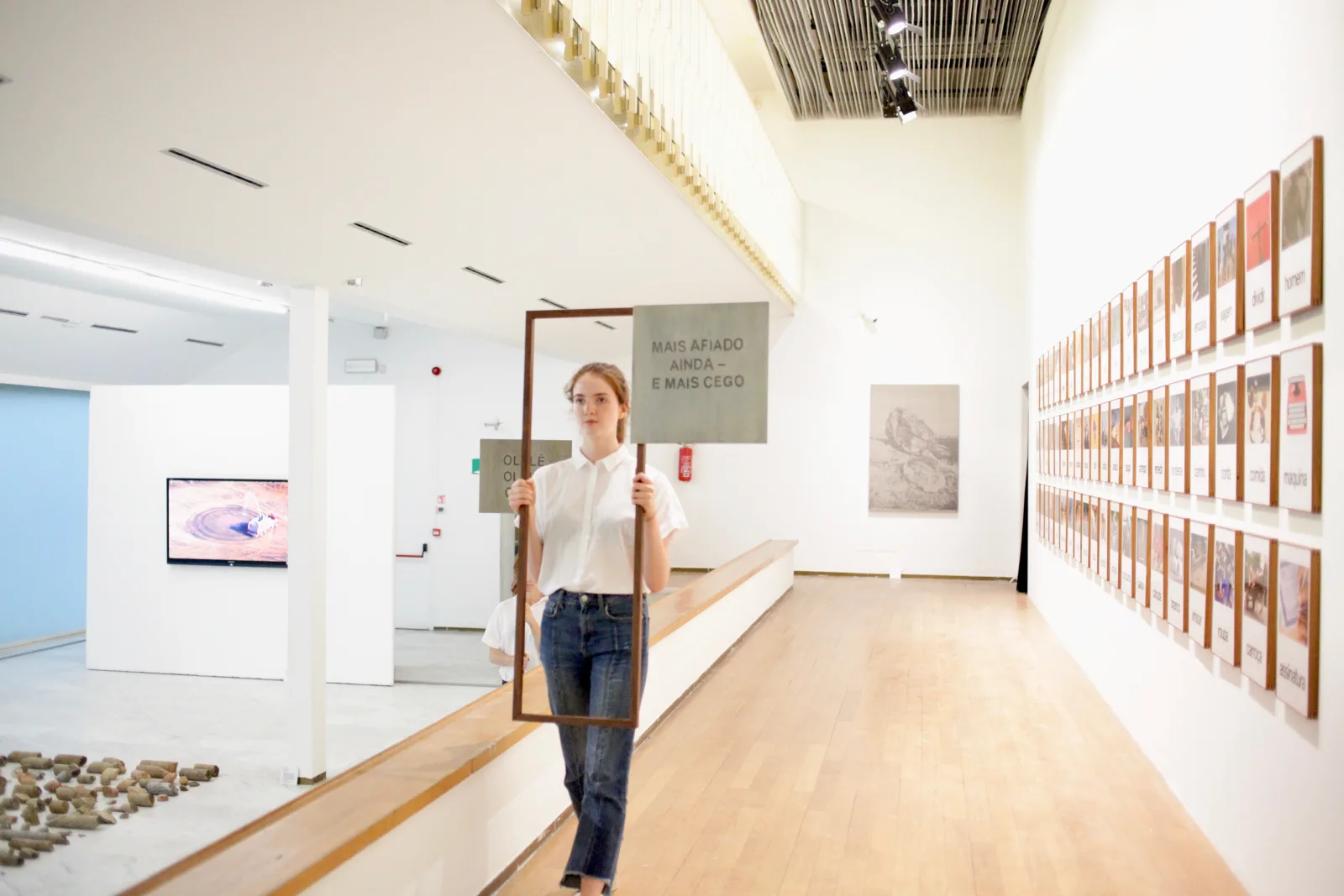
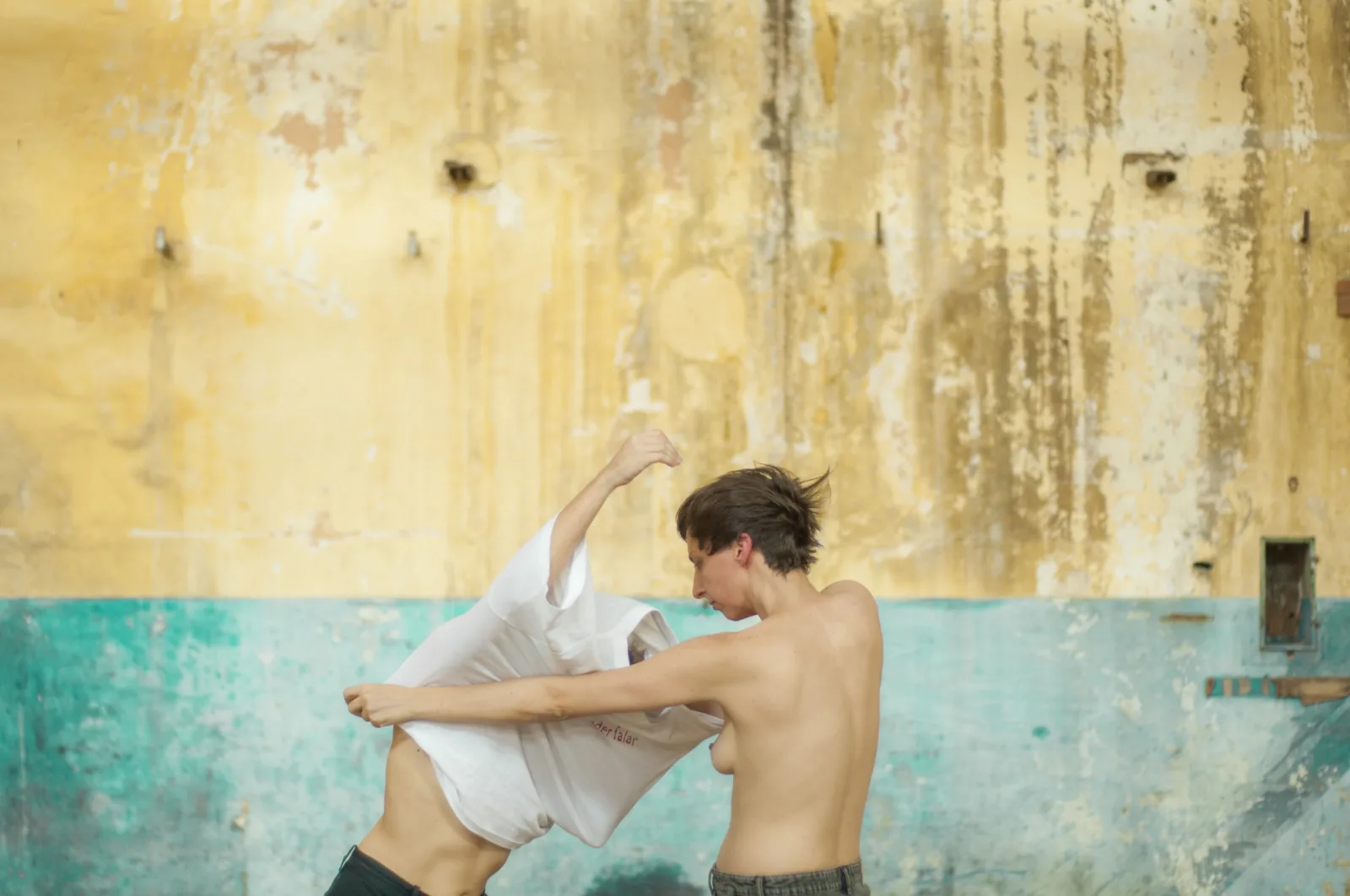
I love doing collaborations. I did the exhibition “Bacante” with the artist Ana Mazzei and, in the exhibition I made at the Pinacoteca, “Pagã” (2023), I collaborated with musicians, costume designers, and choreographers. I usually work with people with whom I have an affinity. Not necessarily friends, but a work affinity. Ana and I had collaborated on another performance called Ofélia (2018) and I invited her to perform in Bacante because I wanted to activate the body in some way in the exhibition. I like to invite the collaborator when I’m first thinking about the work, so it’s not like, “I have this work, it’s going to be this, you’re going to come in and do this,” because then I’d be more of a supplier than a collaborator. It’s marvelous to work in collaboration, because it gives the feeling that we start from the same intention, but the collaborators bring different baggage, experiences, and skills. I’ve been working with collaboration especially for performance work.
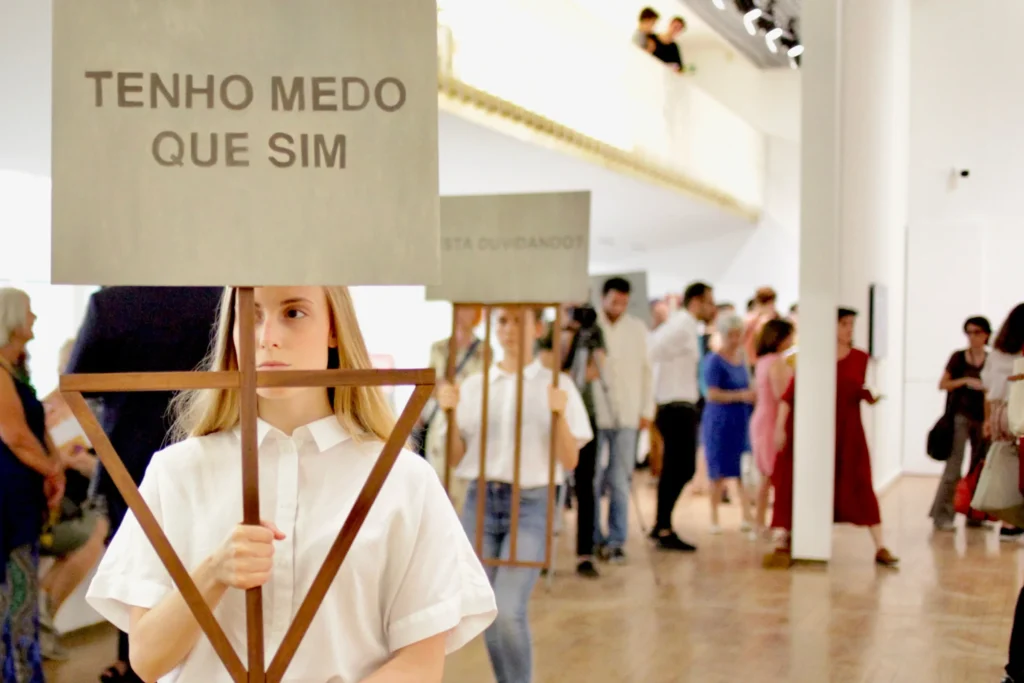
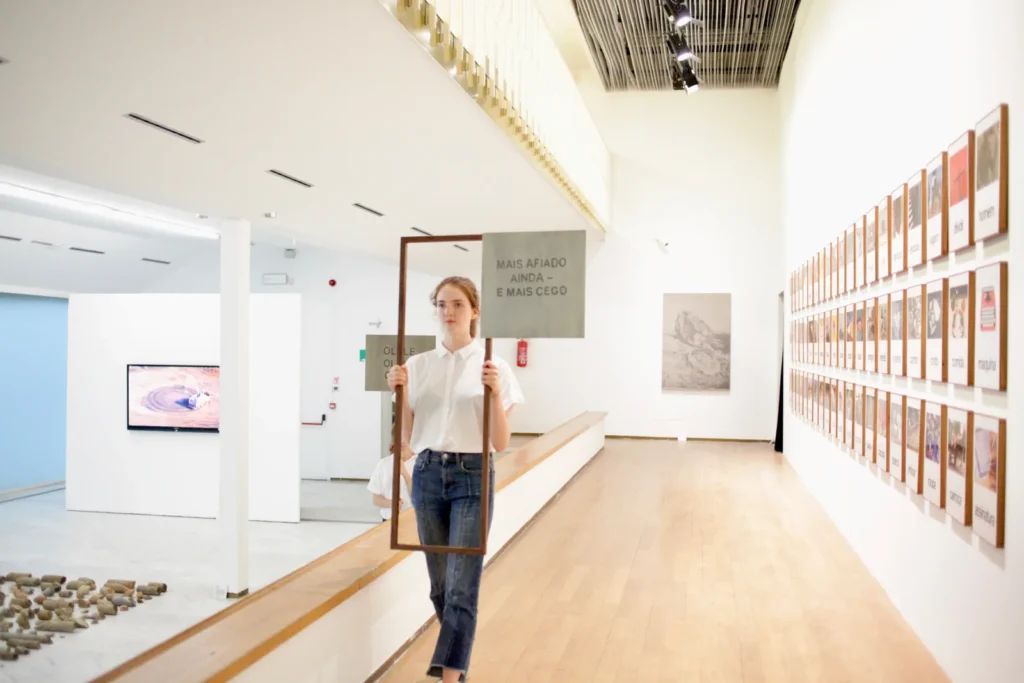
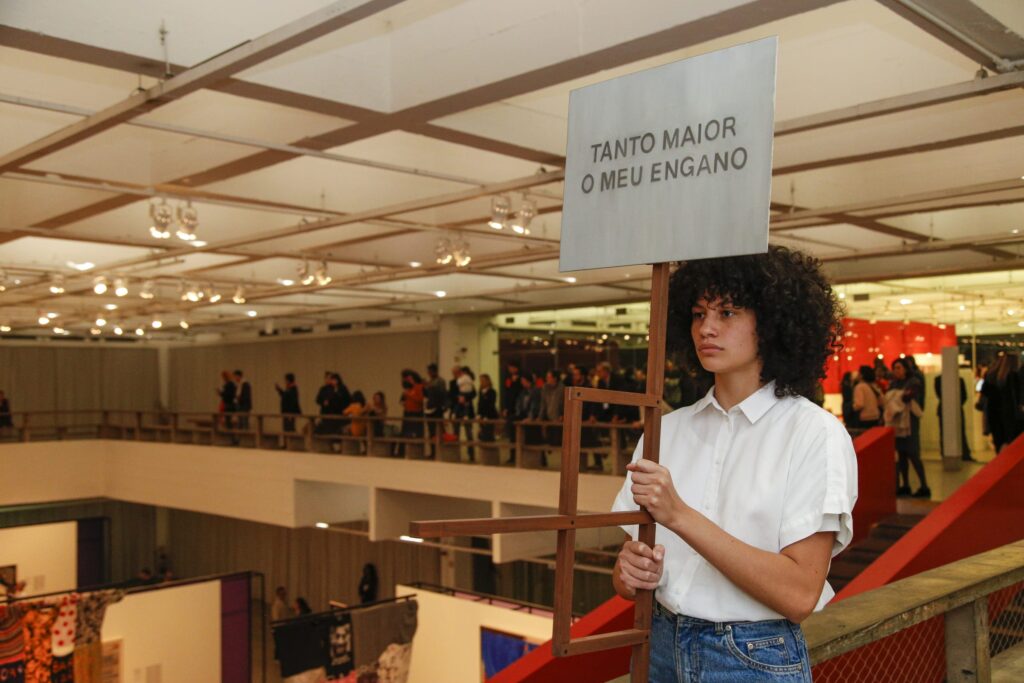
Regarding your exhibition at the Pinacoteca, what was it like creating such a large show for this space?
It was a very ambitious process. I started thinking about this project before I knew it was going to be at the Pinacoteca, almost out of a need to think of something ambitious during the pandemic, to feed myself. I had a strong desire to bring in these elements of theatre in a more open and less shy way, to really embrace what would be this encounter between theatre and the visual arts, and also to create an immersive exhibition in the sense of really embracing the audience with the works, or with a certain environment. The pandemic was this situation in which we couldn’t meet, we couldn’t do anything, and I said: “I want to do an exhibition in which people are affected, for better or for worse.” I began a conversation with Ana Maria Maia, who is the curator, and with Jochen Volz, the director of the Pinacoteca. If I think in terms of collaboration, Ana Maia was my first collaborator because, in the first conversation I had with them, the ideas were very loose. I worked on the pieces for a year and a bit, then there were performances, and it was a very intense process.
Do you see any difference between national and international audiences, or between the effect the work has on them?
I think there are always things we lose and things we gain. In Brazil, we live with an almost naturalized violence against women, an everyday violence that isn’t as intense, or doesn’t occur in the same way, as in the United States, for example. So, of course, the work won’t be as acute. Just speaking from my experience, I get more feedback from audiences in Brazil than in the United States, for example.
On the other hand, one thing that sometimes happens when you’re in the United States is that they’ll put you in the “Latin America” box and that’s a sensitive thing. At the same time, it’s always a completely new audience, with a very fresh eye, without any preconceptions, fore-knowledge – it’s an interesting eye too.
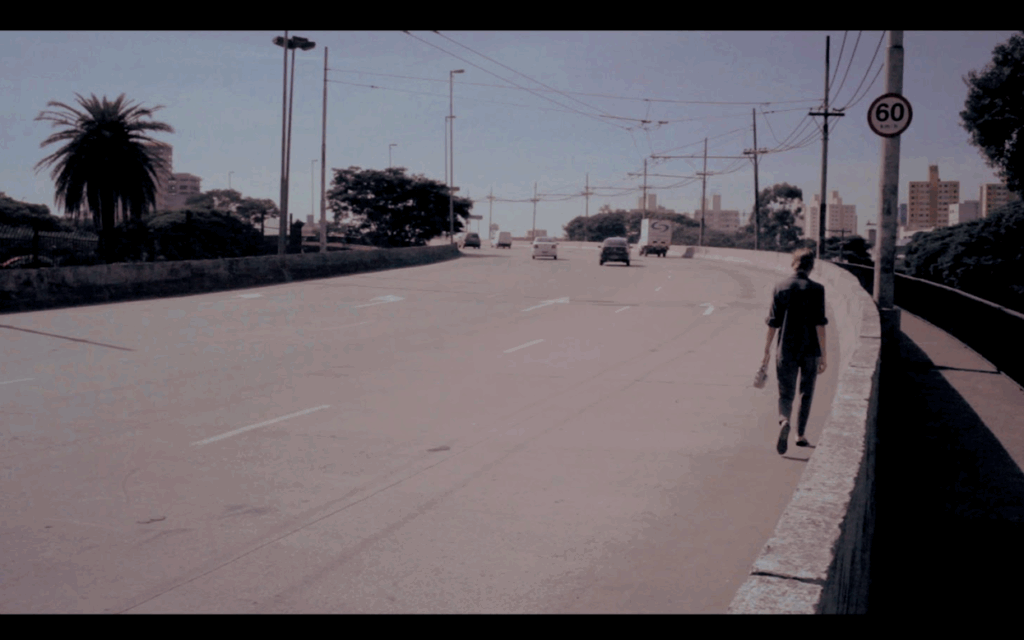
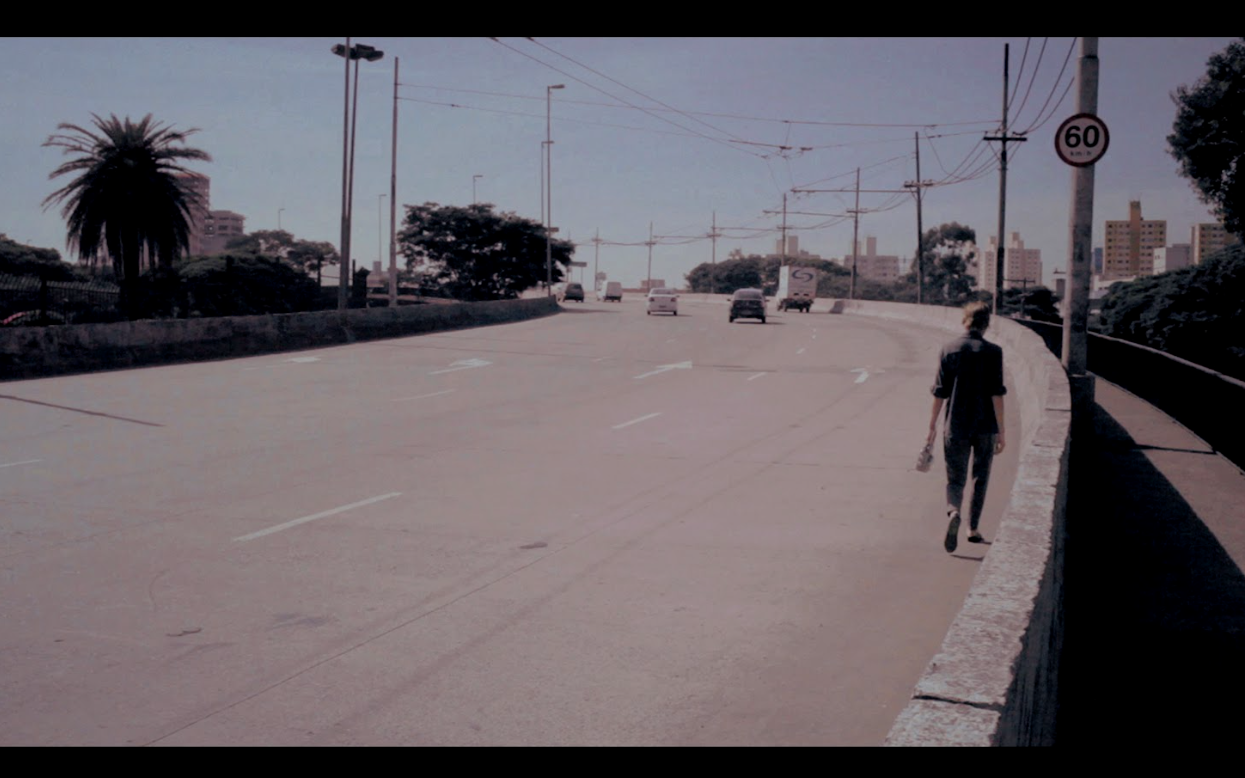
I wanted to ask you about 7.536 passos (por uma geografia da proximidade) (2012), which is more from the beginning of your career. How was the process of making it?
It’s a work that I really like. It was a commission from the Joaquim Nabuco Foundation, where Moacir dos Anjos works, so it was a project that was discussed with him and the Foundation staff. Whenever there’s a commission to make a video, the artist ends up having more time to do the work, to do the research. It arose, firstly, from a discomfort, to be quite honest, a discomfort I’ve always had. My studio, at the time I made this work, was right in the center of São Paulo, between Praça da República and Praça da Sé. And there is a way in which São Paulo makes invisible the people it wants to be invisible, which is very cruel. I think it’s very characteristic of São Paulo. There, you have this way of marginalizing people who don’t belong in the city, or who you don’t want to belong, or who you only want to belong for certain reasons. You make them invisible and push them to the margins.
São Paulo has this huge community of Bolivians who live mainly in Brás. You only know about, or have contact with, this community when there’s news about labor in one of the garment factories that’s analogous to slavery. It seems like something designed to prevent you from having any contact with these people, and this always intrigued me because I was extremely close to them. So I started to frequent the Brás area, and I was part of an immigrant support association. I provided services by documenting community events. Basically, it was an association to provide information.
The neighborhood was very close to my studio. I would walk to Brás, but it was very clear to me that there were two universes that didn’t meet at all, and that disturbed me. That’s why the name of the video is 7000 steps; I didn’t actually count, but I calculated by the distance I was walking how many steps it would be from the studio to Brás. It’s a short distance, but it feels like you’re crossing borders – not just the border between Brazil and Bolivia, because it’s not about that, but other borders and separations in between. I started to socialize more with the people in the area and ended up discovering, in this research, that they have a series of pirate radio stations that serve the community. One of the stations that was most listened to was called Impactos Calientes, a brilliant radio station that played basically all day long. It had a varied program, starting with some news, then songs, and people called the station. As it was pirate radio, it also changed frequency over time, so it was a job to try and find the right frequency during the research. I heard about this radio station and thought: “I think pirate radio is a good metaphor, a good symbol of the situation of these people.” Just this idea of trying to tune in to the stations felt very much like the situation of someone who moves to another country; it seems like you’re always in that place between the stations, you always have one foot in the city you left, where you came from, but you want to be in the city you’re in, you’re a bit in that place where things meet. So I decided to make this video, which is basically of a walk, leaving Praça da Sé, which is São Paulo’s Ground Zero, in the direction of Brás, with a radio in my hand tuned to Impactos Calientes. The station is on a blank dial, so in Praça da Sé it’s not picking up Impactos Calientes yet, it’s picking up other pirate radio stations in the center of São Paulo. At first you hear a pastor, then some other songs that come in and you kind of pick up everything. As I get closer to Brás, the sound of the station becomes clearer, then it switches from Portuguese to Castilian, and Bolivian songs start, and I finish this walk at the little market they used to do every Saturday. At that point, it becomes clear that the situation is reversed, that I’m the foreigner and I don’t belong there and I kind of get lost in the crowd. So it was a bit about this walk, which is about steps, but at the same time is very distant, and about this place “in-between,” this desire to meet, but at the same time the impossibility of meeting in this city that is São Paulo.
It’s interesting to see these analyses of distance versus proximity that appear so often in your work. I wanted to finish by asking you about the video Lasciva (2018).
This video came from research into images of women photographed by Dr Jean-Martin Charcot (1825-1893), in the 19th century in France, who were thought to be hysterical and were diagnosed in different ways, with very different symptoms, all placed inside a hospital in Paris. Dr Charcot, a highly respected doctor, was in charge of this department and his are very cruel pictures. His way of proving the diagnosis was precisely through images (which are in public access); he photographed the patients having these fits of hysteria and, underneath each photo, there is a kind of categorization. It’s very cruel because, obviously, these women are in a very vulnerable situation, suffering from various symptoms and, at that time, the photograph wasn’t a snapshot like we take now, they had to remain still for a while. That’s where the relationship comes in: how much they are staging their own symptoms for the camera. There’s a very perverse power relationship between the men that diagnose the women who are wearing nightgowns, more often than not, in a somewhat sexualized situation, so it’s very uncomfortable to see these images. In the end, what brought me to this research was realizing that these women were portrayed without any kind of subjectivity. They’re just patients, they have a kind of seductive thing going on, but they’re also having a hysterical crisis. Then the desire to do this project arose, which was difficult: how to use these images as a starting point, making a work that didn’t reaffirm this. Because I think this idea of hysteria has almost become a cliché, and I was very afraid of making work that, in the end, was going to be “the piece about hysteria.” I knew I wanted to do something with the body, because they were diagnosed as hysterical due to body positions. The question was how, with the body, can I do the opposite? How, through the body, can I bring out the subjectivity of these women? I invited choreographers Bruno Levorin, Clarissa Sacchelli, and Maitê Lacerda and we selected some images that we wanted to take as a starting point for a choreography, but trying to bring out precisely what had been taken from these women in the photos – their subjectivity and desire – because we thought that what lay behind all the images was a desire that they didn’t have the right to have, and because they didn’t have the right to desire, they were categorized as hysterical. That’s why the work is called Lasciva [Lascivious], because it’s kind of a quest to try to bring desire to this body that is in tension.
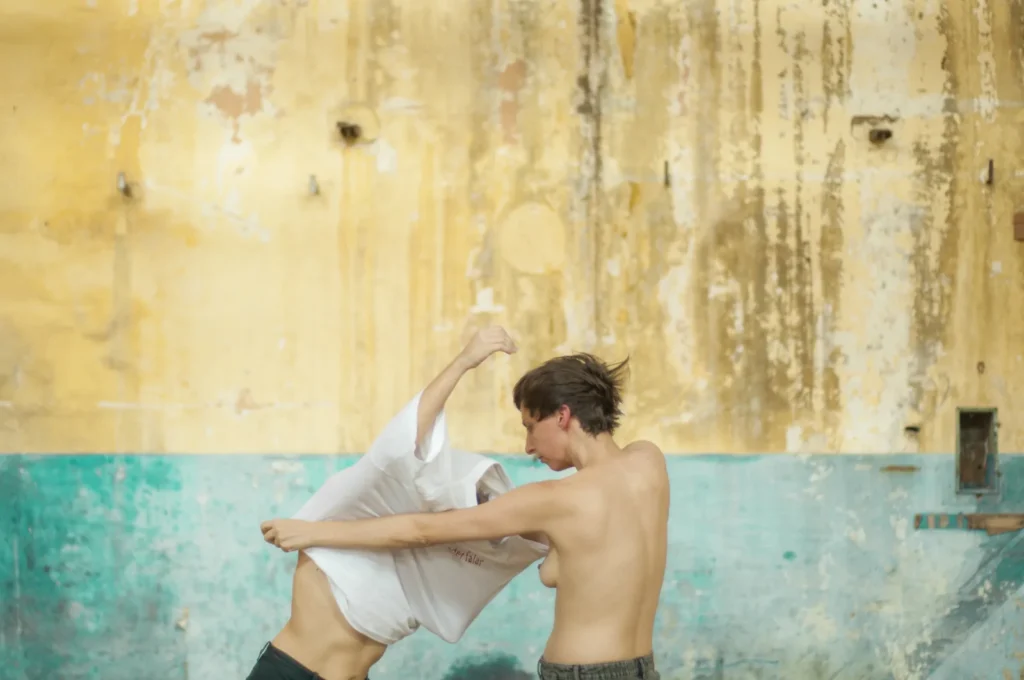
As we ended up researching a lot and rehearsing a lot, the work bore fruit in different ways: a series of choreographic pieces, by Clarissa and Maitê, which we presented a few times, a documentation video, and this video, Lasciva, which I made with excerpts from the movements that were created during the research. They are movements that have a relationship with these images of Dr Charcot, but the idea is precisely to subvert this and bring something else. So, in the video, Clarissa is making choreography. To help with the subversion, I added subtitles, which are excerpts from Euripides’ play Bacantes, which speaks about desire. The soundtrack was made by Gustavo Riviera, who is a rock musician from Forgotten Boys, and I asked him to come up with a soundtrack that was very heavy, very rocky, to give the idea of something that is out of place, something that is deviant from the norm, but that we are precisely putting out there. So there’s a movement that’s a little held back, because it comes from this held back place of the image, but it has a desire for liberation, liberation driven by desire. But it was a long and intense research project, with the fundamental collaboration of Bruno, Clarissa, and Maitê, which I would never have done on my own.
Interview conducted on 28 February 2024 remotely via Zoom.
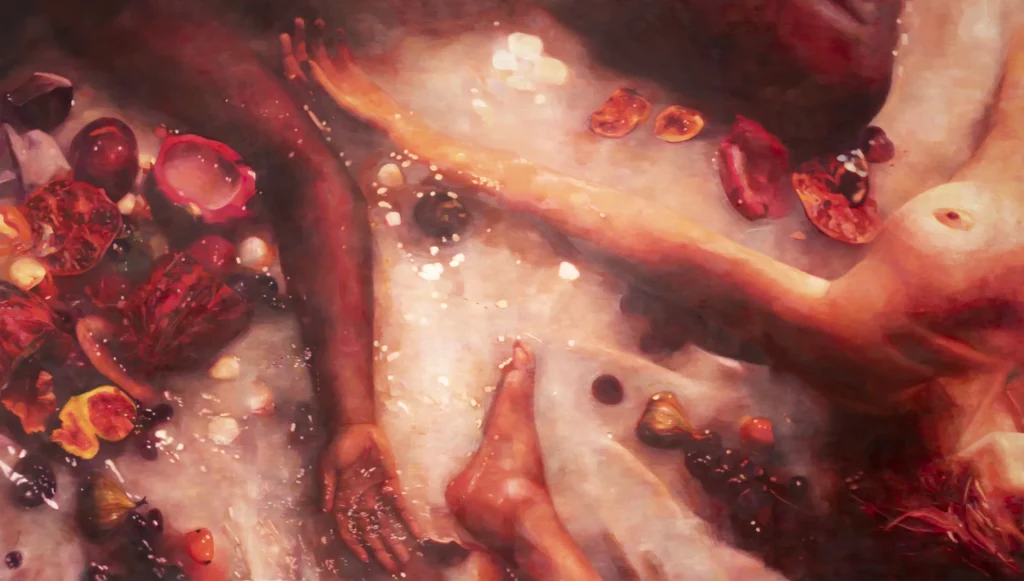
Oil on Arches paper on aluminum |
250 x 440 cm
2023
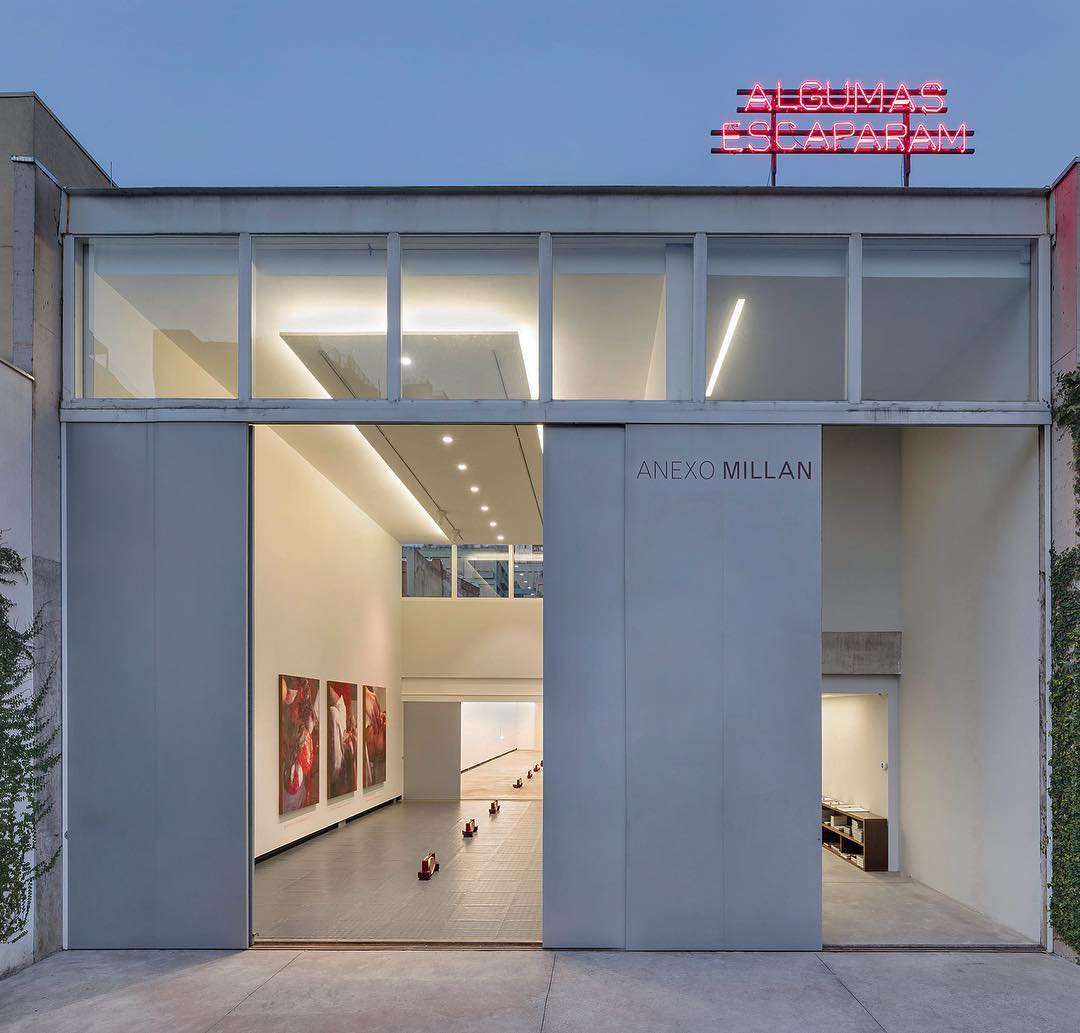
View of “Bacante,” 2019 exhibition at Galleria Milan, São Paulo
2019
2019
Oil and wax on paper |
101,6 x 119,4 cm cada
2019
Neon installation on terracotta structure |
170 x 80 cm
2021
Neon Installation |
200 x 260 cm
2015
Performance in collaboration with Ana Mazzei
2018
Frame
2012
Performance
2018