

Laercio Redondo
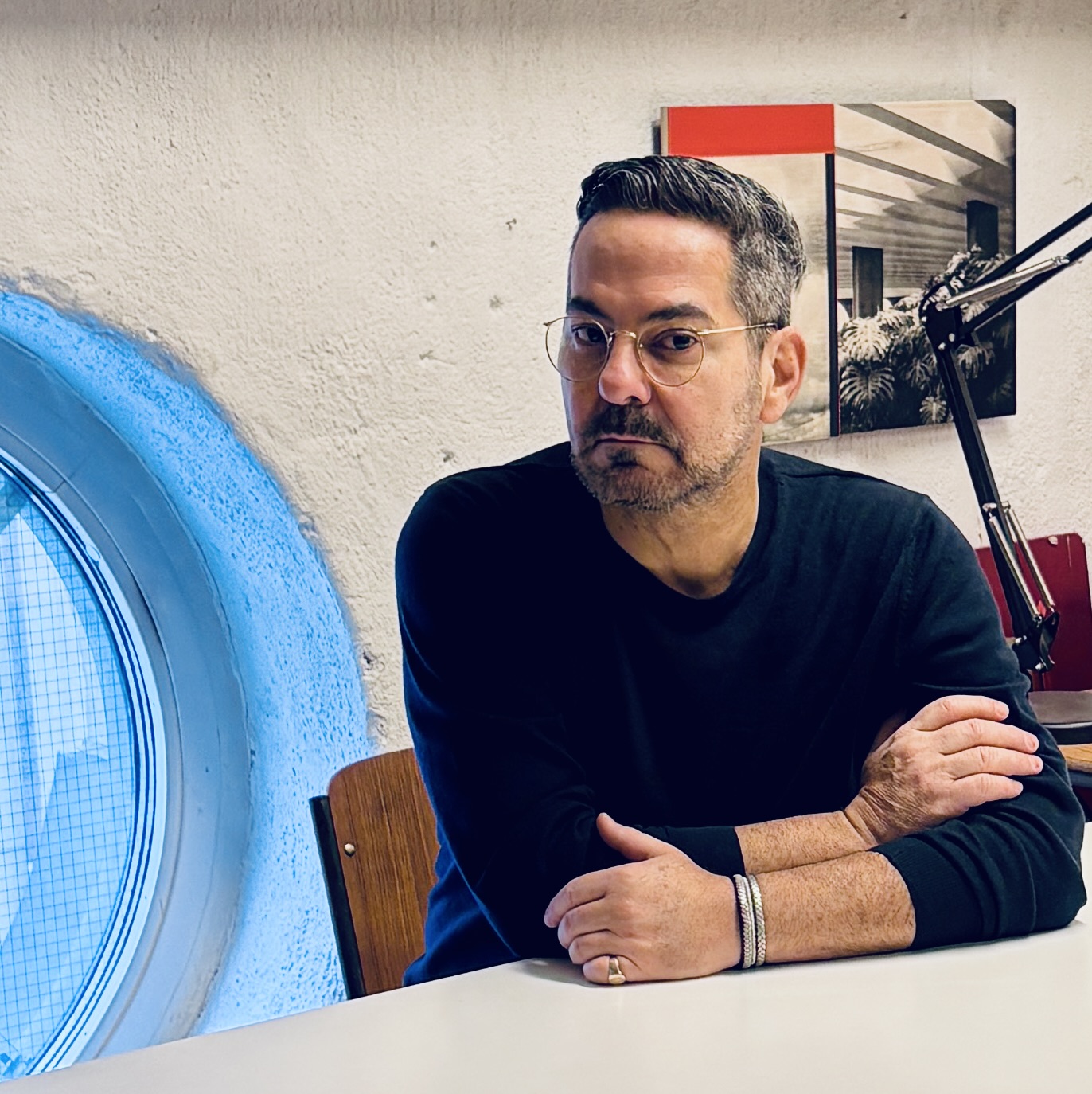
Laercio Redondo (Paranavaí, 1967) is a Brazilian artist who explores the stories that exist between the lines of grand narratives and famous characters. Living between Rio de Janeiro and Sweden, Redondo has a keen interest in discussing modernism in both Brazilian and international contexts, especially in relation to architecture and art. His work often signals the erasures and intricate relationships between collective memory and historical narratives. In his process, the results make apparent the layers of tensions, gaps, or permeations superimposed, spatially and temporally, on the people, objects, and facts thematised in his works. In the interview, the artist reveals how he uses a variety of media, including sculptures, prints and installations, to re-examine the past and reflect on its continuing influence on the present. Check it out:
Laercio, thank you very much for taking the time to talk to us. I’d like to start by asking you to introduce yourself, with any information you think is relevant, thinking of an audience that may not yet know you and your artistic practice.
My name is Laercio Redondo, I’m 56 years old and I live and work between Rio de Janeiro and Stockholm. My work develops fundamentally from my interest in history and its erasures. The creative process usually involves searching for historical facts, people, or cracks in history that I find interesting, to reinsert them into our context, bringing up new questions about subjects, moments, or figures that we think we already know well. My works have thematised, or revolved around, Lina Bo Bardi and her house, Carmen Miranda, Athos Bulcão and the Gustavo Capanema Palace. These are people, facts, or situations that I somehow contextualise in my work, creating a kind of puzzle in my exhibitions – I invite the public to explore it with me, so that we can come up with new questions, complicating, and even contradicting, our perceptions.
Can we start by talking about Carmen Miranda, from 2010?
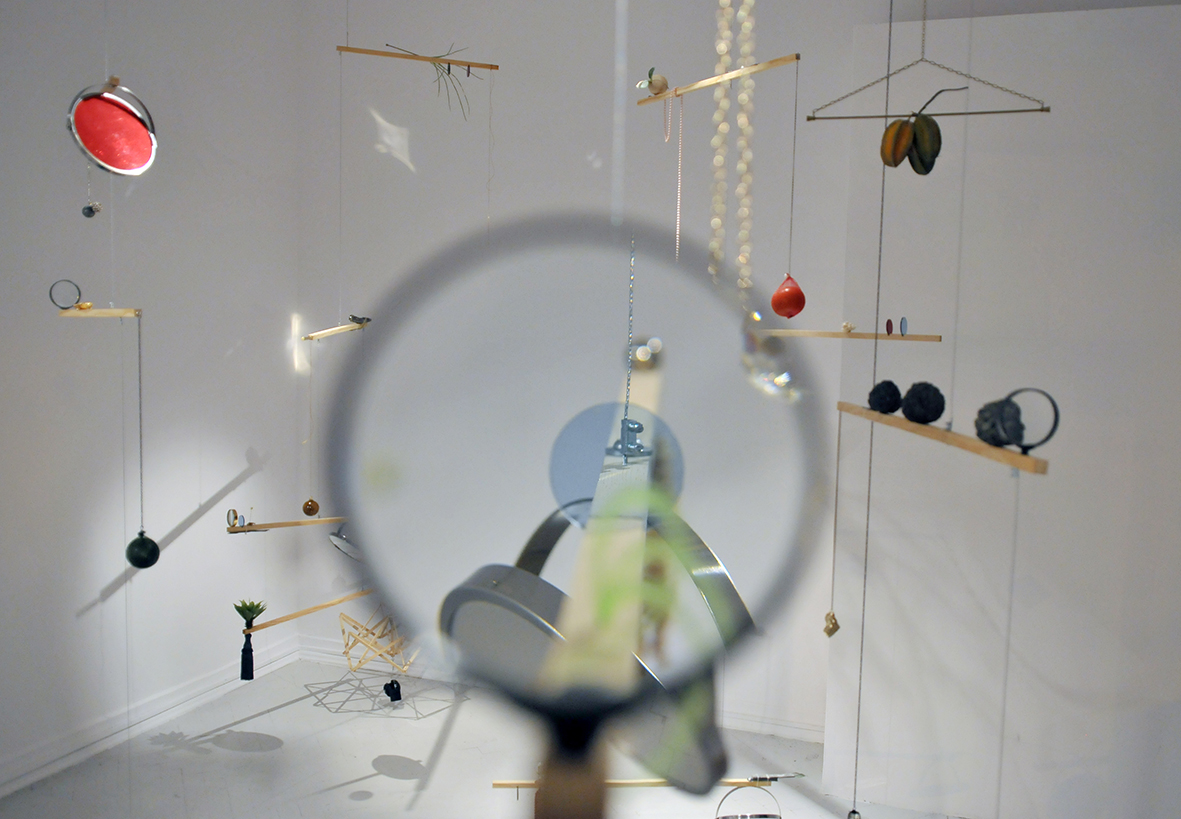
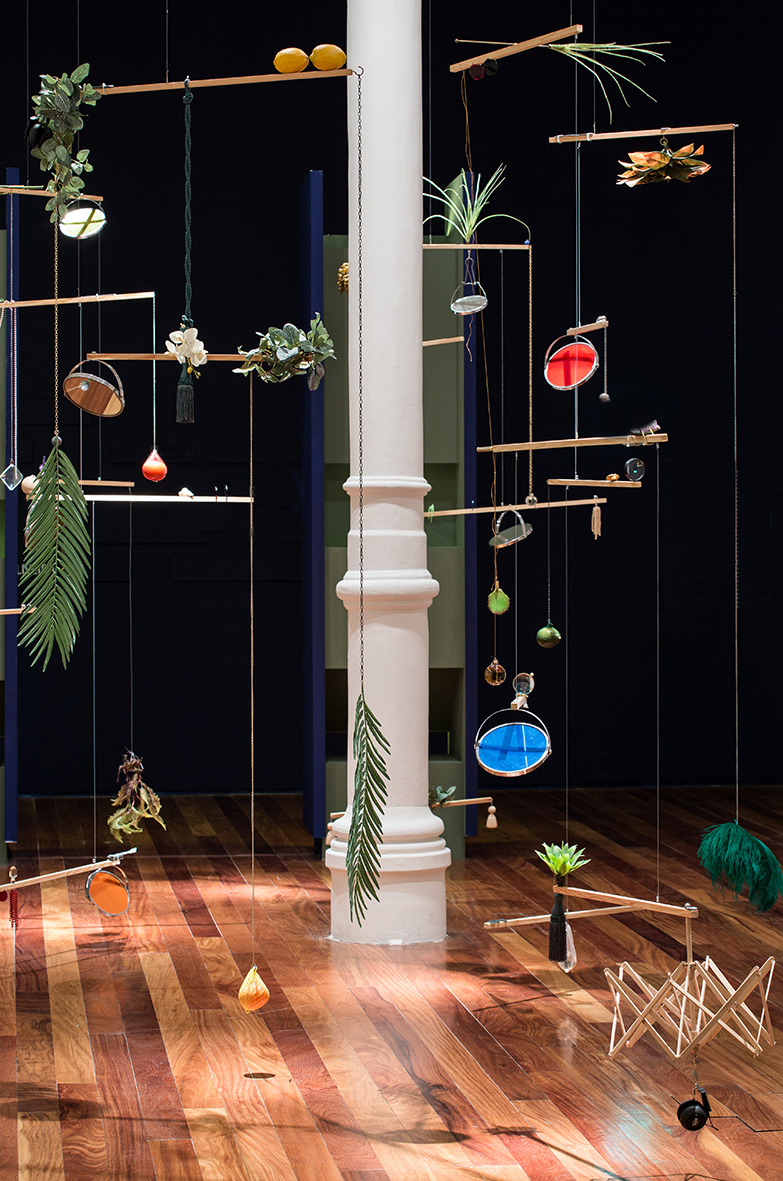
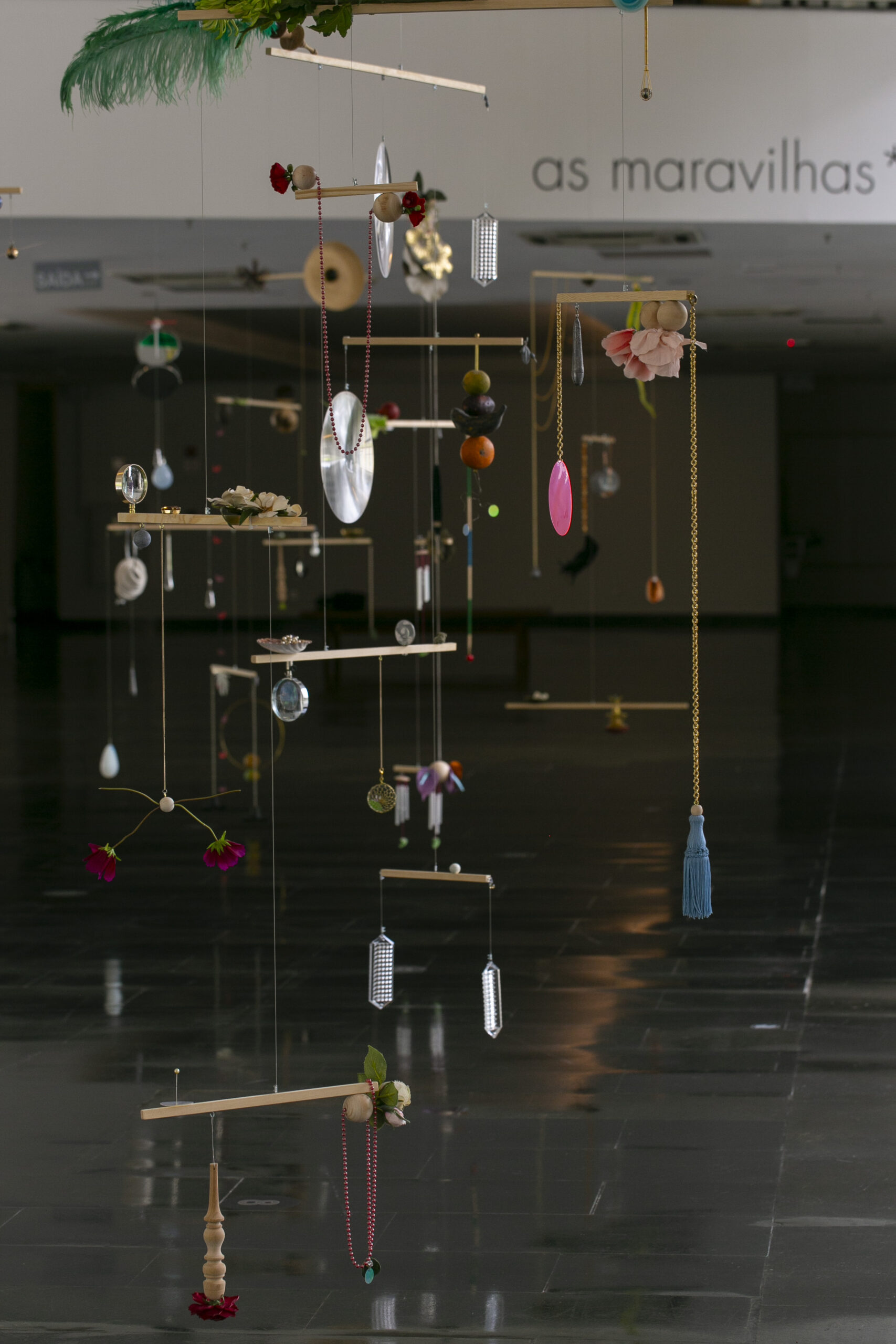
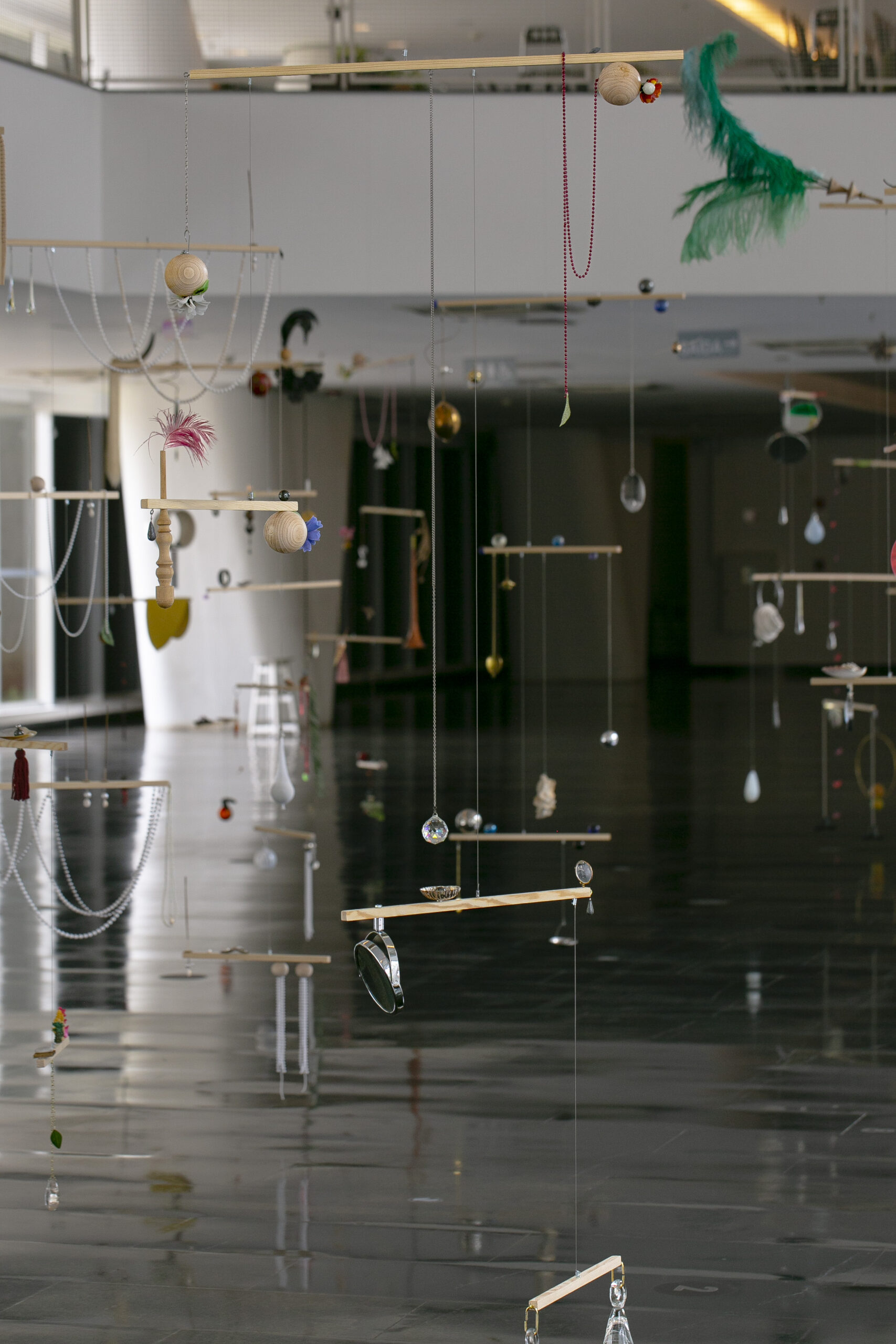
My work on Carmen consists of mobiles that I actually see as a portrait without an image. I don’t use her image per se, but all her props to talk about her in her absence. And what was I interested in saying about Carmen?
Firstly, I have to say that this is a very important work for me, and it occurred when I was in Rio in 2009, at a time when Brazil was appearing on the covers of international magazines and there was a whole euphoria about our country as a new promise of world power. Something that really struck me about this media approach was the fact that, when the editors needed an image to illustrate the country, it was often Carmen’s image that they chose.
It’s worth remembering that Carmen was born in Portugal, but lived in Brazil in the 1920’s; more precisely in Lapa, in the centre of Rio. Her parents owned a boarding house and served food to the workers in the area, and it was in this context that she first came into contact with samba. If you look at her discography from the beginning of her career, you’ll see that she recorded with all the most incredible samba singers of the time.
In Brazilian society at that time, samba had not yet “arrived” in the South Zone of Rio de Janeiro, and [then] Carmen appears, a white woman and, moreover, singing samba. If we consider that this happened at the beginning of the 20th century, a lot of complexity comes to light. A black person seen with a guitar could be interrogated and arrested by the police, so it’s curious to think that samba “crosses” the centre of Rio, which in this case encompasses the peripheral population, and reaches the South Zone carried by a white person who, at a certain point, puts on a Bahian outfit and ends up in Hollywood.
There are many costumes, many disguises, many layers for us to think about what, or who, Carmen Miranda really was. In the beginning, that first Bahian costume is a Yoruba inspired outfit, and when she arrives in Hollywood, it’s stylised and pasteurised, and she’s lost without the context that existed in Rio. But it’s interesting to think of her following this path, going to the United States as an instrument of the ‘good neighbor’ policy between the countries and becoming the figure we know today. But despite her success, what lies behind this image? Another curious fact about Carmen’s foray abroad is that her contract stipulated that she should not speak English properly, despite being fluent in the language. She was placed by the showbiz of the time in a position where she had to behave and act in an often caricatured way, which makes sense in that historical context and in the way she was received in the United States as a South American woman making a name for herself in the country.
This work is not a criticism of Carmen, but rather a way of thinking about how this image of her works, thinking about its gaps, and what it translates into, or hides. So when people look at the mobiles and see the title of the work, they immediately recognise her without actually seeing her: it’s a body, but without an image. Carmen Miranda is a dissident body. What’s more, there was something queer about the image she created, something that is difficult to fully define in a single image. The work, the elements that make up the mobiles, their movement and their aesthetics, all evoke this.
Architecture is also very important in your artistic practice. When we look at works like Carmen Miranda, it’s possible to identify these small architectural elements.
One of the things that most mobilises my work is architecture, and I think it’s present all the time. In fact, perhaps architecture is the most faithful document for understanding an era, because it is always linked to power. Whether it’s the architecture of a community or that of the National Congress, both contain very important data for understanding the times in which we live, the social power plays and the political fantasies of an era in a particular place. My interest in architecture begins especially with the city: how it is organised, how people meet. Perhaps that’s where you make the connection between Carmen and architecture.
Coming back to the mobiles, they came about after a visit to a cabinet of curiosities I saw in Uppsala, Sweden. Cabinets of curiosities arose during the time of the great explorations and “discoveries” in the 16th and 17th centuries and, roughly speaking, they were cabinets made up of several drawers. Opening these drawers revealed a unique collection of exotic objects collected during the explorations, which were displayed for visitors to see, and which, in a way, gave rise to the first museums. It was a way of showing, for the first time in history, the story of the Other, of what was unknown.
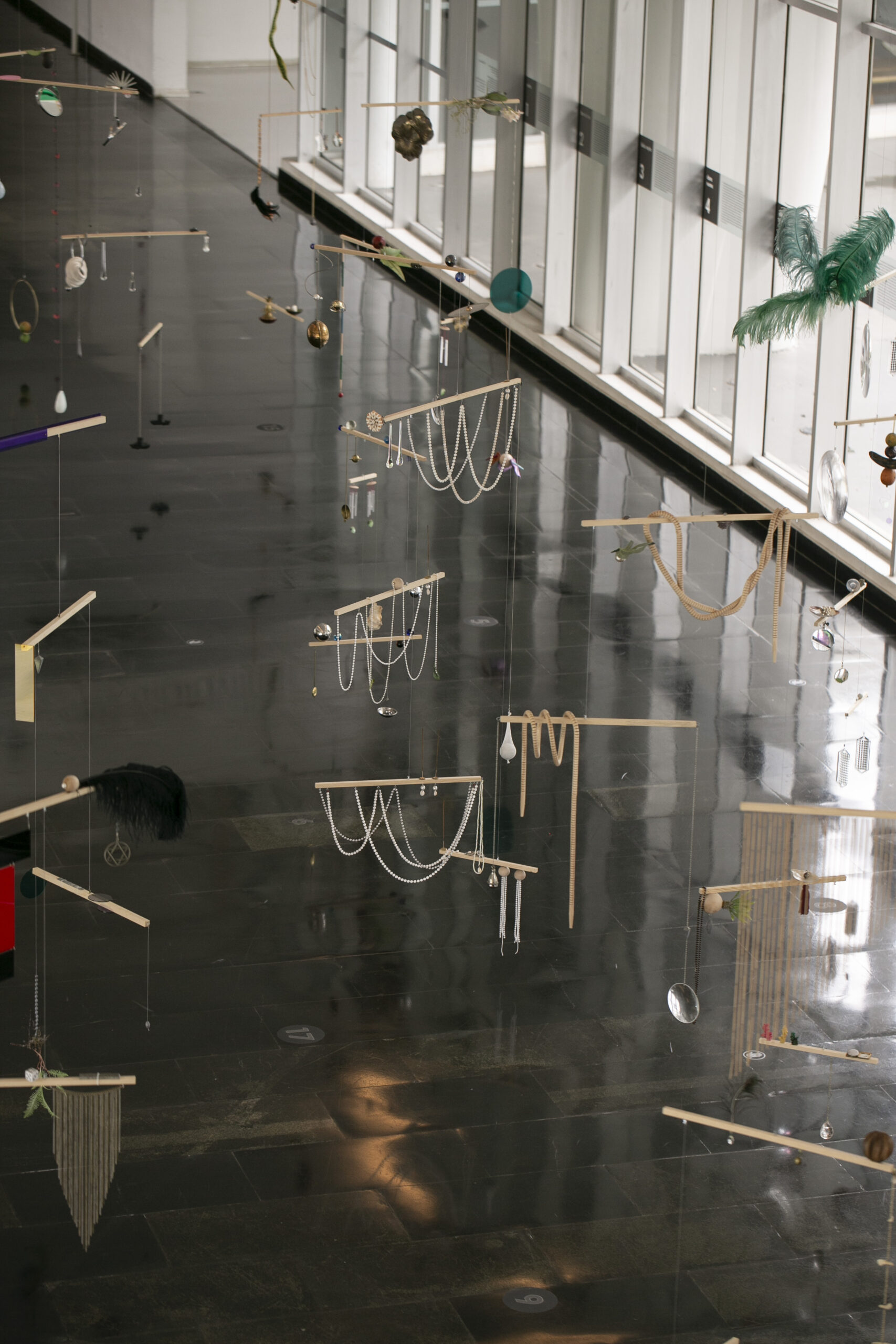
I brought this concept of the cabinet into my work, but decided to translate this “Other” into the format of an abstract portrait of a personality that interests me. At first it seemed very complex and I had my doubts, but the work eventually found its way in the process.The installation on Carmen was made up of eight mobiles. Then, in 2023, I made a large installation (as maravilhas*) in collaboration with my partner, Birger Lipinski, presented at the Museum of Contemporary Art of the University of São Paulo (MAC/USP) from 2 September 2023 to 28 January 2024. This exhibition featured 17 mobiles, designed as portraits of various personalities who interested me. This was a real “litmus test” for me to understand the reception of the work by a large public in a museum..
But also, when you see everything as a whole, it ends up becoming almost a constellation of all the possible readings.
It’s a constellation and it also becomes a kind of dance. I see the mobiles as a kind of performance that takes place in the encounter with the spectators who pass through the space where they are exhibited. As people walk and their bodies move, the mobiles move too. In addition, whenever I install the mobiles, I usually put entries relating to the personalities on the walls. In the installation as maravilhas*, at MAC/USP, I collaborated with Alecsandra Matias, an incredible art historian with whom I continue to collaborate today.
There were 17 mobiles in the space, each with its own number written on the floor of the museum. Viewers had to look at the wall to find the entries for each of the mobiles and the corresponding characters. In my opinion, visiting the work became a kind of “dance”, and the sculptures, their numbers and entries created a very curious movement of viewers within the exhibition. Something very beautiful was happening in this interaction between people and the works.
It’s curious that, over the last few years, because of the mobile works my studio has become a huge repository of unusual objects. This is because I have to collect a huge number of artefacts without knowing exactly for which portrait they will be used, or where. The fact is that most of these objects are not easily found in ordinary shops. Many of them come from auctions, antique shops, flea markets, thrift stores, or are donated by friends. What they have in common is that they have lost their place of origin, and often their importance. Many of these pieces have been discarded from the life they once had. I try to give these objects a new meaning, to give them a new lease of life. That’s why this collection is very private, built with a lot of affection. These aren’t objects that I can just go out and buy and sort out quickly.
Thinking about this element of the portrait, do you always work with personalities with whom you have a connection, but who maintain a certain cultural distance, or do you also include people from your everyday life, closer to you?
Generally, they are people who I think have changed our perception of how the body moves in the world, in the space we share. Personalities like Elza Soares, Ney Matogrosso, Linn da Quebrada, Clementina de Jesus, Maria Bethânia, Carmen Miranda, Hélio Oiticica… These are characters who, in some way, have a performative body that has changed our perception of the existence of a body, they are people who have broken through enormous barriers to finally be who they wanted to be.
A slightly technical curiosity: what comes first, deciding on all the elements, or creating the mobile?
The process is exactly like that of a painting: it goes on and on; a colour, a texture, a volume… one thing pulls on another. I come from painting, and it may sound crazy what I’m saying, but that’s how I see my work with the mobiles. For me, there is a thought of a painting, even though they are sculptures.
The way this selection of objects happens is beautiful, because these are the same questions I see in a portrait, in a painting. How do you translate the personality into which furniture will be attributed to it? What colour? What objects does it relate to? For me, the path is very similar to portrait questions, but here it results in almost an abstraction, where there are only traces and indices, but not exactly similarity.
So many of these personalities are moulded from the relationships we develop with them, and the attributes we give them
There’s something about the spectators’ encounter with the mobiles that I find very interesting: the fact that they seem to suspend time for a few seconds. For a moment, when you look at them, you seem to lose track of what you’re seeing. You can be fascinated and then try to understand: “ah, but what is that?” Something takes shape in your mind when you look at the mobiles, something very playful that I find beautiful.
I think it’s important to tell you about something that happened in 2023. I went to a lecture at the Moderna Museet in Stockholm by the American theorist Jack Halberstam. He was talking about how the queer community dealt with the issue of portraiture and that he noticed a curious trend: abstraction in the current portraits of this community. For him, this indicated that the community understood itself to be “under construction,” without a fixed image of itself.
I found it very revealing and it really helped me to keep thinking about mobiles. For me, it opened up a way of understanding what I was already doing. Although the mobiles only seem to be aesthetic articulations, there is a homage to these figures that I think is relevant, so they are political articulations too. As I said at the beginning, when viewers encounter the mobiles there is a pause, and then the questions arise: “How is this Carmen Miranda? How is this Elza Soares? How is this Ney Matogrosso?” The mobiles open up a space for thought, for associations, for reflection on the history of each of these people. Something happens in this encounter.
It’s a kind of metaphysical representation. When we think of very literal, or extremely figurative, representations, we perceive that they are flawed and may not present all the complexity that these personalities carry.
Exactly. Abstraction in this case, in my opinion, leaves room for future constructions, for a broader understanding of what image is. That’s what I thought about Carmen Miranda. What happens when I take away Carmen’s image and add only her attributes? You immediately start looking for other ways and associations to relate to that image.
This abstraction can open up new interpretations or ways of seeing the person. This is also reflected in the object, when we think about your 2021 exhibition “The Phantom Collection.” Tell us a bit about this exhibition and the works.
My work has taken me to many places in my life. I’ve lived in very different contexts, and that experience always fuels new questions. The work The Phantom Collection is about Sweden and the Folkhemmet issue, which was a social welfare system created at the end of the 1920s and which sought to think about social engineering so that society would function within greater equality. Design was one of the important tools used to achieve this.
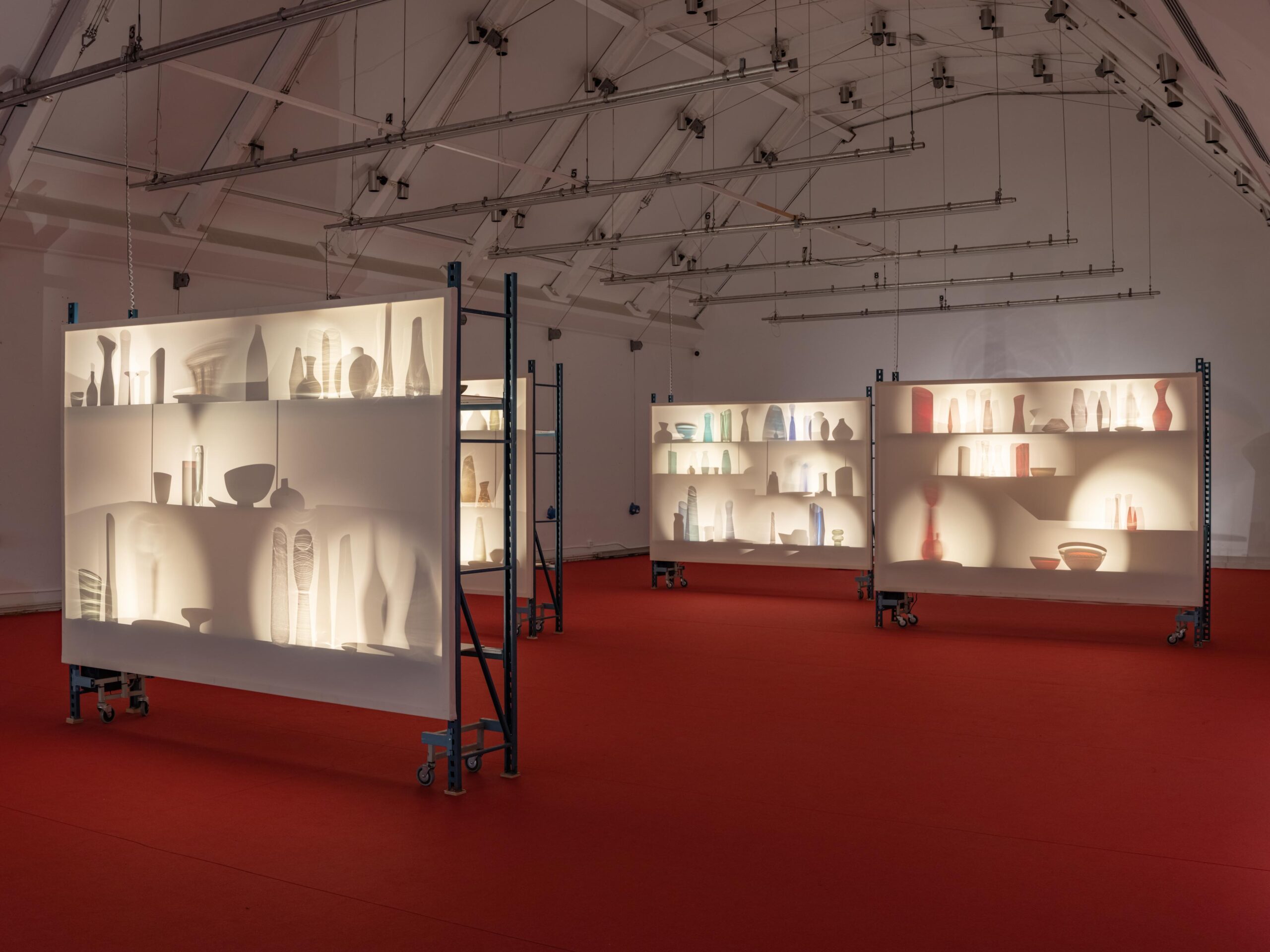
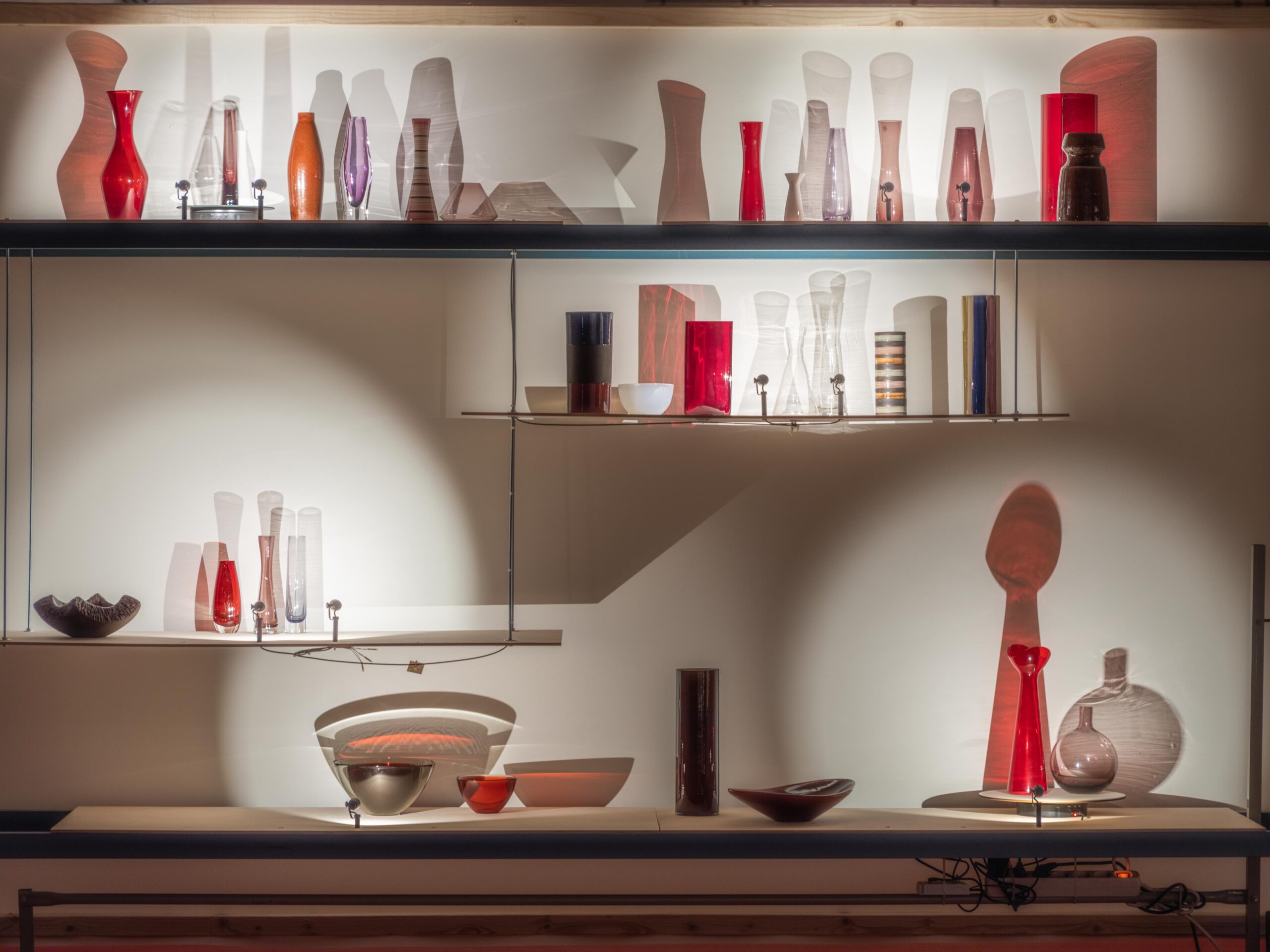
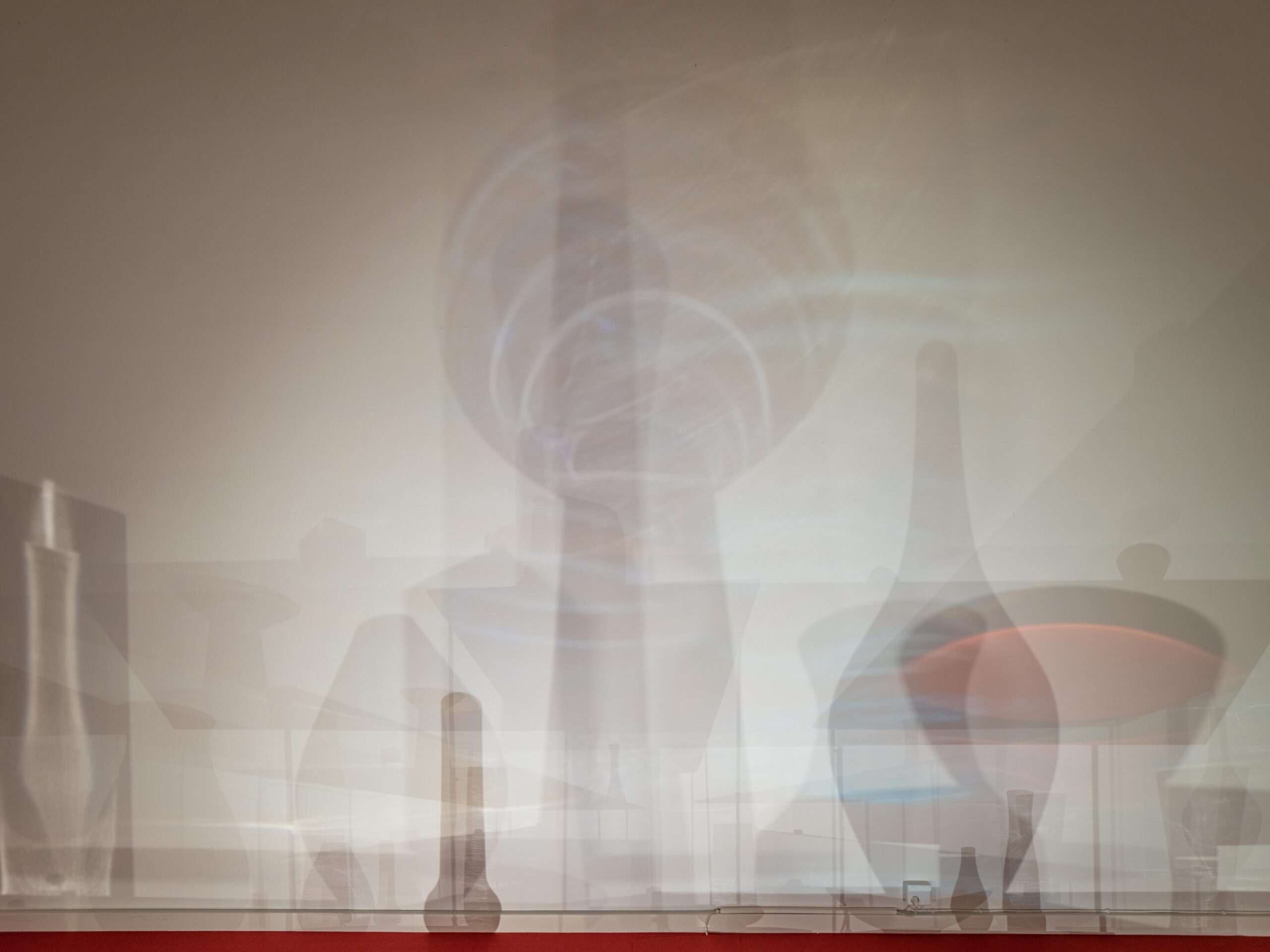
The exhibition “The Phantom Collection,” also in collaboration with Birger Lipinski [showing at Södertälje Konsthall in Stockholm from 23 October to 4 December 2021], is a fictional narrative about a collector who donates a supposed “collection” of glass and ceramic utilities to us.
In the fiction we created, the collection would have existed since the 1930s – and from this we created a narrative to bring the history of Swedish design and modernism closer to the complexity of the present day. In a nutshell, the exhibition talks about the social significance of these pieces that have been produced since the 1930s, and which somehow continue to exist in the same form today, though with many differences in relation to what their form means in today’s society. The concept for the work was to think about what has happened in society since then, and to question what lies behind the idealised image of Folkhemmet, from its beginnings to the present day.
When people entered the exhibition room, they saw something very similar to large projections, but when they turned round, they found the collection of objects. Alongside this, there was a text, but it was also possible to listen to audio throughout the room: the voice of the “supposed” collector telling his story and what he thought about the importance and relevance of these objects over time. We tried to reflect on the issues behind the almost perfect way in which Swedish design has moulded society and customs.
What is it like for you, as an artist with access to different spaces and research taking place in different countries, to develop your artistic and research practice between these different contexts?
That’s a big challenge. When I talk about Swedish modernism in Sweden, it carries a different weight. How is it possible to talk about other places, which are not our place of origin, without falling into a commonplace? You have to be very aware of this.
In the specific case of the work on Swedish modernism, it was a little simpler, since I know the history and the place and I collaborated with Birger Lipinski, who is Swedish. This gave us an entrance key – I wasn’t alone, talking about a place I was passing through. I think I know the temperature in Sweden. It’s challenging, but at the same time it’s a test with a lot of risks, because you put yourself in a situation of confrontation with very obvious cultural codes. In Brazil, it’s one thing for me to ask you to think with me about the question behind my work. It’s another thing, in a European context, for someone from South America to try to enter that space and bring that question to the centre of their work.
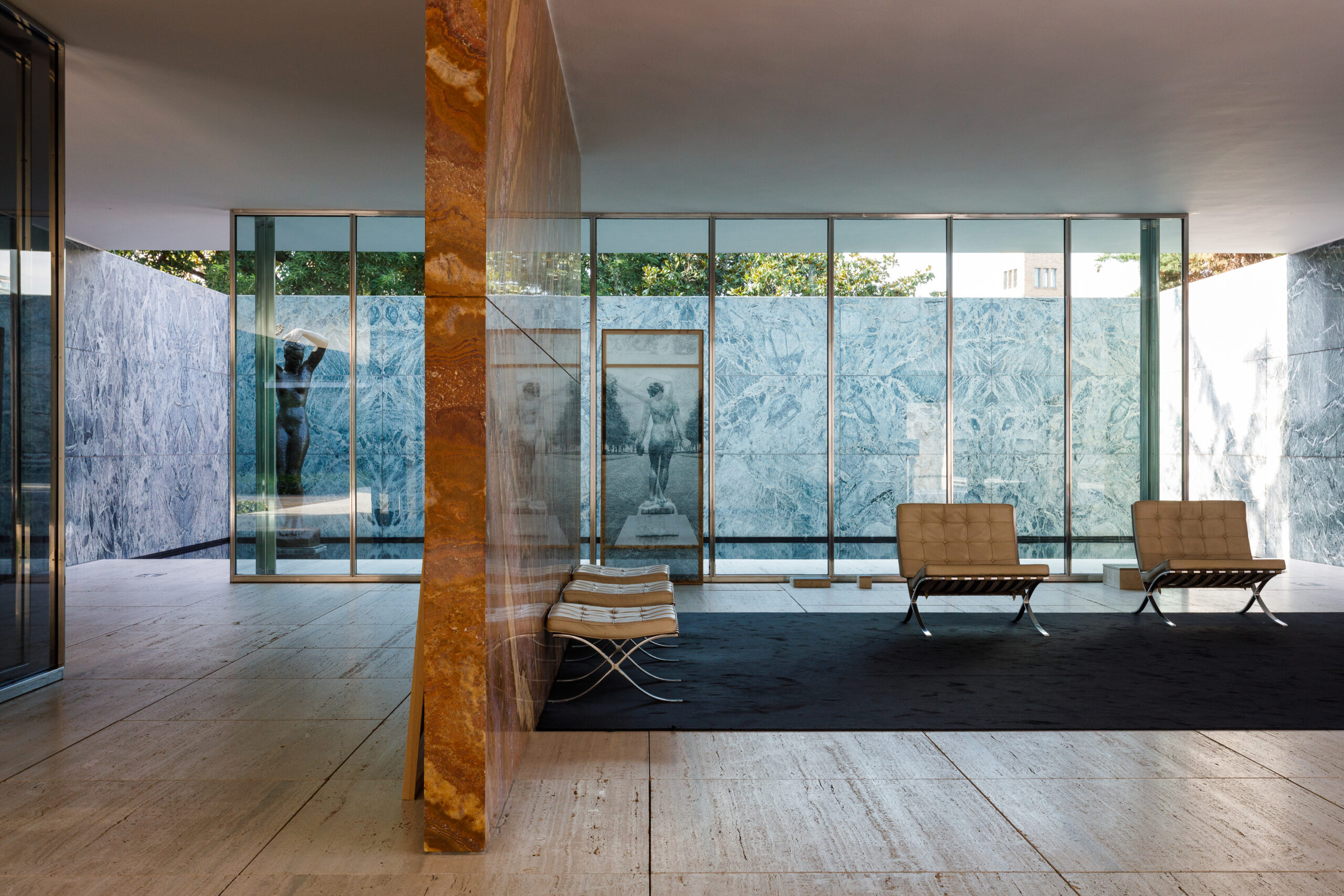
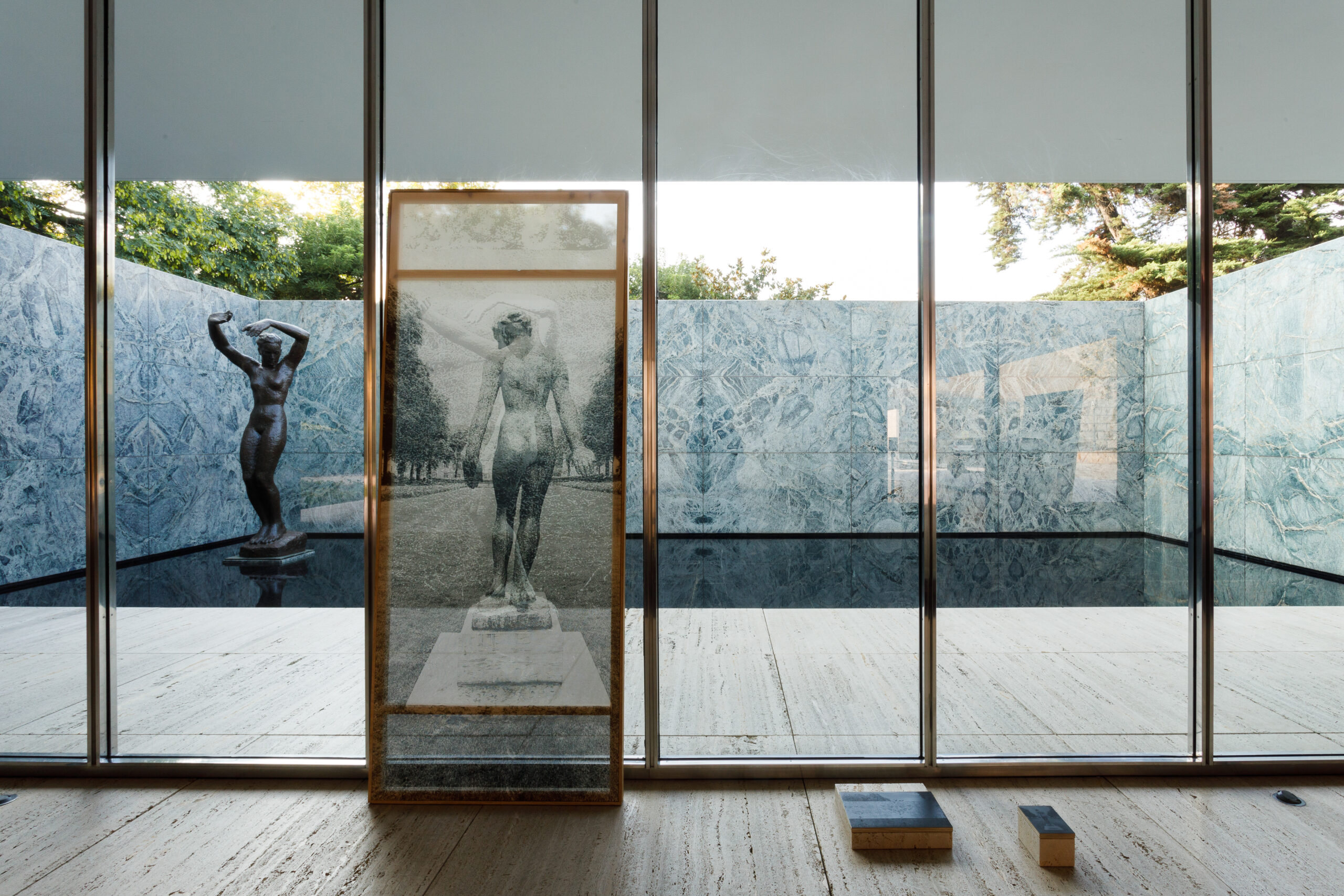
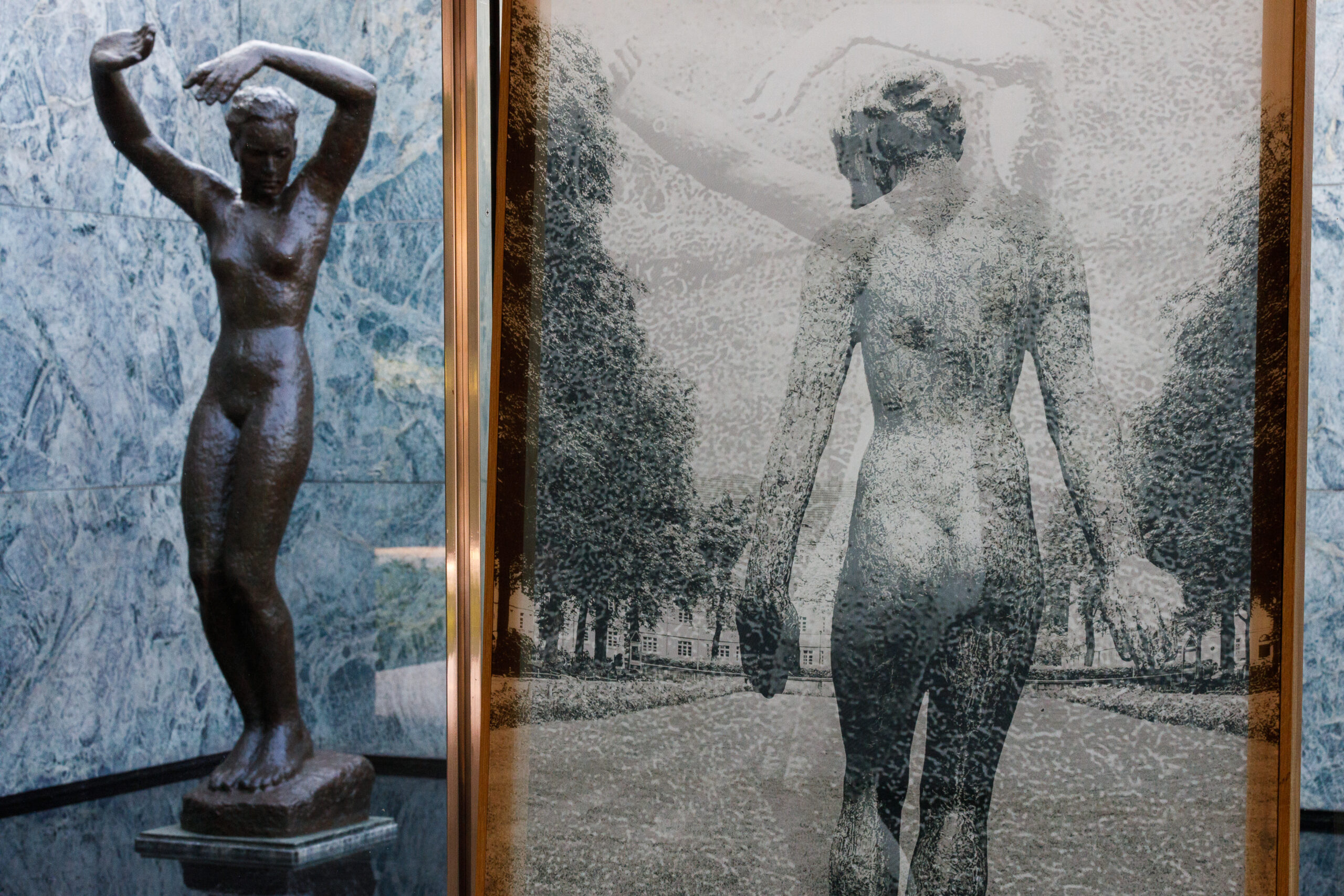
I also had an exhibition at the Mies van der Rohe Pavilion [solo exhibition “The simplest is the hardest to do”, presented at the Barcelona Pavilion, Fundació Mies van der Rohe, from 16 September to 12 October 2020], which is an almost sacred space of Modernism. As an artist interested in how the public relates to this immersion in history that I’m proposing, this was a great challenge.
For example, in the construction and idealisation of the Barcelona Pavilion, there is the figure of Lilly Reich (1885-1947), who was a very important designer of interiors, fabrics, and exhibition spaces, in her time. Mies collaborated with her for a time and, personally, I think that much of the refinement of Mies’ aesthetic choices comes from what he learnt from her. But she died soon after the war and an erasure took place: Lilly Reich disappeared from official history. Of course, many of us who work with culture and are interested in this subject might know a little about her, but the curious fact is that, during the exhibition, several people from the world of culture in Barcelona said to me: “I had no idea that Lilly Reich existed, or about the various dots that you reveal and connect with the history of this pavilion.”
It’s interesting, because the reconstruction of the Barcelona Pavilion is much more complex than it seems. In the end, the pavilion that exists today is a pastiche, a copy – but a copy within what is possible, because it wasn’t possible to locate all the original plans or documents with many of the building’s construction details. So, in many ways, this reconstruction is only an approximation of what the original pavilion actually was. At the very least, it’s interesting to ask why Barcelona decided to rebuild the Mies Pavilion in the period in which it was rebuilt?
At the same time, what did it mean for Germany to build this pavilion in 1929, during the Weimar Republic? We mustn’t forget that 1929 was the year the New York Stock Exchange crashed, and this led to a global economic crisis, but, more seriously, a political crisis also. Germany, of course, would be hit by this event, and its history would take a much harsher turn from then on.
There are so many layers and interrelationships of history to think about. For me, as an artist, I never come out the same after these projects. I learn a lot, but, yes, it’s a great challenge, and also a privilege to enter into one of the most iconic buildings in the history of modern architecture with my work.
These fissures and erasures of history happen both within countries, and between them. For those who work with art, these issues are already well known, but for the general public, the idea of an artist not being limited to one nationality is not new. However, the lack of classification has harmed many artists. Jannis Kounellis, for example, was marginalised in Italian arte povera because he was Greek, although today he is recognised as one of the movement’s greatest figures.
And I don’t think we’ve changed that much; we’re still in this place of a certain discomfort. Although, today, artists are more mobile (due to the internationalisation of art and the scholarship and residency programmes) – we have undoubtedly increased our “chances of exposure” – at the same time, how many of our questions make sense elsewhere? How much of the perspective on the narrative of the construction of history is still hegemonic in a way, depending on who is speaking, and where?
For example, it’s interesting to think about the Venice Biennale (2024), curated by Adriano Pedrosa. I don’t want to go into the merits of what I think of the Biennale, but I do want to talk about the resistance I’ve noticed from some people in the field, due to the fact that he’s a curator from the Global South tackling subjects from other places that don’t necessarily use a “western ruler.” In other words, the place we come from is always, and in any case, relevant. It’s never neutral.
Laercio, can you tell us a bit about the “Relance” exhibition at the Pinacoteca in 2018?
This was a very complex exhibition. When they invited me to hold it in the Octagon, I was delighted, but I said that I would also like to be able to enter the other rooms in the Pinacoteca’s collection, and so that happened. In this exhibition, there was an open route and, as visitors entered the Octagon, they could see a large rereading of a reproduction of a still life by Estêvão Silva (1845-1891), the first black man to enter the academy in Rio de Janeiro in the 19th century.
This rereading was a black print, at first glance a large monochrome. I developed this technique of black silkscreen prints, inspired by the images produced by the daguerreotype, the first photographic process, discovered and disseminated in the first half of the 19th century. But while, in the daguerreotype, the image is silver, in the technique I developed, the image is initially black, almost a monochrome, and reveals itself to the viewer’s eyes as they move their body around the work to observe it.
From the outset, what interested me was the figure of Estêvão Silva, who, until recently was remembered in books in Brazil only as a painter of still lifes. However, there is an anecdote that Estêvão not only painted still lifes, but also created a kind of installation. Using fabric, he set up a wall to display his paintings, but behind these fabric walls he positioned the real flowers and fruit that had been depicted. In other words, there was also an olfactory element. This was extremely innovative and ahead of its time.
On entering the Pinacoteca’s collection, visitors were given a small free book and, as they visited the rooms, they collected cards with the new narrative I proposed about the works chosen from the collection. For me, the exhibition was like Estevão taking me by the hand and pointing out absences in the narrative of our collective history, represented by the gaps in the Pinacoteca’s own collection. To reinforce this approach, I thought that, once again, the use of smells would make a lot of sense. In all, there were 15 interventions, but I’ll mention two: there is an interpretation that the bandeirantes [settlers in Brazil who assisted colonial expansionist expeditions] were able to enter the interior of Brazilian territory thanks to indigenous knowledge of the trails and paths in the forest, since the Europeans, on their own, could hardly have overcome the challenges posed by the dense forest and all the dangers it presented. The terrible fact is that the great Brazilian highways were built on these very paths that the indigenous people opened up, and these highways bear the names of the bandeirantes.
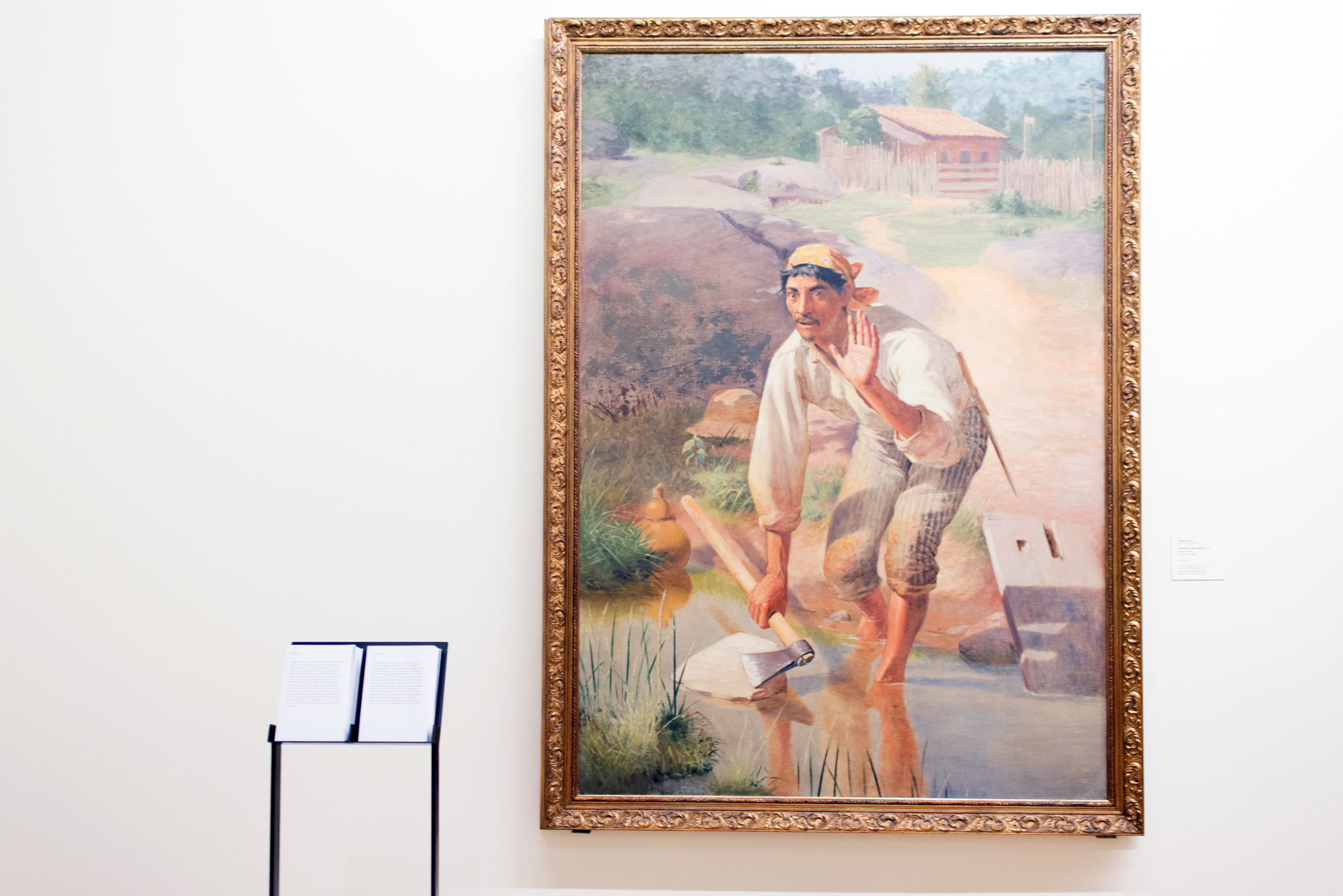
In the intervention I proposed, when the spectator stood in front of a painting depicting a bandeirante and opened the card, they could smell tar and wood and read what I’ve just said. In another example, related to the work Amolação interrompida, by Almeida Júnior (1850-1899), I bring up the connection between the bandeirantes and the population of the interior. As the bandeirantes lost importance after opening the way for the exploration of the territory – after all, they had already completed the task of opening the roads – the members of these expeditions were left without work along the way, while retaining the memory of the historical violence they had experienced. I believe that this gave rise to the figure of the caipira [settlers of the São Paulo region and surrounding states], far from the peaceful image we’ve been told about countless times.In the room where the work Amolação interrompida was displayed, there was also a card with this narrative printed on it and, when you opened it, the smell that came out had been manufactured in a laboratory to evoke for the public the odour of a sharpened knife. Thus, this exhibition, by coining a new olfactory memory, and rewriting history, sought to offer other narratives to understand images that are part of our imagination.
How do you negotiate between deciding how much historical information to give the public along with the image, and the risk of making the work too didactic?
I work a lot with collaborators and never realise a work alone. All the texts for these major exhibitions, for example, have co-authors who help me find this balance so as not to make the work too didactic. People like Soraya Guimarães Hoepfner, Alecsandra Mathias, Laura Erber, Daniel Jablonski, and so many others, were, or are part of, this moment of building the work.
It’s important to say that I always try to stick to the formal aspects of the work and the way I would like the public to approach it. For example, the mobiles, but also the other pieces, work even if you don’t know anything about them. If you do, it will give you a different understanding. There are many ways of approaching a work and I’d like to think that, despite all this research, the work is still totally open and undetermined, and that the public can access it in different ways, even just from the visual aspect.
I often say that art is a language. I wouldn’t go around constructing buildings, because I’m not an engineer or an architect. In the same way, I believe that the visual arts have their own language and a history that is in libraries for anyone who is interested to access. But I don’t expect spectators to have to think about that, in principle. I like to think that they will accept my invitation to simply look at the work. I know there’s a limit to everything, but I really hope I can engage in a dialogue with those who look at my work. How much each person delves into it is something I can’t control.
For me, works of art are like a Trojan Horse: they can carry within them many questions and reflections, even if they can remain what we see at first glance; that is, only what we see externally. It took a while for some of the works I admired to really make sense to me. Understanding the historical context, the intention of each artist, and the place occupied by those who created the work, can help, but sometimes it’s enough to look at the surface of the work and, at that moment, something is already happening there. Also, when I see works from such different periods, it seems that something important emanates from there and gains meaning. Perhaps art exists in that moment when it reminds us of our fragility, of what is most human (and therefore most inexplicable) within us.
Interview conducted on 18th July 2024 remotely via Zoom.
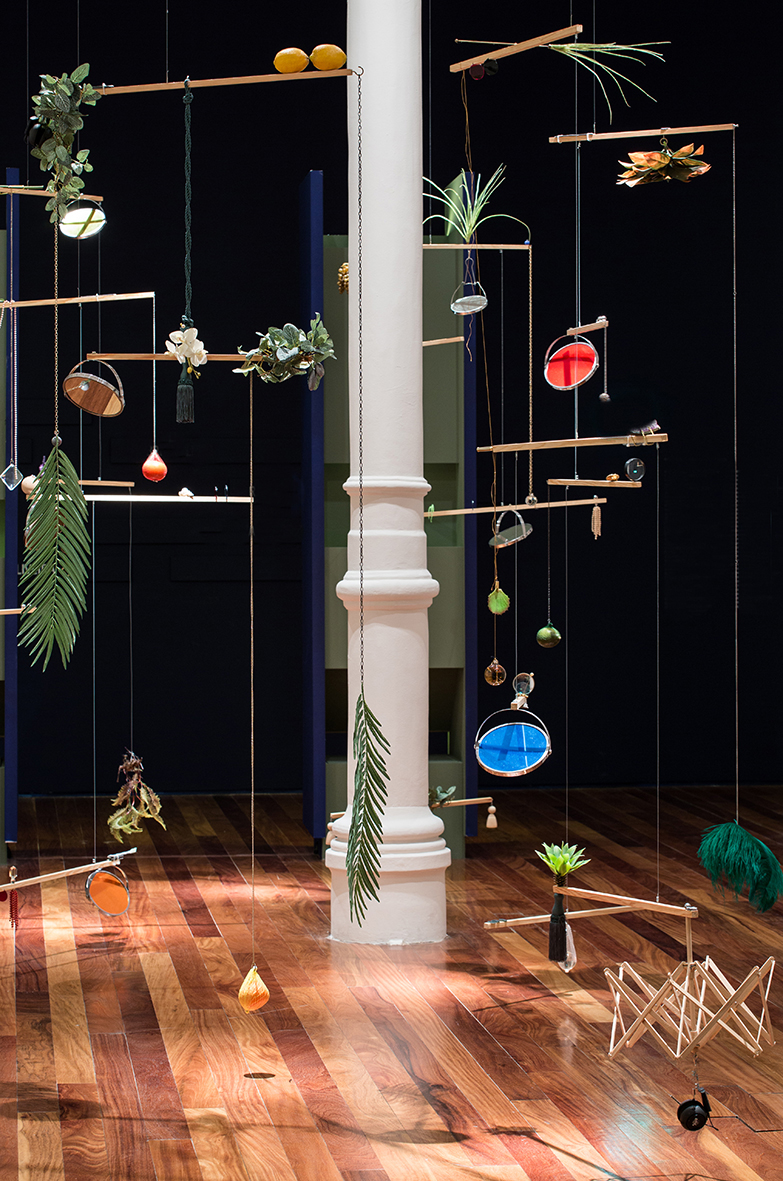
Carmen MIranda
Various dimensions
2010
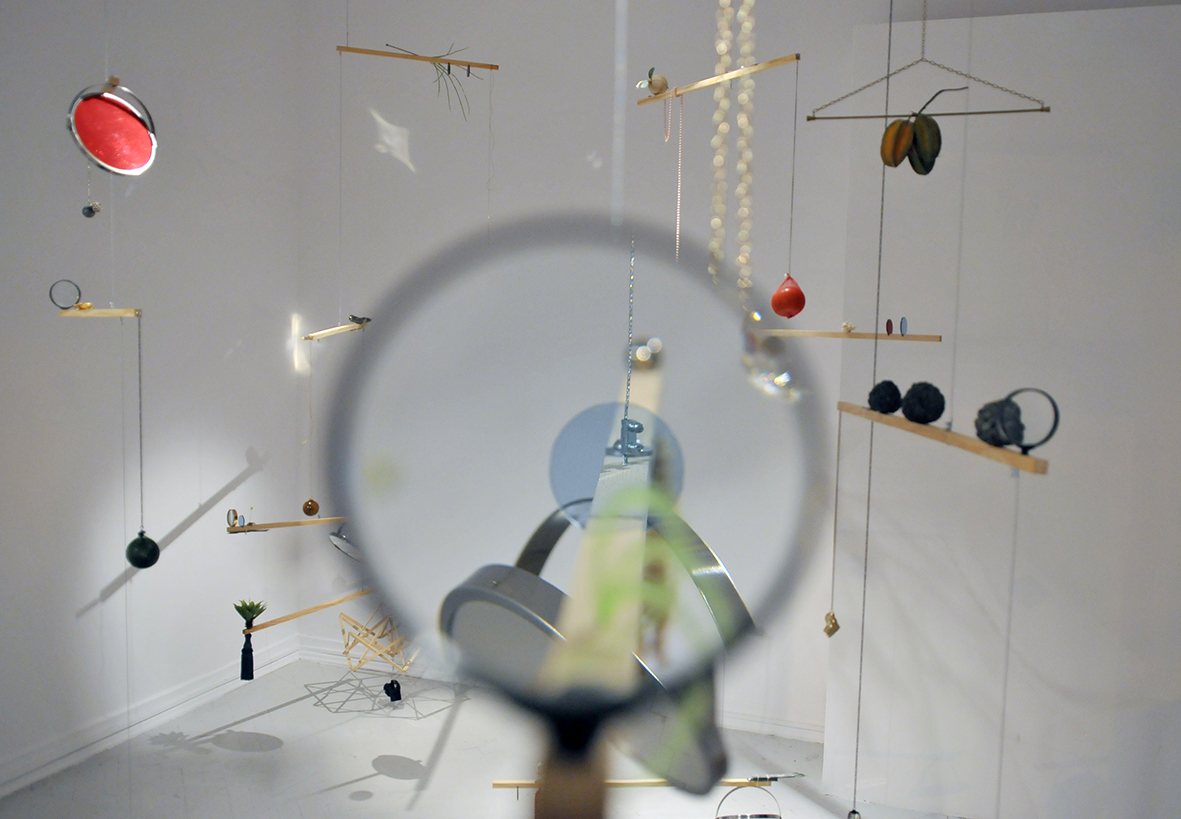
Carmen MIranda
Various dimensions
2010
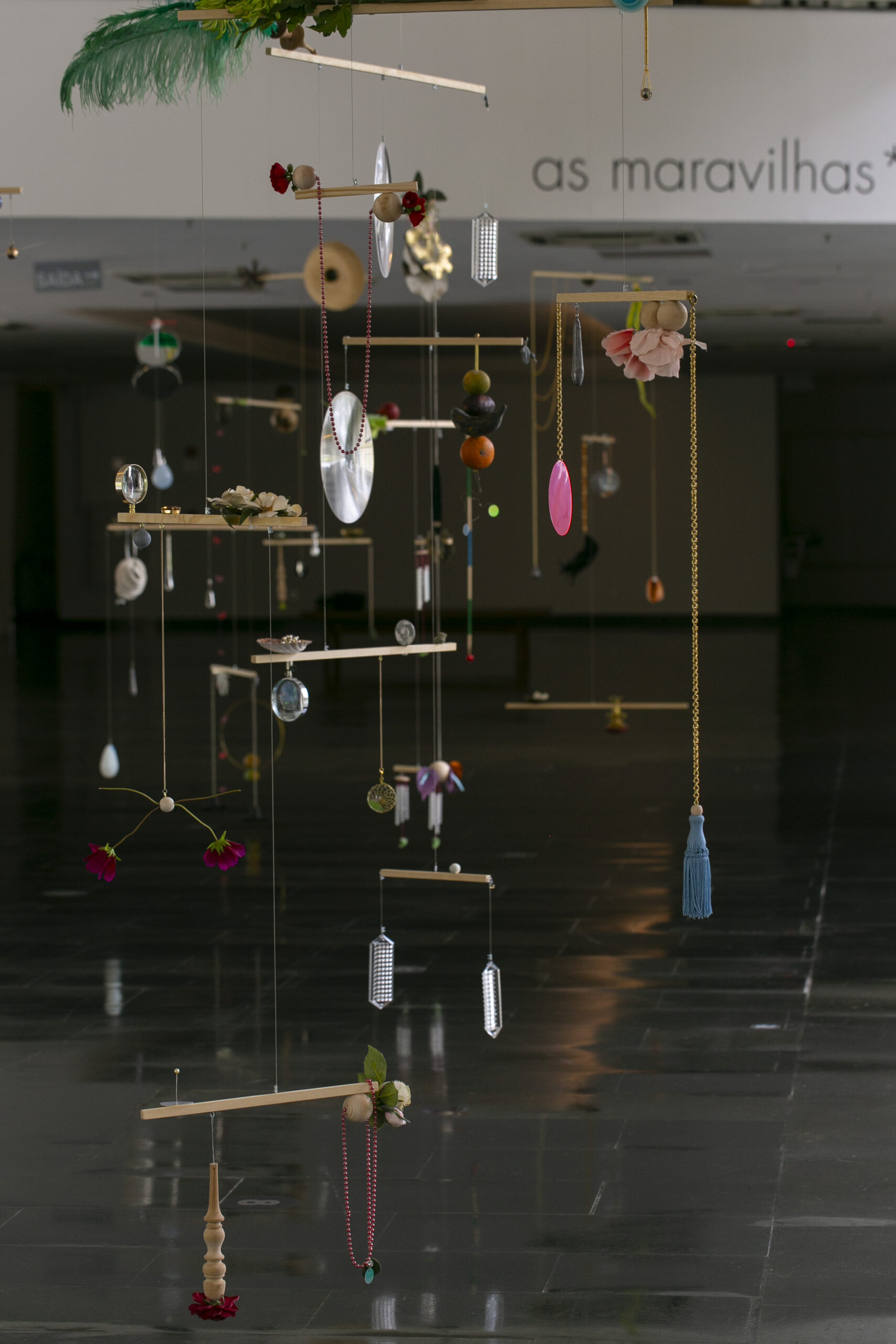
Installation, Dimensions Variable
2023
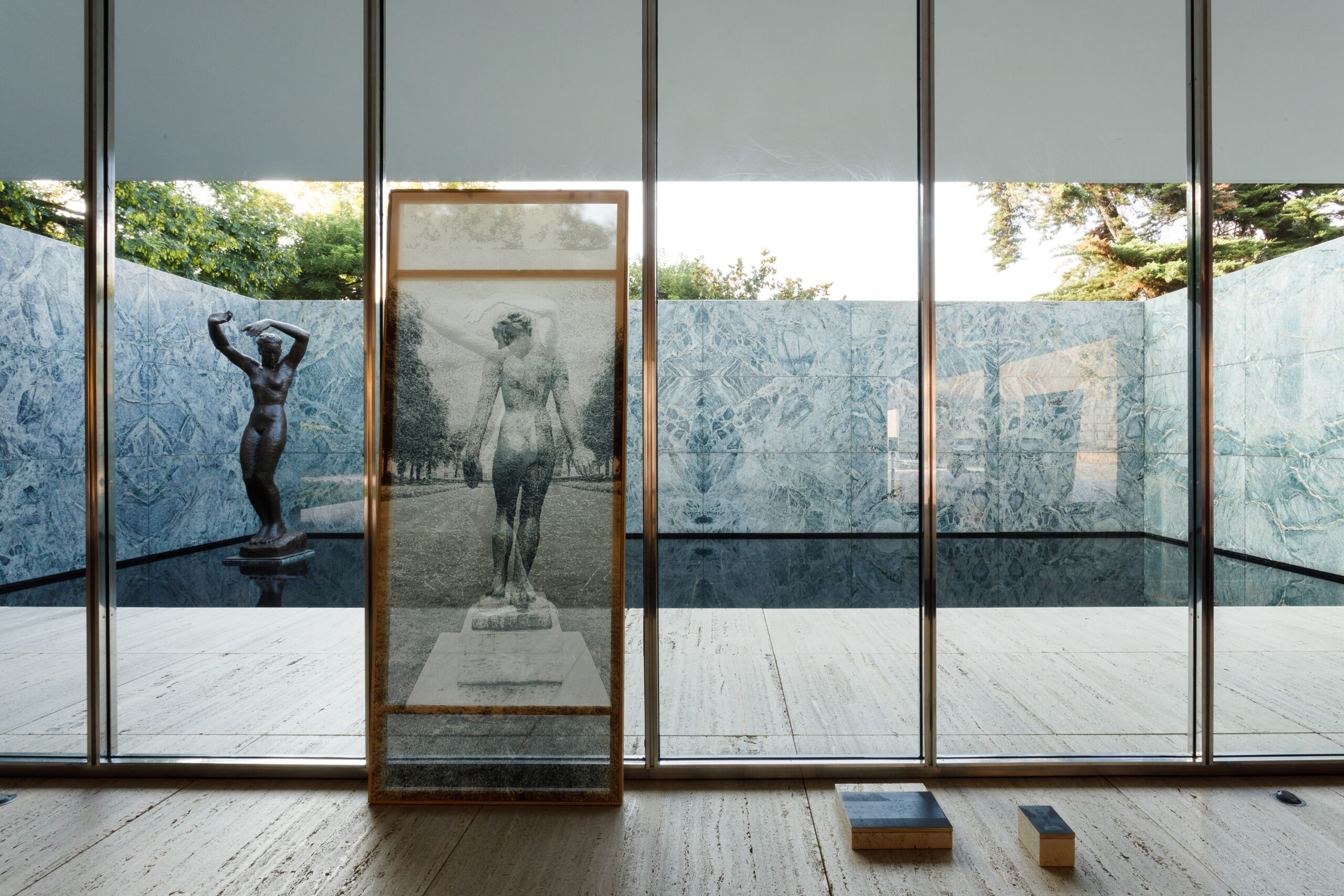
Solo exhibition
2020
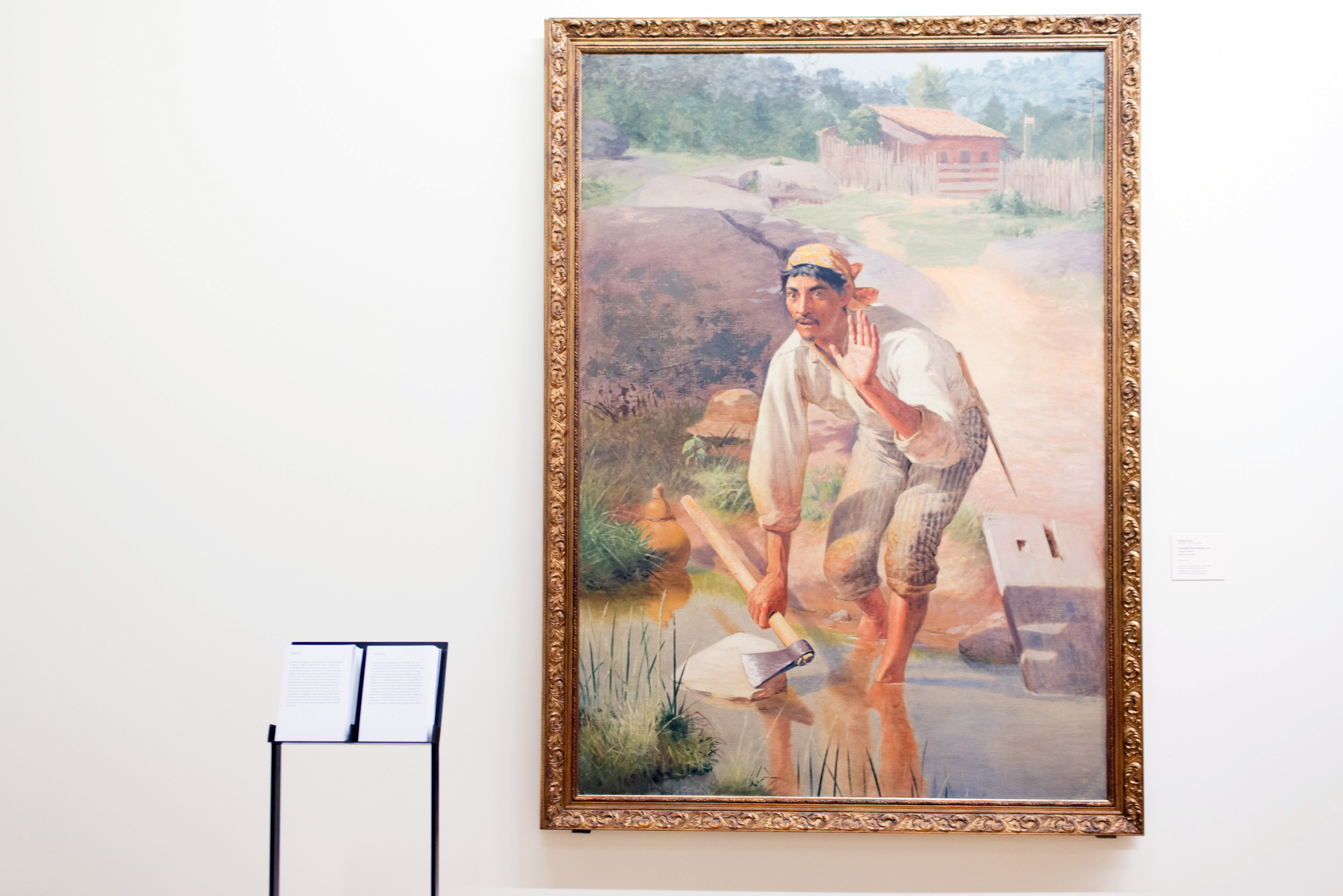
A laboratory-developed scent is released when the card is opened, expanding the viewer’s experience of the work
2018
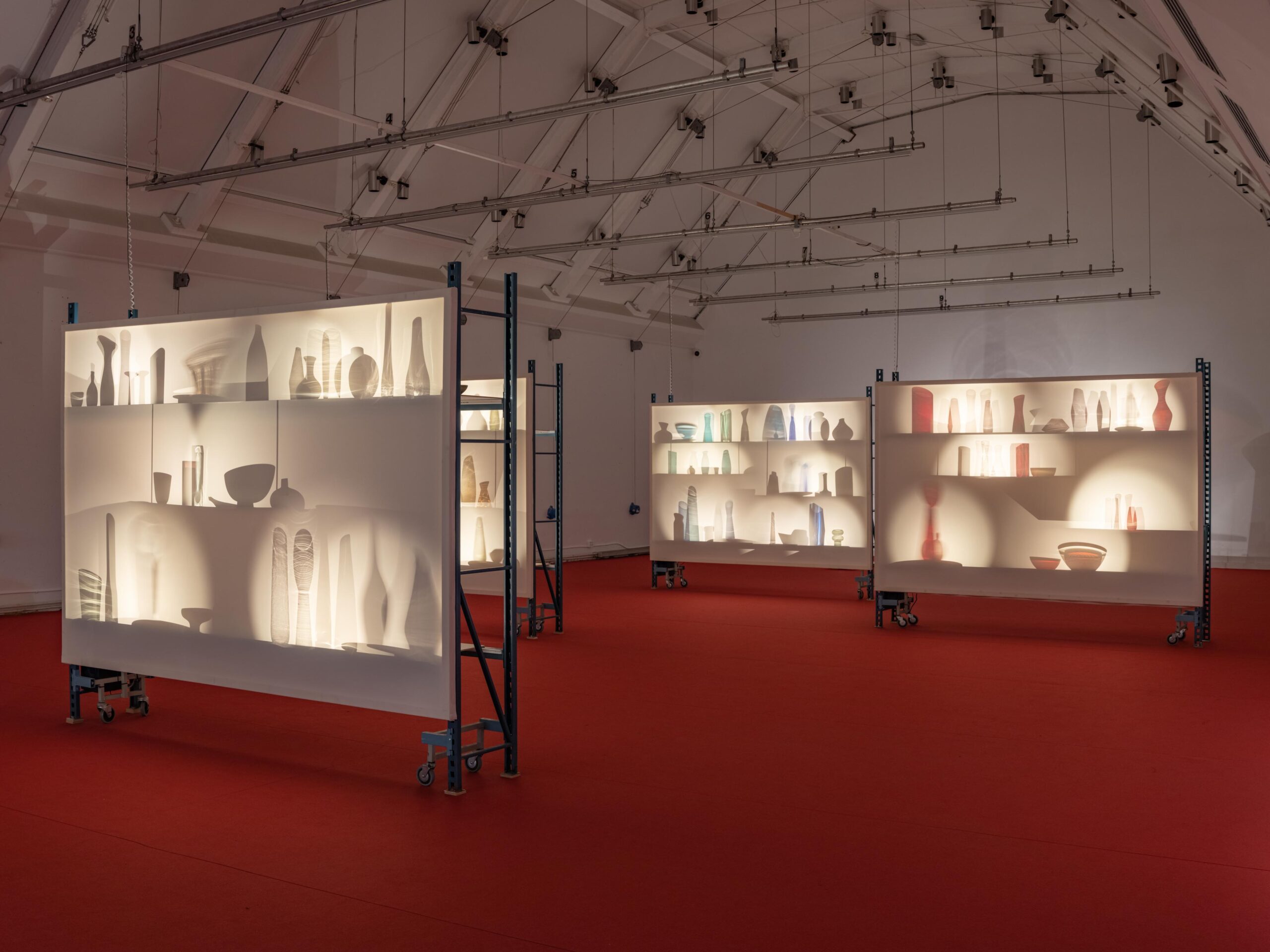
Installation
2021