

Mano Penalva
Mano Penalva (Salvador, 1987) is an artist whose works challenge opposing concepts between the ordinary and the extraordinary, the regional and the global, the industrial and the handmade. His work reveals a keen eye for the complexities of human interactions and the relationships between the individual and the environment, whether in his home country or in other places he has visited. In our interview, the artist details how his practice seeks to dislocate materials from their usual context in order to recontextualise them in the field of art, and how he uses this environment as a means of cultural and social investigation, exploring and questioning the relationships between human beings and objects, and between culture and identity. Check it out:
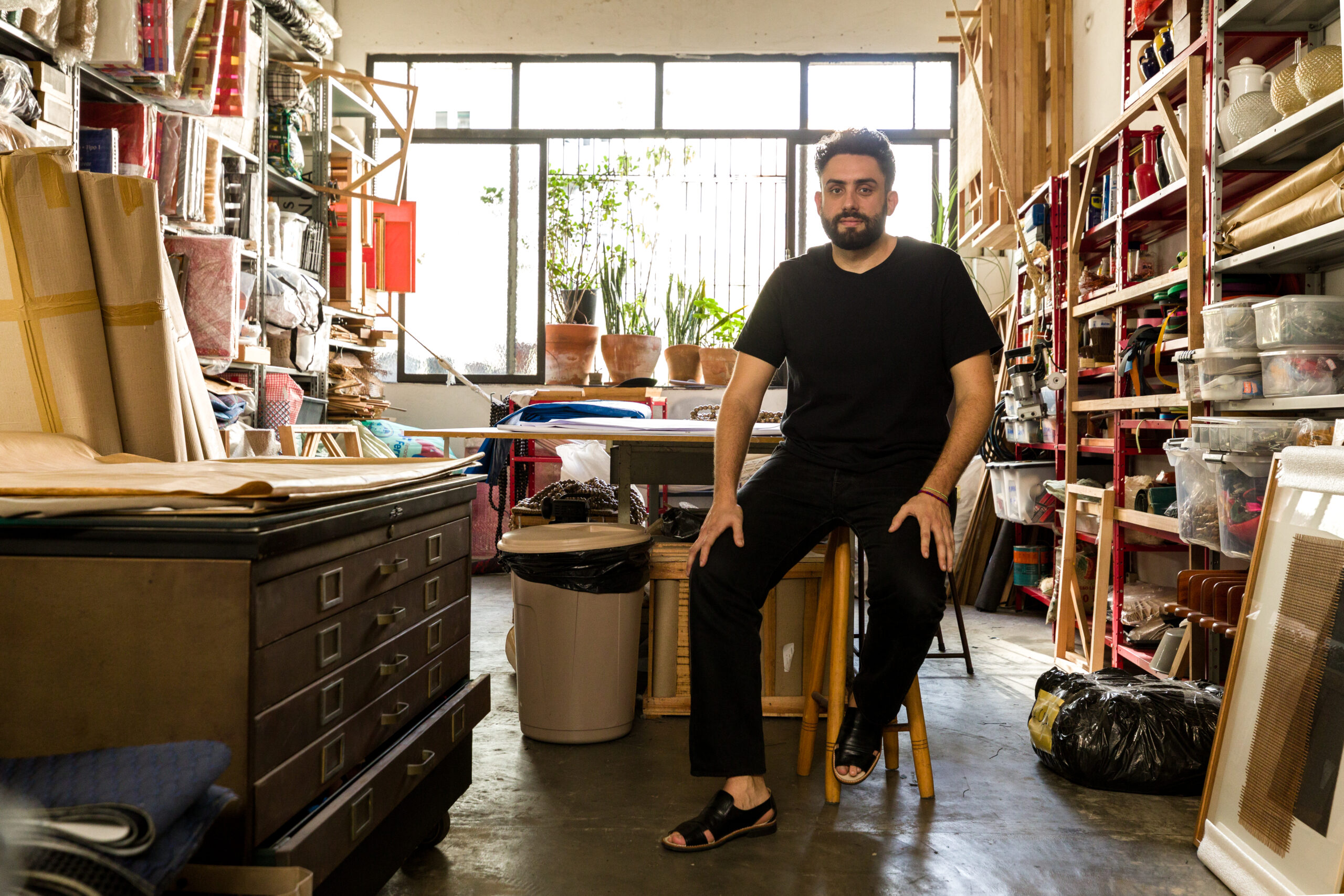
Mano, thank you very much for having me here in your studio. I’d like you to introduce yourself with any information you think is relevant, to an audience that doesn’t yet know you or your artistic practice.
My name is Mano Penalva and I was born in Salvador, Bahia. I’m very interested in observing how beings relate to things. I believe that one of the magical things about being an artist is to be a facilitator, as if things were created to exist in one way and, as an artist, I have this magical possibility to expand these possibilities. I have a degree in communication, but I initially studied social sciences, with an emphasis on anthropology. I worked for a long time in behavioural research, and in market research for big global brands, which gave me the very interesting opportunity to travel a lot, to get to know different aspects of completely different realities, especially here in Brazil. At the same time, I was also studying at Parque Lage, where there was a very strong emphasis on painting, which is still evident in my work today, even when paint isn’t there. My work has many layers, and even the more pictorial works carry a very important socio-cultural charge, which is linked to my upbringing. Today, my production takes place a lot in São Paulo, with a very strong interest in manuality and Latin materiality, especially in Mexico where I’ve been going quite often in recent years to exhibit, but also to produce, and think about, new work.
How do you perceive the influence of Brazilian and Bahian culture on your work? And how has this perception changed as you’ve travelled and had experiences in other places, such as Mexico?
It’s funny – just today, when I was coming to the studio, I bumped into an artist friend called Célio Braga. He’s been living in Amsterdam, in Holland, for 20 years and usually spends six months in Brazil and six months there. He was telling me how important coming to Brazil was to him and I really think that, in Brazil, there is a certain viscerality, something very powerful. I also found this in Mexico, especially in Mexico City. I had the impression that my work was very much associated with Brazilian-ness, but this was people’s perception, because I didn’t have that vision myself. Sometimes it bothered me a little, because articles would come out labelling me as a “Bahian artist” or a “Brazilian artist who brings the Bahian look to art.” In fact, I believe that the location of art has nothing to do with it; I don’t believe there is such a thing as “Bahian art” or “Brazilian art.” I think that this question of the cultural environment can outline some elements that contribute to this production, but I really believe in the larger field. At the launch of his book at the Luisa Strina gallery, Cildo Meirelles answered several journalists who asked him about how he felt at the apex of conceptual art by saying: “Stop calling me a conceptual artist, I’m an artist and that’s that.” I find that very interesting to reflect on.
Your work, like Project for a Monument, interacts a lot with pop art and contemporary issues, but also establishes a dialogue with art history. Could you tell us more about this project?
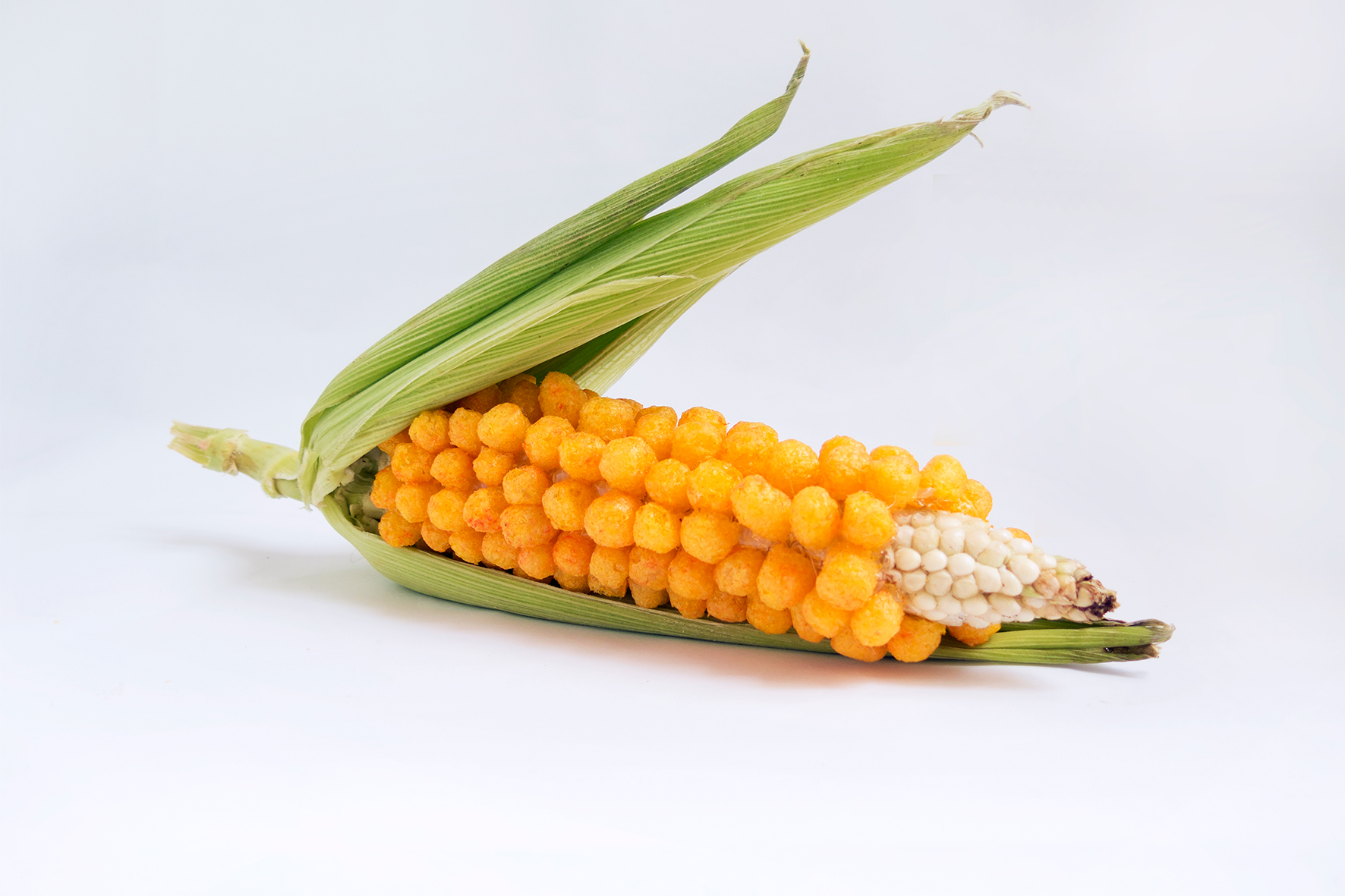
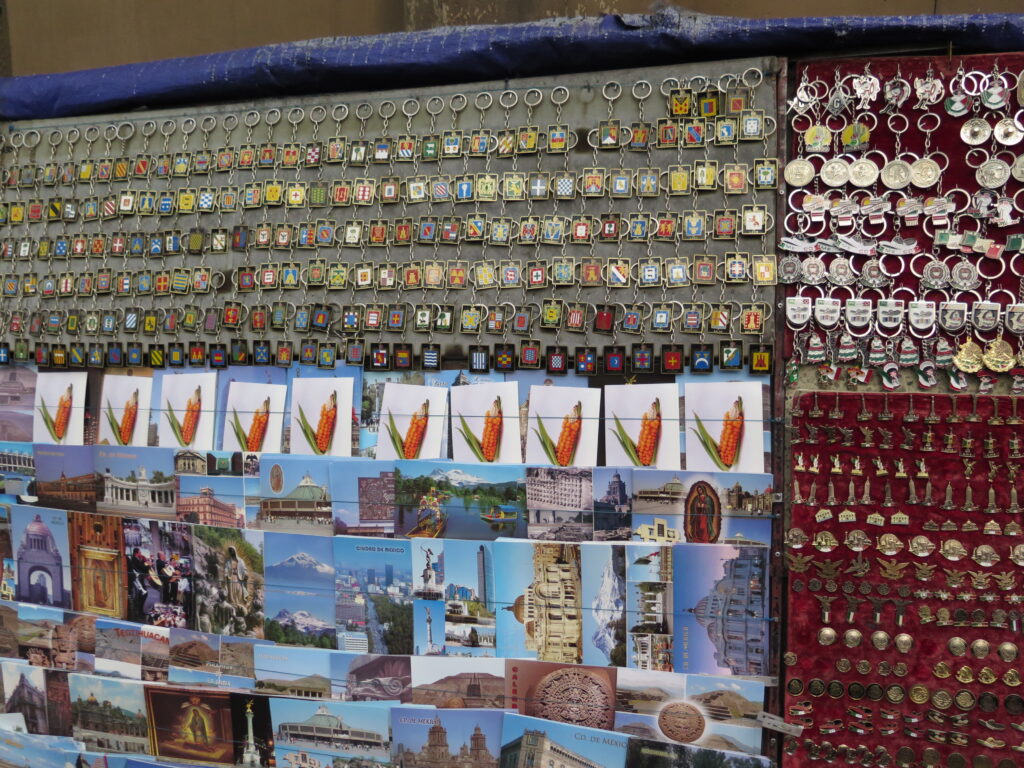
Projeto para Monumento talks about the construction of the body that is fed, which is also a monument, a construction. One of the first works I did in 2017, and which I consider very important, is called Maíz, 2017. Maíz means corn in Spanish, and this work was born from a news story I saw in the city, which said that good, organic corn was being exported to the United States, and transgenic corn produced in the United States was exported to Mexico. So I created this image, which is a corn made out of Cheetos, in the form of a postcard. I worked with ten street vendors in Mexico City, selling these postcards, and every year I returned to the city to put more cards in the market. And it was very curious, because there were some vendors who were reluctant. They usually sell images of Che Guevara, the Latin American tower, the pyramids, but it’s also a Mexican symbol, the corn thing, within the culture, and is very much associated with food. I started talking to them about selling the cards there, and how all the proceeds would go to them, because I wanted this work to circulate. The following year, I went back to talk to one of the sellers – the most reluctant to take on the project – and he said, “What took you so long? I sold all the postcards in the first week.” For me, this feedback is very important because, in some way, it’s a work that is in dialogue with the postcard art movement. and also speaks a lot about food, about these exchanges that take place… not just culturally, but also socio-economically. In the case of this corn, many people don’t realise that it’s made of Cheetos and it’s almost the same process that happens with food, how many things we end up eating without realising what’s really there. I have another series of works called Costales, which is made from raffia bags that travel the world transporting generally dry foodstuffs such as grains, black pepper, rice, beans, basil, popcorn, coconut and fertilizers. They are general-purpose Colombian sacks. To make this work, I needed around 60 pleated raffia bags to create these textures, these layers. What interests me about this is that it creates an abstraction of both word and form and moves into the field of painting. It’s paint on a structure, but it’s industry that determines and applies this paint. These works talk a lot about the history of art. They have a load of references to Abraham Palatnik in them, but they start from this matter that is at stake in life. So there’s a lot of questioning about these symbols and codes that are printed on these bags, as if they were entry visas. Until recently there were no passports or entry visas. Visas began after the Second World War and, considering means of transport were not hyper-developed, ease of transit was not great. In fact, the social factors of transit were determined by socio-economic factors, i.e. those who had money travelled. Today, since aeroplanes have made travelling much easier, it’s necessary to create other policies to protect entry into spaces. This also applies to grains and foodstuffs. You also have to create new policies and new codes to be printed on these bags, as if they were going to be seen. In fact, this is the end product, but until we reach these transition agreements and the exchange of these bags around the world, we need macro- and micro-gigantic external policies.
And speaking of the context and the influence of painting on your work, can we talk a bit about the Ventana series?
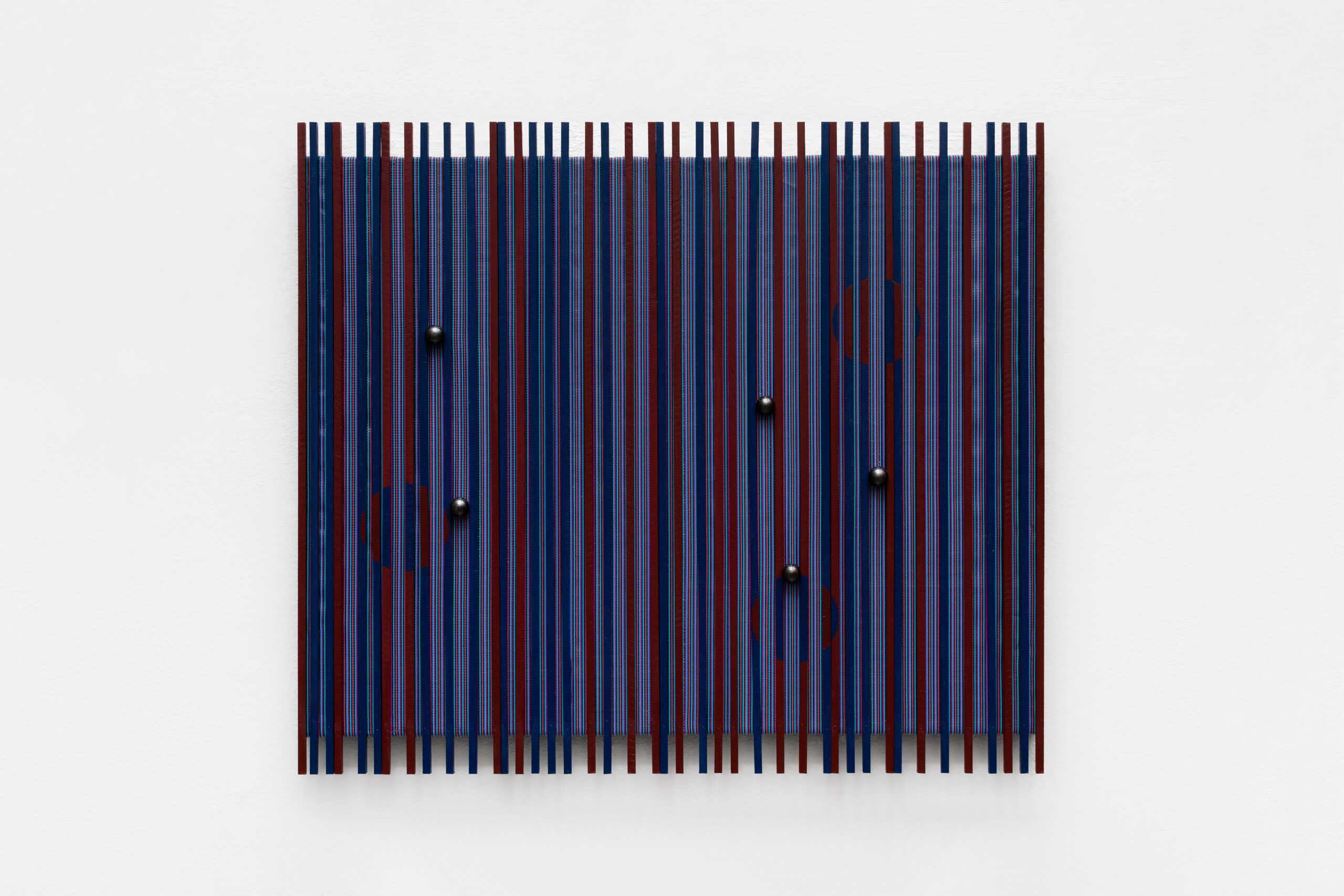
This is the most recent work I’ve produced, which was on show at the Simões de Assis gallery [Exhibition “Dois pra lá, dois pra cá”, opened at the Simões de Assis gallery in Curitiba from 7 March until 20 April 2024]. These works are an offshoot of a series I started around 2013-2014, called Samba. They are strips of nylon – usually found on beach chairs and market bags – pleated and folded. It’s a work much in dialogue with Op Art, and is about observing materiality, and how a material behaves when utilized. Each time I bought these materials, it was very difficult to handle them, because anything could crumple and mark them, and the folds respected this condition and nature of the material. This series took place back then and I recently started making these works, which have a second layer in the use of wooden slats. It’s a work of color composition and painting. All these works contain a game and, as you pass through them, this second layer brings new information.
Yes, it’s a very abstract work. While we can identify some elements of the material, the texture, the layers, the end result is abstract.
It’s a geometric abstract, so it speaks a lot to concrete production. My work often has a strong sense of humor, is almost a joke, due to the nature of the material. Then I choose this very plastic material, which is in the markets, on the beaches. In the last layer, for example, I use enamel paint, which is also a material that is present in the street, in life, in everyday life. It’s not the super-refined paint of a classic painting, nor is it an oil paint. I joke with the people here in the studio and say that I’m interested in the deliciousness of the paint, both in production and in the result. I enjoy doing it. I apply the brush and the surface is completely covered with this layer that has a plasticity, a certain shine, even though it’s satin finish.
Even the plastic, when you work with it in a structure that’s a little more rigid than a panel, gives it a quality, like gloss, that we don’t see in everyday life. As much as it’s a fabric, you always see it in use when the curves are molded, not smooth. I’d never seen it in a roll.
A fascinating aspect of my work is the question of rolls of material. We often tend to see certain items as intrinsically regional and artisanal, assuming that they were made by hand. We naturalize these objects as popular, or regional, but forget that there is a huge industry behind them. In fact, many of these items are not hand-made at all but are the product of highly sophisticated industrial processes. Exploring this theme is directly linked to my interest in anthropology, with a specific focus on the study of material cultures. I seek to understand how these materials interact with cultures, how they are appropriated and worked with. I am also intrigued by the possibility of moving these materials into the field of art, transforming them into something completely new and different.
Vejo o artista como alguém com uma potência de ressignificar os materiais e as coisas e permitir que continuem existindo na vida de uma outra forma. A minha produção e o meu interesse caminham muito por esse lado de entender, observar, escutar e ressignificar esses materiais e coisas dentro da cultura. É uma espécie de batalha boa: não tem perdedor nem vencedor, tem faíscas, tem trabalhos.
(Translation: I see the artist as someone with the power to re-signify materials and objects, allowing them to continue to exist in life in a different way. My production and my interest go a long way towards understanding, observing, listening to, and re-signifying these materials and objects within culture. It’s a kind of good battle: there is no loser or winner, but there are sparks and there is work.)
I have a work called The Blessing, where I put a giant string of seagrass on a rocking chair. This simple act transforms the chair from being just a chair into a blessing – a blessing from a lady, a blessing from my grandmother. This transformation reflects the great contribution of the Fluxus and Dadaism movements to the art world. They taught us that small displacements can have a powerful impact, acting in a kind of “magnifying glass effect.” The artist has the ability to magnify or diminish the importance of something, providing new perceptions and meanings.
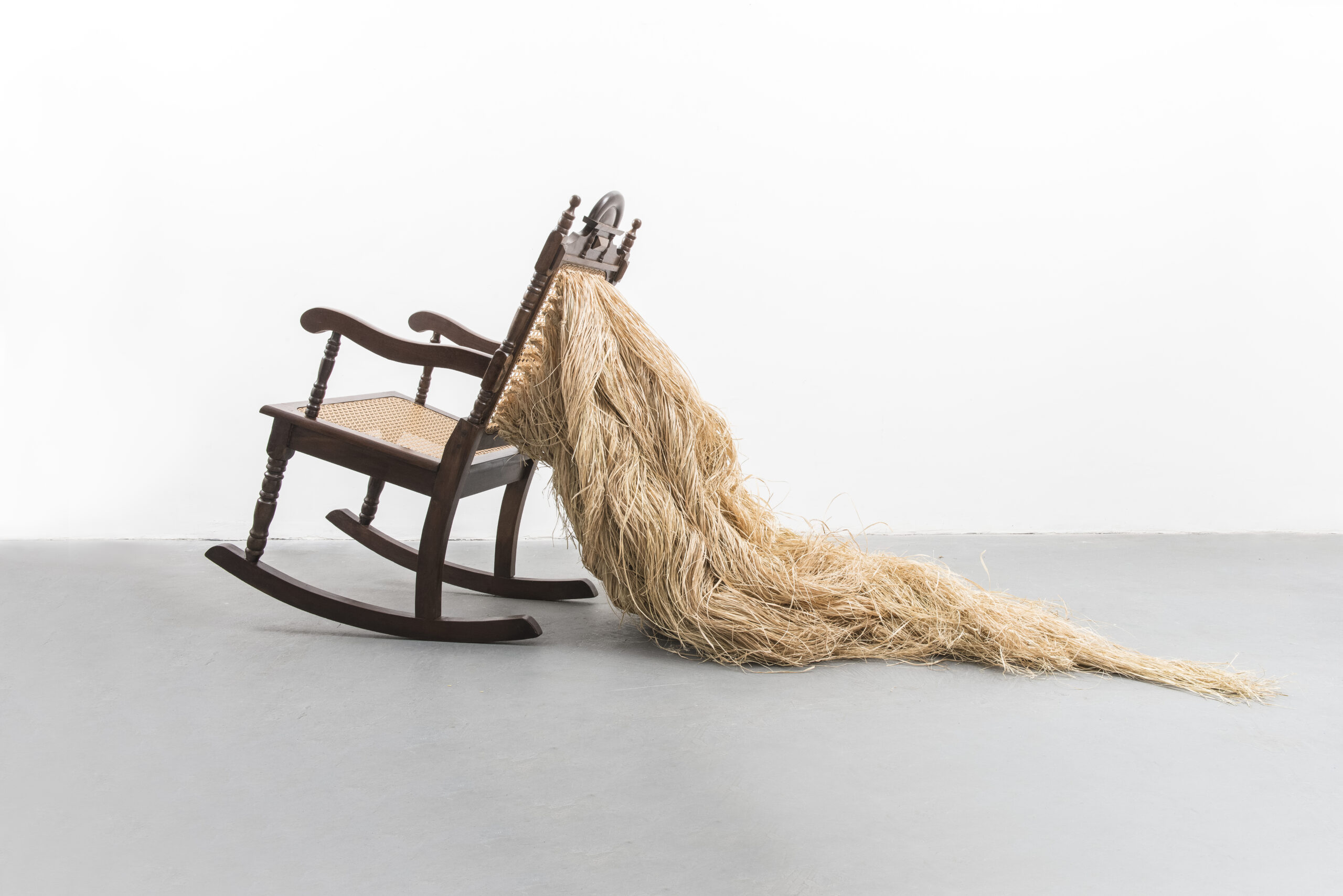
When we talk about these non-precious and extremely widespread materials, different people recognize them in different ways. For example, Koreans may identify one use for this material, while Brazilians may recognize another. Perhaps in Mexico City, people associate this material with a different use. The space in which each person attributes their understanding to that object, its texture, their cultural background and experiences, is unique.
That’s a perfect reading. In 2016, I worked extensively with tote bags, a common material in Brazil, and exhibited these works in Miami and Brussels. The interpretations were diverse: people connected to fashion associated the tote bags with Chanel, which had used them in a fashion show in 2012, or 2014. Others saw a connection with Africa, or with people carrying tote bags on the streets of Paris.
This is the plural power of art: the ability to be interpreted according to each person’s experiences and cultural background. These works have a broader charge, representing the expansive field of art, which manages to penetrate, and be reinterpreted by, culture. Although many people associate these works with Op Art, my interest lies more in the encounter of materials and the effects they produce as painting and composition. It’s about the plasticity, the sophisticated lustre, which, although familiar, invites deeper observation. Frederico Morais, a curator whose thinking I admire, said that one of the contributions of Latin American art is to lend the world a “caliente-sexy” aspect to artistic production. I find this vision extremely powerful because through materials we can talk about form and geometry in an engagingly rich way. We are trained to recognize shapes, but my intention is to challenge the viewer to look beyond this, exploring new layers of meaning.
Staying on the subject of the Ventana series, what is the process of creating and choosing the titles and mode of presentation of works?
The titles are all based on observations of ordinary, everyday things, such as kissing, hourglasses, baleba – which is a game of marbles – tambourines. These are names and words that, in a way, act as a call to observe these in the ordinary world. It’s precisely to indicate that the work is not in that pure place of form, color, and painting. It’s in a slightly more quotidian place.
Some of your works are quite sculptural and have an optical play of colors that changes according to the viewer’s perception. How do you integrate these elements into your work?
The studio works very much like a laboratory, where I allow a space for trial and error. Often, I don’t start out knowing what the work is going to be. I allow myself to follow the flow of the material, and sometimes I go with an idea. I have a work called O beijo (The Kiss), which is made with beaded rope and, depending on the angle you look at it, can be purple or green, like a moiré effect of optical interference. This work, for example, could have another layer of green, but it’s very complex, because if I move it up 10 centimeters, or if I add a slightly lighter or darker green, the work becomes something else. So there’s a lot of experimentation, and trial and error. I really let these mistakes appear in my work because, for me, they are sources of inspiration. There’s an optical game that doesn’t allow you to see everything at once. The body needs to move for these layers to appear. That’s why this exhibition is called “Dois pra lá, dois pra cá”, which is like a dance. When we ask someone to dance and they say they don’t know how, we say: “come on, it’s very simple, it’s two there, two here.” It’s almost like an invitation to have a simpler perception of these works. Let’s just enjoy them. It’s not necessary to have all this knowledge and training in art to experience these pieces.
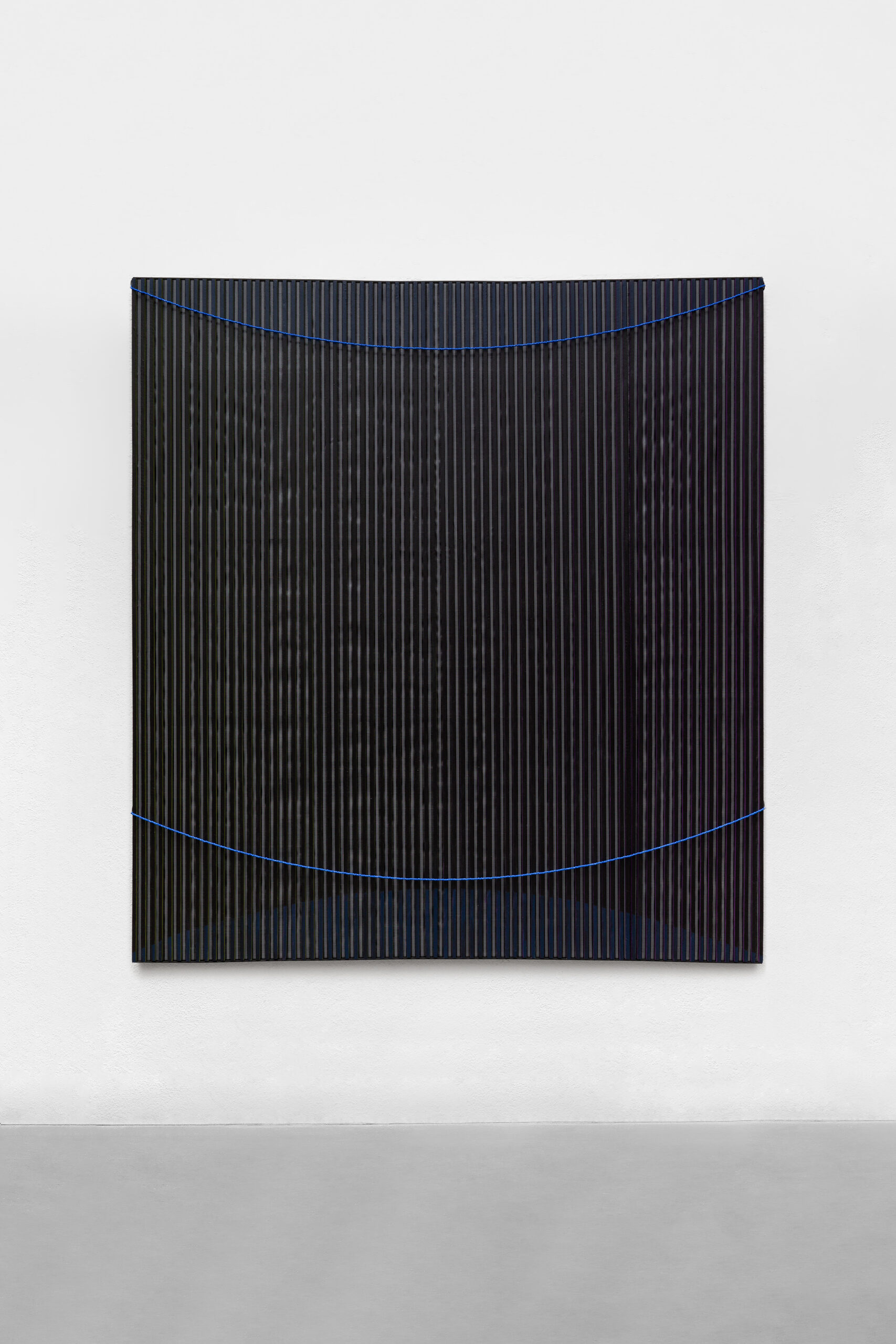
2024
It’s interesting that unconscious movement that happens when a viewer tries to negotiate the space of their vision with the work. They usually find themselves in a kind of dance, a dynamic that allows them to observe and examine different aspects of the pieces, which changes as the viewer explores these different positions.
Yes, absolutely. I also have another series of huge works that I call Alpendre. A porch is a small veranda at the front door, which comes from Arab culture, but many other cultures have adopted this architectural feature in their own way. Spain, with the arrival of the Moors, for example, had a strong influence on this architectural form. These works have been given this name because they represent much of what I consider important in my production and research, which is this place of transition between the house and the street, between the public and the private. These pieces function as this place of passage, where the body has to almost acclimatize to entering and leaving the house. This was very evident during the pandemic, for instance, when houses – from the simplest to the most sophisticated – all created this space to take off your shoes and wash your hands. Or that place where people put a plant to ward off the evil eye. It’s in this place where we create an area that prepares the body for leaving or entering the house, so it has a very bodily relationship. The times I’ve exhibited these works, they’ve functioned almost like a window, in which there’s this relationship between the external and the internal, like in a stained-glass cathedral. These layers have squares of different sizes, so there’s also this optical effect, and when the body walks through these elements, through the movement of the squares, it creates another perception of deepening and distancing.
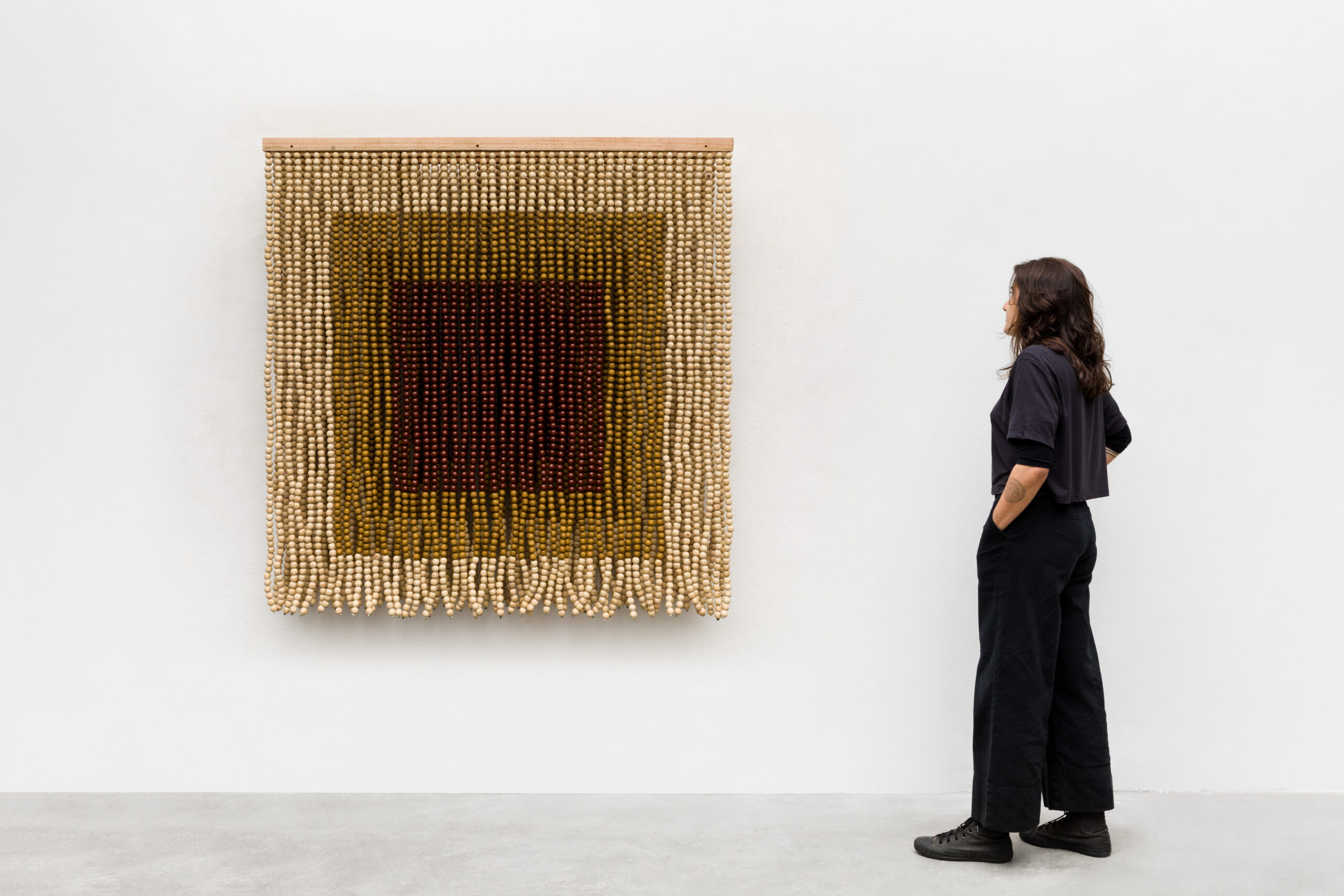
This density that is created in space is also interesting, because although it’s a very simple barrier to cross, at the same time the layers create a density that is difficult to penetrate. The Ventana series also promotes this sensation of a permeable barrier, which is still a barrier.
In the Ventana series, all the works were made using permeable elements, such as straw, muxarabi (Arabic-inspired latticed balconies), and sieves with different densities that are normally used to separate the chaff from the wheat, to separate grains, and are even used in construction work to sift sand and remove pebbles. This also has to do with how the body is perceived in society. The muxarabi, for example, is the first place where women appear to society, that place where you can see without being seen. It’s a very important colonial architectural element, especially for Brazil’s climate, as it allows air to pass through. Glazing everything, and putting everything in concrete boxes, can cause a serious problem. If we don’t start adapting and thinking about it, buildings will become greenhouses. This work on Ventanas is based on the observation of architectures and architectural values, such as the work on Eaves, for example. Eaves are those architectural structures on the façades of colonial houses that were extensions of the roof, and the number of eaves on a house indicated the family’s financial status. If the family was wealthier, the house had three eaves, called eira, beira, and tribeira. If the family was less well-off, the house had neither eira, nor beira, giving rise to a popular expression. It was an architectural element, but it was also a social distinction. So I started making these works with wooden beads, which are very present in the daily lives of Brazilians – whether in the curtains that separate houses and rooms, or on the backrests in taxi-drivers’ cars. Above all, they create a layer of air between the body and the seat, because the ergonomics of cars were not like they are today – there was no air-conditioning.
It’s curious to think how these wooden beads, or even structures like doors, might appear in cultures other than in Brazil.
Yes, it goes far beyond Brazilian culture. In New York, for example, we see taxi drivers using these same backrests on their seats. Of course, this is decreasing more and more as the ergonomics of cars are improving. However, people also have a cultural flow, and take some of their culture and values to other places. That’s what I find so interesting.
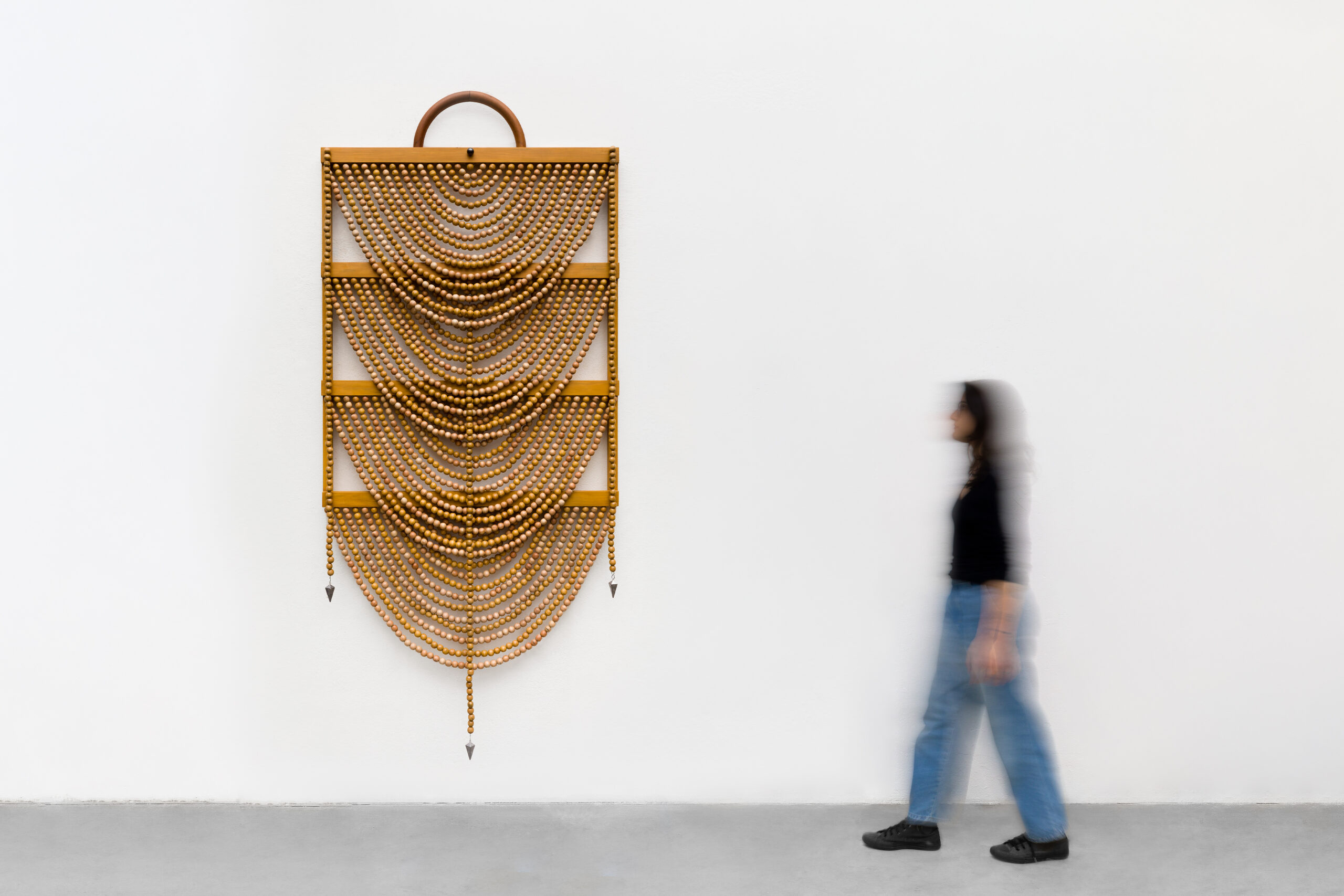
2023
There is also a democratization of the object, and of these architectural details that travel very easily. Whether you think of the Arab world or the European world, there is no religious or cultural judgement of these objects. They are simply incorporated and reused as needed. This is also reflected in the tote bags and these materials which are, in a way, culturally democratic.
Yes, exactly. Returning a little to the question of personal baggage, in the exhibition I did in Mexico [Cama de Gato exhibition, which opened from 24 September to 29 October 2022 at the LLANO gallery space in Mexico City] visitors perceived completely different elements, based on their own beliefs and experiences. Some saw references to Candomblé, or Santeria, as it is known locally. Jewish visitors identified Jewish elements, while Buddhists saw Buddhist references in the beads. Some also saw elements of sadomasochism, such as the rings. This exhibition very much addressed the logical relation between pain and pleasure. The compositions were made with fabric from car seats and beads and made reference to the backrests that offer “massages” to workers who spend many hours in the car. It also invited visitors to experience this idea of pleasure and pain and to reflect on what this “massage” really is.
Are these wooden beads produced in Brazil?
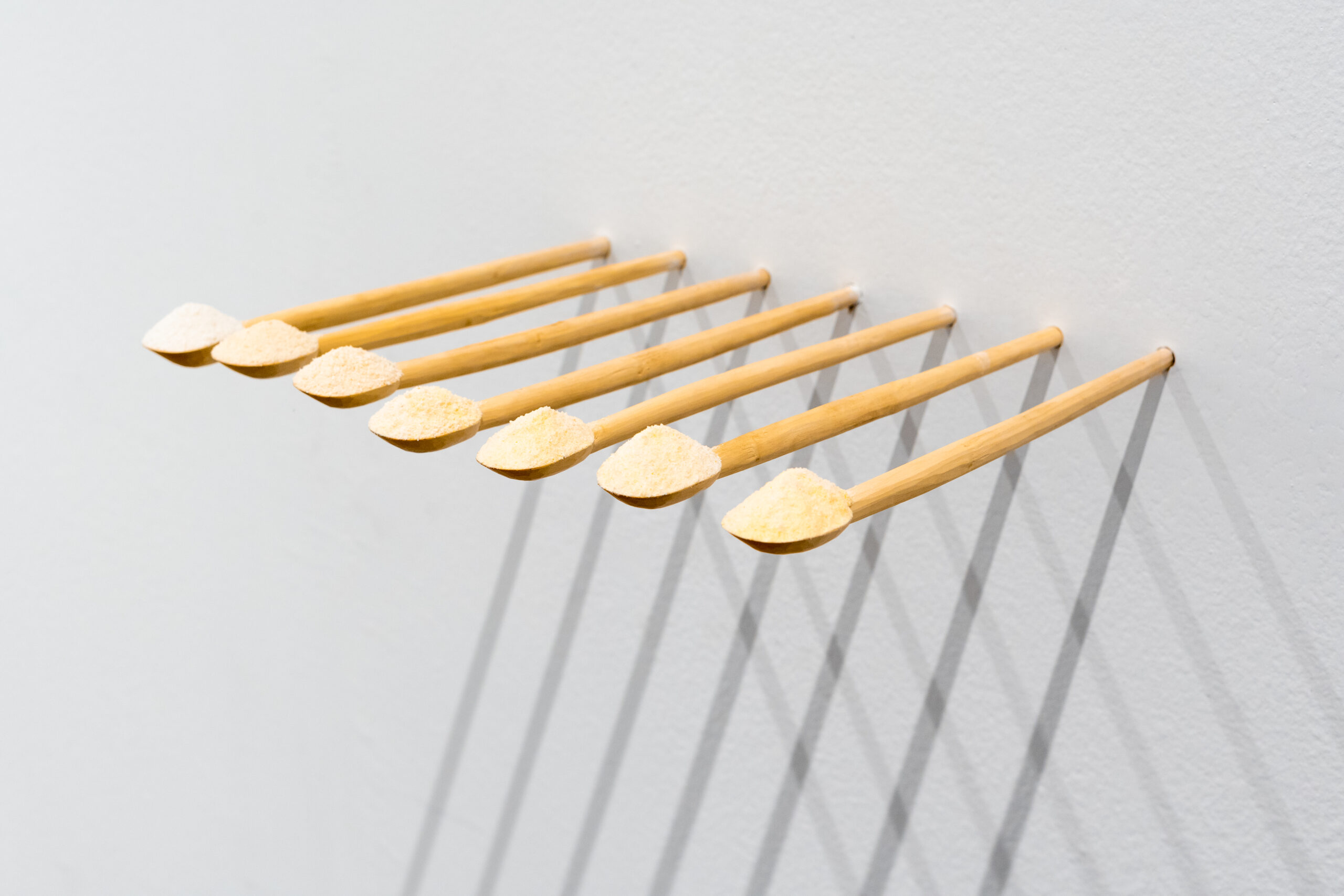
Today, I work with a family of artisans in the interior of Paraná, and this is another aspect of my research and production. I realise that every work, every idea, requires a medium in order to exist. Therefore, I’m interested in making the most of these media. For example, I have a piece called Branquinhas, which is seven shades of white, but it’s made of cassava flour. This work speaks volumes about the quality of these flours – an aspect that only those who know it well can understand. As a northeasterner, I can decipher these qualities, such as the most toasted, the least toasted, the whitest, the crunchiest, and so on. This has a lot to do with the culture and logic of, for example, the Eskimos, who have thousands of names for white. Or the indigenous people who have different names for greens, because of the perception of their imagination within the forest. I put myself in the position of knowing the qualities of these flours and, as there are seven of them, it ends up creating the logic of one for each day of the week and, with that, the work becomes completely geometric.
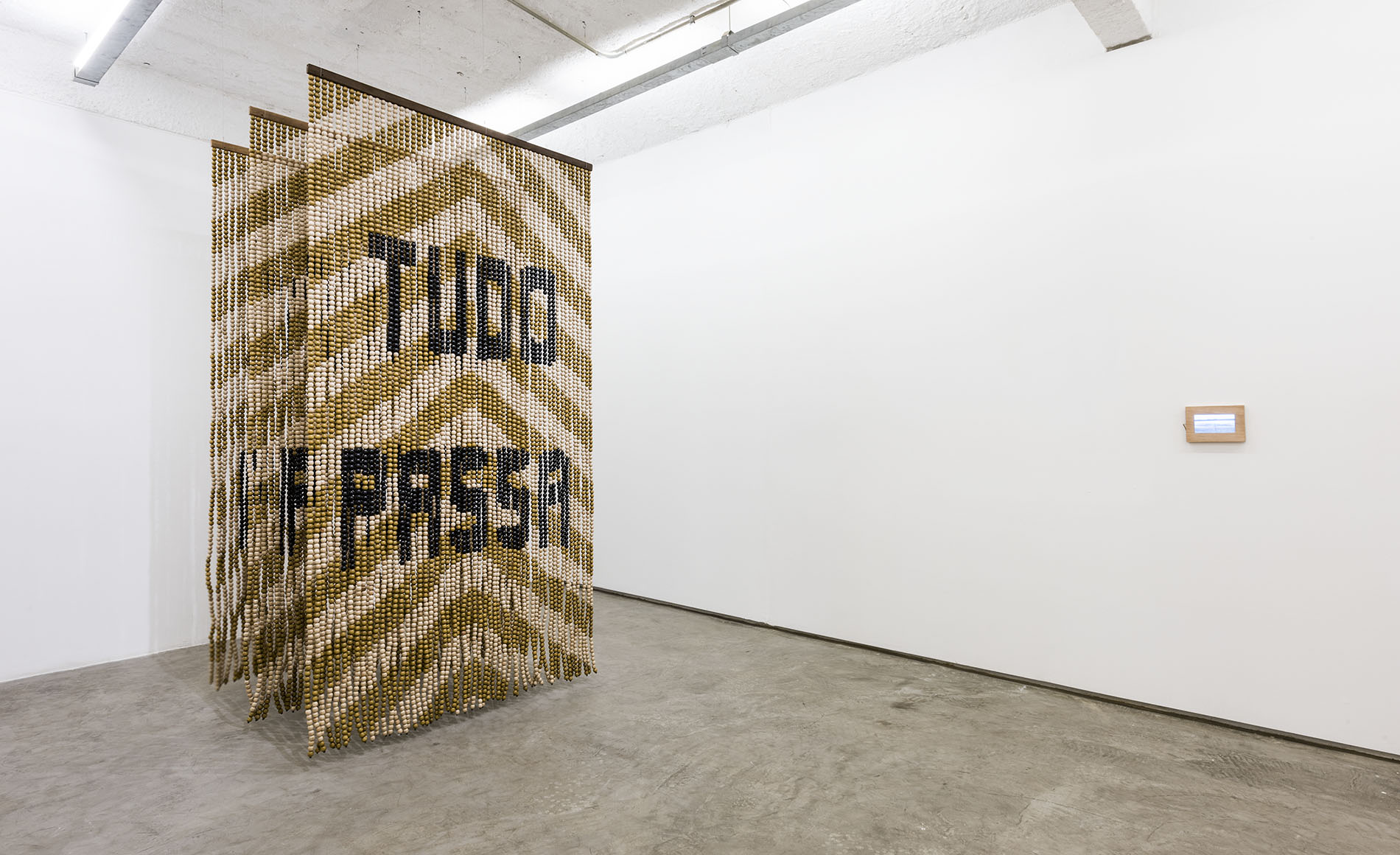
Moving on to another work, could you tell us about Tudo Passa?
This work was born in 2016, during a very difficult period in Brazil, when the impeachment (of President Dilma Rousseff) was taking place. I believe this work is broader than just the political, as it has been used at various times since then. When the pandemic started, I held a meeting with the gallery I worked with, and we decided not to present the work again, as it had been presented on other occasions during political movements. However, one day an artist in Italy published the work on Instagram and I just shared it on my profile. After that, there was a huge amount of sharing, to the point where Instagram itself contacted me because they couldn’t understand the amount of sharing of that image.
How do you work on these series? For example, do you finish a series and then return to these elements and use them again?
I tend to work on several things at the same time. My production all happens together in a somewhat random process, and that’s what drives me. Sometimes I’m working simultaneously on three different series. Whenever I’m involved in large projects that require a lot of time, I usually move on to work that I can complete more quickly, such as collages. Then there are the performance works and actions, like Garden for David Hammons, in which I installed a green tarpaulin in Mexico City and sold plastic flowers with which to close drains. David Hammons is an artist I like a lot, and he did a work that, for me, is the ultimate in power, called Bliz-aard Ball Sale. In this piece, he sells snowballs in the New York winter, and the work is very much about selling the maximum of perishability and, at the same time, infects both adults and children. I think this is very powerful, when a very broad spectrum of people can access the work in different ways, and in Garden for David Hammons I pay homage to him.
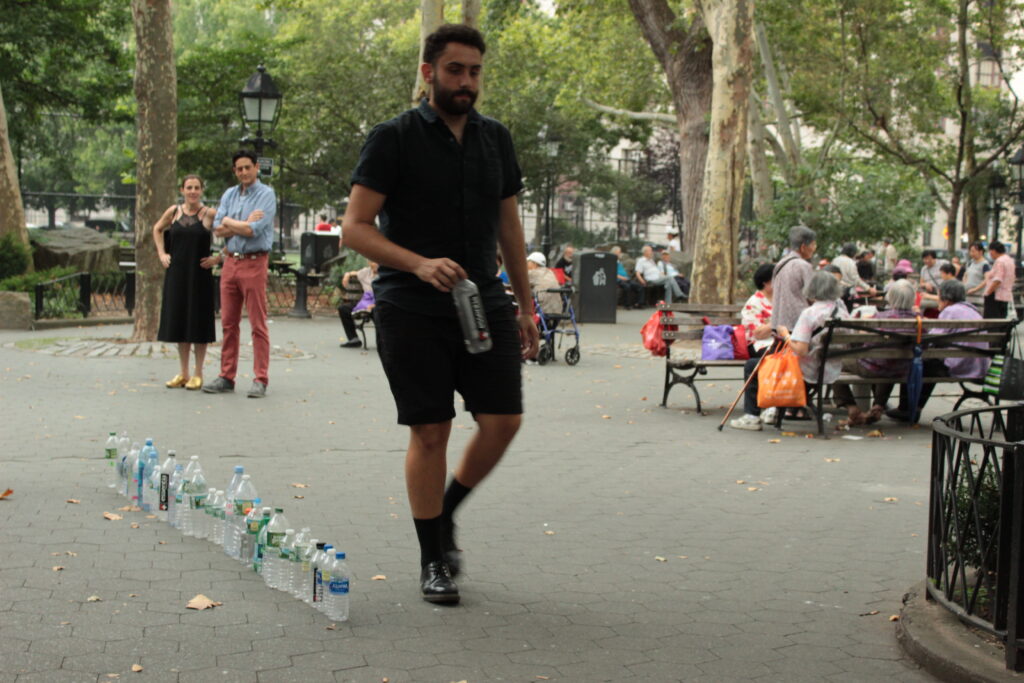
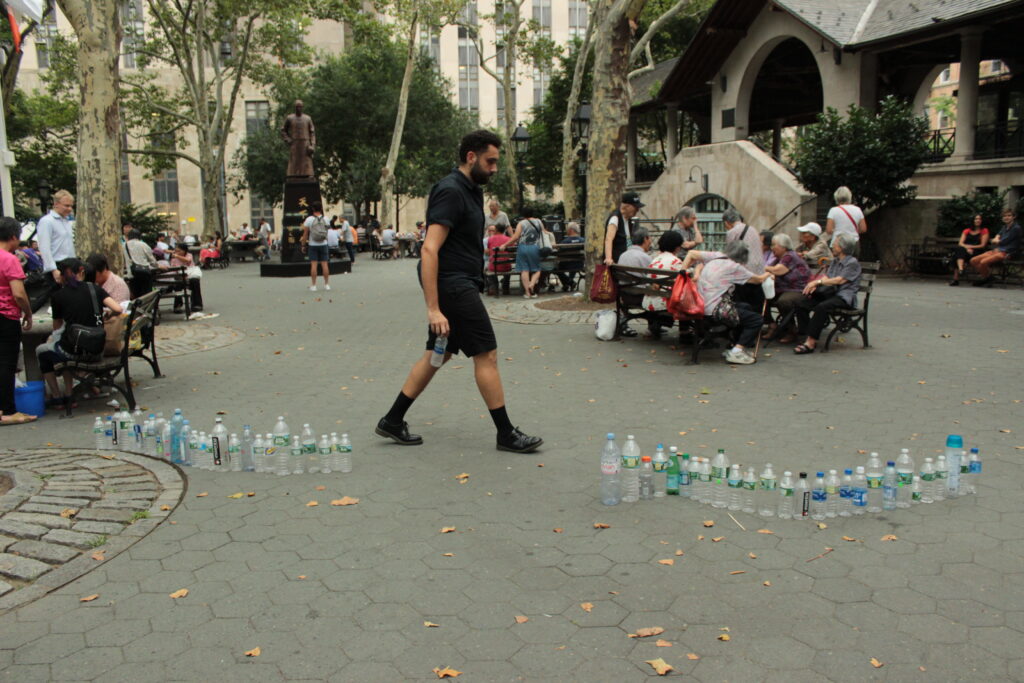
I have another performance that I really like, called Interested Drawings. During the three months I spent in New York, for a residency I did at AnnexB in 2018, I collected all the water bottles I drank. At the end of this period, I started drawing in the street using these bottles. The work consists of creating a line with all these empty bottles, removing the last one and placing it at the front. The plastic bottle is an object to which we are super-connected, that is ergonomic in our hands, but which is questioned all the time – for example, we don’t know if it’s a sustainable one or not. This generated various reactions from the public – from observation to indignation. Some people were completely furious, swearing at me and asking why I was doing it. But I was well prepared for these reactions and was really interested to see how people would react.
It’s interesting to see that, despite this material saving, it still causes this architectural barrier in the space. I imagine there were people watching, but all being careful to avoid knocking it down, or interfering with it.
The place it caused the most aggressive reactions was in Brooklyn. It was very interesting to see, for example, if the bottles were empty and the wind knocked them over, I’d go back and replace them all. Some young people, and also a street vendor, were very angry. They said, “You’re an idiot, why don’t you put water in it?” But people were trying to find a solution to something that had no solution, because the work was precisely about dealing with the inclement weather of that moment, reacting to what was happening. The work was called Interested Drawing, because this line moved according to people’s level of interest. So it could be anything from encouragement, like “I like it, keep going,” to revolt. One of the confrontations, which almost turned into a fight, was with a street vendor in Brooklyn who didn’t agree with it. He started cursing, and every time he cursed at me, I brought the line back to him. It was a public space, so he couldn’t do anything – I was sharing that space with him.
It’s curious how social, geographical, and even logistical, restrictions end up molding the way you create and present your work. Could you tell us more about the challenges or limitations you’ve faced in your artistic practice?
Thinking about the challenges, we have a bit more structure here at the studio nowadays, especially in terms of export documentation. For a long time, we had a logic within our production of making work that could fit in a suitcase. The work doesn’t even need to be the size of a suitcase, but it does need to have parts that fit inside a suitcase. And I think this is also a piece of data, information about the work that speaks to this characteristic isolation that we live in; whether it’s language, geography, distances, or the size of Brazil itself.
Interview conducted on 14 March 2024 at the artist’s studio in the Vila Buarque district of São Paulo.
Wooden slats, nylon band, enamel paint and chassis | 80 x 90 x 6 cm
2024
Postcard | 10 x 15 cm
2017
Times, wood and straw from the coast I 100 x 150 x 60 cm
2016
Wooden bead, ribbon, stretcher, steel wire, sinker, and nail | 220 x 100 x 10 cm
2023
Wooden bead, ribbon, and iron stand | 150 x 150 x 30 cm
2023
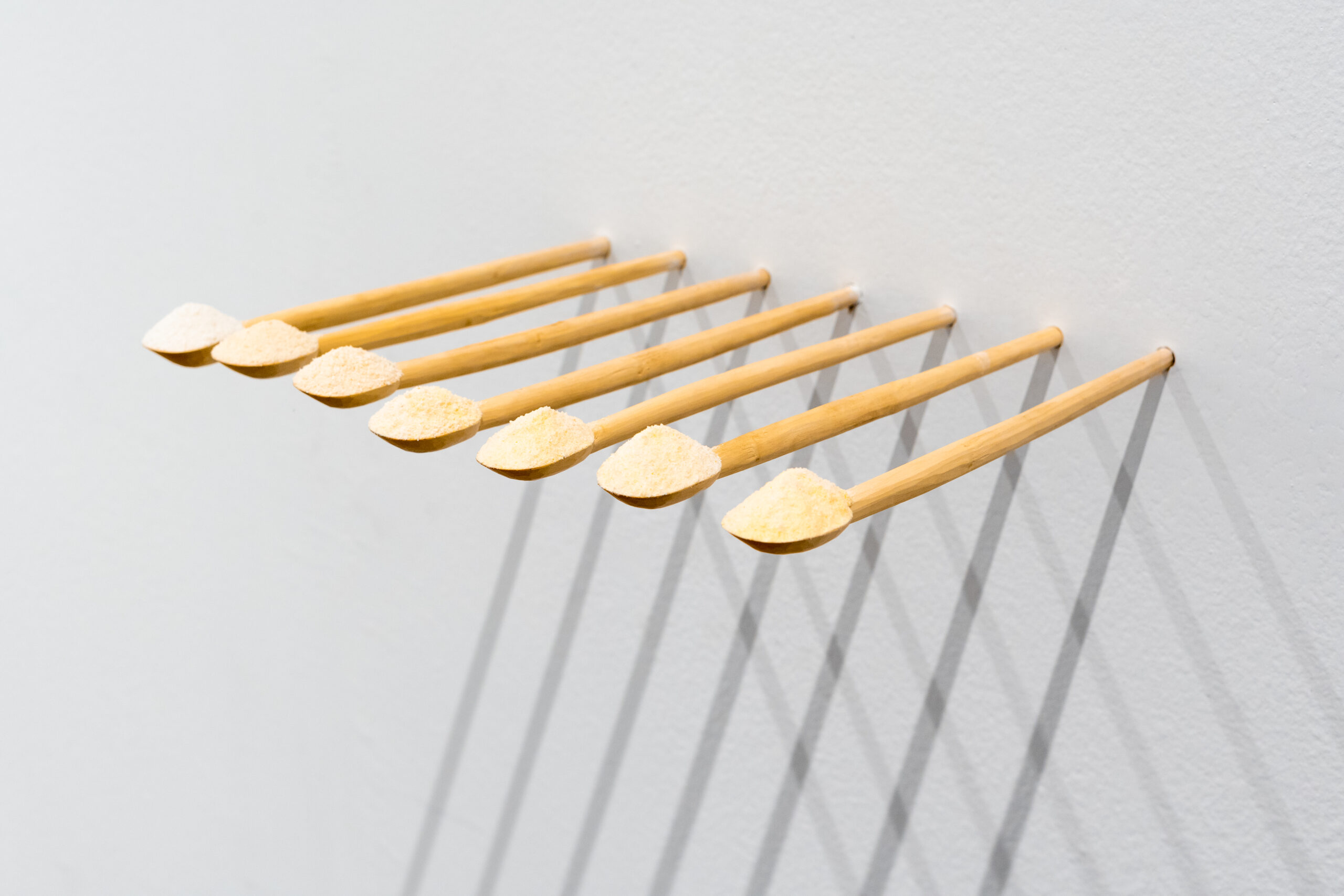
Wooden spoons and 7 types of manioc flour | 5 x 40 x 30 cm
2023
Wooden slats, nylon strip, enamel paint, beads, ring, nails, and stretcher | 162 x 151 x 5 cm
2024
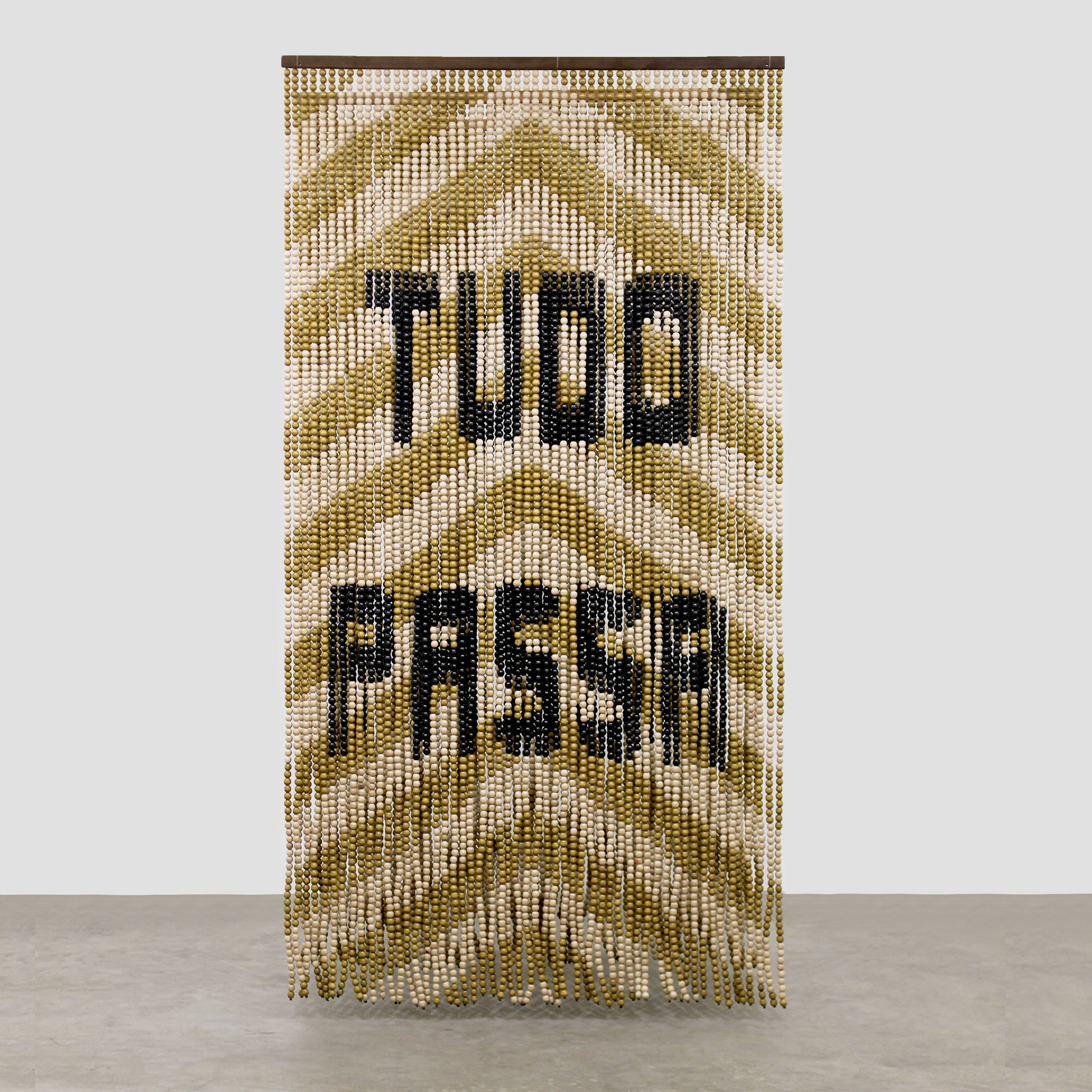
Wooden beads, wooden slat, and ribbon | 280 x 150 x 120 cm
2016
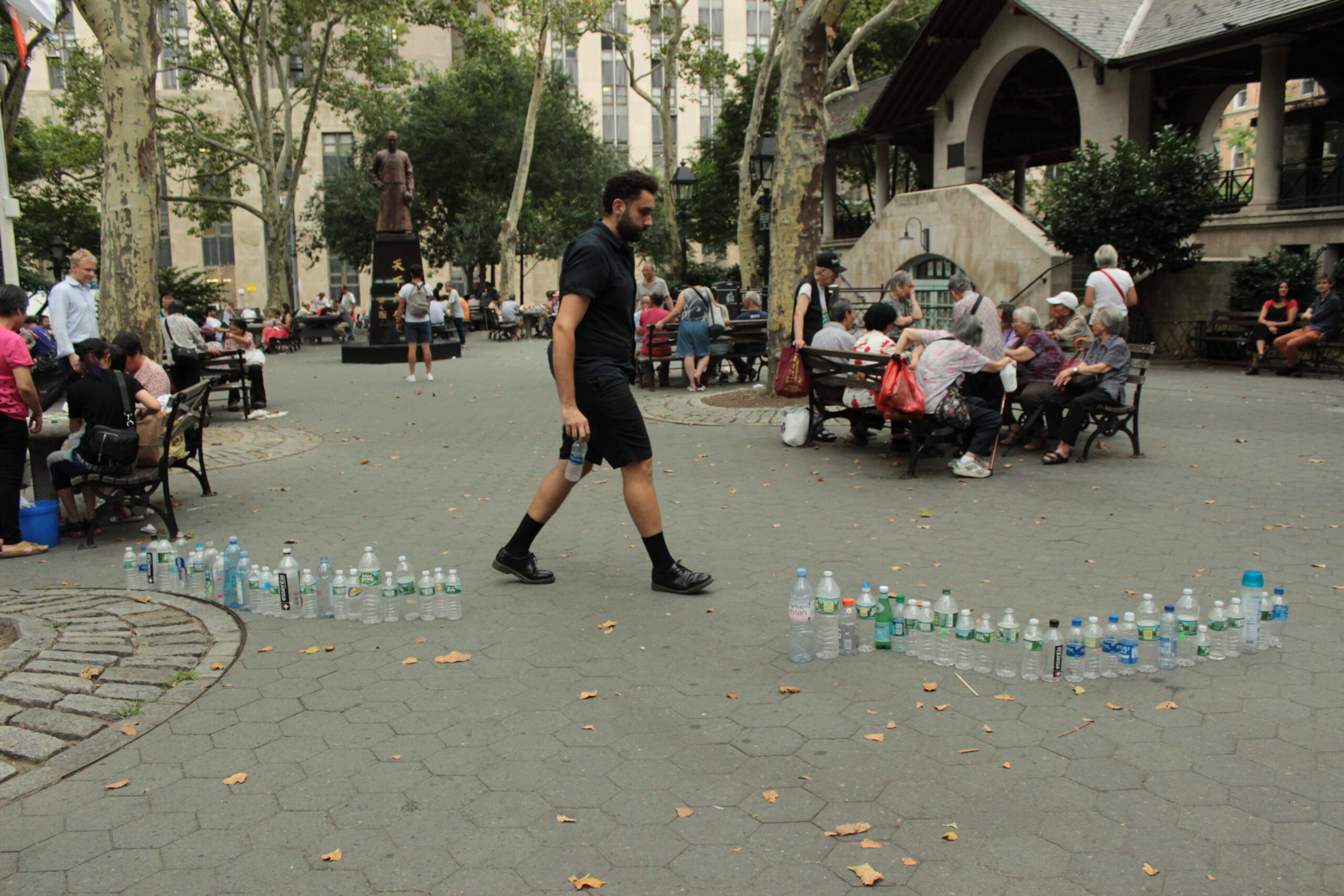
Action on New York’s streets. Construction of lines using plastic water bottles, in which the artist created their own rules to continue the line based on the public’s reaction.
2018