

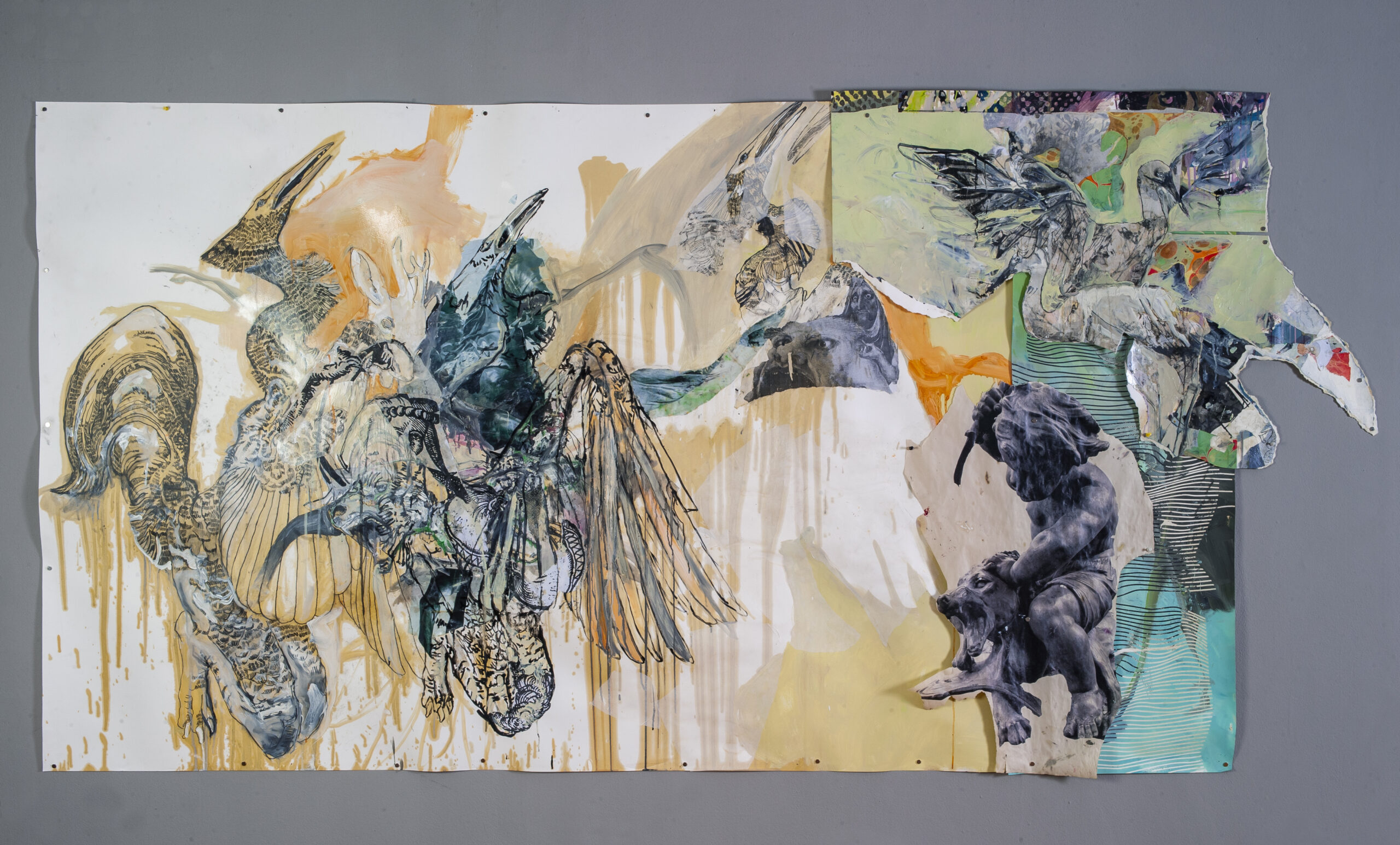
Cadu
As an artist, educator and researcher, Cadu (São Paulo, 1977) investigates the convergences between different fields of knowledge, blurring conceptual and material boundaries. His artistic practice develops in an experimental field, where abstract ideas take shape through processes that embrace chance and unpredictability. Social collaboration catalyses dialogue and the collective construction of meanings, amplifying the impact and resonance of his works. This approach allows Cadu to explore complex social issues in a deeper way, giving voice to different perspectives and realities. In our interview, the artist reflects on how his work addresses the tensions between the individual and the collective, the material and the immaterial, exploring the layers that make up our contemporary socio-cultural experience. Check it out:
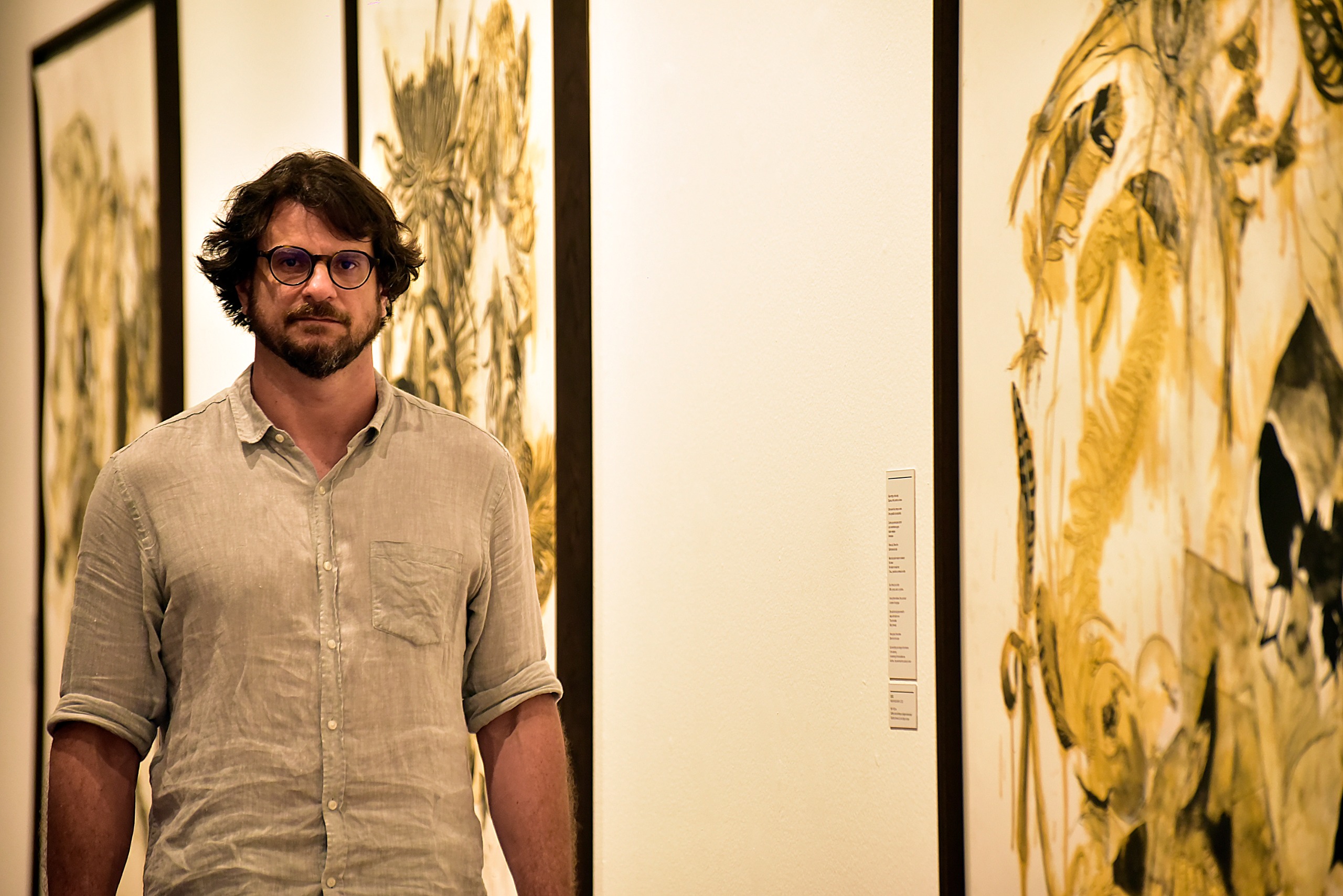
Cadu, thank you very much for taking the time to talk to us. I’d like to start by asking you to introduce yourself, with any information you think is relevant, thinking of an audience that may not yet be familiar with your artistic practice
My name is Carlos Eduardo Félix da Costa, but I choose to use just Cadu as my artist name, without a surname, which is the nickname I’ve been called ever since I was a child. This decision has to do with work choices that are made between my technical sense and my ethical sense and that aim to dilute authorship, disappearance, secrecy, and which begins, in a way, with what I call myself. I’m a white man, 46 years old, 1.87 metres tall, with straight hair. I was educated at UFRJ (Federal University of Rio de Janeiro), at the School of Fine Arts, where I studied painting in the mid-1990s. At the end of that decade, I started teaching drawing, life drawing, teaching observation, and doing internships at universities in the teaching area, in fashion and industrial design faculties. After university, I began postgraduate studies, working in the fields of art and philosophy, in which I have a master’s, doctorate, and post-doctorate, also from UFRJ. Along with my artistic career, I found shelter within institutions such as cultural centres, working on the production side and setting up exhibitions, or in production companies, setting up exhibition projects, until my artistic practice and my teaching joined together. I’ve taught at a number of private and public universities and I’m currently an assistant professor in the Department of Arts and Design at PUC-Rio (Pontifical Catholic University of Rio de Janeiro), where I coordinate LINDA, the Interdisciplinary Laboratory in Nature, Design and Art. In Rio de Janeiro, I’m represented by Galeria Silvia Cintra, and in São Paulo by Galeria Vermelho.
How long have you been working in this department?
Since 2007 I’ve been teaching at the Department of Arts and Design as a complementary professor, and I can also work at other universities. So, in parallel, I worked at UERJ (State University of Rio de Janeiro), Veiga de Almeida University and Estácio de Sá College. But since the second half of 2017, I’ve had a full-time position. For many years I was also a teacher at Parque Laje, a free school that is very important in Rio’s art scene.
Tell us more about this intersection between nature, design and art.
This confluence actually follows the example of acts that weren’t even called that, “ecologically”. We can say that they were perhaps inaugurated with the publication of a book called Walden, in 1854. Henry David Thoreau (1817-1862) lived for two years, two months and two days in a cabin and recounted this journey, which actually began as a form of civil disobedience, as he wanted to avoid paying taxes. From then on, I realised that he was also associated with a literary current of American transcendentalists who nurtured a relationship with the landscape, with the ideas of the Enlightenment, contacts with the peoples of the New World, the concept of freedom, aspects that began, I intuit, to appear in art from the moment that artists like Claude Monet (1840-1926), J.M.W. Turner (1775-1851), Paul Cézanne (1839-1906) and others left their studios. At this point, the way of seeing the world began to be less separated from the environment. Now, obviously, since we are immersed in the processes of historical reparation, which will always cross class, gender and race, we are looking at our own legacy here in Brazil and realising that this relationship between religion, art, and science, which creates places for expanding the imagination and subjectivity, was already constituted right at the heart, right in the ethos of our original peoples.
I know it’s difficult to make a direct connection, but thinking about Swimming in the Sea, from 2022, how do you see these interests emerging in your artistic practice?
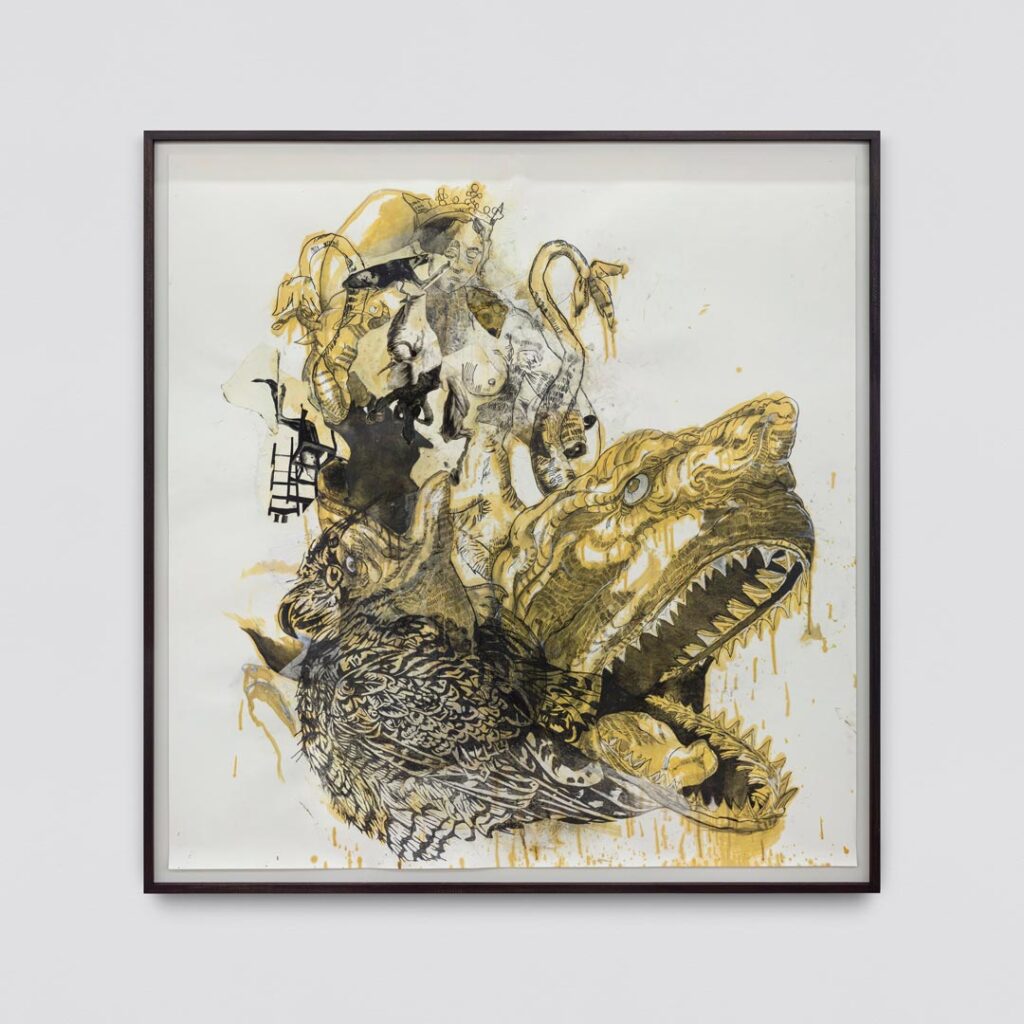
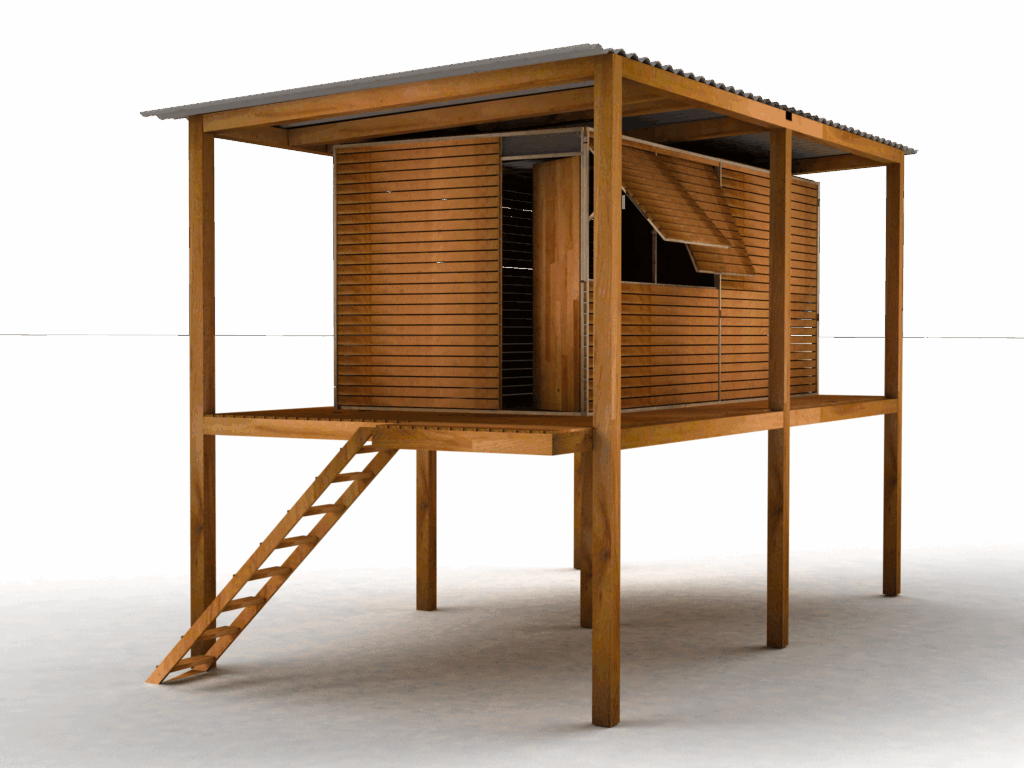
I can trace a path, going back a long way. My early research at university led me to adopt a non-artistic approach to landscape drawings. Instead of just contemplating a cut-out – which we normally saw placed on the drawing or painting easel – I invested my time with equipment and small prosthetic models that made elements of nature manifest in the work. I worked with the wind, with sunlight, with animal behaviour, with the topography of the land, and this process of making an interface between nature and the medium was my artistic contribution. In other words, generating images that functioned as a co-participation between me and an entropic element. At a certain point, the desire to go into nature was so intense that for my doctorate I realised the project Seasons (2012-2013), when I lived in a hut in the middle of the forest for a year. I spent three months building that shelter and another nine months living there, in a period that circumscribed all the seasons and, symbolically, a nine-month gestation process. In a way, this inaugurated a lack of discernibility between making art and being in a state of art, whether making objects or teaching. Curiously, I then began to be invited to inhabit, for certain periods, human communities, or wild natural contexts, where the work took place in the midst of these relationships. What was once just an element of nature began to pass through people as collaborators. These more current works are something of a novelty, as I don’t usually work with figuration. During the pandemic, I returned to the basics of my training: drawing with graphite. With that, I started a visual mythology that was very much based on the concept of the chimera, using images created by naval explorers between the 15th and 18th centuries. Swimming in the Sea brings animals, beasts, octopuses, krakens and mermaids, all within a traditional practice of representation. But my relationship with nature, and the bridge between projective practice and artistic practice, goes back a long way.
Could you talk about the abstract elements in The Monk Pierrot and the Bridal Castaway (2020-21).
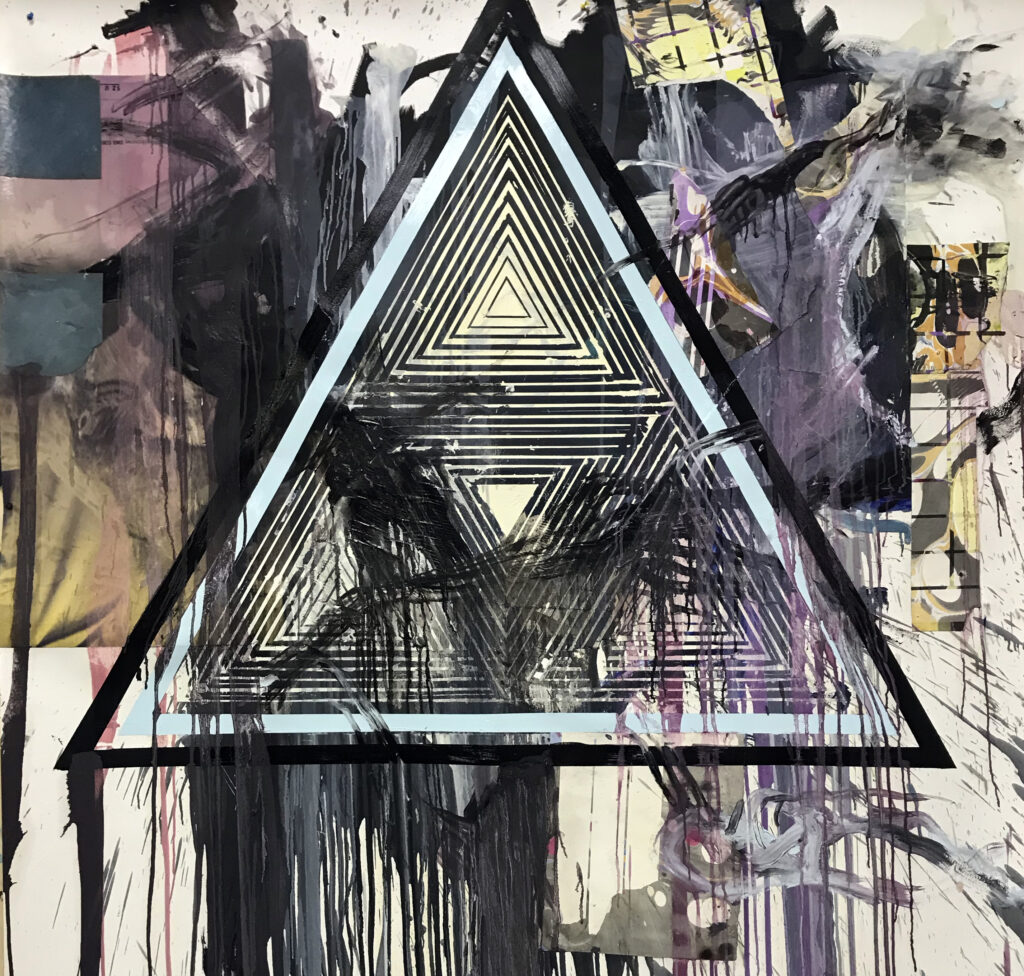
I have a very strong relationship with literature and I create some characters for myself. Each exhibition is a specific fable. O monge Pierrot and o náufrago nupcial are, in fact, products of drawing that have a more abstract approach, and are about an interest in sacred geometries and forms that appear in the natural world, biomimicry or the presence of chaos in this, which would be the nuptial castaway. The Pierrot monk is this scholarly, sombre figure who, underneath his habit, wears a carnival costume. And the castaway is completely desperate, lost in her certainties. They work together to create surfaces, since one works with rigour and precision and the other works with the technique of marbling, which is totally fluid, totally unpredictable, but which are also labyrinths in some way.
Yes, because the marbling technique, these processes of nature, however random they may seem, are very systematic.
Sometimes we take the symptom to be the cause. In fact, every mountain will become an island again at some point. It’s just that we won’t be here to see the replication of these patterns and the systemic way in which these things happen, sometimes violently, but also perfect. It’s another time scale. Sometimes, when we don’t comprehend the possibility of the cycle happening again – when the extremes will meet and start the process all over again – we think it’s confusing. The surface of the stones that are associated with the word marbling is nothing more than taking those drawings – à la the Rorschach test – as things that don’t make sense. But once you understand how things are done, they have an admirable logic.
What is your creative process like as a multidisciplinary artist?
É um pouco como eu vivo. Fazer, pensar criativamente, não só é uma atividade, para mim, profissional, mas existencial. Olhar a realidade diretamente é muito difícil. É preciso inventar escudos, proteções lúdicas para nos proteger da aridez do real. Aí entra um diagrama pessoal, que estabeleço como a relação entre a medusa e o narciso. Se você olhar diretamente para a Górgona, virarás pedra, porque a verdade é dura. Então, você faz um escudo de Perseu, faz uma cambalhota lúdica para indiretamente poder tocar em questões que são muito incômodas para você. Mas, se você se encantar demais com o seu próprio reflexo, com suas criações, pula no lago da vaidade e se afoga.
(Translation: It’s a bit like how I live. Making, thinking creatively, is not only a professional activity for me, but also an existential one. Looking at reality directly is very difficult. We have to invent shields, playful protections to protect us from the dryness of reality. This is where a personal diagram comes in, which I see as the relationship between the jellyfish and Narcissus. If you look directly at the Gorgon, you’ll turn to stone, because the truth is hard. So you make a Perseus shield, you do a poetic somersault so that you can indirectly touch on issues that are very uncomfortable for you. But if you get too enamoured with your own reflection, with your own creations, you jump into the lake of vanity and drown.) So, once again, that concave surface of the shield can help you to not sink, to float a little. My day-to-day life involves managing various types of projects. As a teacher, I say that my brain works almost like a torrent these days. I can’t process a file all at once, so I fragment it, think about it together with those under my guidance and am lucky enough to come up with something else that is neither what I wanted, nor what the subject imagined. It’s a third person who comes along and does the job. And in art, sometimes it’s even a way for me to react to this: if I’m working too hard, if I’m investing too much in on the very rational side, I need to work on something more chaotic, that’s individual, that only depends on me. That’s where drawing and painting come in. On the other hand, I’m in a department that is very sympathetic to new technologies, which gives me the opportunity to work with a lot of interesting people and a lot of new technical processes. Sometimes the work will take shape, such as theatre plays, films, musicals, paintings, photographs, installations, performances, which are both my gestures and gestures made in collaboration. But at the end of the day, if I had to name a place where everything begins and ends, perhaps it’s in the drawing. Everything comes from an idea that, at some point, has been on paper graphically.
In relation to your question, the atelier unfolds in many dimensions. There’s obviously the atelier, which is a place for workshops, that exists. There’s the academic studio, where writing and other activities take place on university premises. And there’s my playful diary, where everything is always noted, which are my notebooks. They say that when Lampião’s house was set on fire, he said something like: “My house is my hat.” My studio is my hat. Wherever I am, I’m in my studio. That’s why this question is so thought-provoking and, at the same time, so difficult to answer, because what I eat, what I say, how I relate to people, what I profess, my relationship with the world, in the realms of reason, politics and the sacred, are all one and the same thing.
You commented on technology and some of the access you’re guaranteed because you’re inside the university. Tell us a bit more about that.
I think they’re exercises in language. We’re now having a lot of contact with artificial intelligences, with additive 3D printing processes, with virtual modelling, an inclination towards metaverses, irreversible movements in a networked economy, late capitalism, surveillance. In the Department of Arts and Design, I come into contact with materials, professionals, and thinkers, who deal with this in a praiseworthy way. I’ll give you an example. I’m part of a research project on urban mobility in Rio de Janeiro sponsored by FAPERJ (Carlos Chagas Filho Foundation for Research Support in the State of Rio de Janeiro). There’s a very strict part, but at the same time, there’s a part where we need to collect data from journeys that are going to take place with users – temperature, noise, heartbeat, atmospheric pressure – which, once captured by sensors, will receive a more objective output, to meet the mobility needs of the citizen. But together with colleagues, I can also do a lot of other things with this data to build works of art. The sense of cartography, the sense of displacement, the sense of the individual’s relationship with the landscape, these are things that have already been explored, but which will take on new contours due to the nature of this material. As another example, I collaborate with researchers who, for a long time, were responsible for digitising the collection of the National Museum, which burned down in 2018. Sérgio Azevedo, Jorge Lopes and Cláudio Magalhães (the first from UFRJ and the other two from PUC) spent 20 years digitising the collections. Unfortunately, only the data exists now and many of the objects have been lost. So, after mourning, we began research that allowed us to move from a place of lack to a place of power, creating works of art with the debris from the fire itself.
Educational research, university research, and artistic research, are approached much more separately than they should be. I don’t know if you agree.
That’s the challenge, really, to be able to do work that raises relevant metaphors in the artistic field and that can be integrated into pedagogical practice at the university. And this is the attitude of the design that is produced within PUC, called design in partnership, where I feel there are humanist and ethical bases for following projects. But let’s face it, it’s nothing new – this was the project of the Bauhaus in Germany before the war.
How do you see the relationship between the public and the work, thinking about the general public who perhaps don’t have access to all this information, or who end up relating to the work only in a visual way.
It’s very delicate, because we’re going through a bigger crisis, which is an image crisis. We produce an unprecedented amount of content. Getting information is a journey through an enormous layer of noise, in which highly spectacular and appealing images compete and its appetite for consumption is only matched by the wear and tear and discarding of these images. The more I have, the more I want. Then, when using a platform like Instagram, for example, you sometimes have to compete with visual results that may have taken three years to come into existence, or with other things that were made in three minutes. There’s a challenge, a wig that’s difficult to comb.
Como é que a gente vai desvincular a arte da ideia de entretenimento? Porque a arte propõe uma desaceleração, propõe uma suspensão da relação de finalidade, da relação de causa e efeito, das posturas de desempenho e produção, enquanto seu campo está contaminado pelas relações velozes, pelo descarte e pela pirotecnia.
(Translation: How do we detach art from the idea of entertainment? Because art proposes a deceleration, it proposes a suspension of the relationship of purpose, of the relationship of cause and effect, of the postures of performance and production, while its field is contaminated by fast relationships, disposability, and pyrotechnics.) There is a lot of consumption disguised as information and, as a result, a lot of art that ends up being unseen and unnoticed. As an artist and educator, my job is simply to show that there are gaps, and that it’s possible but they require a nature of listening, silence, and ambiguity, for which people generally don’t have the time, or from which they are prevented having access due to the insertion of pragmatism required in day to day economic reality.
How do you see the relationship between institution and work, institution and exhibition? I feel that Brazil lacks variety in the objectives and formats of institutions.
These relationships are always fraught with friction, there are no perfect alliances, there are no perfect allies. I’m an employee of a Catholic university, so if I’m too worried about everything that’s happened in the name of Jesus, I’ll jump out of the window, I won’t work there. Knowing that the institution is made up of people, however, that it is not an abstract organ, then one way is to act micropolitically to soften the hard core of a structure, which tends to accept change slowly. And I think the same is true of other places. We can’t help but realise that in the last ten years Brazil has gone through very complex processes greatly affecting the way we act in these places, and accepting certain new practices at the same time. We’ve taken a few steps backwards. There is a very large population in the country that is extremely conservative, and institutions have to try to work to give discourse to everyone, as long as one is not harmful to the other. Diversity is super important. I can no longer live in an idyllic fantasy, which I’m passionate about, of the tropicalism of the 1970s, to see it as a reaction to the dictatorship, and not want to write off a Brazil that today is extremely prejudiced, full of contradictions, libertine and religious, corrupt while also an economic powerhouse, very retrograde in terms of morals and customs, oppressing certain classes that are shouting and making very important things appear, with new ways of living. The role of the institutions is much greater because they have to deal with all this – it’s a big challenge.
Taking this more political angle, I’d like you to talk about Clotho (2015 / 2019).
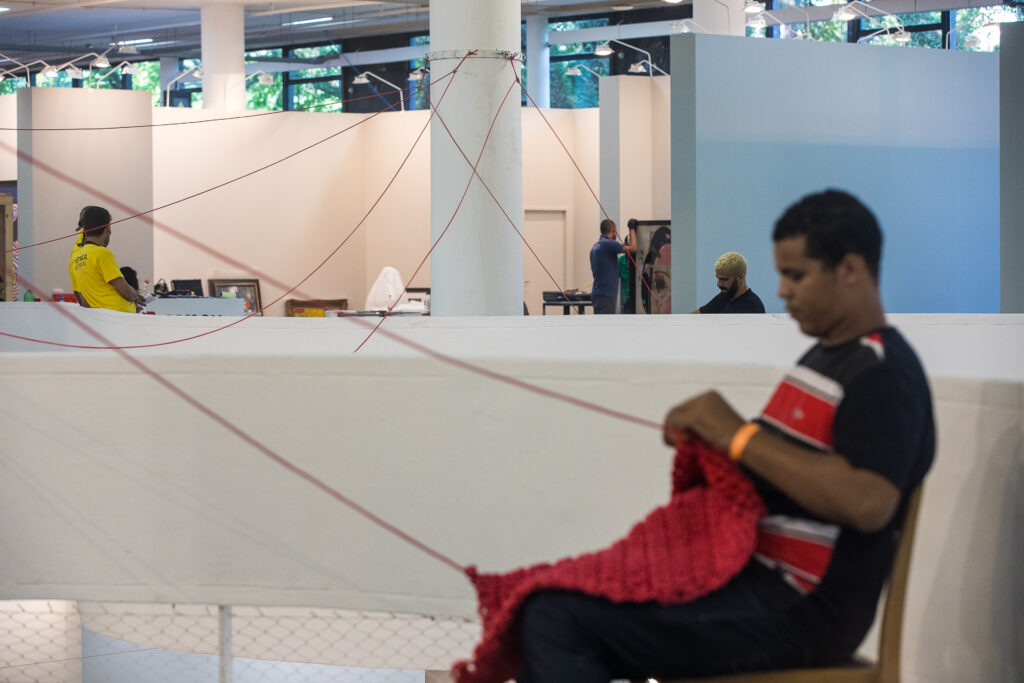
This work emerged, as a first version, in Poland, during an artistic residency in a country town called Nowy Sącz, which is two hours from Krakow. I was encouraged to work in a cultural centre that had been renovated, receiving a lot of funding from the European Union, but which, for that very reason, had become a little disconnected from the city, had lost certain charismatic characteristics and where the public no longer visited. I don’t know why they called me to try to create ways of bringing people back. The strategy was for mothers and children, proposing music-related activities, and also working with my landscape mechanisms, setting up little machines to catch the sunlight, and so on. One of the practices was to make instruments in workshops with young people. But that region had a strong tradition of crochet and knitting crafts, and I was introduced to a great craftswoman there called Eva. I thought that was incredible – Eva, the first woman. She happened to know a lot about handicrafts from the north-east and the south of the country, because on Instagram she chatted to people who were into it from all over the world. After that tourist moment between us, we started talking about the human condition and she told me she wanted to teach her daughter to knit. She said: “I wanted her to learn, because when I started I was an insomniac, very anxious, and this practice has helped me to calm down, and I’m realising that she has certain similar symptoms.” I thought that was an excellent idea for a work. Together, we thought of a cylindrical structure the same size as her and whose beginning and end were connected to wires that ran the length of the gallery, which would lead to another same, twin, structure that was the size of her daughter. Her daughter would learn to knit there, in the exhibition space. For a few hours a week, during the exhibition, mother and daughter would be knitting and having their knitting undone, in other words, in a confluence of the vector of theft and donation. The title came from the mills; Clotho is one of the weavers of fate. The work succeeded, and her daughter learnt to knit.
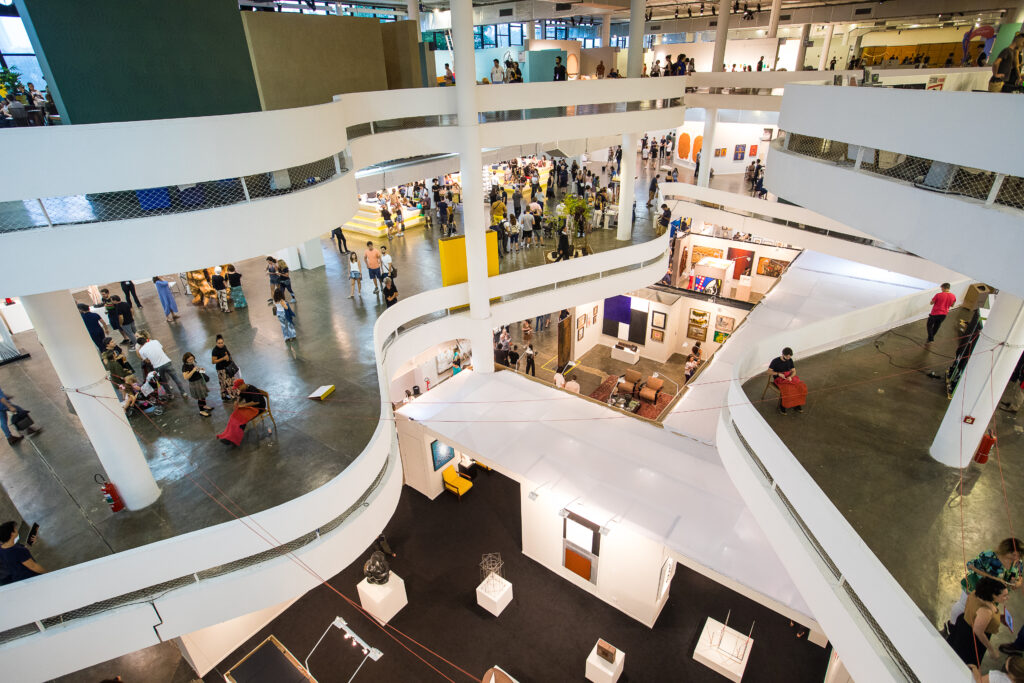
During one of the SP-Arte fairs, they invited artists to propose performances. I had been talking to my gallery, Vermelho, at the time about setting up the work, but I didn’t know who to do it with. Then they introduced me to a really nice guy called Gustavo Silvestre, who has a project called Ponto Firme (Firm Point), which works with knitting and crochet techniques in some of São Paulo’s prisons. Gustavo agreed and added another layer. The fair lasted five days and during those five days we joined two structures on the sides of the São Paulo Biennial hall that were connected to each other, except that in this case they didn’t have to be cylindrical, it was just a plane. The length of the wire was the size of the perimeter of Niemeyer’s building. Volunteers from the project worked there as people who give the workshops, or do the workshops, as well as former prisoners who were being re-socialised. Thanks to the collaboration, I ended up reaching all the layers I was trying to reach: there’s a poetic aspect, there’s a technical aspect, there’s a partnership aspect, and there’s an aspect that isn’t exoticism, but is, in a way, inclusion, re-socialisation in society. Nobody knew about the ex-convicts, I’m telling you that for the first time. It was something that was very important to me, very important to Gustavo, but we didn’t feel the need to explore it publicly, because we know that it could be distorted in a manner that was very harmful and damaging to those individuals.
Drawing, carving, cooking, walking, embroidery, are, in a way, practices that return to the body. Meditative practices that contribute to mental tranquillity. Gustavo’s project is certainly very important, not only for perhaps offering a livelihood, as many become artisans, but above all as a place to recover self-esteem, identity, and healthy mental practices.
To close, I’d like to ask you to share a challenge or difficulty that you see in your artistic career.
I work in culture and education, two areas that, over the last ten years at least, have suffered severe violence, while at the same time developing curious and very interesting resources to deal with these scenarios. I think my current discomfort comes from how we can create a more sustainable process of life to multiply this place of construction of subjectivity and imagination, which is somehow integrated into everyday economic life. I don’t know the answer to that. Because at the moment it depends a lot on incentives from institutions. At the same time, I’m not going to wait for them to act. So today, my greatest difficulty, despite living a very privileged life, is being able to maintain the places where these encounters, these relationships can exist. Colleges and universities are suffering a lot, regardless of whether they’re places that seem to be guaranteed because they’re middle class or upper middle class. And my biggest fear is that, at some point, reality will impose itself in such a way that I’ll give up, because this is an athletic job, not for a 100 metre runner, but for a marathon runner. I hope that if we talk in five years’ time, I’ll be able to give you another answer, telling you that it’s all over and that we resisted.
Interview conducted on 5th June 2024 remotely via Zoom.
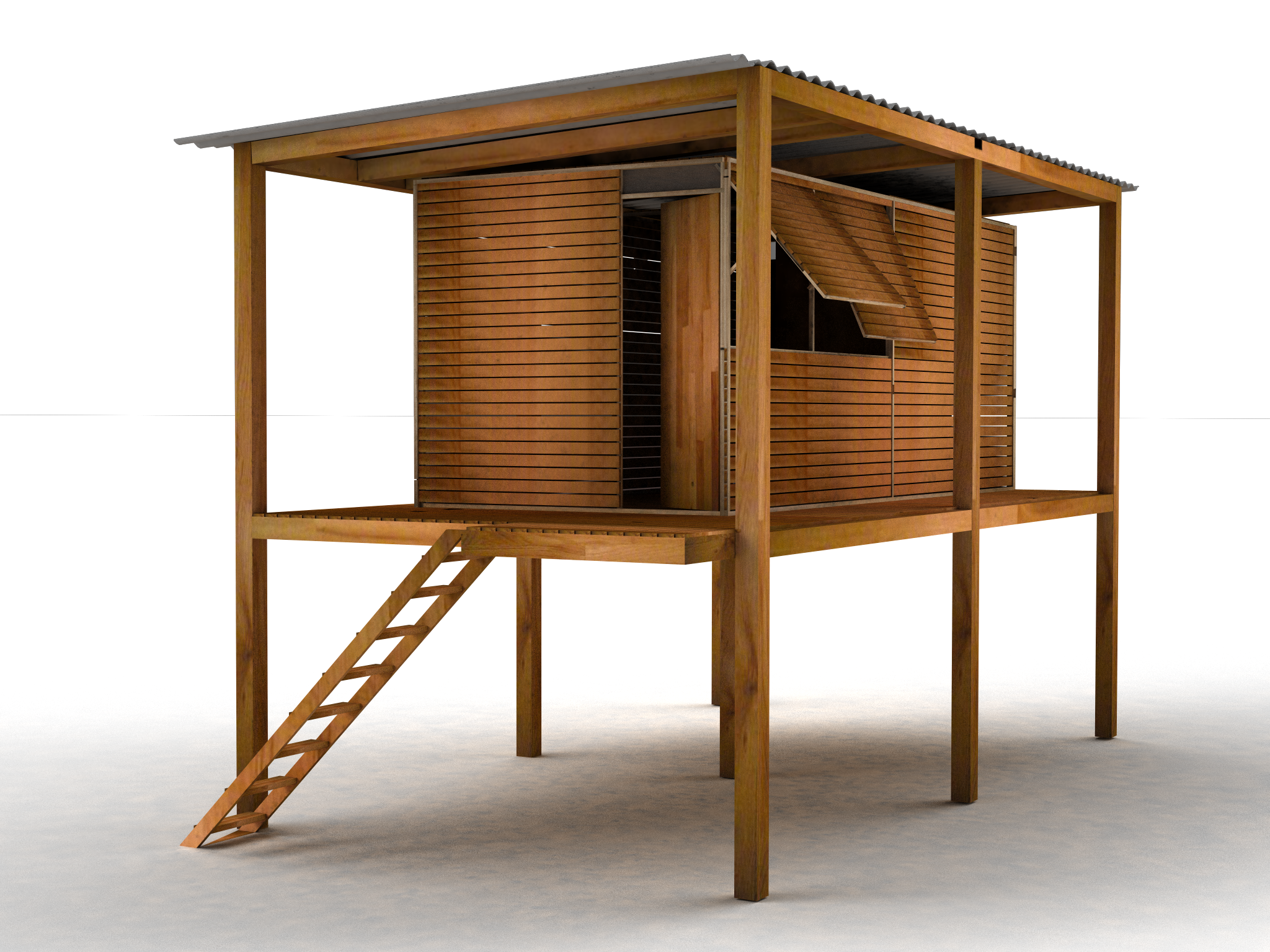
Boxwood, MDF, cardboard
50 × 70 × 40 cm
2013
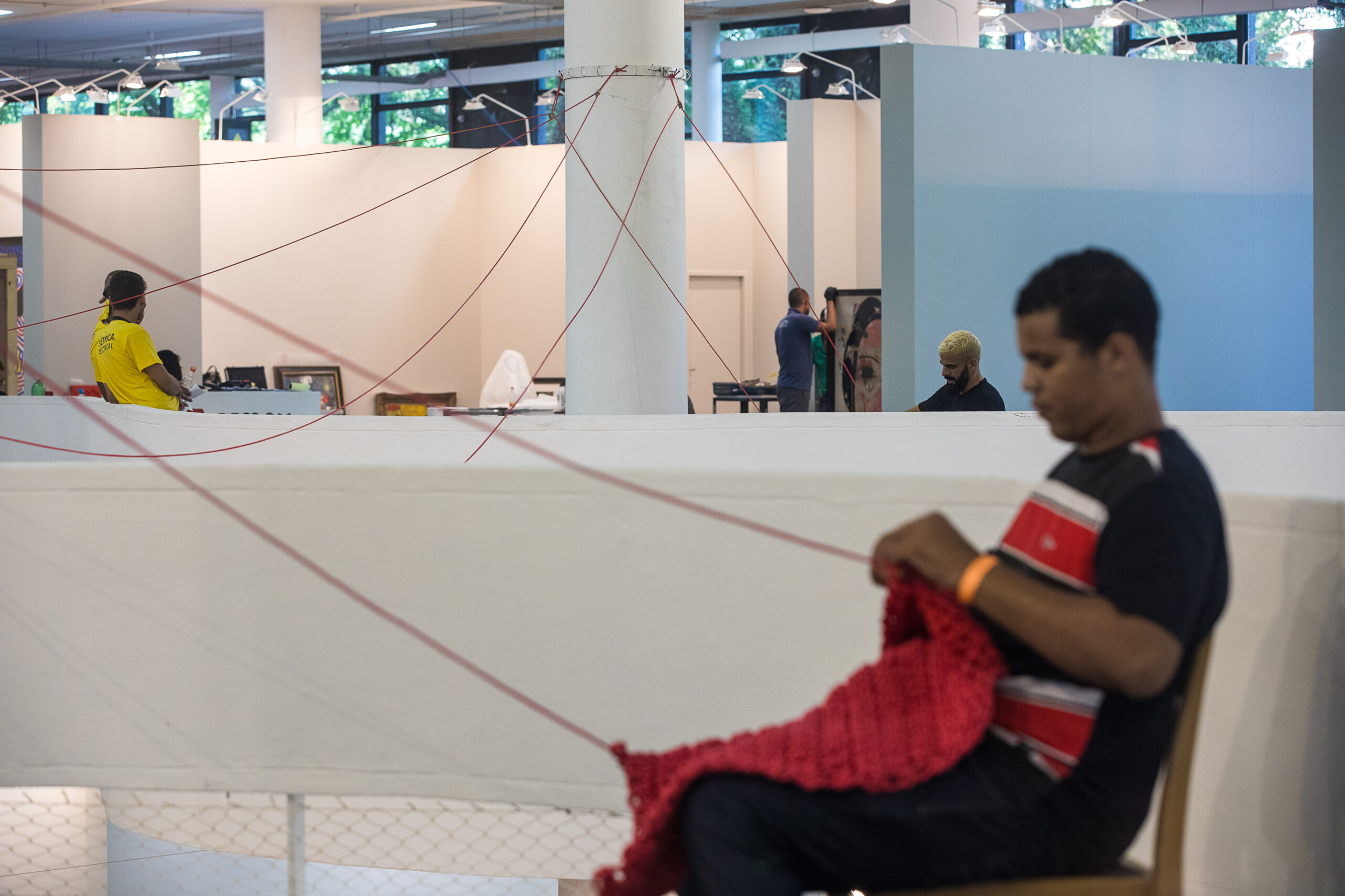
6 mm red cotton rope, pulleys and chairs
2015–2019
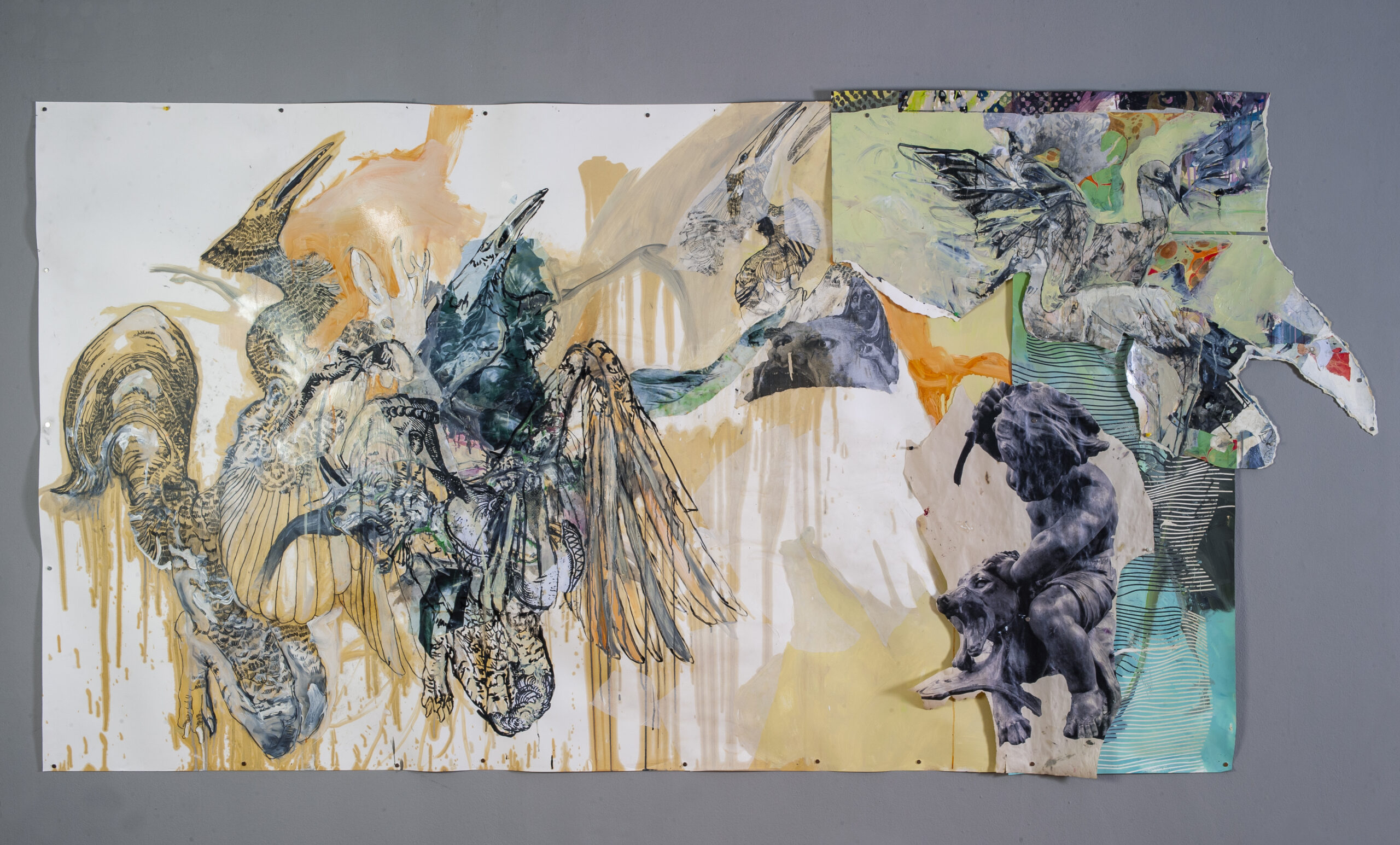
Collage and oil on paper
| 152 × 300 cm
2024
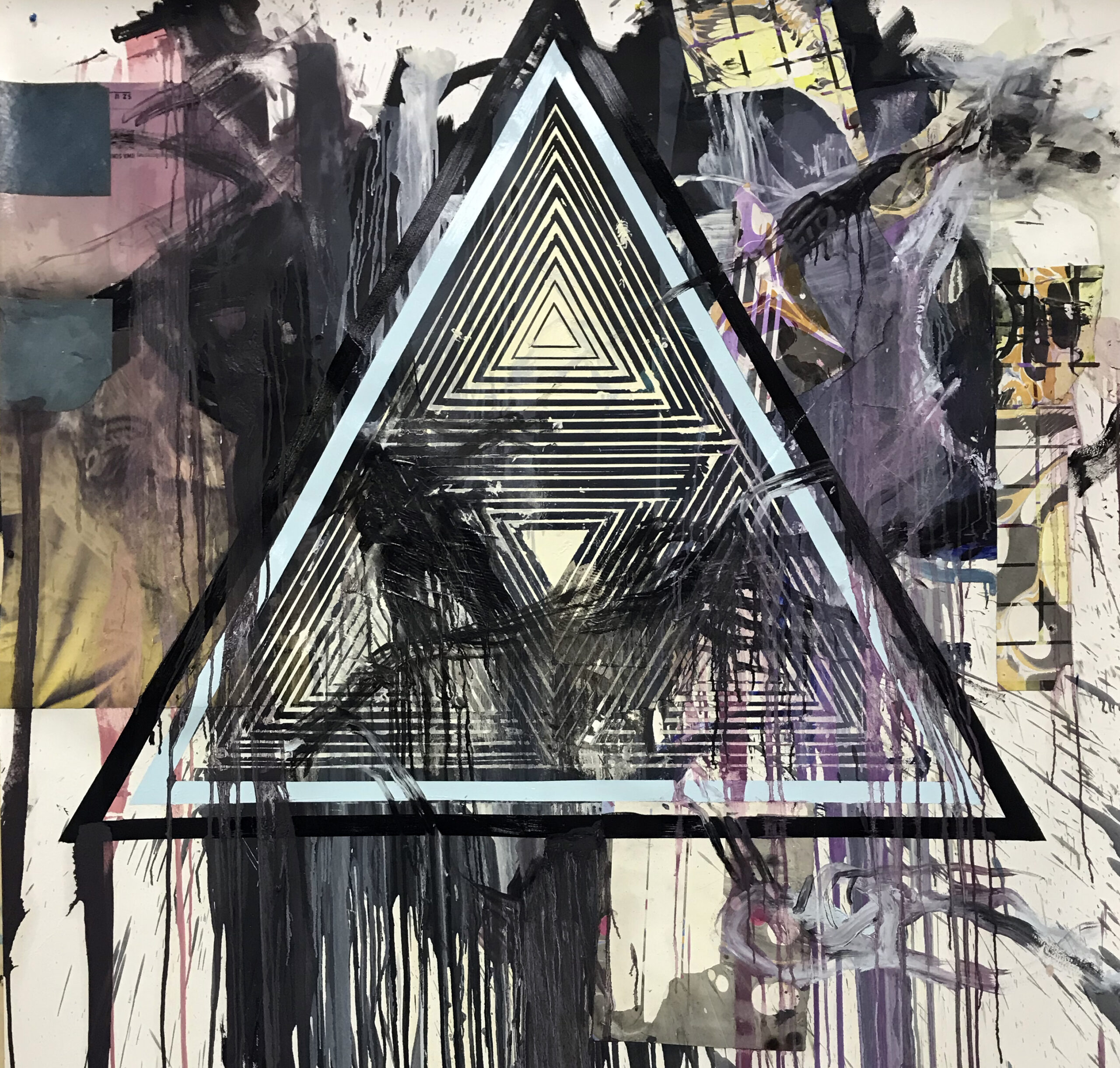
Marbling, collage and oil on paper
| 142 × 142 cm
2020–21
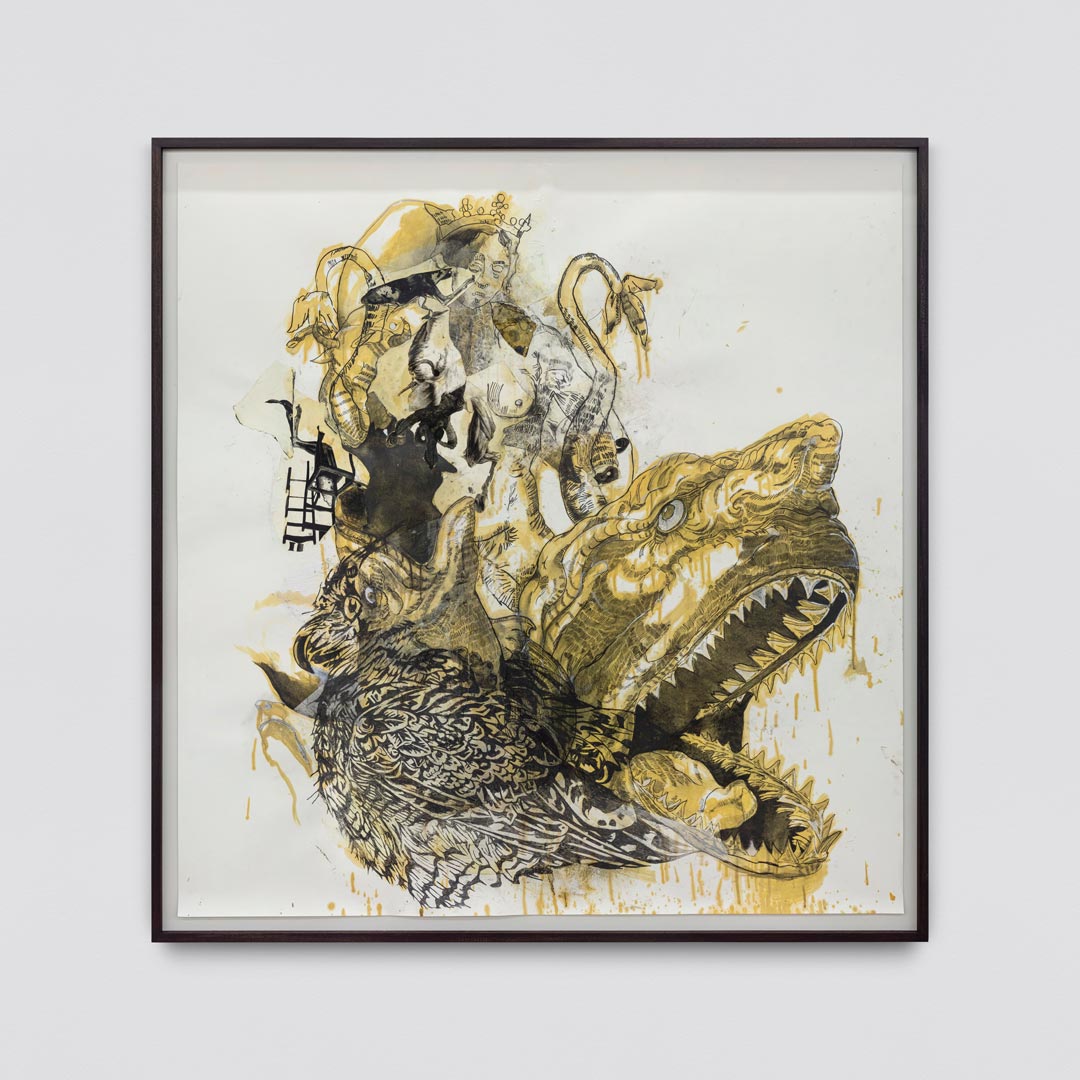
Graphite, linseed oil and collage on paper
| 157 × 152 cm
2022