

Vivian Caccuri
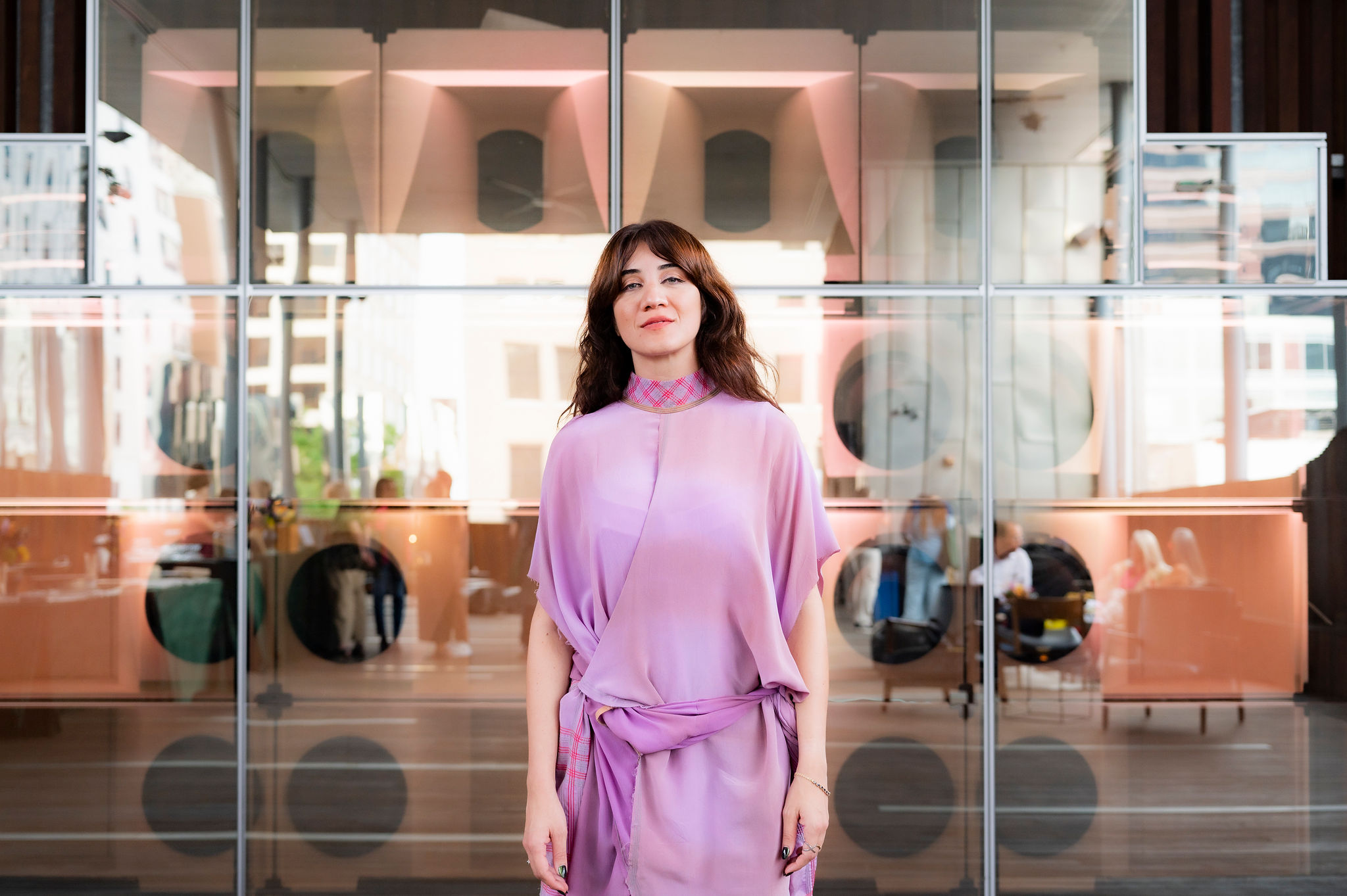
Vivian Caccuri (São Paulo, 1986) is an artist whose work explores sound as a central element. In her works, this component goes beyond hearing, connecting to visual aspects such as the vibration of candles that occurs in response to bass frequencies, or the interaction with surfaces, which creates visual effects such as moiré. Her works traverse installation, drawing, and performance, combining sensory experimentation with narratives that explore the political and cultural impact of sound. In the interview, the artist reflects on how sound is controlled and negotiated in different contexts, how cultural factors shape her perceptions, and how the interactions between sound, space, and the body influences her creative approach. Check it out:
Firstly, I’d like to thank you for taking part in the interview. I’d like to start by asking you to introduce yourself, with any information you think is relevant, thinking of an audience that doesn’t yet know about your artistic practice.
My name is Vivian Caccuri. I’m from São Paulo but I’ve lived in Rio de Janeiro for many years. I work with different materials, but always related to music and sound. Not necessarily all my works have sound, but in general they talk about something you can hear.
Did you study sonography or art? What was your training like?
I studied both. I have a degree in fine arts, a master’s in music, and I was also a visiting researcher at an American university, studying music and technology, so I have a background that includes both. I also work on soundtracks with Thiago Lanis, for which I have a company that exists in parallel to the other things I do. We also work with music for audiovisuals, so I can work on both fronts – I can compose music, I can play music. If I started out as a visual artist, it was in drawing, which was the first thing I remember doing with great pleasure and concentration. I started with drawing but, with having so many musicians in my family I quickly started collecting music, becoming interested in instruments and, later on, raves, when I was in my teens. In the past, I thought I had to choose one of the two, but I simply know that I want to do both and I dedicate my life to bringing these two domains together in one practice.
Do you also make pieces that are just the sound part, or are they always combined with installation?
There’s no rule, so yes, I’ve done work that’s all sound. But it happens very rarely. When it does happen, it’s usually because I can’t get to the venue, so only the sound is sent. The last time this happened, everything was done through the intermediary of the Brazilian Embassy in India. The work consisted of some modified loops that I made from a Gilberto Gil song called “Gaivota.”
In this case, for example, was it in a room, and were headphones used?
No, I prefer anything else but that – you can even play it on a little radio, but please don’t put a headset on me. I’m radically against headphones, which go over the heads of hundreds of people and are often of dubious quality. The only demand I generally make is not to have headphones.
I’d like to ask you to talk a bit about the work, The Weeping Dancer (2022).
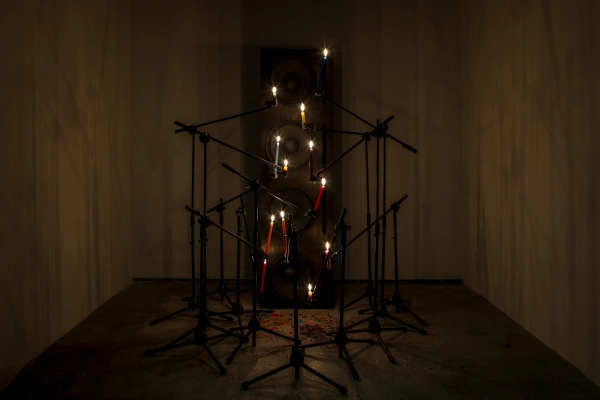
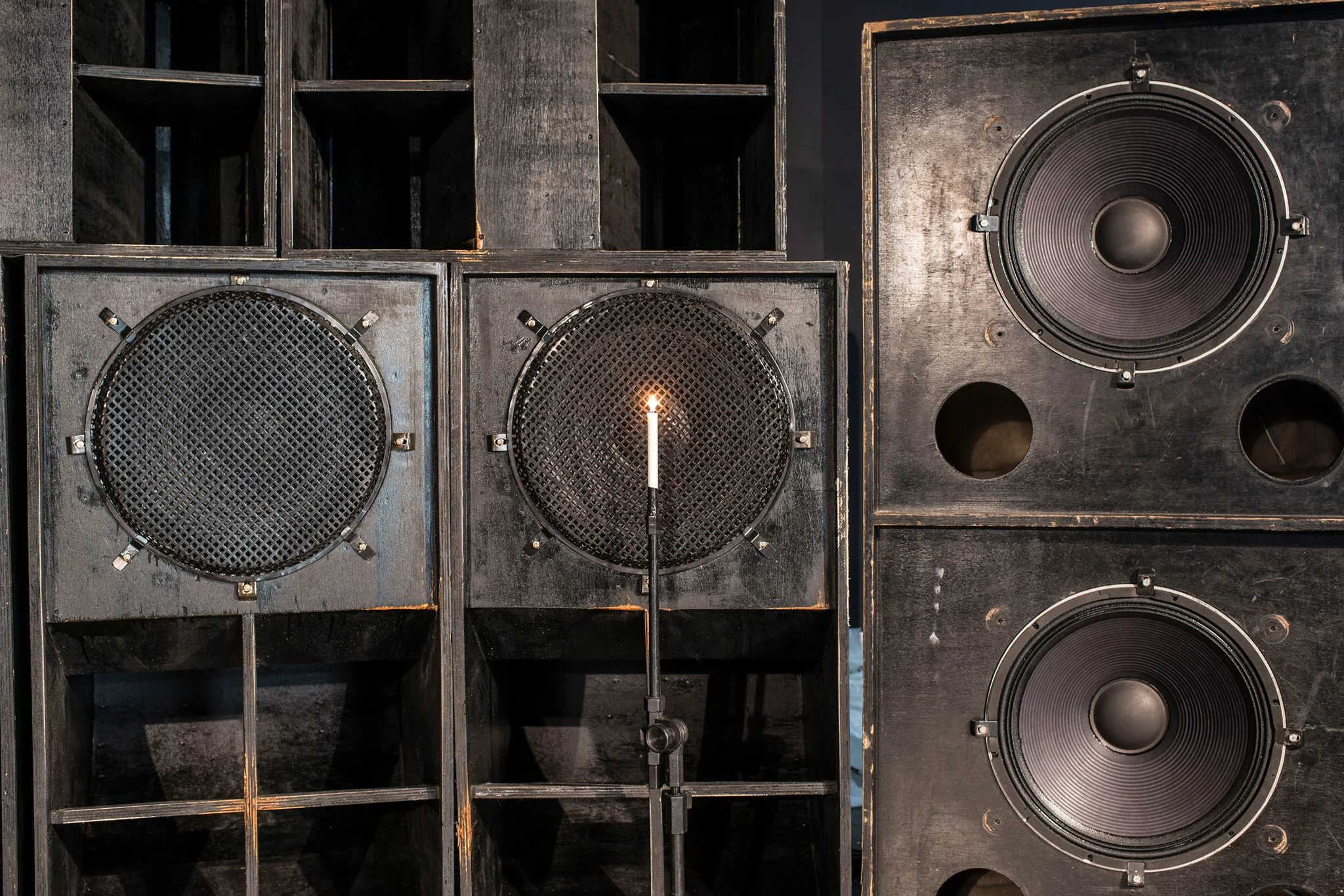
This work is a sound sculpture made up of bass speakers, called subwoofers. The lowest frequencies of sound are the ones with the biggest waves. These are waves that move the air, that make materials shake or vibrate. So rarely, with a high-pitched sound, can you hold the table and feel a strong vibration like a low-pitched sound. I discovered this by simply placing a candle in front of the speaker, which made the flame dance along with the music. The flame vibrates, it has shapes, it transforms, and it’s pulsating and dancing along with the music, and that’s what gave rise to the name Weeping Dancer.
And how does it work? Are the candles replaced? Is it an installation maintained for the duration of the exhibition?
They are replenished. Some types of candle last longer, others less. I suggest my favourites, so that the institution also understands that the work requires logistics and, therefore, daily care. I think Weeping Dancer contains a very strong image – the fire together with the loudspeakers – and this is something that the public generally likes a lot, but it’s difficult to get an invitation from a museum that would agree to exhibit the work, even though it was one of the main works that got me into the 2016 Bienal in São Paulo.
Can you tell us a bit about the work, Vessel Body (2022), which was exhibited at the New Museum in New York in 2023?
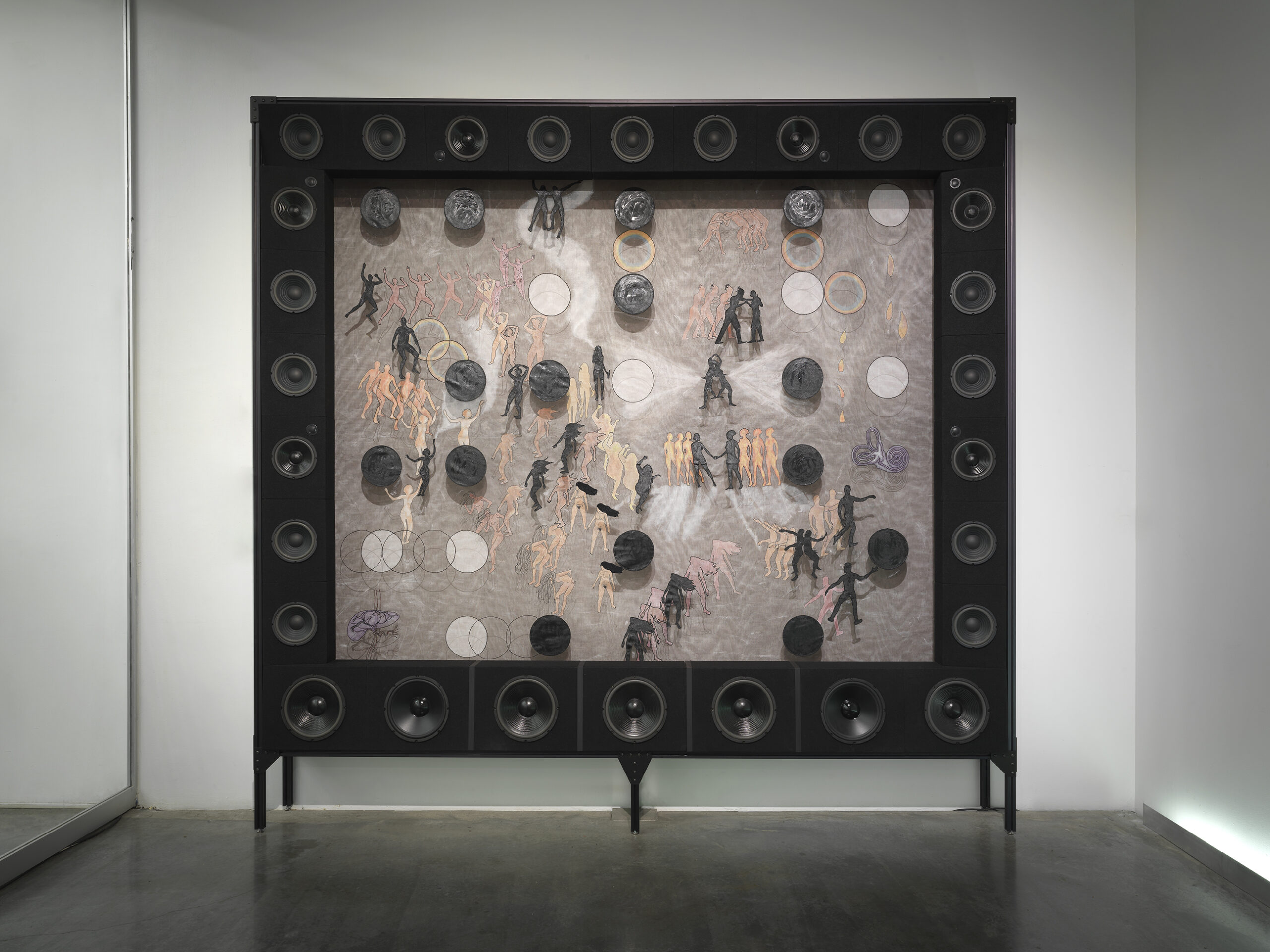
This was a work that brought together the two worlds of my practice: the visual and the sonic. Vessel Body is a large frame built with loudspeakers to a design that I planned, using car speakers. Inside this sound frame, there was embroidery work done on translucent mosquito netting, which is one of the materials I work with the most. The embroidery was based on photographed scenes from parties I’ve given in my studio. Most of the embroidered figures are people I know, but I always transform their body and appearance. It’s not a type of drawing that wants you to identify who the person is. I’m more interested in how these dancing bodies show new gestures: it’s a body that isn’t so framed by etiquette, normality, day-to-day life, everyday life.
Na noite, o corpo adquire outra forma, principalmente quando ele está dançando. Então, isso me interessa, porque também conta sobre o som, que é o som que faz esses corpos saírem desse frame de um corpo produtivo, pragmático.
(Translation: At night, the body takes on a different form, especially when it’s dancing. This interests me, because it also tells us about sound, which is the sound that makes these bodies break out of this frame of a productive, pragmatic body.) In the exhibition room there were two Vessels that had these embroideries, one facing the other, and a soundtrack I made was playing there. I recorded sounds from my own body – my lungs, my viscera, my heart – with a digital stethoscope and edited them, finding the best sounds from these recordings. I edited a lot and went on to make techno using these sounds. Instead of using Hi-Hat, which is electronic, I replaced it with a sound that came from my body. It became a dancing sound, because it’s a question of substitution, but at the same time it was comfortable – I think that would be the word – because they are sounds that come from organic noises.
I think that many artists who work with audio in contemporary art start from a process of experimentation, not from a process of research into music, into theory. So it’s interesting that you say that these two practices are already well combined in your artistic practice.
It’s just that I rarely “tour” another medium. For example, I have very few videos, and I don’t exhibit videos very often. It’s rare for me to work in a medium that I haven’t mastered, because I like to be able to be inventive, tactile, and spontaneous, which is more difficult with a medium that I don’t know technically. I’d say that sound is not a choice for me, it’s my way of life. I put myself in situations where I meet people who have music as their motive. The people I most enjoy socialising with work with it, and dedicate themselves to it. I collect instruments, I collect a lot of music, so I work with sound because it’s the life I live. It’s different from trying to make a piece of work to experiment with another medium and see what comes of it. Sound is already so naturalised in my daily life that I don’t encounter a technical barrier caused by profound ignorance. Obviously, I’m far from knowing everything about sound, but I have the means to learn new techniques more easily than, for example, with 3D animation. I’d spend days doing the simplest things in 3D animation.
What’s the process like working with drawing?
Drawing was my first medium – I’ve always loved drawing. I recently had an exhibition at Galeria Millan [Exhibition “Invisible Hand”, on show from 6 April to 4 May 2024 in São Paulo] of drawings on paper. I felt a different kind of fulfilment in that exhibition. I felt I was showing something more intimate about my production, because each thing on paper is a trace of my gesture and my gaze. I had forgotten this intimate joy of drawing, since embroidery doesn’t necessarily provoke the same sensation. I drew people, life models, and people at parties in my studio, as well as stages, lights, and sound waves. At the same time, all my embroidered works, whether abstract or figurative, are based on my own drawings, but it’s very different to treat the drawing on paper like an embroidery. The embroidered designs in the Sonograma series are abstract and made from sound spectrograms, my attempt to create a landscape for a specific sound. To create them, I make recordings with a tape recorder, or even a mobile phone, and open this file in software that shows me the “sound spots,” called spectrograms. It looks a bit like an ultrasound recording. These contours and lines of sound are what I use to draw and paint the embroidery canvas, in an enlarged size. The result is somewhat mysterious, as the canvas is quite transparent and the colours are slightly washed out.
And the mosquito netting has a certain movement – maybe near a speaker it vibrates a bit. Is that on purpose?
Two overlapping screens create an effect called moiré, in which circular graphics appear and disappear as you walk towards or around the screen. As you walk, the warp and weft changes angles and this creates the vibration. This was done intentionally many times, especially in the New Museum, where a lot of moiré was used, because I think that this, together with the sound, creates an interesting vibration in the space.
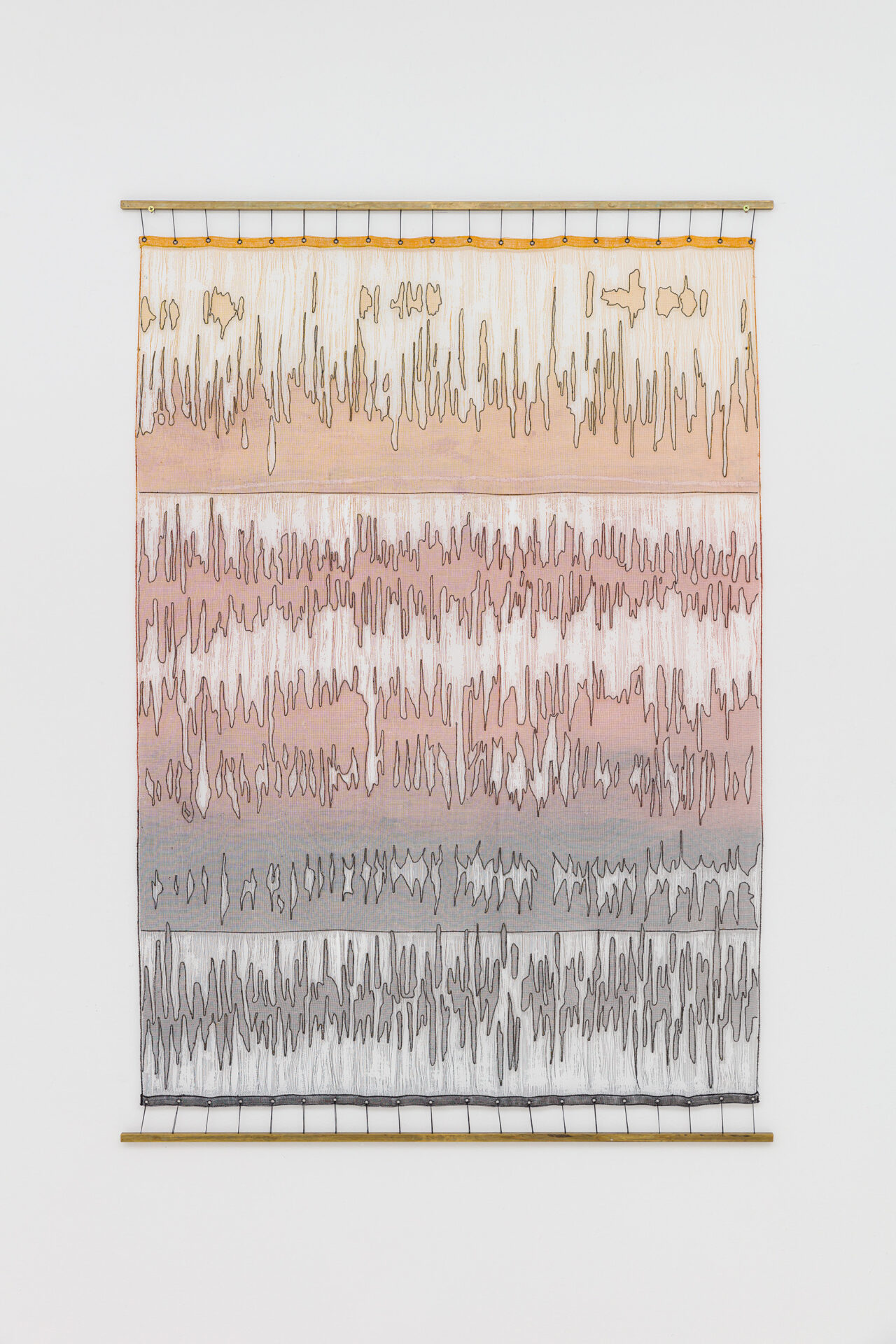
Foto: Ana Pigosso
And has your practice always developed simultaneously through installations and drawings? Or was there some kind of order, perhaps, within your career?
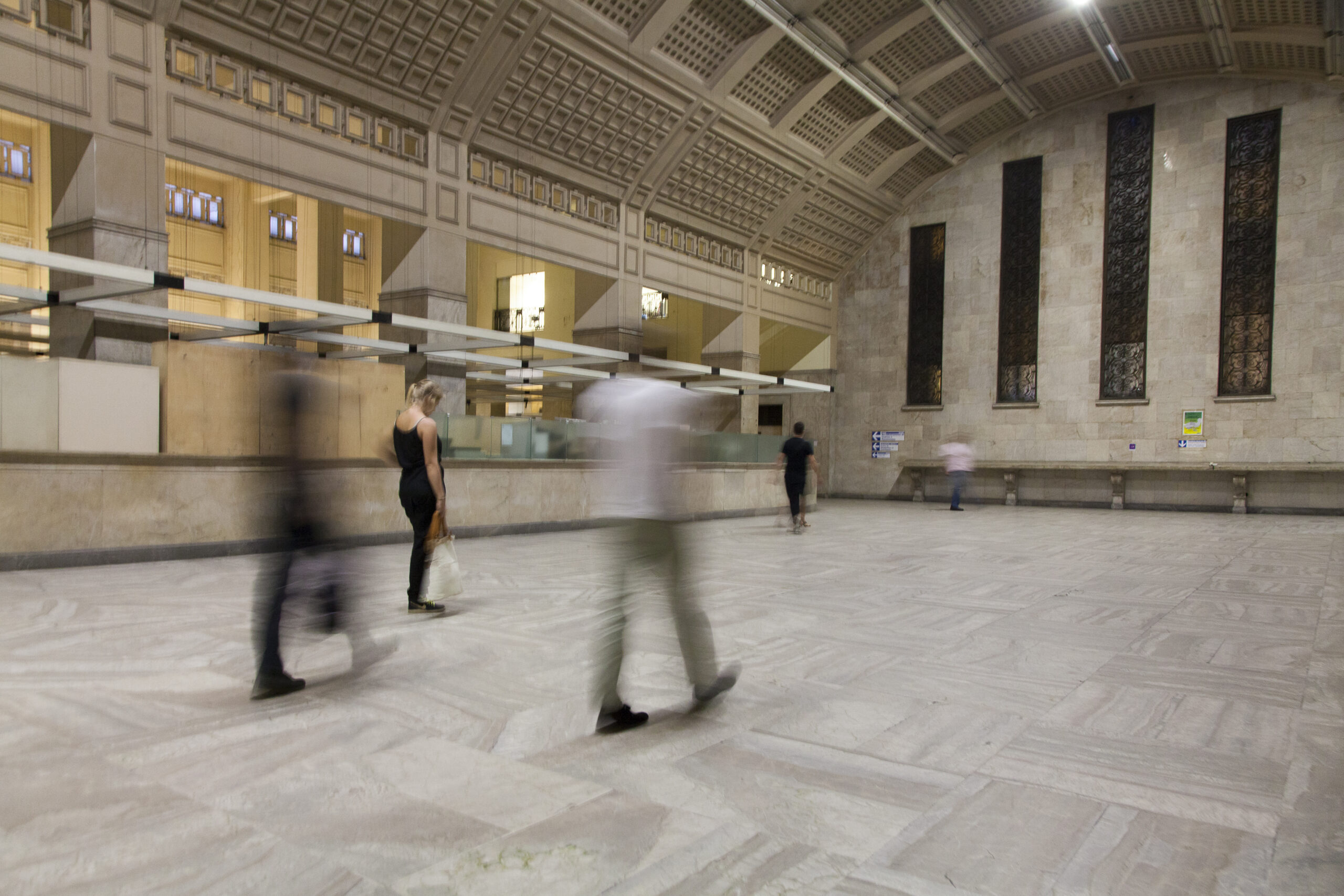
The backbone of these works on canvas, and of some sound works, lies in a performance of mine called Silent Walk (2012-2015), which took place 40 times in various cities in Brazil, Latin America, and Europe. Me and 12 other people walked for eight hours in silence on a route I had pre-prepared. Nothing could be said or communicated between people during the entire journey. I’ve visited many places this way, in silence. In Rio, I’ve entered many buildings; the helipad of the BNDES (National Bank for Economic and Social Development), Dilma’s room at the BNDES, the cloister of the São Bento monastery in São Paulo. Getting into many of these places required some laborious negotiation. For those taking part in the performance and just following the path I had drawn beforehand, the experience became a little surreal: you were on the street and, out of nowhere, you entered an unknown place, a door opened, another, into a corridor and, without any warning, you arrived at a chapel that had been locked for years. It was about this kind of discovery of spaces and new qualities of silence. During these walks, I found and collected a lot of things, a lot of materials, including the mosquito net and the protective screen that have been used for many years in my work. A mini-documentary was even made by Deutsche Welle about when I found these screens during the planning of one of these walks. In addition, I proposed a lot of performances within this performance, so during the walk, there were some actions, by me, other artists or musicians. It was very beautiful because there were people who were processing intimate things during the performance that I had no idea about. I’ve walked with mourners, people who were going through difficult times, and that silence ended up taking on the various qualities and colours of a collective. Also, walking in silence with ten people attracts a lot of attention. I’d never realised that. It was work that I stopped doing when the 2013 protests began in Brazil, a time when it became increasingly difficult to enter spaces because buildings were afraid of black blocs, of terrorism. There was a fear at that moment and it started to become very complicated to do the work. And I think the space with the public really changed after 2013. In addition, I was already very focused on installations, on other performances, so it was a work that ended naturally, in 2015 or so. I really want to do it again, and a lot of people ask me to. At the time, I had a Facebook page where I organised all the walks, so I still have a record of everyone who took part. Some people took part in three, four, five walks. It was almost like a club. But I’m dying to do it again. One day, maybe I will, but it’ll have to be something really special.
Did the walks always last eight hours, or did they vary a lot?
Sometimes they went on for a while, but they always finished with a dinner planned to mark the end of the walk. At the dinner, people could talk again. Some people never spoke again. It was very good to end up like this, because we exchanged our impressions and, during these dinners, I began to dismantle various fixed ideas I had. For example, when I read these people’s faces during the performance, they didn’t have much expression and I often thought they were extremely annoyed, or hated everything. At the dinner I discovered that they were loving it, but their faces wouldn’t let me read what was going on. It was during these performances that I stopped thinking that facial expressions mean something deeper than just a facial expression. It doesn’t indicate much, especially when you’re not talking. Anyway, there were so many observations about myself, about people’s bodies, about public space, about architecture, about silence and power. Dilma’s room, for example, was huge and extremely quiet. There are team meeting rooms, private meetings, state secret rooms, all of which are totally sealed so you couldn’t hear a sound outside. The BNDES is in the noisiest centre of Rio – there’s everything going on in that block, everything. Then you don’t hear anything inside the room, and so you understand that silence and power are linked. It’s not for nothing that people say “they want to silence me,” because the act of silencing implies that an individual, or an institution, has more power than a certain person, to the point of silencing them. But it’s one thing to say this in internet activism, in comments on posts, and another thing to see physical structures built to control sound, verbal content, and what is heard. It was at that moment that I began to understand more about the political side of the work of the silent walk; that sound, architecture, and sound equipment, say a lot about who can make the sound, who can listen to the sound, who controls the content, who controls the listening space. It’s no coincidence that every work that has sound has to be discussed and negotiated with the museum where I’m going to exhibit it so that it can be heard in the way I had imagined, or close to it, because adaptations are always necessary. I’m not interested in creating a work that will neutralise, and get in the way of, other works in a group exhibition, but I also want my work to be heard in the most powerful way. As a result, it’s always a negotiation. The acoustic space contains various politics that are not as objective as the politics of the visual, the concrete, what is built and tangible.
As a curator, there is always a negotiation around works that involve sound, since the sound can be heard from other parts of the exhibition and end up influencing how the public thinks about, and perceives, other works in the space. Is this a common situation in exhibitions and something you can negotiate?
Eu acho que tudo parte das origens da concepção do trabalho. Porque, se a concepção já tem uma natureza autoritária, e o artista exige o trabalho totalmente onipotente, isso não é um trabalho de arte que valeria defender. Então, eu tento partir de concepções que podem se encaixar numa diversidade de situações. É bem diferente da música, por exemplo, porque, quando a música não é ouvida de uma forma isolada e atenta, ela se torna plano de fundo do espaço, por exemplo, a trilha sonora dos ambientes comerciais. Agora, a ideia para um trabalho sonoro – pelo menos as minhas – é nunca pensar no som como um plano de fundo, mas como a coisa principal.
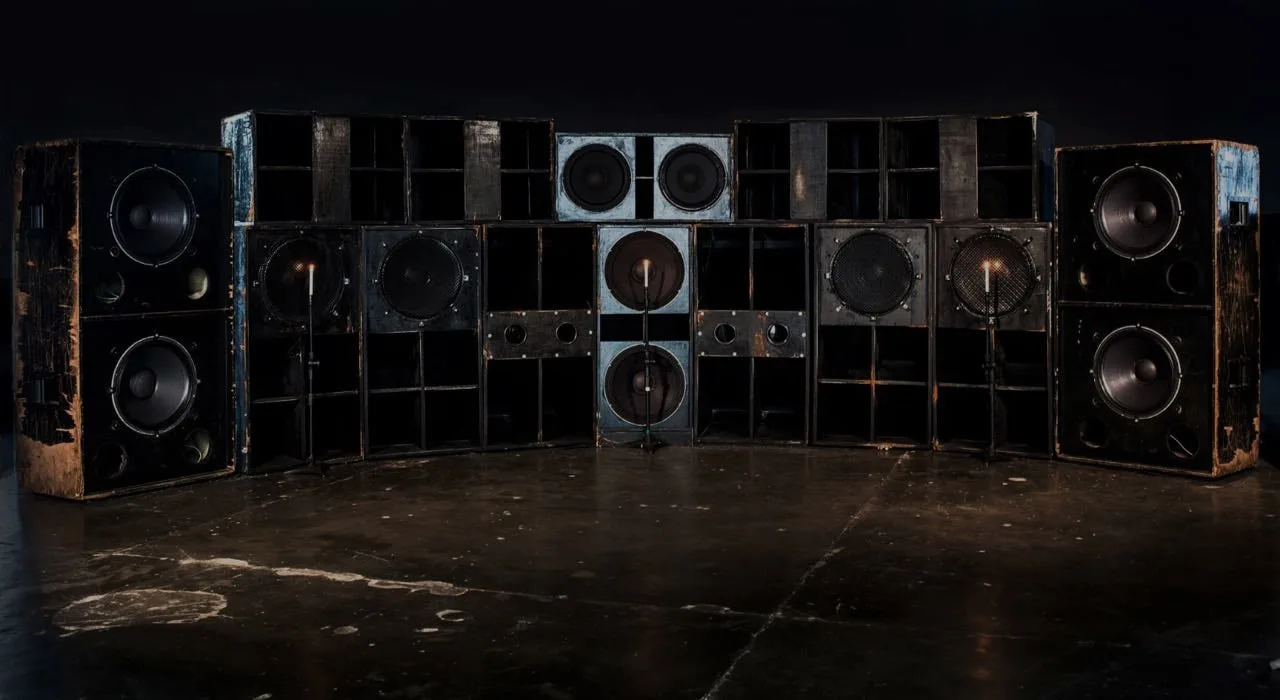
(Translation: I think it all starts from the origins of the conception of the work. If the conception is already of an authoritarian nature, and the artist demands the work to be totally omnipotent, that’s not an artwork worth defending. So I try to start from conceptions that can fit into a variety of situations. It’s very different from music, for example, because when music isn’t listened to in an isolated and attentive way, it becomes the background to the space, like the soundtrack of commercial environments, for example. Now, the idea for sound work – at least mine – is never to think of sound as background, but as the main thing.) I’ll give you a practical example. My work TabomBass (2016), for the Bienal de São Paulo, was a large sound system handmade by a São Paulo sound system collective, whose parties I’ve been attending for many years, and all the speakers were subwoofers. For most of the duration of the exhibition, one of my compositions was played which was silent. Why? It was silent because it was dealing with such low frequencies that they weren’t understood as musical tones. As a result, it just moved the candles. The sails were dancing with that wind and that pulse. You heard the pulsation, but you didn’t hear musical tones, without being disruptive in the extreme. The same installation also included some musical soundtracks that had to be heard really loud. The sound was so powerful and full-bodied that I suggested playing it once an hour. The guides already knew that the installation would have the same dynamics as a church bell. A few minutes before this loud section rang out, the guides would prepare the group they were accompanying and talk a little about the work, until they heard it ringing loudly. So, for me, this was a good artistic decision, because I was able to take into account a choreography of the space, and also a choreography of the guides and the public. Thinking in the choreographic form is very interesting, although it’s not always possible to do it that way. Sometimes the restrictions are much greater. For example, I also made a glass sound system that was on the High Line in Chelsea, New York. It could only be played twice a day. Even so, there were a lot of complaints from the neighbours, even when at very low volume. Although it’s a very important place to be, as an artist, I don’t think it was such a successful job. The sculpture, the concrete part of the work, was very well done in the United States, but the performative part of the work didn’t work. In each environment, each city, these things change. It’s amazing how we like loud, powerful sound, and that same volume that we find marvellous, enveloping, would, in a Scandinavian country be considered unbearable, loud, uncomfortable. You have to be able to deal with this cultural data and also try to escape from established standards.
I’d say sound is, in a superficial way, universal. Language is something else. Tell us more about these differences you’ve observed in your work in various locations.
I have to talk about this through the mosquito work. Through the sound of mosquitoes I learnt a lot about the perception of certain sounds. The mosquito (especially the Aedes aegypti) is a very successful species, because it only lives where there are humans, and there are billions of us. The mosquito follows the logic of the human population, which is why there is such an absurd volume of insects. That’s why the mosquito is hated all over the world, and the sound it makes is also really hated. I started asking people in different places, “Why do you hate the sound of mosquitoes?” and the most objective and immediate answer is: “because I know I’m going to get bitten and I know it can transmit diseases.” It’s also the most practical and superficial answer. I wasn’t happy with this answer and I tried to understand, to read about, the sound of the mosquito in indigenous cultures, traditional African cultures. There are several fables about the mosquito talking to you in a dream, just as you’re going to sleep, and this sound has a certain discourse. I found this very interesting and it was also important to understand the history of the Aedes aegypti mosquito in Brazil, as it is not native. Does the mosquito remind us of something we don’t want to remember? For example, in Rio de Janeiro, the highest places were reserved for the rich, because they were the places where there were the fewest mosquitoes. All the rest of the population, all the people with lower purchasing power, were close to the mosquitoes. There’s something about colonisation in that mosquito sound, a memory. So I began to invest in these stories. I showed the mosquito, for example, in India, in a work that was a mosquito net with several mosquitoes embroidered on it. I told a story about mosquitoes meeting men, and in the room I played a female mosquito sound in order to attract the male mosquitoes into the room. Talking to the Indians about mosquitoes was like talking to any Brazilian – it was the same problem as theirs. Their mosquitoes are huge too, just like ours, and it where we were was a tropical region. As a result, I was talking about something that didn’t need much translation. Now, when I showed a work that was a sound installation with a mixture of mosquito sounds and church organ sounds in Sweden, the mosquito had another meaning, it was a sound that, for the Swedes, reminded them of summer, because there are mosquitoes in Sweden, but they are seasonal mosquitoes and they don’t have diseases like the Zika virus, or dengue fever. That same sound was reminiscent of other things, but it was also reminiscent of high temperatures. Therefore, when I talk about mosquitoes I’m talking about heat, I’m not talking about cold. It was useful to use the mosquito to understand how the body in different cultures reacts to this sound. In Brazil, we’re afraid of this sound because we have the story of yellow fever, which killed hundreds of thousands of people, we have Zika, dengue fever – these stories are told and lived. In Sweden, there’s no such thing as tropical diseases, so the moment of heat is remembered when you hear the sound of the mosquito. Sound is linked in a very visceral way to these experiences of the sensation of being in space, in the world, in temperature.
A practical question, but I’m curious. Was it easy to replicate the mosquito noise to attract other mosquitoes?
Yes, there are many things that you can do exactly as a scientist recommends and that don’t work out because of N factors. I don’t know to what extent I attracted mosquitoes, because the place already had a lot of mosquitoes, so it’s not like I was trying to attract mosquitoes from another neighbourhood. They even used my embroidered screen to land on. It was a mosquito airport there, and in the room I installed some ultraviolet lights that they usually like. It was an environment for people and mosquitoes to live in. India is full of mosquitoes because it’s very humid. When I want to do something to better understand the biology of the mosquito, how it reacts, what it can do, I have several colleagues who are researchers, and laboratory directors who study mosquitoes. Butantan’s Entomology Department is like an informal partner of mine. Dr Flávia Virgilio is the head of the department. They’re super enthusiastic about my series of works on mosquitoes, and she’s happy to help me with many things, answer questions, send me a paper or suggest solutions. This means that when I talk about mosquitoes, I also end up involving this health/scientific aspect. It’s nice to have an in-depth understanding of what I’m talking about. She’s already helped me order a mosquito trap, and maybe at some point we’ll film a video with mosquitoes that are native to Brazil. They’re blue, so they’re beautiful, apart from anything else. To record the sound too, which, as far as Dr Flávia and I know, has never been recorded. It’s nice that sometimes it works to combine my interest with scientific interest. But it’s always very challenging.
To finish off, I’d like to ask you to talk a bit about Fragile Tritone (2020).
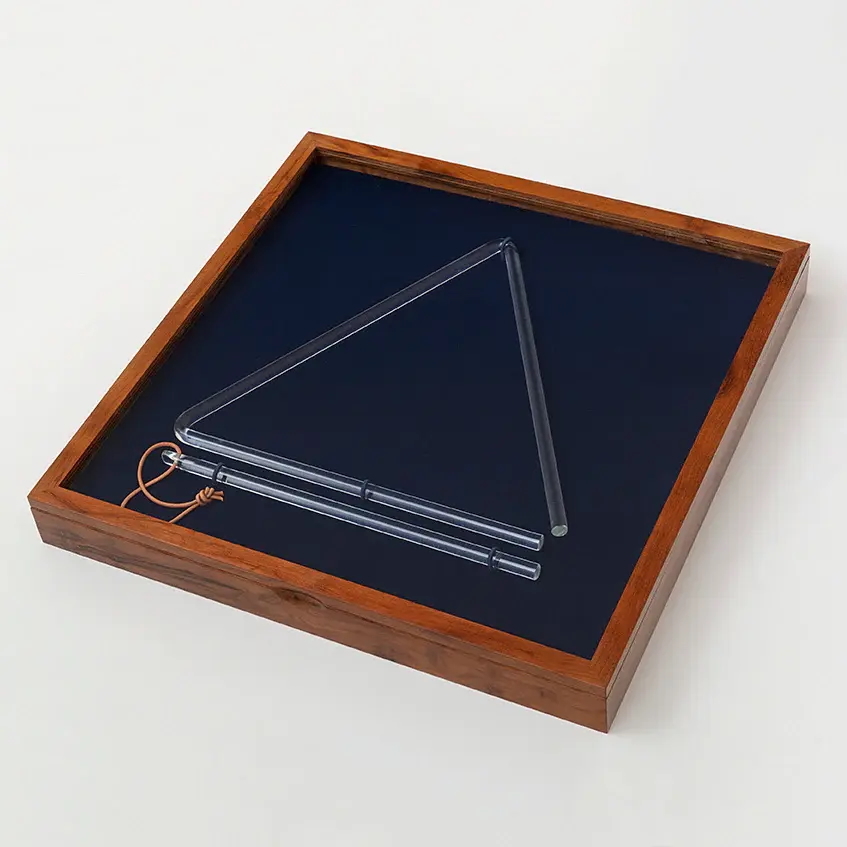
This work is a multiple made when I was thinking about the orchestral triangle. For me, the triangle is like a mosquito. It’s the most underrated instrument there is. In an orchestra, the person who plays the triangle is often mocked. It’s an instrument that’s often used to get you started playing other instruments, and it’s not uncommon to see it as just a detail. Then I discovered where the triangle came from, what it was, and how it evolved from an instrument that opened processions in Ancient Egypt. Then, it was the main instrument, like a religious bell. Now it has been reduced to a kind of folkloric, and somewhat naive, object. So I thought I’d start making things, environments or musical compositions, or installations, in which the triangle was the most important instrument. I did this at the Pinacoteca do Estado de São Paulo, where I occupied an entire room with a sculpture of triangles; there were hundreds of triangles from various different cultures in the shape of a triangle. During the same period, I was asked to do a multiple, and so I thought of a triangle that can’t be touched, which is why it has a more ethereal character, because it can’t be manipulated. I used the glass, those colours, that way of presenting it, to make a triangle that resembles the power it had thousands of years ago. Something that only a few people were allowed to touch, to give it back its majesty.
Interview conducted on 24 July 2024 remotely via Zoom.
Subwoofers, amplifiers, microphone stands, candles, timed playlist and mono audio
I 177 x 587 x 65 cm
2016
Subwoofers, amplifiers, microphone stands, candles, timed playlist and mono audio
I 177 x 587 x 65 cm
2016
Loudspeakers, amplifiers, microphone stands and coloured candles I 194 x 54 x 54 cm
2022
Mosquito netting, waxed cotton, cotton, acrylic resin and brass
147 × 103 × 3 cm
2023
Photo: Ana Pigossi
Performance
2012 & 2016
Mosquito netting, bitumen, cotton thread and polyester grosgrain
314.96 × 358.14 × 35.56 cm
2022
Glass, leather | 27 × 25 × 1 cm (triangle), 24 × 1 cm (beater)
2020