

Tales frey
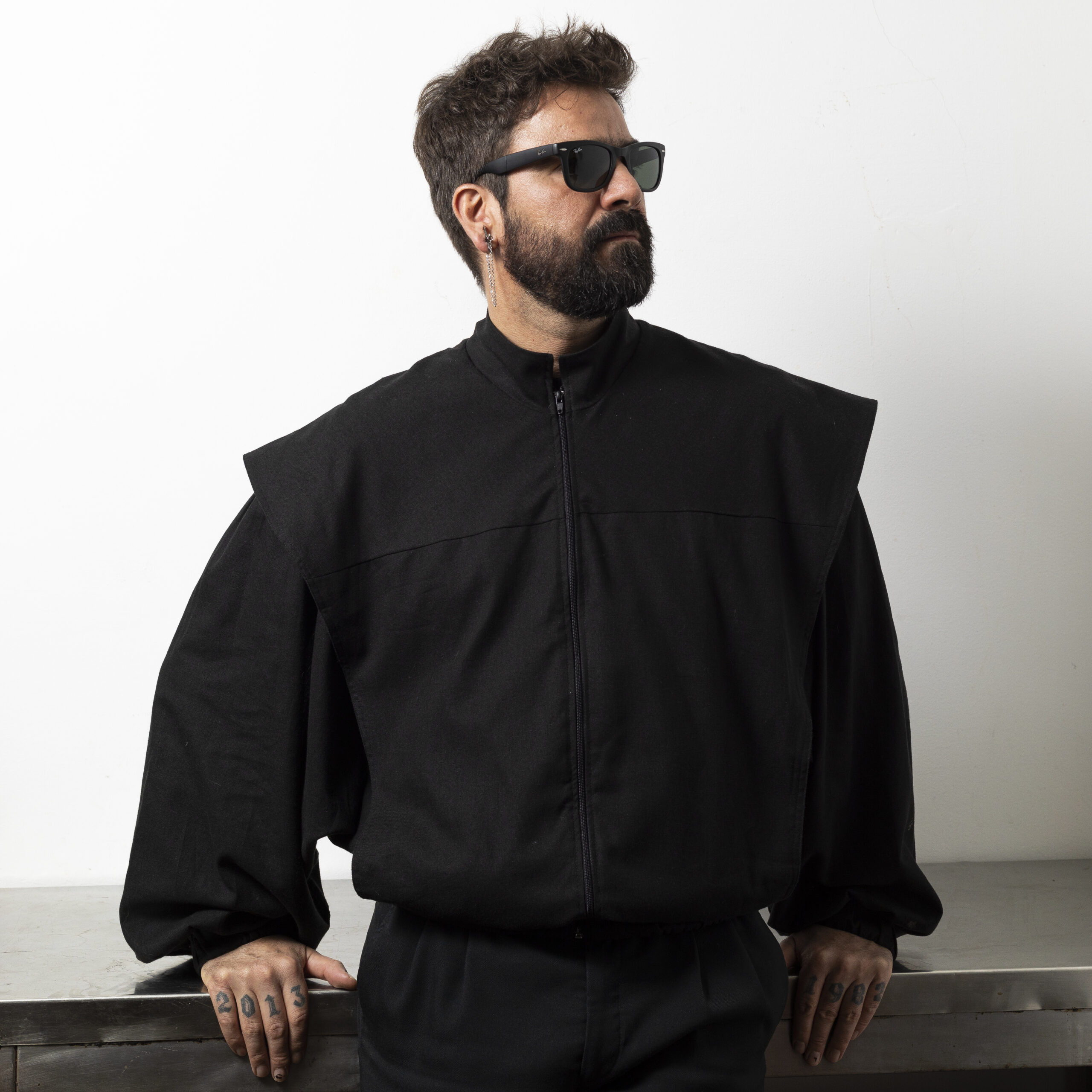
Tales Frey (Catanduva, 1982) is a transdisciplinary artist whose work challenges conventional norms about gender, the body, and space. His artistic journey began in the theater, where he explored various roles, from acting and directing to costume and set design. However, it was in performance that Frey found not only a means of expression, but also a platform for personal and social experimentation. In his performances, the body takes center stage, serving as a tool to question and challenge concepts of identity, gender, and bodily expression. In the interview, the artist explores the different ways of documenting his live performances, such as video art, photography, and art objects, and how his personal experiences have shaped his approach to the performing and visual arts. Check it out:
Tales, first of all, thank you very much for taking the time to talk to us. I’d like to ask you to introduce yourself, giving any information you think might be relevant to an audience that doesn’t yet know about your artistic practice.
My name is Tales Frey, I’m 41 years old, and I was born in the interior of São Paulo, in the north-west of the state, in a city called Catanduva. I left there very early to live with my father in São Paulo city and then moved to Rio de Janeiro, where I did my degree in theater directing at UFRJ (Federal University of Rio de Janeiro). Before then, my main means of artistic expression had been the performing arts, in the theater itself. Theater wasn’t a means of expression through which I fulfilled myself only by working as an actor or director, I also worked as a costume designer, as a set designer. I experimented with different roles. I started very early, at the age of 11, doing amateur theater, but even then, I was very attentive to all the stages of the creative process until a play was finished. Although I loved all the processes, I missed developing a completely authorial project, so I turned to theater directing in search of this possibility to create more authorial work.
At the same time, I also studied costume design, so I ended up developing skills in this area, which brought me into contact with other techniques, and even backstage work. Until 2008, my main means of expression was theater, but I already liked the language of performance. In 2002, I started experimenting with performance without having much idea of what this artistic genre was yet, without knowing the theory and history of performance. I began to understand what this artistic expression was, in the sense of knowing performance conceptually, when, in 2006, I became a student of Eleonora Fabião, who is a great reference in the field. At the time, I was very interested in performance, but back then it wasn’t earning me much financially, so in order to survive I worked in the theater and, with the money I earned, I created my own performance projects in parallel.
In 2008, I moved to Porto, Portugal, to do my master’s degree in Art Theory and Criticism at the Faculty of Fine Arts at the University of Porto. Then I ended up staying in the country for my PhD in Theater and Performance Studies, which I did at the University of Coimbra. To this day (2024) I live in the city of Porto, and I also keep my studio here. I work in the city, but not only here. I do various artistic residencies, present work in different places, and, in the end, I’m always in different contexts. However, I can say that there are two main contexts in which I’m often doing or producing something: for example, when I go to the state of São Paulo, the countryside is my refuge – it’s my parents’ house, where I have my things, I have my collection, space to work – while in the state capital, I have the gallery that represents me in Brazil, which is Verve. In Porto, I have my studio and my home. So these two places – the state of São Paulo and the city of Porto – are places I’m really always in.
As well as being an artist, I’m a professor at the University of Minho – an excellent public university in the north of Portugal – and this underlines the way I’ve always liked to work, combining theoretical research with artistic practice.
Thinking about performance, and the way your work also unfolds through video and the object, what is it like for you to negotiate between different elements that, we could argue, perhaps create different bodies of work?
Eu posso dizer que eu sou um artista transdisciplinar. Eu não tenho muitas técnicas específicas. Ou, melhor dizendo, eu posso até falar que eu sou um artista indisciplinado, porque eu trabalho sem, necessariamente, uma técnica. Então, como eu disse, o meu meio principal de expressão artística por muito tempo foi a performance e, sendo uma pessoa habilitada para fazer arte ao vivo, o que acaba acontecendo é que as minhas principais técnicas vêm das artes cênicas.
(Translation: I can say that I’m a transdisciplinary artist. I don’t have many specific techniques. Or, rather, I could even say that I’m an undisciplined artist, because I work without necessarily having a technique. As I said, my main means of artistic expression for a long time was performance and, as someone who is qualified to make live art, what ends up happening is that my main techniques come from the performing arts.)
I can also say that, having a background in art theory and criticism, I also have the technique to produce writing. Combining these two qualifications – writing and practice in the performing arts, so to speak – with the technical training I’ve acquired, this knowledge ended up unfolding in my daring to make creations that are supported by varied languages. For example, my first experiments in video and photography emerged from performance creations, due to the need to document ephemeral situations and live actions. I started to really open out my research in the presentation of work in the video and photography format from 2010 onwards, but I had been filming and photographing my actions since 2006 – I did this without thinking about the potential of that opening out as an autonomous work. In other words, I hadn’t yet thought of photography, video, and other documentation presented autonomously, as specific languages that already differed from the original performance.
My first materializations, which are more sculptural, objectual, also came from my creations in performance. The first objects I created were clothing, costumes that were used in performances. Then I realized that some of them had that autonomy I was talking about, that they could carry traces of the live actions and, at the same time, could also be exhibited independently, as distinct works.
Perhaps we could talk a little about the work Estar a par (2017). I think it touches on all these points. How did this work begin? From the object or the performance?
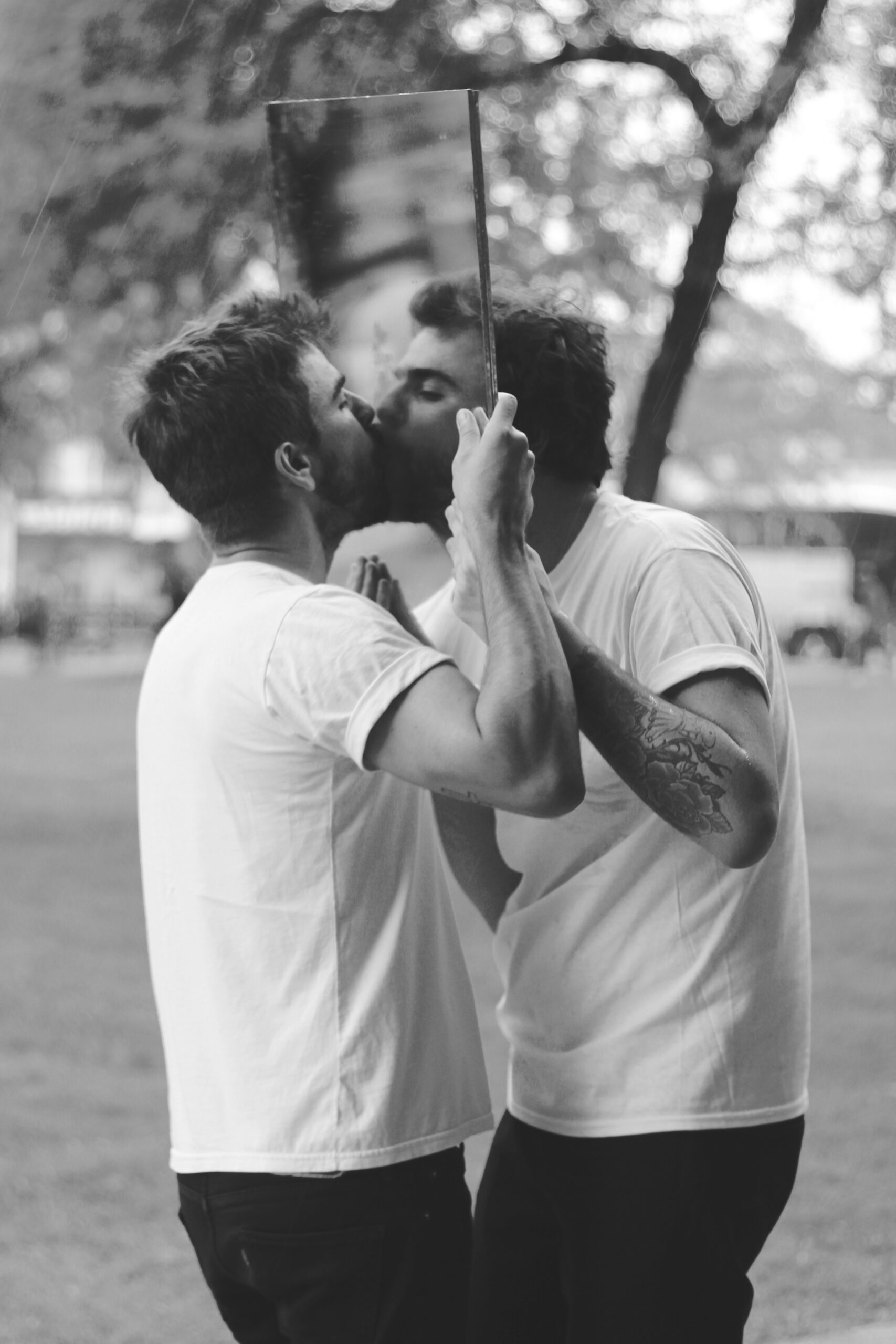
It’s curious how this work came about. In 2016, I was doing a performance at the Horas Perdidas Biennial in Monterrey, Mexico. I presented a performance piece that consisted of kissing a double-sided mirror for an hour, without interruption, with the participation of Hilda de Paulo, to whom I am married. This happened before her gender transition, so Hilda was publicly presented, in that specific situation, as having a cisgender male identity. People’s interpretation of this situation – two people kissing the same mirror – was that it was composed of a homosexual relationship.
In this durational action, which I entitled Be (on) You (2016), the mirror subverted the kiss and proposed a narcissistic game, because there was no kiss in which our lips touched; we were intermediated by the mirror. While I was performing this action with Hilda, I began to realize that my body was very well adjusted to hers.
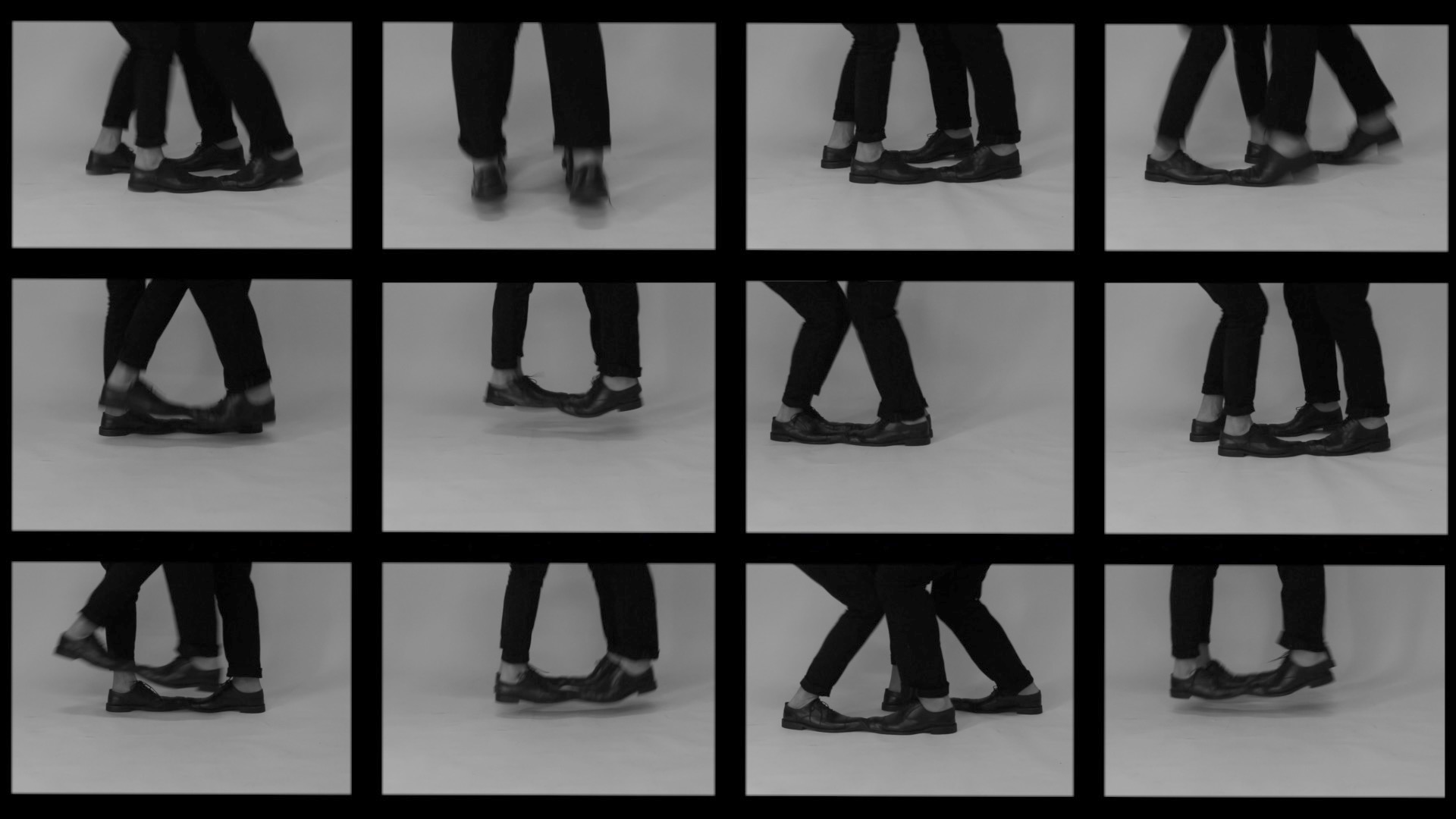
Prior to the Mexico action, I had created a similar action in other contexts, but under a different title, because it encompassed very different meanings to Be (on) You. The costumes were changed according to certain social conventions, so in the previous proposal, F2M2M2F (2015), I wore high heels, clothes and accessories that are considered “feminine”, and I didn’t have the collaboration of Hilda de Paulo but rather that of some other partner, and they were always much smaller than me and wore so-called “masculine” clothes, in other words, flat shoes. The movement in the case of F2M2M2F was more disjointed due to the different heights, emphasized by the shoes worn by each performer, and there wasn’t as much familiarity between me and the partner who performed the action with me, at least not in the same way as I have with Hilda, to whom I’ve now been married for 16 years. When I did the Be (on) You performance with Hilda, everything became much simpler and, due to the ease generated by the harmony of our bodies, and by the use of men’s costumes (flat shoes and such), we suddenly began to move through the space with our feet almost connected at the tips; we were in total harmony.
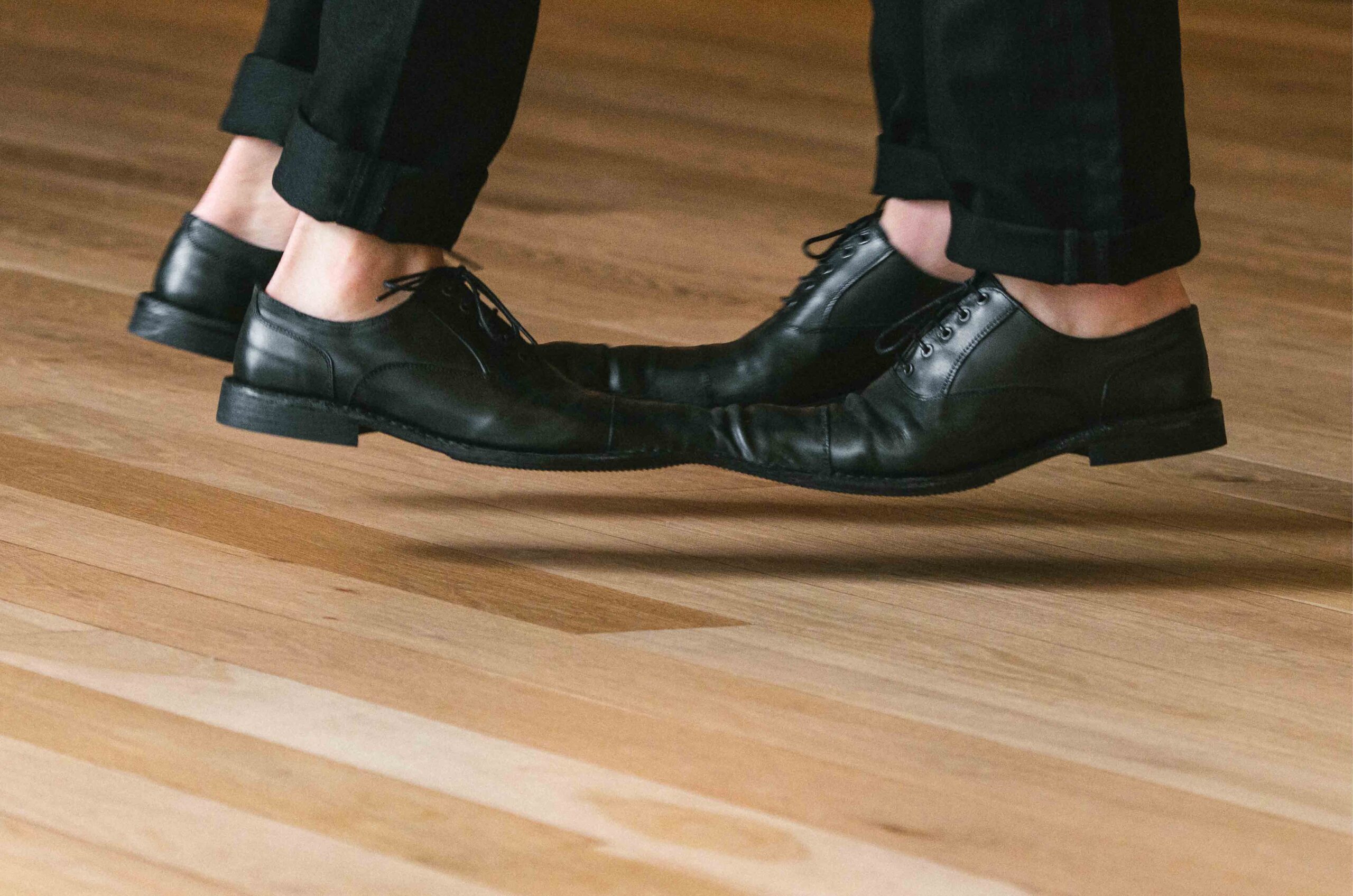
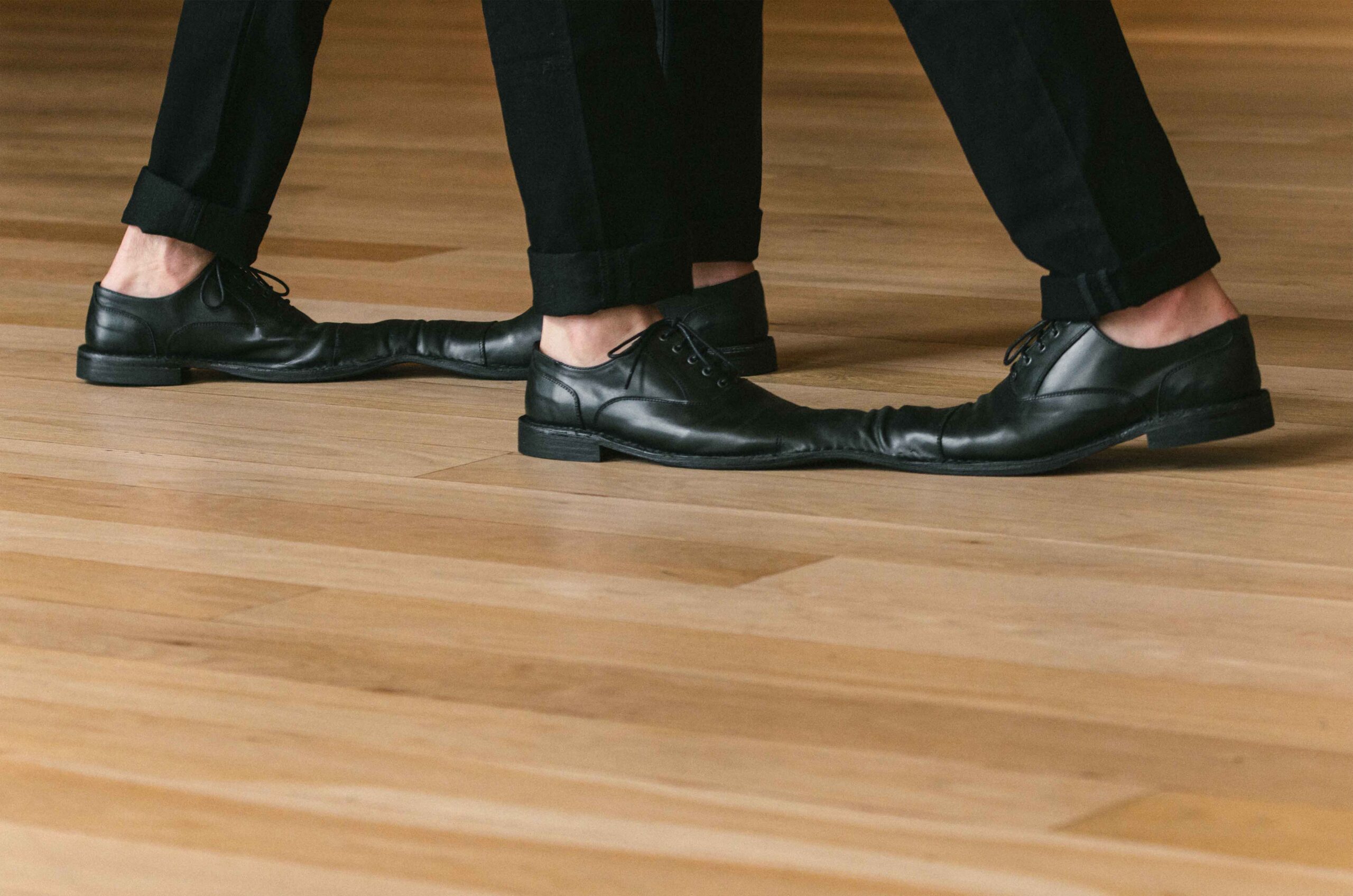
That’s when I had the insight to create shoes that would force our bodies to be joined together. At that moment, while I was performing for an hour, I conceived a work in a very intuitive way. Estar a par is precisely the first object work I’ve created that can actually be presented independently of the performance. I can say that I initially designed the shoes for Estar a par to serve a performance, but the shoes were conceptualized during a performance that didn’t even have the shoes as fundamental elements.
The work emerged in 2017, and, from it, I was able to create a series of instruments on the theme of putting bodies together. The idea is to think about harmonizing differences, putting people, different singularities, together, to live through a challenging experience in which they have to harmonize in order for the situation to happen in the best possible way.
So this work started with the object, then turned into a performance and resulted in a video?
I designed the object not to be presented independently, but to serve a performance. Every time we did the action, the audience was fascinated by how easy it was for us to move around the space together and would ask me to wear the pair of shoes. Whenever it happened that the audience wanted to try on the pair of shoes, I had the idea of making it possible for them to use them. Because the shoe sizes are big, they fit many feet fit. It can be the case that they’re a bit tight or a bit wide. The feet of those who want to wear the shoes may not be perfectly adjusted, but the work itself can also carry another sign, since our bodies won’t necessarily be well-adjusted to all spaces. So, a new symbolic layer emerges from that same work.And the realization in video is because I’m a “documentation freak.” I like to document everything and then see if there is any potential to present it separately from the live work. I really enjoyed one of the first experiments I did with Hilda, which was in a car park. In that situation, a video emerged that I love, but then we developed such skill with the shoes that I expanded the work into various other formats. I present it as a photographic diptych, as a single photo in which I am with Hilda, and I also made two other videos of the action: a documentation of the presentation I made at the BienalSur in Buenos Aires, at MUNTREF, in 2019, and a video made in the studio – to which I gave the title Estar a par – Passo a passo (2019), where I present only the feet showing all (or almost all) the steps we discovered throughout the process. It’s important to mention that we always carry out the action without any prior rehearsal. Everything that is discovered happens continuously during each performance of this action. During the experiments, there was an accumulation of discovered steps, and this accumulation has all been summarized in Estar a par – Passo a passo, which is one of the many developments of the same work.
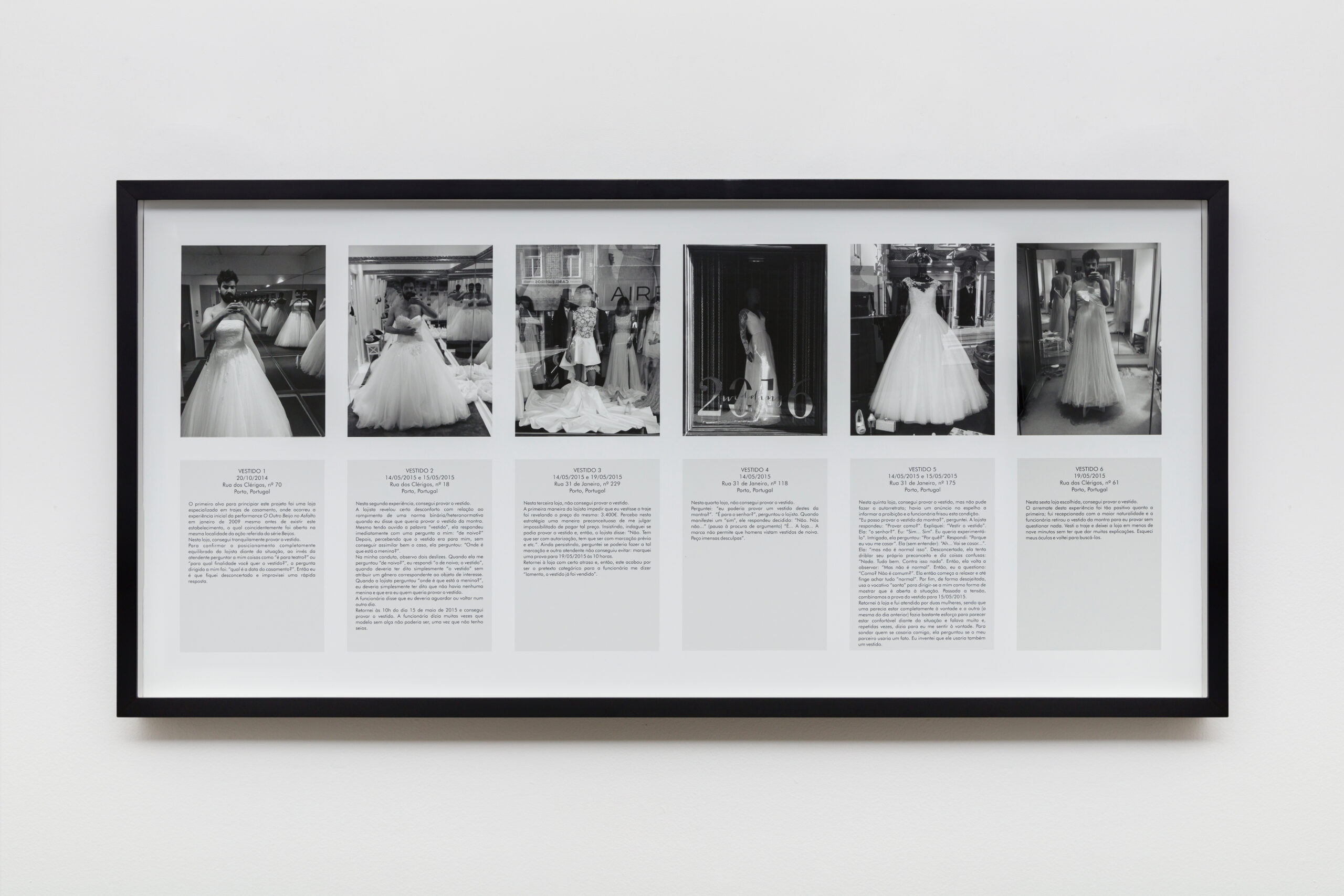
Going back a bit, you spoke about some of the mirror performances, in which you changed costumes, and I wanted to connect this with the work Vestido (2014), which is a little older.
The Dress is a very interesting piece of work that still resonates a lot in my projects. I started designing it in 2014, while visiting several wedding dress shops in the same street in Porto. I wanted to do something new, but I wasn’t sure what, so I decided to look for a new creative methodology. I behaved like someone who’s going on an anthropological experiment. I went to see if I could try on the dress in the window. The idea was to collect some information there that would inspire me to create a piece of work. I put a tape recorder in my pocket and asked to try it on. It was surprising, because the process taught me a lot, and my language was transformed with each experience. In the first shop, I went in and said: “Oh, I’d like to try on that dress.” Then the assistant said, “The groom’s?” and I said, “No, the bride’s.” I was automatically giving gender to an object (the dress). As a result, I realized that I couldn’t say “bride’s dress”, but “wedding dress.” I learned a lot of things in this process, and I was also positively surprised by how people never asked if I was looking for a dress for the theater or for any other artistic purpose. In the very first shop, the assistant only asked me the date of the wedding. I realized that everything was fine with her – she hadn’t created any obstacles. This showed me a society with a certain openness in that context, from 2014 to 2015. It was during this process that I realized that some shops might refuse. And if they did? What would I gain from documenting this experience? I decided to photograph the dress in the window, in case they didn’t allow me to try it on. When I was able to try it on, I made it a rule that I had to take a selfie wearing the dress. At the end of it all, the mechanism of the work was a compilation of the photographs with a synthetic narrative for each image that summarizes each experience.
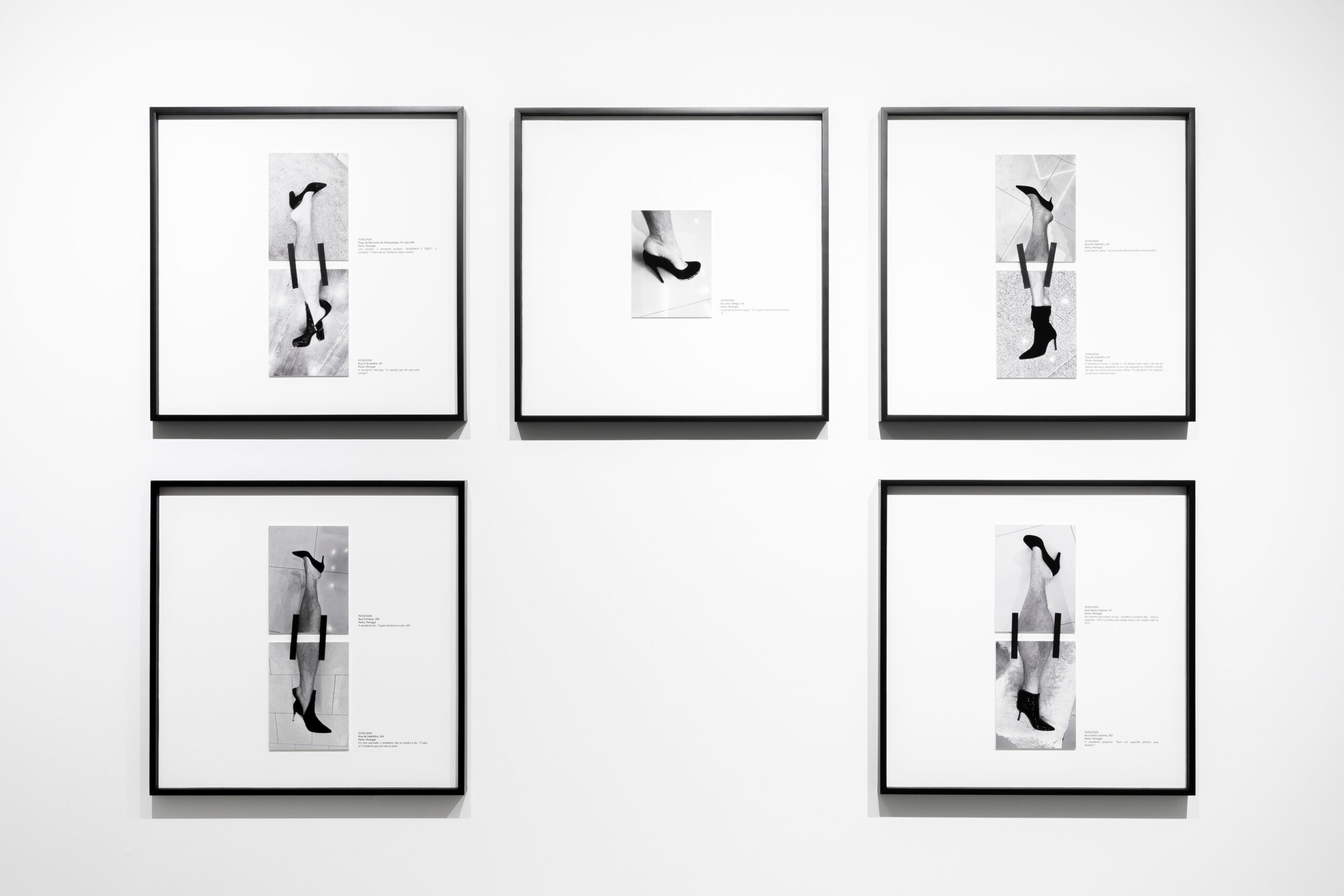
I’m now working on a new project, which consists of trying on high-heeled shoes. I go to specialized shops and often come across statements like: “women’s sizes go up to 39.” I hardly (I could say never) find heels in the shop window that fit my feet. I’ve realized that shoe fittings make even more sense than wedding dress fittings for such discussions, because I can usually actually wear wedding dresses that fit my body, but shoes I never can.
So this performance of the shoes is done with a similar process, going to the shop, asking for the number…
The process is similar, but the mechanism of this project, called Calçado (2024), ends up being aesthetically bolder, because it has a composition close to collage. In this case, I don’t take photos of shoes in shop windows, because people usually allow me to try them on, but the shoes never fit perfectly on my feet. The texts that recount my experiences are much more succinct and are almost always summarized by some absurd statement directed at me. In the composition, I gave it a different aesthetic treatment from the first project, which was simply a presentation of photographs and texts flanked by each other. In this second case, I actually thought about composing more hybrid bodies, connecting feet to form many strange pairs, as well as some solitary feet. In fact, this combination of legs and/or feet is something that recurs a lot in my aesthetic exercises.
I think there’s also a temporal aspect to the way we access shops and products. For example, if I wanted to buy a pair of women’s shoes today, I’d probably buy them online. Hearing you talk about going to the shop and asking for a number reminds me much more of my childhood. So there is this temporal recognition of how consumption happens, and how it has changed recently.
Yes, it’s less face-to-face. Our relationship with life in general is less face-to-face. I tend to like to see and touch. I very rarely buy things online, especially clothes, unless I really wanted shoes that fit, then I would look for specialized online shops. But this is a demonstration of how there is an exclusion for certain bodies in society, because a body that doesn’t fit a hegemonic standard can’t simply walk down a pavement and fall in love with a pair of shoes and want to buy them in the same way that bodies that meet the standards can. There is a differentiation that is explicit in this relationship, and it is this that I want to condemn.
How do you perceive this condemnation? It occurs on several levels. Do you see these exclusions only in terms of men and women, or also in terms of size and shape?
think it goes beyond male and female. It’s a body standard that has to meet capitalist demands, in the sense of the body’s construction. It’s not just about what we consume, but also how we construct our bodies. We are induced all the time to strive for thinness and to have a fit body. We are bombarded with information in search of this so-called “ideal” body. We realize this even in the kind of training that exists when we go to buy something and it doesn’t fit us. It’s already a way of making us understand what kind of body we should have. The capitalist way of working conditions us, trains us, and forces us, to conform to shapes that are already available, already given.
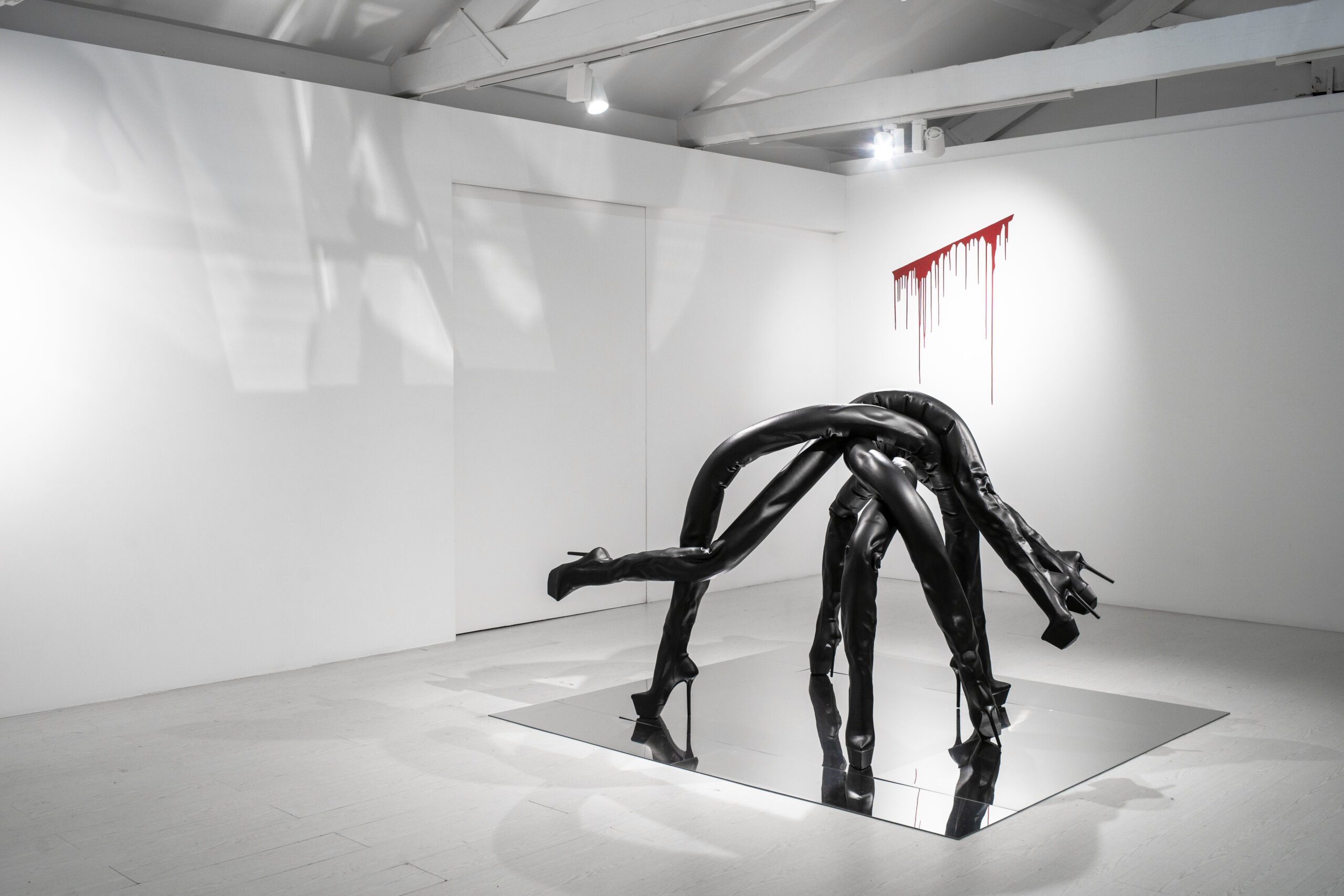
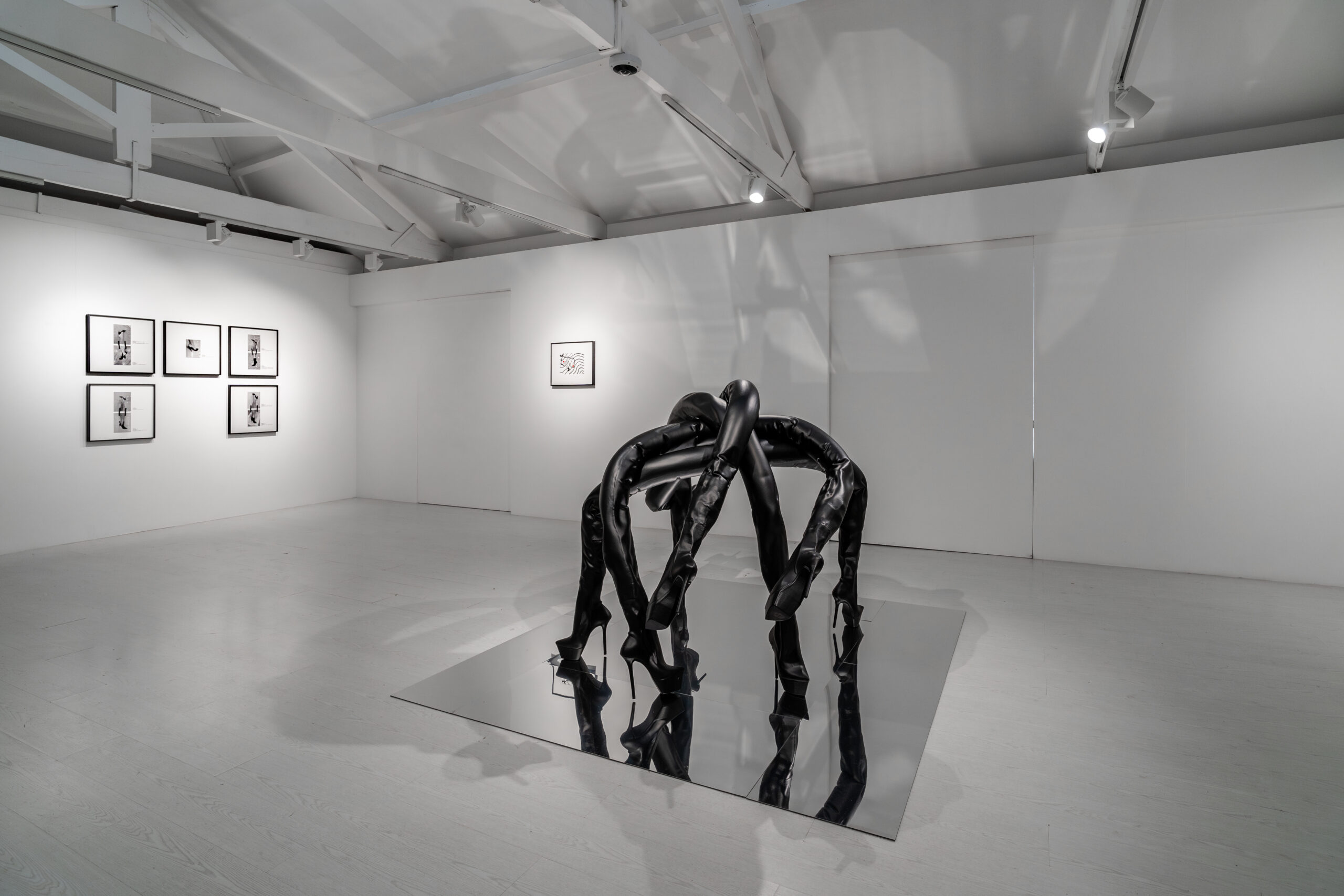
In fact, in this project in which I create relationships with shoes, I’m building a large-scale sculpture that I call Stiletto Dance (2024), something unprecedented in my practice, and which is in the process of being prepared for an exhibition that will open in April. [The exhibition opened at the Maus hábitos space in Porto, Portugal, and ran from 6 April until 11 May 2024].
This sculpture speaks, in a way, about an exclusion I experienced as a child. My mum owned a women’s gymnastics and dance academy between the 1980s and 1990s. I wanted to be part of that gym because I saw it as an art environment. My mum created dance choreographies, and I had her as an important reference. I saw women dancing and I wanted to belong there too. I also wanted to dance, to take part in the live performances, but I couldn’t because it was an exclusively female environment. I emphasize that my mother wasn’t as aware as she is today, but in that context she was reproducing what society was like. Gymnastics and dance centers were for women of a specific social class, thinking about cis, white, slim women. Today, the work my mum does in the field of physical education is completely inclusive, takes into account differences, includes all ages and genders beyond the binary. So it’s really nice to see how she’s changed for the better. At the same time, I realize how my childhood experience still resonates with me, whether it’s because of the inspiration my mother has always been to me (with her skills in costume design, dance choreography, music editing), or because of the exclusion I felt, and not just in the context I’ve described. This all ends up showing through in my creations in some way. And I express these reflections through art and, inevitably, criticisms of the rigid customs of the societies in which I live come to the surface.
I’d like to ask you about the Memento mori series. It’s a series of performances that you always do on your birthday, right? Where did this idea come from? When did you do it? Does it happen every year?
Yes, I’ve been doing it every year since 2013, when I was about to finish my PhD. The research I was doing was on ritualization and involved both beliefs circumscribed in religiosity, and those related to fashion (the thesis was developed mainly from fashion), taking into account how these forces can cause notable changes in bodies. I wanted to talk about body modification and how it occurs through this belief in something perceived as superior, like a greater force that governs our lives. During this period, I was experimenting with various rituals and began to realize that, for a ritual to be characterized as such, there must be a transformative efficacy in it, there must be an effective change. So I started to think about rituals that really enable irrevocable transformations, that allow no return, and to explore rituals in our daily lives, such as birthdays, weddings, and including funerals. If I get married, I’ll never get my single status back, because I could be divorced or widowed, but never single again, so I thought I’d explore birthdays too.
Another detail that may have motivated me to create the Memento mori series is the fact that I was born on the first birthday of one of my sisters. I spent my life celebrating my birthday together with her, always understanding this event as a collage of two rituals, in which two people fulfilled their rites of passage on the same date. Every year, there was this combination of two birthday parties in the same house, with two different groups of friends who, over time, became the same niche of friends.Memento mori is a collage of rituals because it’s art and life, it’s a strict ritual, but it’s also an artistic ritual. I think it’s worth mentioning that I’ve made a performance project for my wake, which will consist of finalizing this series of birthdays. I have no control over how it will happen, but I have left instructions.
Did you leave the plans for your wake as a performance?
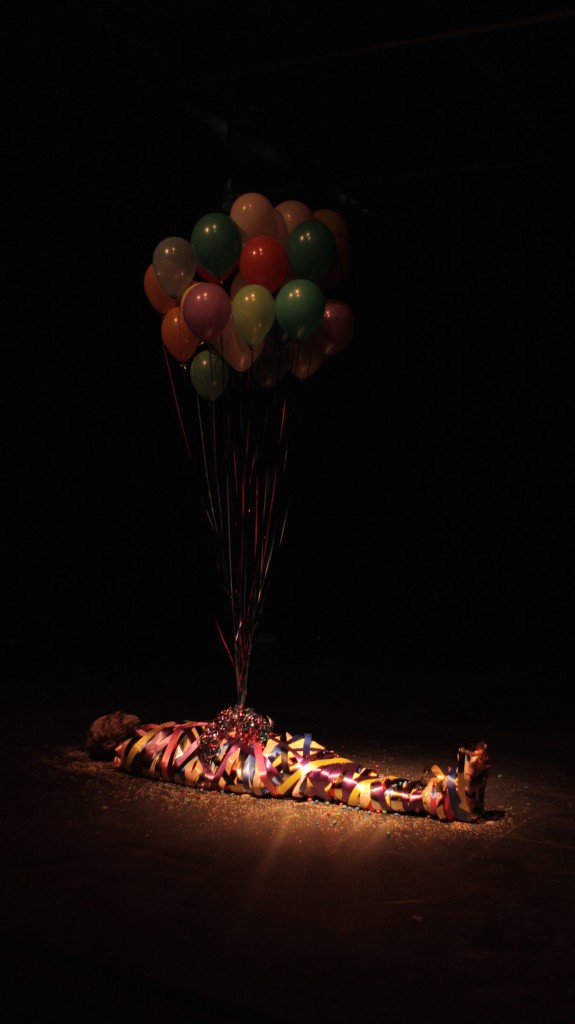
Yes, I have instructions, but I don’t want them to be revealed until it actually happens [laughs]. Life is very crazy, you don’t know who’s going to go first, but I’ve let my family know. My marriage was also explored. I married Hilda inside a gallery, and for three days we did this wedding ritual process as well. The birthday performances came about in the same year, 2013, after my wedding. My birthday is on 20 June, and I decided to throw a party that could also look like a wake in the first action of the series, so I tried to combine the festive elements of a conventional birthday with the morbid codes we see at wakes in different cultures. I encoded both these festive and morbid signs on my body, creating a figure that resembled a mummy, with balloons to give the illusion of ascension, of levitation. But at the same time, if we look at it skeptically – or even suspiciously, considering more concrete, more scientific data – this situation is only constructed to create illusions. The body will remain there, the balloons will wither, the party will be over. In this sense, there is also a construction, so that we can have a more skeptical understanding of death.I created this first performance/birthday event under the title Proxim(a)age (2013 – ), and determined that it would be a series. I did it as a challenge, so every year I have to create a new performance. Every year I make the birthday as a performance and I think a lot about how the artistic project itself is transformed, because I create an artistic ritual that is also a rite of passage, but when I repeat this artistic ritual in other places, and at other times, it is transformed and ceases to be the initial rite of passage. When I repeat the action, it creates the illusion that I’m having another birthday, and another. So, if I were to calculate, from the repetitions, how old I am today, I’d be aged over a hundred.
It’s interesting to observe this banal aspect of, say, a birthday, a wedding, a wake, these rituals that we create, which are extremely performative. The action is extremely performative.
A nossa vida tem muito ato que é muito simbólico e muito performativo, muito performativo mesmo. E é claro que, ao dizer que algo é performático, a gente coloca um signo ali que deixa claro que aquela situação é também um projeto artístico, que a desloca desse corriqueiro para o artístico. Mas a gente tem muito gesto performativo no nosso cotidiano, e são confirmações que são realizadas nesses rituais. A gente repete do mesmo modo as coisas, a gente faz e nem sabe por que está fazendo algo, mas a gente está reproduzindo rituais e confirmando dados através desses rituais.
(Translation: Our lives have many acts that are very symbolic and very performative, very performative indeed. And of course, when we say that something is performative, we put a sign there that makes it clear that situation is also an artistic project, which moves it from the ordinary to the artistic. We have a lot of performative gestures in our daily lives, and these are confirmations that are carried out in these rituals. We repeat things in the same way, we do them and we don’t even know why we’re doing them, but we’re reproducing rituals and confirming data through these rituals.)
So that interested me a lot. I started to deconstruct the way of celebrating, thinking about doing my way of celebrating a birthday, my way of doing a wedding, and my way of doing a wake, not necessarily complying with what is socially understood as the way of doing things.
Thinking about these Memento mori rituals, which are very social, and going back to the question of the dress, do you see in your performances this differentiation between the political, the social, the criticism, and the celebration, or is everything a little more fluid in this sense?
I think everything is always intertwined. I can never separate the aesthetic and the political. Everything is always political. Even this kind of artistic ritual that I do, which seems to deal with a very specific situation of mine – my birthday, my wedding – ends up becoming an event with a lot of signs about politics. When I married Hilda, I held the wedding at the Catanduva Cultural Centre, and it wasn’t a choice we made in vain. Of course, the proposal ends up becoming a public debate, because it’s a same-sex marriage within a public body. This, in fact, sparked debate and also angered a more conservative group, who later came out saying that the local council was funding the wedding, which wasn’t true. I decided to have the wedding, and they just gave me the space. This political game played out very clearly in this wedding situation. It also happens a lot at birthdays because, as this is a way of breaking away from how we celebrate a birthday, the way it happens is completely different. People arrive for the event and don’t necessarily have contact with the birthday boy or girl. The birthday boy is in performance, so I don’t even get congratulations anymore. This game, which is also part of the political game, doesn’t happen.
To finish, I’d like to ask you if you’d like to share with us any difficulties, obstacles or problems you’ve encountered during your career.
I had to deal with censorship, which wasn’t a good thing. I also had to deal with a lack of ethics along the way. There was also a lack of resources and, at many times, having to make something I wanted to do without much financial support was a big challenge. There’s also the challenge of realising that we often need to be strategic in the way we negotiate with people on the same circuit, with institutions, and with artists.
But there’s also a positive challenge, which I particularly like, of not knowing a certain technique and having to learn it in order for a work, or some idea, to materialize. I’m currently experiencing exactly that and it’s very exciting; I’m sleeping very little, I’m anxious because I’m carrying out a project that I’ve never done before, which is a large-scale sculpture with very sophisticated materials, and I’m doing it with a local factory called ArtWorks. They produce great works for great artists from Portugal and also international artists. So I feel very responsible for the steps that are taken by a huge team of people and I have to give the final word to say, “this will work, I want it this way,” and suddenly I see the thing being built. It’s fascinating, it’s stimulating, but at the same time it’s a great challenge.
Interview conducted on 23 February 2024 remotely via Zoom.
Photographs | 120 × 56.6 cm
2014
Collage
2024
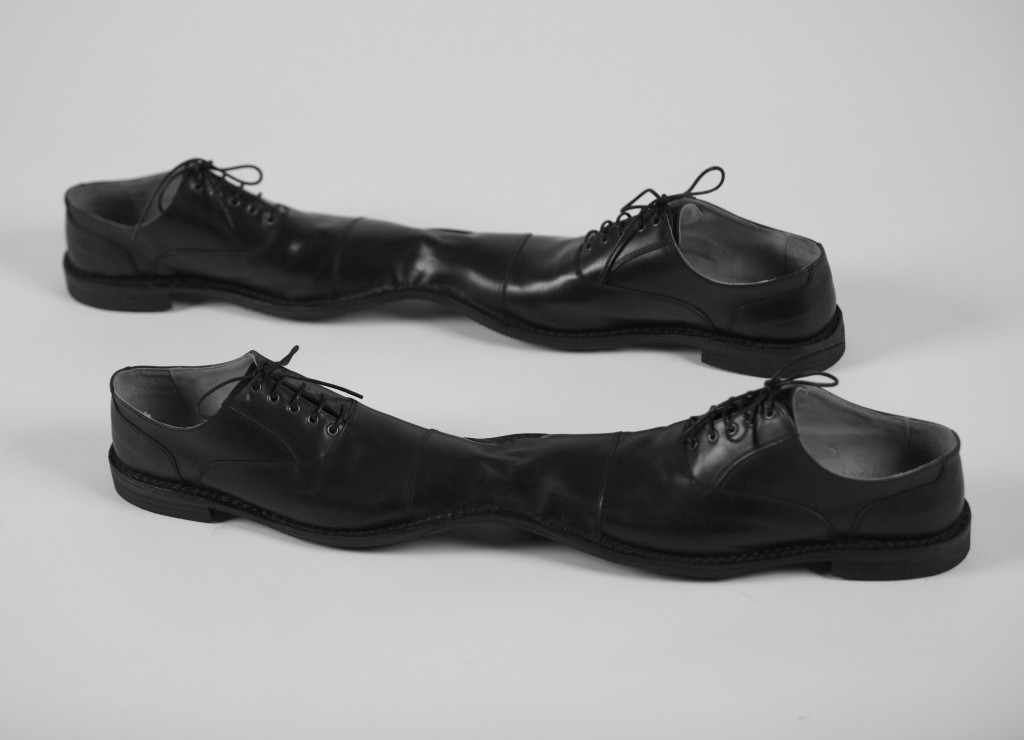
Object | 63 × 24 × 11.5 cm
2017
Frames
2019
Resin, wire, leather on aluminum
120 × 150 cm
2024
Performance held in Guimarães, Portugal, in June 2013 | 100 × 56.2 cm I Photograph by Hilda de Paulo
2013
Frame
2016